News, Reviews, and Commentary on all forms of science fiction, fantasy, and horror audio. Audiobooks, audio drama, podcasts; we discuss all of it here. Mystery, crime, and noir audio are also fair game.
As mentioned on SFFaudio Podcast #116 there is no commercially available audiobook edition of The Space Merchants. What I failed to mention, however, is that there is a two-part radio dramatization from 1957:
CBS Radio Workshop – The Space Merchants
Based on the novel by Frederik Pohl and C.M. Kornbluth; Performed by a full cast
2 MP3 Files – Approx. 1 Hour [RADIO DRAMA]
Broadcaster: CBS
Broadcast: February 17th and 24th, 1957
Provider: archive.org Mitch Courtenay, portrayed by Staats Cotsworth, is a rising star copywriter for the Fowler Schocken Advertising Agency. He’s just been given the company’s biggest campaign – he must promote the colonization of Venus. You’d think would be no problem at all given that Earth is an over-populated planet with polluted air and played-out resources. But there’s a wrinkle – somebody is working against Mitch, and an underground rebellion threatens the very foundations of Earth’s economy!
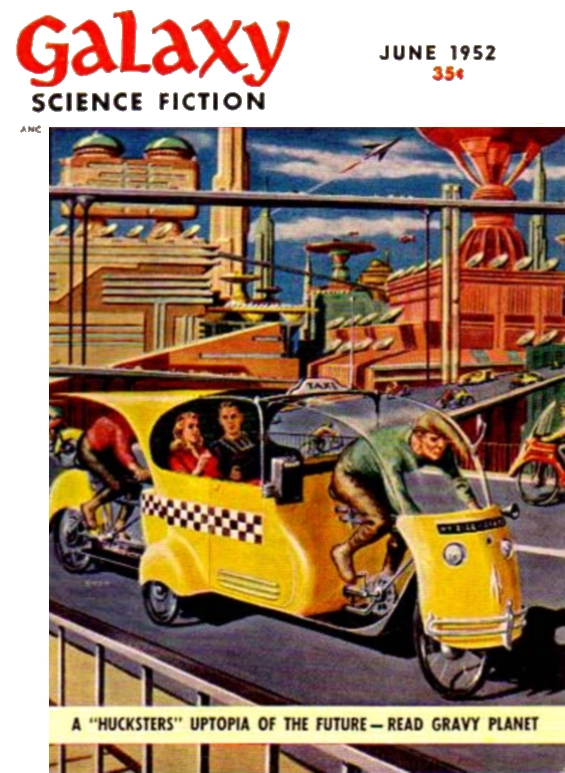
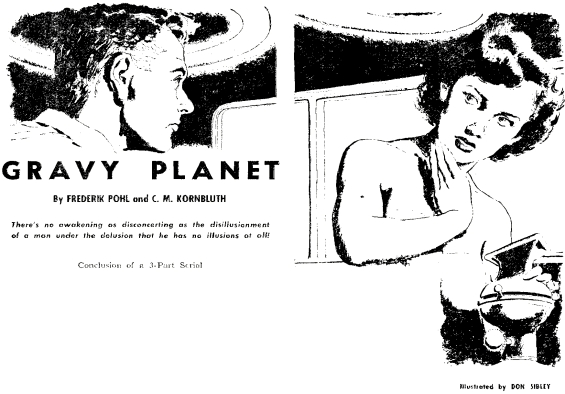
First serialized in the March through May 1952 issues of Galaxy Science Fiction under the title Gravy Planet, The Space Merchants by Frederik Pohl and C.M. Kornbluth was one of the most popular science fiction novels of the 20th century. Here’s the first ever depiction from it, by Ed Emshwiller, for the cover story from the March 1952 issue of Galaxy:
Darrell Sweet’s cover for the 1976 Ballantine Books paperback edition took inspiration from the original magazine appearance:
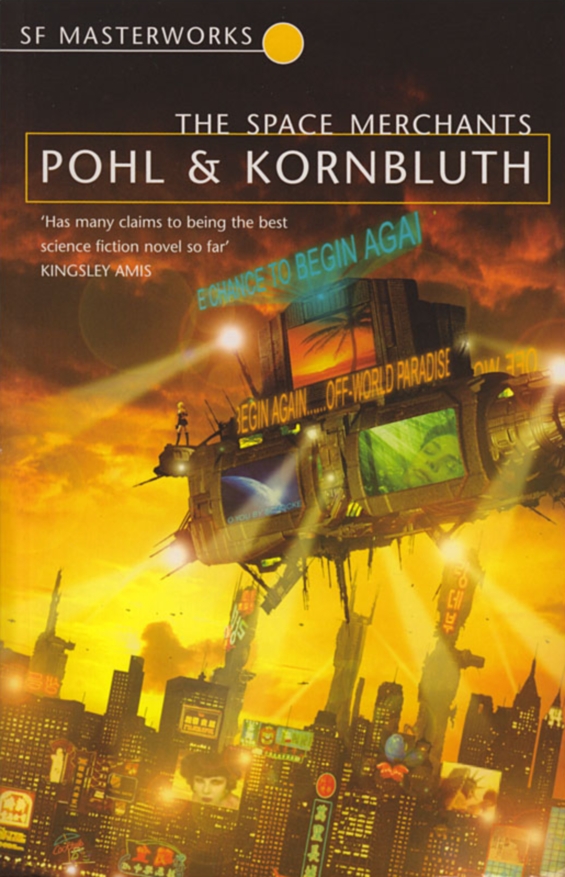
Whereas Steve Stone’s cover art for the Orion / Gollancz – SF MASTERWORKS (Volume 54) edition seems more inspired by Blade Runner:
The SFFaudio Podcast #116 – Scott, Jesse, Tamahome and Professor Eric S. Rabkin talk about The Space Merchants (aka Gravy Planet) by Frederik Pohl and C.M. Kornbluth
Talked about on today’s show:
Frederik Pohl’s blog, differences between Gravy Planet and The Space MerchantsCoca-Cola vs. Yummy Cola, com-pocalypse (a commercial apocalypse), advertizing, conservationists -> connies (or consies) is an analogue for communists -> commies, Tristan Und Isolde, Costa Rica, Chicken Little, Fowler Shocken, 1950s. Jews in “the Science Fiction ghetto”, H.L. Gold, Phlip Klass (William Tenn), Ray Bradbury, Isaac Asimov, the Wikipedia entry for The Space Merchants, a study guide for The Space Merchants, Levittown, Man Plus, The Merchants War, Pohl’s interest in psychiatry, Gateway, structural problems in The Space Merchants, identity theft, a hero’s journey, The Odyssey, katabasis, banana republic, the United Fruit Company, Cuba, U.S. Marines in Columbia, Vance Packard’s The Hidden Persuaders, Jack O’Shea, little people are the perfect astronauts, pilots tend to be small people, the continuing relevance of The Space Merchants, “transformed language”, The Left Hand Of Darkness by Ursula K. Le Guin, “the Glaciers didn’t freeze overnight” (Rome wasn’t built in a day), what side do you oil your bread on, pedaling your Cadillac into the future, are there more cars in the U.S.A. than people?, William Gibson, The future is already here — it’s just not very evenly distributed, corporatocracy, Oliver Stone, does Wall Street run the world or is it Madison Avenue?, representative government per capita (per head) or ad valorem (to value), The Marching Morons, dystopia, utopia, citizen vs. consumer, CBC’s The Age Of Persuasion podcast, the effectiveness of advertizing, feminine hygine products, “it has wings”, coffiest vs. Starbucks, Jon Huntsman, Tim Pawlenty, how effective is advertizing?, saturation of advertizing vs. the message of advertizing itself, does advertizing work?, who consumes dog food?, soyaburger, Chlorella, algae, soylent red, despite what he says Eric is not a jerk vegetarian, seitan (wheat gluten food), Moby Dick, Mountain Dew in the U.S.A. vs. Mountain Dew in Canada, energy drinks, Jolt Cola, phial vs. vile, Philip K. Dick’s Do Android Dream Of Electric Sheep?, the Penfield Mood Organ, caffeine, Tamahome likes unsweetened chocolate, what did Montezuma drink all day long?, does has the internet lessen the impact of advertizing?, the spillage from penis enhancement, Eric bought a wide cross section of pornography, “genuine spurious placebo”, Boeing “forever new frontiers”, the Dubai Ports controversy, Cisco Systems, I, Robot, Minority Report, gesture recognition, Yelp, Wikileaks: U.S. diplomats pressed Boeing deals, Bombardier, “he came from an old family”, Kennedy, Bush, Heddy and Hester, Hedy Lamarr, Hester Prynne, The Scarlet Letter by Nathaniel Hawthorne, Alfred Bester’s The Demolished Man, The Stars My Destination, “Eight sir, seven sir, six sir, five sir, four sir, three sir, two sir, one. Tenser, said the Tensor, Tenser said the Tensor. Tension, apprehension, and dissension have begun.” Rebecca Black’s Friday is a train wreck, Arthur C. Clarke‘s Tales From The White Heart, colonizing your brain, “you haven’t read a book until you’ve talked about it”, is solitary reading a different kind of thing than social reading?, satire, Monty Python’s “The Funniest Joke In The World” sketch, advertizing in books, advertizing in paperback novels, propaganda, recommendation vs. advertizing, making something available vs. thrusting it upon you, metaSFFaudio, The Reapers Are The Angels by Alden Bell, Flannery O’Connor with zombies, why SFFaudio doesn’t link to Amazon.com, Morning Joe, Fox News, Scott is now a politician, Douglas Adams, political debate being replaced by sound bites, Jon Stewart vs. Sean Hannity, Jon Stewart’s appearance on Crossfire, Will Rogers, communication vs. advertizing, jokes are revelations, brand awareness, why do kids want to see Transformers 3?, Cedar Rapids is a coming of age movie about the nature of friendship, why is there no commercial released audiobook of The Space Merchants?, The Puppet Masters by Robert A. Heinlein, Them!, anti-consumerism (anti-Americanism), tobacco packaging warning messages (are ads), the tobacco industry vs. the anti-tobacco industry, church advertizing, Scientology doesn’t sell the same message as many other religions, L. Ron Hubbard, A.E. van Vogt, Dianetics, the premise of Null-A, Friedrich Nietzsche.
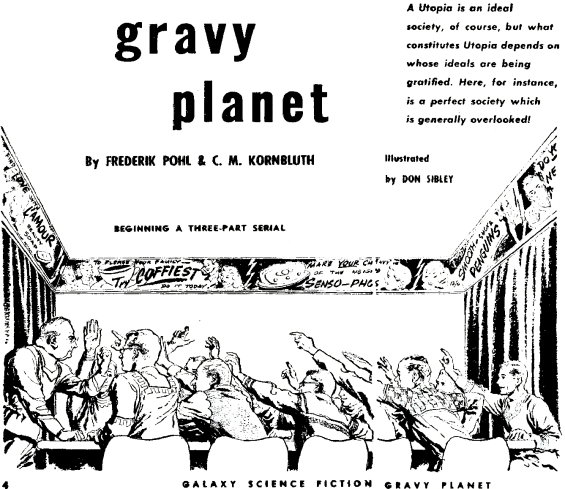
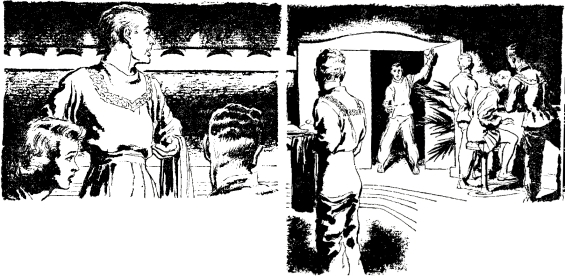
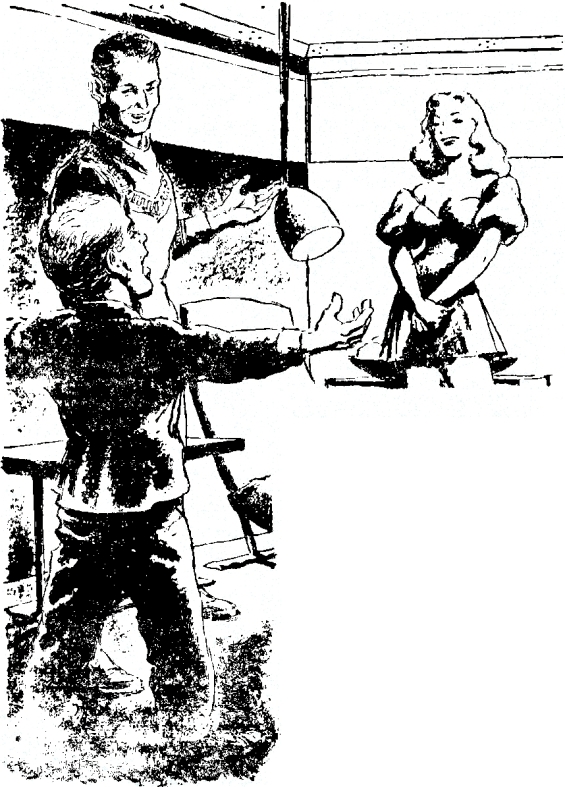
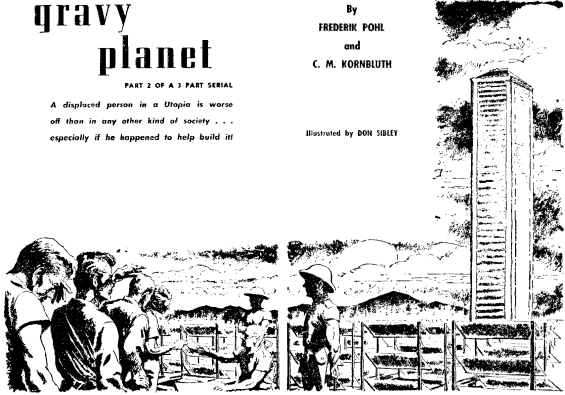
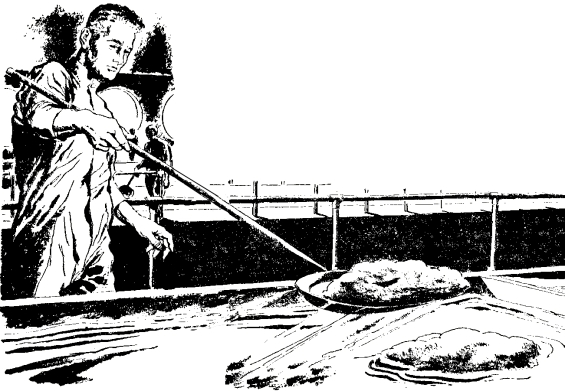
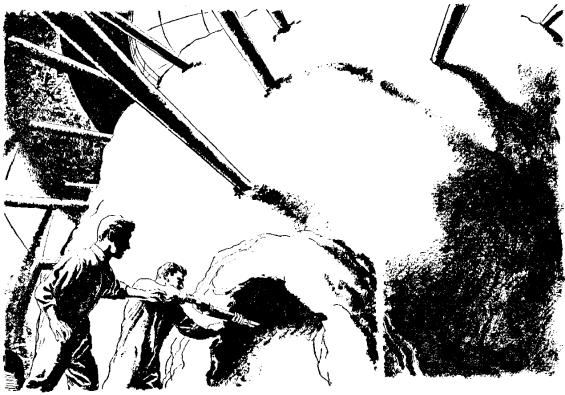
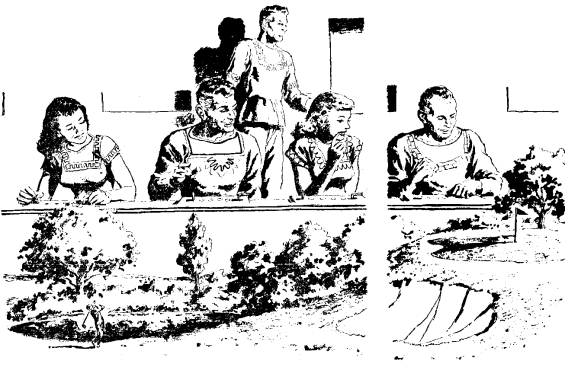
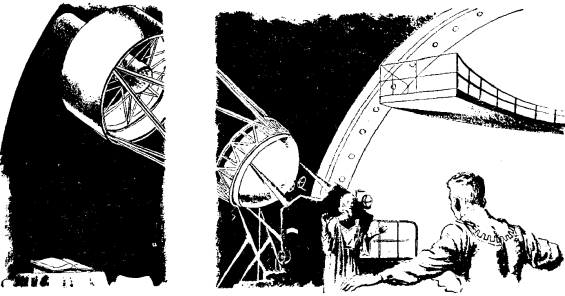
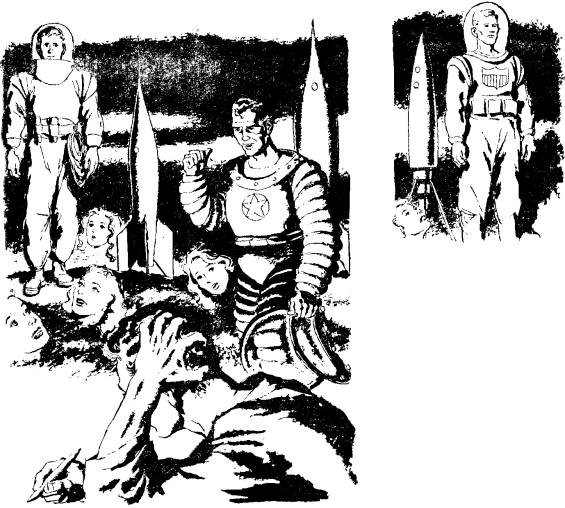
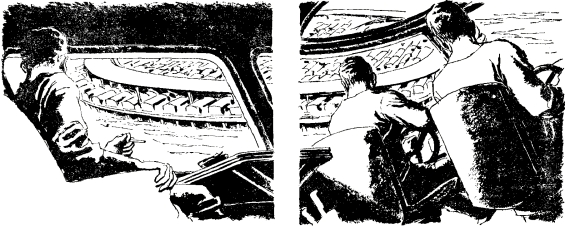
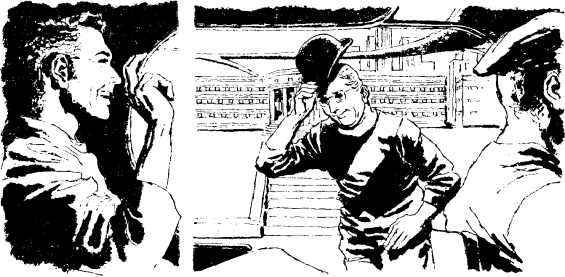
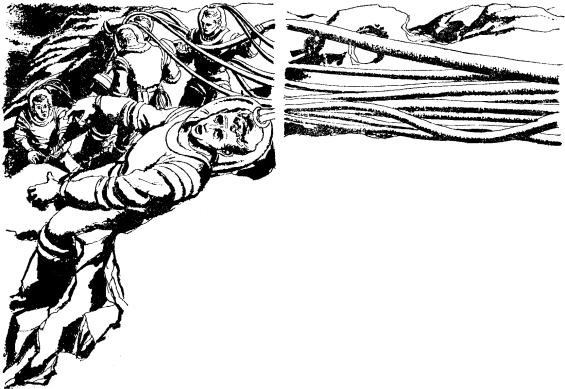
Illustrations from the original serialization of Gravy Planet (aka The Space Merchants) in Galaxy Science Fiction magazine’s July August and September 1952 issues:
The SFFaudio Podcast #113 – Jesse and Eric S. Rabkin talk about Stupidity and Intelligence in Science Fiction (and Fantasy).
Talked about on today’s show:
Johann Wolfgang von Goethe’s The Sorcerer’s Apprentice, Mickey Mouse, Fantasia, Christopher Marlowe‘s The Tragicall History of the Life and Death of Doctor Faustus, Brothers GrimmClever Hans (the fairy tale), Clever Hans (the horse), War With The Newts by Karel Čapek, Excerpt from (Book Two – Up the Ladder of Civilisation), trephination, “there are some things man was not meant to know”, evil science and evil scientists, R.U.R., Mary Shelley’s Frankenstein, Frankenstein is an egotist whereas the creature wants community, Chapter 11 of Frankenstein, intellect vs. empathy, “One man’s life or death were but a small price to pay for the acquirement of knowledge which I sought.”, the ideology of intelligence is suspect, Gulliver’s Travels, Laputa, philosophers, The Clouds by Aristophanes, “head in the clouds”, BBC Radio dramatization of Lysistrata, The Black Cloud by Fred Hoyle, “the big bang”, telepathy, Gregg Margarite, “Genius in not a biological phenomenon.”, “stupid people can have smart babies and smart people can have stupid babies”, eugenics, sterilization programs, “we know so little about what we mean by intelligence”, “we breed against the outliers”, “If I see further than others it is because I stand on the shoulders of giants”, Sir Isaac Newton, Newton vs. Leibniz, Darwin vs. Wallace vs. Darwin’s grandfather, Robert A. Heinlein, “steam engine time”, Columbus and the egg, humans (persons) can compound our intelligence, Flowers For Algernon by Daniel Keyes, Charly, “we shouldn’t define humanity by our intelligence”, The Time Machine by H.G. Wells, flowers from Weena, “fundamental humanity has to do with emotion and not intelligence”, He, She and It by Marge Piercy, programming a robot with stories, Yod is a robot-like golem, “it was immoral to create a conscious weapon”, The Doomsday Book by Connie Willis, Eric is the world’s least reliable critic of The Doomsday Book, The Invisible Man by H.G. Wells, philosophy of science, the meaning of weapon, We by Yevgeny Zamyatin, tool vs. weapon, “we have one mad scientist after another”, Gojira!, Ozymandias, Watchmen, Understand by Ted Chiang, “talking to babies”, “if everyone in the world around you is an idiot…what kind of relationship can you have with the world”, His Masters Voice by Stanisław Lem, Hogarth is an incredibly intelligence person, Edgar Allan Poe, Audible Frontier’s Solaris: The Definite Edition, The Futurological Congress, Isaac Asimov, Eric puts on his professorial hat, nous, the etymology of the word “intelligence”, Asimov reads between the lines for you, the etymology of the word “stupid”, what’s with the word “sentient” in Science Fiction?, Beyond Lies The Wub by Philip K. Dick, ansible, “sentience is the bag that we put all our coding for equally human”, was Larry Niven the prime promulgator of the SF version of “sentience”?, The Island Of Doctor Moreau by H.G. Wells, “words are a map on the world”, The Time Machine, evolution and the clash of the classes, Wells respects the intelligence of his readers, Morlocks vs. Eloi, the King James version of the Bible, “Eloi Eloi Lama Sabachthani“, Hugo Gernsback, Amazing Stories, “whizz bang sensofwunda”, The New Accelerator by H.G. Wells, “the warp drive is not important”, “the ansible is not important”, “we are all time travelers”, “in Wells’ greatest works he leaves some part of the story open”, “but whether this was a reprieve for us or them only time will tell”, Experiment In Autobiography by H.G. Wells, The Gods Themselves by Isaac Asimov, “Against stupidity the gods themselves contend in vain”, Friedrich Schiller, reporters became cynical now they just go see what’s happening on Facebook, The Marching Morons by C.M. Kornbluth is public domain, much of Kornbluth is PD because he died so young, The Space Merchants by Frederik Pohl and C.M. Kornbluth, Little Black Bag by C.M. Kornbluth, Idiocracy, stupid people have lots of (stupid) babies (?), what’s wrong with The Marching Morons?, PLENTY!, “The Marching Chinese”, Thomas Robert Malthus, eugenics and dysgenics, what ties do genetics and intelligence have?, a very high fraction of American presidents have been left handed, immigrant groups produce terrific comedians, Microcosmic God by Theodore Sturgeon, storing up ideas for my “word hoard”.
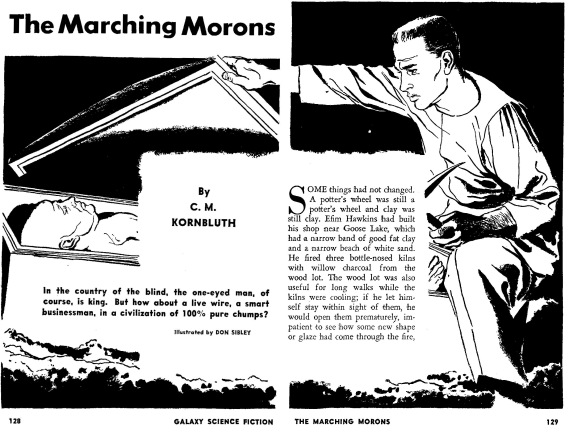
The SFFaudio Podcast #112 – a complete and unabridged reading of The Marching Morons by C.M. Kornbluth. It is wonderfully narrated for us by William Coon of Eloquent Voice.
The Marching Morons is a Science Fiction novella written by Cyril M. Kornbluth, originally published in Galaxy Science Fiction’s April 1951 issue. It has been famously anthologized in The Science Fiction Hall of Fame, Volume Two (B).
The story is set hundreds of years in the future: the date is 7-B-936. Its protagonist is John Barlow, a man from the past put into suspended animation by a freak accident involving a dental drill and anesthesia. He is revived in a dystopic future where the dysgenic breeding of humans has, in combination with intelligent people not having many children, overwhelmingly populated the world with morons. An elite few non-idiots must work slavishly to keep the world productive. Barlow, who was a shrewd con man in his day, has a solution to sell to the elite.
In his introduction to The Best Of C.M. Kornbluth Frederik Pohl explains some of the inspiration to The Marching Morons. Apparently the work was written after Pohl suggested that Kornbluth write a follow-up story to The Little Black Bag (a classic Kornbluth short story). In contrast to the “little black bag” arriving in the past from the future, Kornbluth wanted to write about a man arriving in the future from the past. To explain sending a man to the future, Kornbluth borrowed from David Butler’s Just Imagine (1930) science fiction film in which a man is struck by lightning, trapped in suspended animation, and reanimated in the future.”
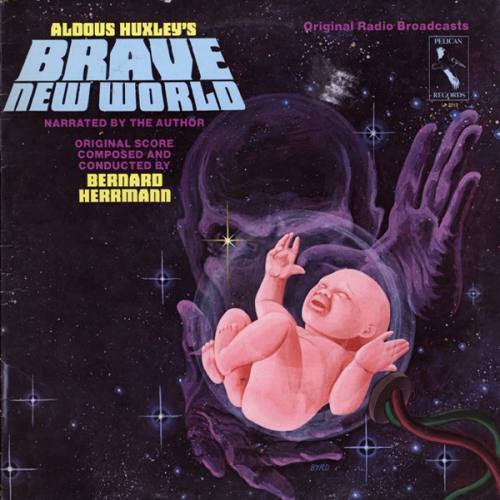
The CBS Radio Workshop was an experimental dramatic radio anthology series that aired on CBS radio from January 1956, until September 1957. Subtitled “radio’s distinguished series to man’s imagination,” it was a revival of the earlier Columbia Workshop, broadcast by CBS from 1936 to 1943, and it used some of the same writers and directors employed on the earlier series. Its first two episodes were a two-part adaptation of Aldous Huxley’s dystopian stunner Brave New World. It has some strong claims to being the definite adaptation as it is both introduced and narrated by Aldous Huxley himself. Here’s how Time magazine’s February 6, 1956 issue described it in their review:
“It took three radio sound men, a control-room engineer and five hours of hard work to create the sound that was heard for less than 30 seconds on the air. The sound consisted of a ticking metronome, tom-tom beats, bubbling water, air hose, cow moo, boing! (two types), oscillator, dripping water (two types) and three kinds of wine glasses clicking against each other. Judiciously blended and recorded on tape, the effect was still not quite right. Then the tape was played backward with a little echo added. That did it. The sound depicted the manufacturing of babies in the radio version of Aldous Huxley’s Brave New World.”
Music for the series was composed by Bernard Herrmann, Jerry Goldsmith, Amerigo Moreno, Ray Noble and Leith Stevens. Other writers adapted to the series included Robert A. Heinlein, Sinclair Lewis, H.L. Mencken, Edgar Allan Poe, Frederik Pohl, James Thurber, Mark Twain and Thomas Wolfe. According to Bill Hollweg the two MP3 files have been “cleaned and the volume normalized” – and they do sound great!
Brave New World
Based on the novel by Aldous Huxley; Performed by a full cast
2 MP3 Files – Approx. 1 Hour [RADIO DRAMA]
Broadcaster: CBS
Broadcast: January 27 and February 3, 1956
Source: Archive.org
Most interesting to me, however, is some of the commentary about this adaptation. On the back of the Pelican Records LP (LP-2013) edition there is critical essay on Huxley, Brave New World and this adaptation, by none other than Ray Bradbury! It is truly wonderful and I have reproduced it below:
There is science fiction and science fiction. There is science fiction still looked down upon by many intellectuals in our society, because it is written by the wrong people. And there is science fiction minus the label, written over in the main stream by acceptable A-1 main-line writers which is OK. And at the head of the list for some 40 years or more you would have to put Aldous Huxley and Brave New World. Whenever lists are drawn up for schools containing the acceptable authors who dare to be imaginative, it is Huxley and Orwell, ten to one.
Forget about Asimov, Clarke, Sturgeon, Heinlein, get lost.
There are a number of reasons beyond snobbishness of course. Huxley was in mid-career when he veered over into Future Country. Behind him lay half a dozen novels, most of which had good or fine reviews, and most of which are still selling moderately well and being read today. But mention Huxley and most people will name the one they know him by, Brave New World.
At the time it was published, much of the novel was fresh and innovative, properly cynical about human behavior and, at times, verging on territory laid out by Evelyn Waugh. Later on, Huxley and Waugh would indeed meet in the middle of the same cemetery. Huxley to dig graves and plant Hollywood types with his After Many A Summer Dies The Swan and Waugh with his The Loved One another shake of similar bones.
Since its publication, Brave New World has been skinned and boned and borrowed from by dozens of less competent writers who saw the serious fun Huxley had with his story and couldn’t resist imitating it.
As a satire today, reread when some of the things it talked about have moved straight on into our lives, the novel suffers as indeed it did back in 1932, from being a half-job. All the good stuff is up front in the book. Toward the end the fun and the imagination of Huxley diminish. Having the Indian hang himself seemed to me, even when I was younger, a bad solution to a good novel. Even Huxley, in 1952 when I first met him, expressed some doubt about his original ending.
But on his way to the finale, let’s face it, Huxley was the only referee we had for our impeding technological game. With foresight and precision he saw the Pill coming and ducked. He circled round cloning long before it became a tv Tale show mini-debate by mini-minds pretending to offer, as a result to most of us, mini-news. The drug culture of today noon occupied Huxley’s mind at breakfast 45 years back, long before he sprinkled mescaline on his Wheaties. While he was at it, old Aldous invented and reinvented the machined pornographies that have infiltrated our cinemas to slumber us better than Nembutal and bore us more than family picnics, well beyond 1984. And if we have not as yet birthed his ‘feelies’ into our world, we are on the thin dumb rim of doing so.
If there is a zero for failure to imagine at the center of the novel, and this radio play, it is the inability of Huxley (and Orwell, too later on) to in any way recognize or prophesy Space Travel. This may well be because of the time we lived in, then, when the Space Age seemed so remote, so impossible, that it could not be entered on any imaginary ledger to tip the scales toward an equally improbable better if not happy ending.
This was revealed in a lecture which I shared with Huxley onstage at UCLA some time in the early Sixties. Speaking first, he wondered again and again, what the next great development in literature might be.
I was stunned. In sat in my chair hardly daring to rise and deliver my speech, for suddenly my evening had changed. I had intended to make a few remarks about why I wrote what I wrote, but suddenly here was Huxley asking and not answering what was, to me, anyway, an obvious question with an obvious answer. What would the next great literature be?
Science Fiction! I wanted to shout. Good Grief and Jumping Jehoshaphat! Science Fiction!
Since every problem you can name in our time has to do with science and technology (name one that doesn’t) what else us there to write about except Pills, technological drugs, automobiles, smog, nuclear power, solar energy, space travel, tv, radio, transistors, free-ways, all, all of them scientific extensions of scientific dreams.
I rose and did not shout it. But I rose and said it, quietly, out of deference to my author hero.
Huxley shook my hand after the lecture and smiled at me with that dry quiet smile of his, and we spoke of Space Travel and how it might have changed Brave New World if he had thought to consider it in the full.
I still wish today that I might take his ghost to Cape Canaveral and whisk him to the top of the Vehicle Assembly Building where I have gone to stare down, with a wildly beating heart at the topmost part of the Apollo rockets lying ready below to give us alternative futures. We are not doomed to stay on Earth and share Huxley’s Indian suicide or Orwell’s Big Brother. When the time is ripe, we will just up and ‘go’.
All this said, when we return to the radio show, here captured to remind us once more that CBS, of all the radio networks, was the most open, the most adventurous, the most creative. Considering the year it was broadcast, 1956, long before Playboy made its real impact on our country, it is a fascinating work, of much imagination and good taste.
Let me step aside now, I have shouted my quiet shout. The next voice you’ll hear, a lovely gentleman’s voice, is that of Aldous Huxley. Would that he were alive today, for anther teatime chat and another long look into a sometimes dubious, sometimes exhilarating Future.
The SFFaudio Podcast #102 – Scott, Jesse and Tamahome talk about new audiobook, book, and comic book releases.
Talked about on today’s show: The Infinite Worlds Of H.G. Wells, Sherlock Holmes, Memory by Donald E. Westlake, Hard Case Crime, A Good Story Is Hard To Find, nihilism, SFSignal’s 122 books that bring Scott to tears, All The Lives He Led by Frederik Pohl (a semi-nihilistic novel), Yellowstone, “half minus negative zero”, A Matter Of Time by Glen Cook, The Black Company, Abel One by Ben Bova, blood and flesh and shirtless, Deathless by Catherynne M. Valente, BoingBoing, Russian Ark, Enigmatic Plot vs. Enigmatic Pilot, Enclave (aka Razorland) by Ann Aguirre, The Maze Runner by James Dashner, The Scorch Trials, The Hunger Games, Hunt The Space Witch and Other Stories by Robert Silverberg, WWW: Wonder by Robert J. Sawyer, Starstruck, Blair Butler, “Geoff Boucher’s Los Angeles Times Hero Complex ‘Get Your Cape On’ pick of the week”, The Quantum Thief by Hannu Rajaniemi, Macmillan Audio, Audible.com, Brilliance Audio, Warriors edited by George R.R. Martin and Gardner Dozois, Forever Bound by Joe Haldeman, Lawrence Block, O. Henry-ish, “I see no reason to buy through iTunes” (vs. Audible.com), Limitless (aka The Dark Fields) by Alan Glynn, F. Scott Fitzgerald, Flowers For Algernon, Understand by Ted Chiang, acquiring a whole bag of pills, “smart people are neat”, Tantor Media, History Is Wrong by Erich von Däniken, Jesse becomes momentarily depressed, The Guns Of August by Barbara W. Tuchman, John Lee, the John Cleaver series, have world events have sped because of modern technology?, Libya, Tripoli, “The Graveyard Of Empires”, “from the halls of Montezuma to the shores Tripoli”, NPR, A History Of The World In Six Glasses by Tom Standage, beer, wine, spirits, tea, coffee, cola, the Today In Canadian History podcast, the Canadian Navy, I Don’t Want To Kill You by Dan Wells, I Am Not A Serial Killer, “normally I don’t do this”, Dexter, the Writing Excuses podcast, Homeward Bound by Harry Turtledove, alternate history, We by Yevgeny Zamyatin, Grover Gardner, Eric S. Rabkin, George Orwell’s 1984, Herland by Charlotte Perkins Gilman, William Dufris, binary fission, Tantor Media is very innovative in including ebooks with their audiobooks, we need a new demarcation to desperate urban fantasy romance from SF, “conspiracy and ignorance based books”, The Prefect by Alastair Reynolds, Tales From A Thousand Nights And The Night (aka 1,001 Nights!) translated by Richard Burton, The Thousand Nights And A Night is the first fix-up novel, Nostromo by Joseph Conrad, South America, Three Men In A Boat (To Say Nothing Of The Dog) by Jerome K. Jerome, To Say Nothing Of The Dog by Connie Willis, Have Spacesuit, Will Travel by Robert A. Heinlein, Atlantis And Other Places by Harry Turtledove, Slave To Sensation shouldn’t be a science fiction novel, Orson Scott’s Card Intergalactic Medicine Show, Rejiggering The Thingamajig by Eric James Stone on Escape Pod #277, body-swapping, I Will Fear No Evil by Robert A. Heinlein, gender-swapping, For Us The Living: A Comedy Of Customs by Robert A. Heinlein, Heinlein’s old theme: “naked people talking to each other”, Heinlein likes to examine social preconceptions and social prejudices, “not a Heinlein classic but still classic Heinlein”, Eifelheim, Luke Burrage, Idiot America by Charles P. Pierce, George Washington riding a dinosaur, The Broken Sword by Poul Anderson, contemporary with Tolkien (rather than derivative of Tolkien), Michael Moorcock, Eric Birghteyes by H. Rider Haggard, Bronson Pinchot, The Plague Dogs by Richard Adams, anthropomorphic fiction, quasi-Science Fiction, quasi-Fantasy, Coyotes In The House by Elmore Leonard |READ OUR REVIEW|, The Call Of The Wild by Jack London, We Three by Grant Morrison, Transmetropolitain, Warren Ellis, Tama’s pet peeve in comics is silent panels, Audible Frontiers, The Death Of Grass by John Christopher, The Tripods, The Sam Gunn Omnibus, The Steel Remains, Cliffs Notes are now available as audiobooks, Brave New World, The Spiral Path by Lisa Paitz Spindler, Eat Prey Love by Kerrelyn Sparks, William Coon’s Eloquent Voice titles, Andre Norton’s The Time Traders, Gilgamesh The King by Robert Silverberg |READ OUR REVIEW|, Philip K. Dick, Henry James, Anton Chekov, Paul of Cthulhu, Yog-Sothoth.comThe Whisperer In Wax, wax cylinder tech, Embedded by Dan Abnett, SFSignal.com.

 CBS Radio Workshop – The Space Merchants