The SFFaudio Podcast #125 – AUDIOBOOK/READALONG: The Horla by Guy de Maupassant

Podcast

The SFFaudio PodcastThe SFFaudio Podcast #125 – The Horla by Guy de Maupassant, read by Gregg Margarite (of LibriVox), followed by a discussion of the story – participants include Jesse, Tamahome and Jenny Colvin (of the Reading Envy blog).

Talked about on today’s show:
“c’est magnifique!”, is this Jesse’s favourite story from the 19th century?, H.G. Wells, is The Horla Science Fiction, aliens, ghosts, Guy de Maupassant is crafting our feeling on how the story should be interpreted, Mont Saint-Michel, Ladyhawke, Second Life, Normandy, Paris, France, ghosts, goats with human faces, biblical stories of possessed pigs, metaphor of the wind, the wind as a telekinetic force, invisibility, personal experience vs. faith, succubi, vampires, Jim Moon’s Hypnobobs podcast (reading of The Horla and Dairy Of A Madman), was Guy de Maupassant interested in science?, his prolific output, Sigmund Freud, is this a psychological drama?, the character in the movie vs. the short story, sleep paralysis and depression, is the unnamed protagonist of The Horla bioplar?, syphilis, H.P. Lovecraft, Benjamin Franklin, the character has a Science Fiction attitude (a disposition towards science), a story of possession (like in The Exorcist), glowing eyes, Rouen, “excuse my French”, external confirmation, diagnose yourself, São Paulo, Brazil, The Horla means “the beyond”, what lives beyond the Earth?, Jenny wasn’t thinking aliens at all, creatures from other dimensions, the Predator’s cloaking device, is the horla really Santa Claus?, hypnotism and hypnotists, post-hypnotic suggestion, confabulation, its a quasi-phenomenon, why can’t everyone be hypnotized?, Hamlet, did he burn down his house or did the horla do it?, noir, movies demand the defeat of evil, “Son Of The Horla and Spawn Of The Horla“, science and skepticism, who broke all the drinking glasses?, the Futurama version of a Twilight Zone episode,

“The vulture has eaten the dove, and the wolf has eaten the lamb; the lion has devoured the sharp-horned buffalo, and man has killed the lion with arrow, sword and gun; but the Horla is going to make of man what we have made of the horse and the ox: his chattel, his servant and his food, by the mere exercise of his will. Woe to us.”

Tamahome should read some H.P. Lovecraft, here’s H.P. Lovecraft’s description of The Horla:

“Relating the advent in France of an invisible being who lives on water and milk, sways the minds of others, and seems to be the vanguard of a horde of extra-terrestrial organisms arrived on earth to subjugate and overwhelm mankind, this tense narrative is perhaps without peer in its particular department.”

Lovecraft is using deep time to scare us instead of the supernatural, The Statement Of Randolph Carter, sorry I cant talk right now I’m being digested, Cthulhu’s guest appearance on South Park, the elements, space butterfly,

“We are so weak, so powerless, so ignorant, so small — we who live on this particle of mud which revolves in liquid air.”

a cosmic view, the Carl Sagan view, evil is everywhere, an allegory for science, Frankenstein, “men ought not meddle in affairs normally deemed to women”, the Frankensteinian monster, a warning against science vs. science is our only way of understanding the universe, we have one place to look and that is to science, the propaganda he’s pushing, “there are things we can’t explain”, gentlemen did science back then, Library Of The World’s Best Mystery And Detective Stories on Wikisource, the case of my body being haunted, Edgar Allan Poe, Diary Of A Madman, turn us into batteries, “this is a looking glass”, the main character holding a photograph of himself, foreshadowing, out of body experience, Tama fails the quiz of the lesson earlier, when we don’t know – don’t conclude, we ought not conclude anything from this scene, we are not supposed to know we know the answer, Harvey Keitel’s appearance on Inside the Actor’s Studio, becoming comfortable with the unknown, The Necklace by Guy de Maupassant, F. Scott Fitzgerald, Jesse proceeds to recount the entire plot of The Necklace, like a really sad O. Henry story, Somerset Maugham, Henry James, A String Of Beads, “Mais oui.”

The Horla by Guy de Maupassant

The Horla by Guy de Maupassant - illustration by Julian-Damazy

The Horla by Guy de Maupassant - illustration by Julian-Damazy

Guy De Maupassant's Le Horla 1908 Edition

Posted by Jesse Willis

LibriVox: The Point Of Honor by Joseph Conrad

SFFaudio Online Audio

LibriVoxFirst published in Pall Mall Magazine, along with an H.G. Wells novel and a Jack London short story, The Point Of Honor is a Joseph Conrad novella that had its genesis in the real duels that two French Hussar officers fought in the Napoleonic era. Their names were Dupont and Fournier, which Conrad disguised slightly, changing Dupont into D’Hubert and Fournier into Feraud.
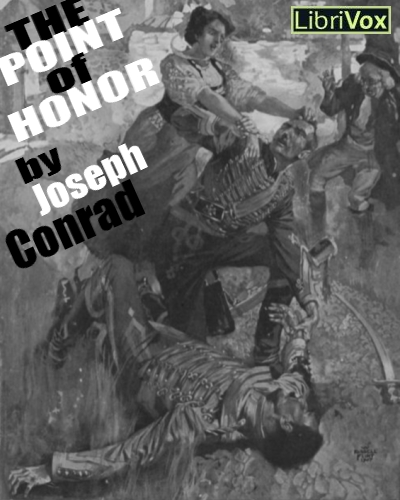
LIBRIVOX - The Point Of Honor by Joseph ConradThe Point Of Honor (aka The Duel)
By Joseph Conrad; Read by Mark F. Smith
4 Zipped MP3 Files or Podcast – Approx. 3 Hours 29 Minutes [UNABRIDGED]
Publisher: LibriVox.org
Published: May 18, 2008
Two French Hussar officers, D’Hubert and Feraud, quarrel over an initially minor incident that eventually turns into a bitter, long-drawn out struggle over the following fifteen years, interwoven with the larger conflict that provides its backdrop. At the beginning, Feraud is the one who jealously guards his honor and repeatedly demands satisfaction anew when a duelling encounter ends inconclusively; he aggressively pursues every opportunity to locate and duel his foe. As the story progresses, D’Hubert also finds himself caught up in the contest, unable to back down or walk away. Pall Mall Magazine’s January, February, March, April and May 1908 issues.

Part 1 |MP3| Part 2 |MP3| Part 3 |MP3| Part 4 |MP3|

Podcast feed: http://librivox.org/bookfeeds/the-point-of-honor-by-joseph-conrad.xml

iTunes 1-click |SUBSCRIBE|

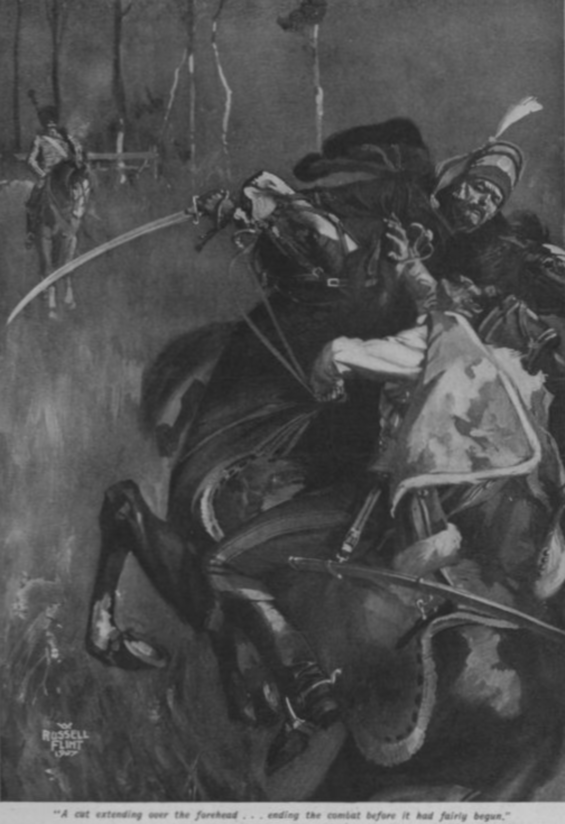
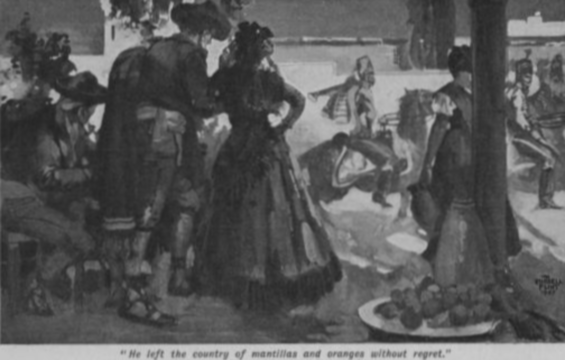
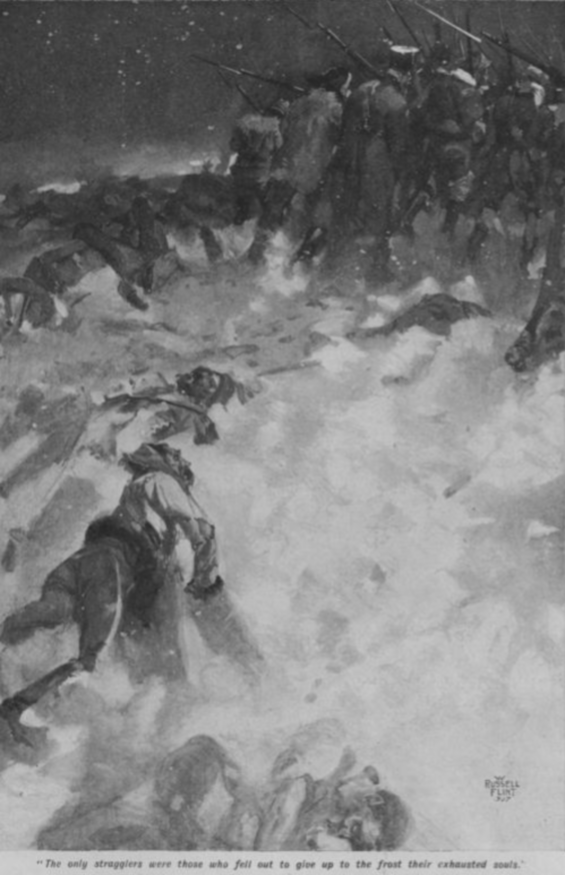
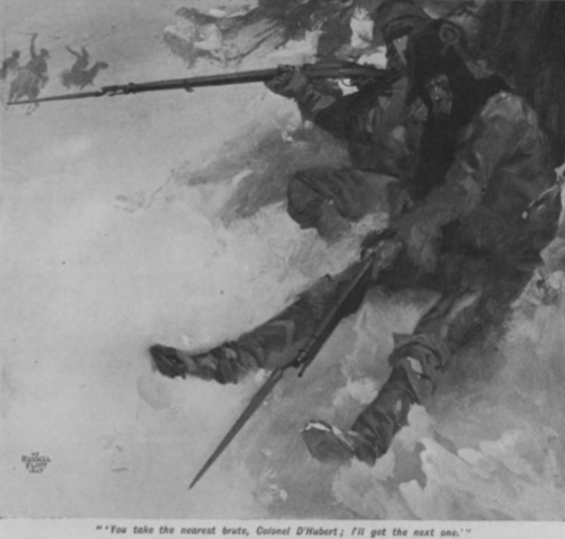
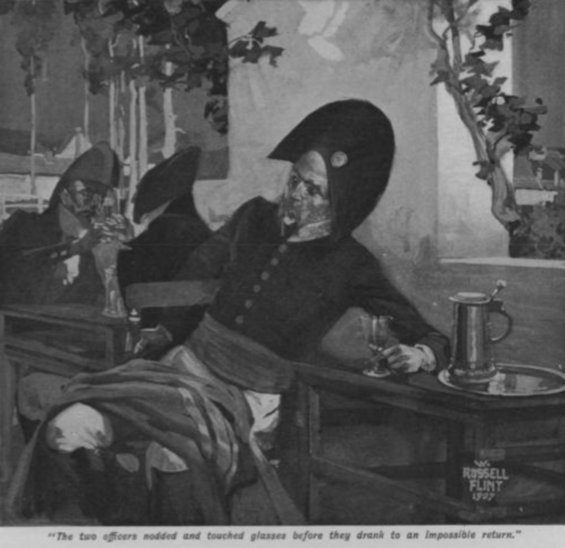
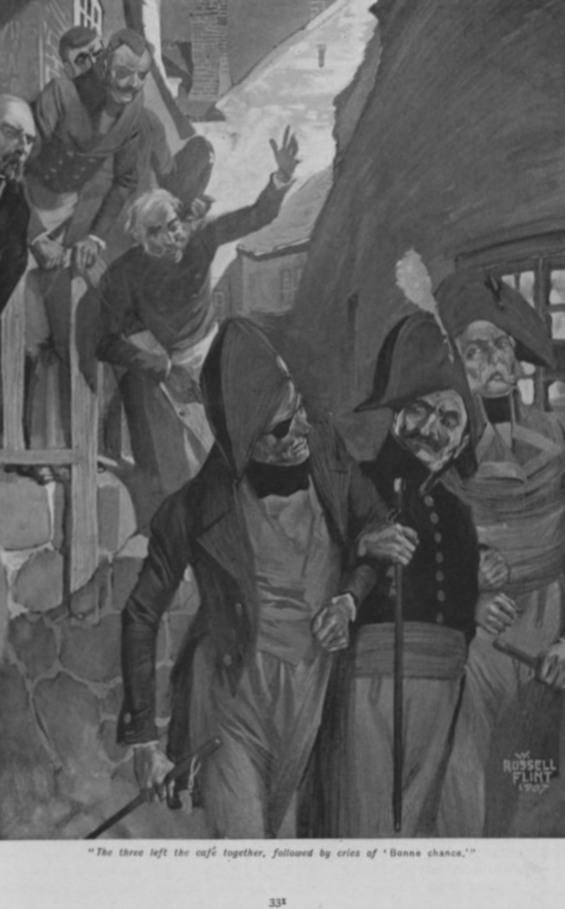
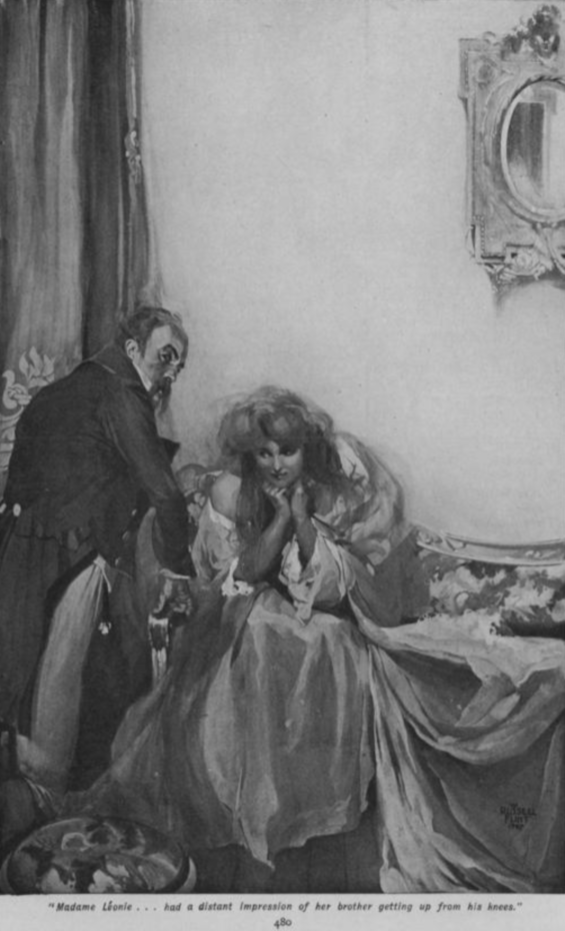
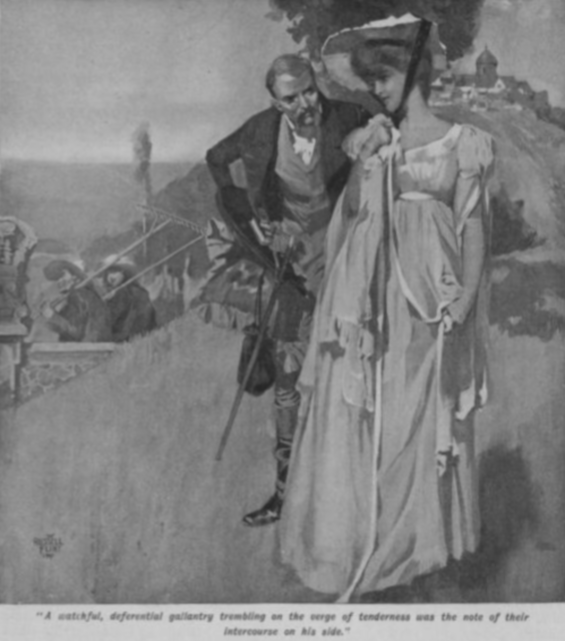
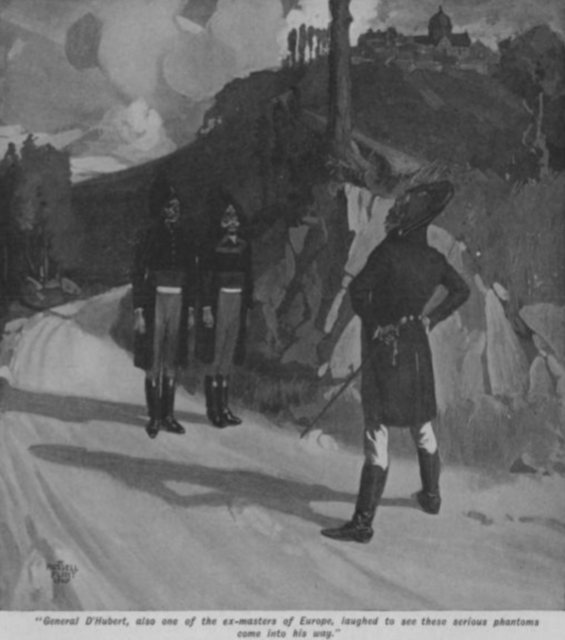
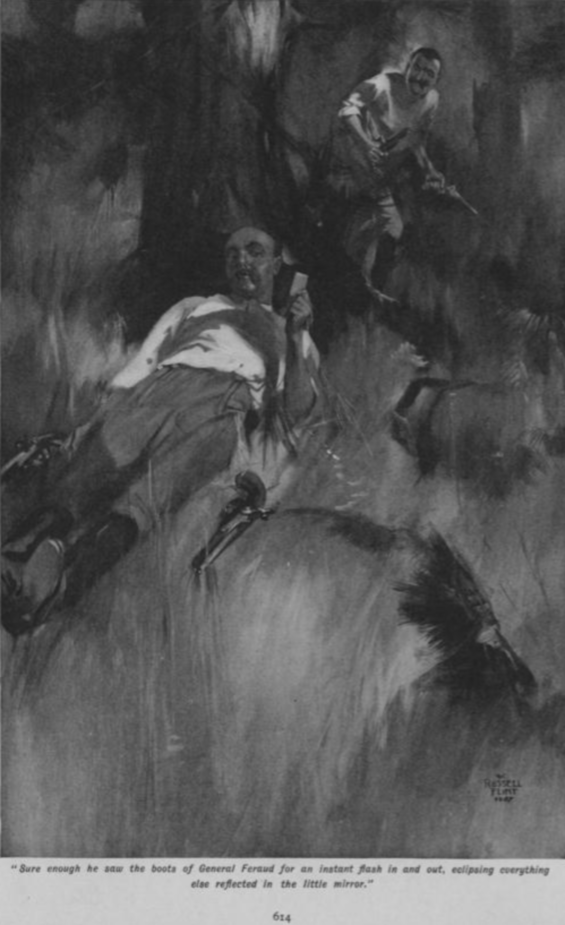
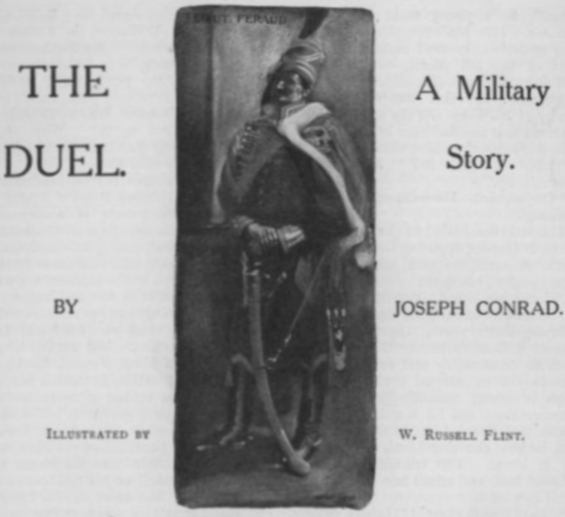
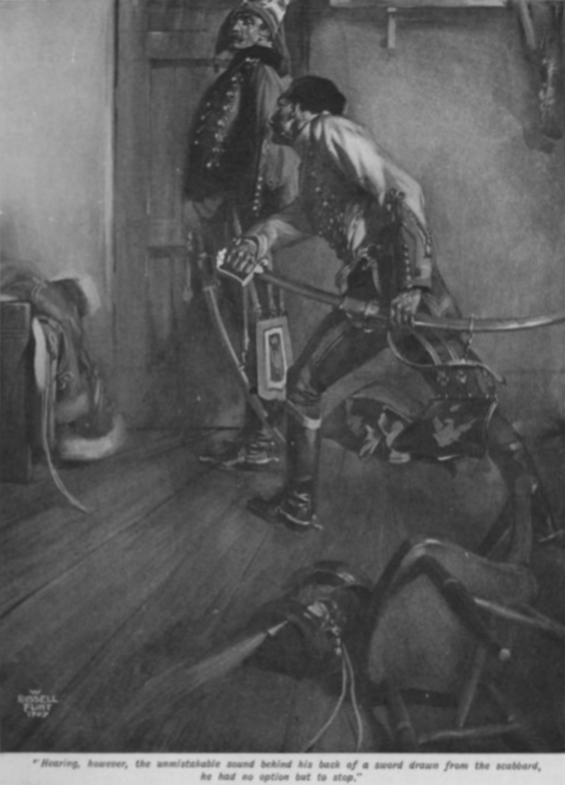
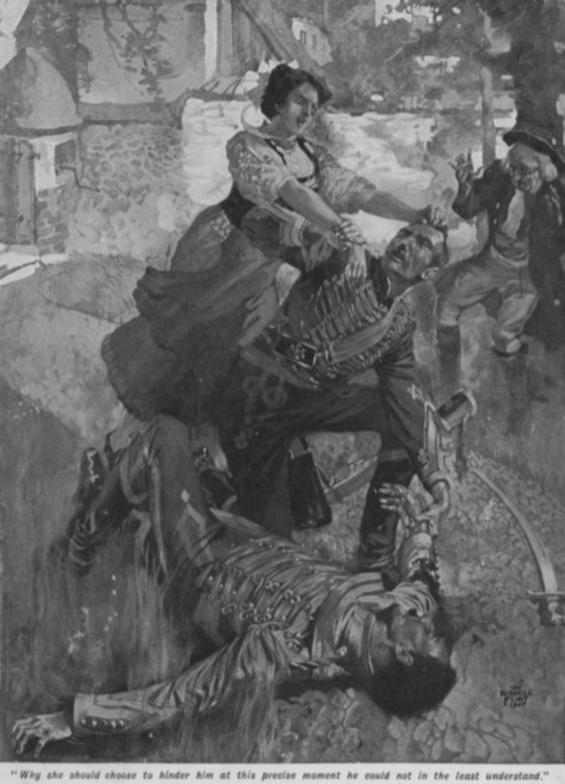
Here’s are the William Russell Flint illustrations from the original magazine serialization:

The Duel by Joseph Conrad - Illustrated by William Russell Flint

Here’s the trailer for The Duellists (1977) :

[Thanks also to ConradFirst.net and Live At The Heartbreak Lounge]

Posted by Jesse Willis

Voices In The Dark: The Stolen Bacillus by H.G. Wells

SFFaudio Online Audio

Voices In The DarkFear of disease is probably just as old as disease itself. But the modern fear, the fear that a single individual carrying a vial full of specific incurable pathogen – the fear that one crazed fanatic could decimate an entire city’s population by poisoning its water supply – that fear can probably be traced back to the late 19th century and perhaps even to the inventor of the first true Science Fiction short stories, Mr. H.G. Wells. Had the ending of The Stolen Bacillus been done in a slightly different way it may have spawned the whole zombie contagion phenomenon a century early.

The Stolen Bacillus by H.G. WellsThe Stolen Bacillus
By H.G. Wells; Read by Dawn Keenan
1 |MP3| – Approx. 16 Minutes [UNABRIDGED]
Publisher: Voices In The Dark
Published: 2005
An anarchist, intent on wreaking ruin on a city, steals a phial from a bacteriologist. First published in the Pall Mall Budget’s June 21, 1894 issue.

Posted by Jesse Willis

The sound of Robert A. Heinlein’s voice

SFFaudio Commentary

Something has been bothering me. It’s been bothering me for years actually.

One commenter, a long time ago, brought it to my attention, wondered if there was a recording of Robert A. Heinlein’s voice out there, somewhere.

I’m thinking Heinlein on tape is just incredibly rare.

I actually have a lot of H.G. Wells’ voice on audio. Why do we have so little Heinlein?

I’ve heard a couple of very brief clips of Heinlein speaking, but honestly they are really just pathetic.

Apparently, Heinlein did commentary during the Apollo 11 landing. I can’t find that online.

Here’s all the online audio of Heinlein that I know about so far:

Robert Heinlein comments on the political motives behind his stories. |Zipped WAV File|

13 Seconds of Robert A. Heinlein speaking about the Apollo 11 moon landing. |Zipped WAV File|

Two sentences of Robert A. Heinlein on Stranger In A Strange Land |FLASH|

Here’s a YouTube biography of RAH (set to the tune of Battlefield 1942):

And while we wait for your replies, (my flimsy excuse), I present the Battlefield 2 intro sequence:

Satellite coming down in 3, 2, 1…

UPDATE:

Check out this wonderful video a 1949 group interview from the set of Destination Moon! Robert A. Heinlein is there, on set, as he served as a technical adviser.

Heinlein appears at about 5 minutes into Part 1. He reappears again, briefly, at the end of Part 3.

Update II:

Robert A. Heinlein’s “This I Believe” |MP3|

[immeasurable thanks to Bill Mullins, Robert, Bill Higgins and CrowTRobot1313]

Posted by Jesse Willis

ABC Radio National: The Philosopher’s Zone – The Evil Of The Daleks

SFFaudio Online Audio

ABC Radio National - The Philosopher’s ZoneThe Philosopher’s Zone is the long running podcast, and radio show, from Radio National, Australia’s public broadcaster. I’d argue that the programme consistently rivals the best shows on both CBC Radio and BBC Radio!

The latest to grab me was a fascinating exploration of the embodiment of evil. Guest Robin Bunce relates, to host Alan Saunders, his theories on the exact nature of evil the Daleks embody. Daleks, it seems, didn’t start out as mere extraterrestrial Nazis – despite what their creator, Terry Nation, seemed to indicate. Instead, Bunce says that the Daleks took inspiration from the cold war, fears of nuclear annihilation (by neutron bomb), religious fundamentalism and particularly the Science Fiction of H.G. Wells. Sure, their are some episodes that make the Daleks like Nazis (and Davros like Hitler), but the story is more complex. Here’s the description:

They are among the most loved, or most feared, villains in science fiction. But what is it that makes Daleks such great baddies? What constitutes evil and why do the Daleks represent a very specific idea about rationality and morality? This week, we talk to a philosopher about what the Daleks have to tell us – in their mechanical, screechy voices – about who we are.

|MP3|

Podcast feed:

http://abc.net.au/rn/podcast/feeds/pze.xml


The Evil of the Daleks Part 1 by tardismedia

Posted by Jesse Willis

The SFFaudio Podcast #113 – TOPIC: Stupidity and Intelligence in Science Fiction and Fantasy

Podcast

The SFFaudio PodcastThe SFFaudio Podcast #113 – Jesse and Eric S. Rabkin talk about Stupidity and Intelligence in Science Fiction (and Fantasy).

Talked about on today’s show:
Johann Wolfgang von Goethe’s The Sorcerer’s Apprentice, Mickey Mouse, Fantasia, Christopher Marlowe‘s The Tragicall History of the Life and Death of Doctor Faustus, Brothers Grimm Clever Hans (the fairy tale), Clever Hans (the horse), War With The Newts by Karel Čapek, Excerpt from (Book Two – Up the Ladder of Civilisation), trephination, “there are some things man was not meant to know”, evil science and evil scientists, R.U.R., Mary Shelley’s Frankenstein, Frankenstein is an egotist whereas the creature wants community, Chapter 11 of Frankenstein, intellect vs. empathy, “One man’s life or death were but a small price to pay for the acquirement of knowledge which I sought.”, the ideology of intelligence is suspect, Gulliver’s Travels, Laputa, philosophers, The Clouds by Aristophanes, “head in the clouds”, BBC Radio dramatization of Lysistrata, The Black Cloud by Fred Hoyle, “the big bang”, telepathy, Gregg Margarite, “Genius in not a biological phenomenon.”, “stupid people can have smart babies and smart people can have stupid babies”, eugenics, sterilization programs, “we know so little about what we mean by intelligence”, “we breed against the outliers”, “If I see further than others it is because I stand on the shoulders of giants”, Sir Isaac Newton, Newton vs. Leibniz, Darwin vs. Wallace vs. Darwin’s grandfather, Robert A. Heinlein, “steam engine time”, Columbus and the egg, humans (persons) can compound our intelligence, Flowers For Algernon by Daniel Keyes, Charly, “we shouldn’t define humanity by our intelligence”, The Time Machine by H.G. Wells, flowers from Weena, “fundamental humanity has to do with emotion and not intelligence”, He, She and It by Marge Piercy, programming a robot with stories, Yod is a robot-like golem, “it was immoral to create a conscious weapon”, The Doomsday Book by Connie Willis, Eric is the world’s least reliable critic of The Doomsday Book, The Invisible Man by H.G. Wells, philosophy of science, the meaning of weapon, We by Yevgeny Zamyatin, tool vs. weapon, “we have one mad scientist after another”, Gojira!, Ozymandias, Watchmen, Understand by Ted Chiang, “talking to babies”, “if everyone in the world around you is an idiot…what kind of relationship can you have with the world”, His Masters Voice by Stanisław Lem, Hogarth is an incredibly intelligence person, Edgar Allan Poe, Audible Frontier’s Solaris: The Definite Edition, The Futurological Congress, Isaac Asimov, Eric puts on his professorial hat, nous, the etymology of the word “intelligence”, Asimov reads between the lines for you, the etymology of the word “stupid”, what’s with the word “sentient” in Science Fiction?, Beyond Lies The Wub by Philip K. Dick, ansible, “sentience is the bag that we put all our coding for equally human”, was Larry Niven the prime promulgator of the SF version of “sentience”?, The Island Of Doctor Moreau by H.G. Wells, “words are a map on the world”, The Time Machine, evolution and the clash of the classes, Wells respects the intelligence of his readers, Morlocks vs. Eloi, the King James version of the Bible, “Eloi Eloi Lama Sabachthani“, Hugo Gernsback, Amazing Stories, “whizz bang sensofwunda”, The New Accelerator by H.G. Wells, “the warp drive is not important”, “the ansible is not important”, “we are all time travelers”, “in Wells’ greatest works he leaves some part of the story open”, “but whether this was a reprieve for us or them only time will tell”, Experiment In Autobiography by H.G. Wells, The Gods Themselves by Isaac Asimov, “Against stupidity the gods themselves contend in vain”, Friedrich Schiller, reporters became cynical now they just go see what’s happening on Facebook, The Marching Morons by C.M. Kornbluth is public domain, much of Kornbluth is PD because he died so young, The Space Merchants by Frederik Pohl and C.M. Kornbluth, Little Black Bag by C.M. Kornbluth, Idiocracy, stupid people have lots of (stupid) babies (?), what’s wrong with The Marching Morons?, PLENTY!, “The Marching Chinese”, Thomas Robert Malthus, eugenics and dysgenics, what ties do genetics and intelligence have?, a very high fraction of American presidents have been left handed, immigrant groups produce terrific comedians, Microcosmic God by Theodore Sturgeon, storing up ideas for my “word hoard”.

The Marching Chinese

Posted by Jesse Willis