The SFFaudio Podcast #166 – TOPIC: SFF FORMS (Short Story, Novella, Novellete, Novel, Fix-up, Trilogy, World)

Podcast

The SFFaudio PodcastThe SFFaudio Podcast #166 – Jesse, Luke Burrage, and Eric S. Rabkin discuss, at length, the SFF FORMS (Short Story, Novella, Novellete, Novel, Fix-up, Trilogy, World). Here’s the premise:

Science Fiction Forms: Short Story, Novella, Fix-Up, Novel, Trilogy, and World. Respectively, they might be exemplified thus: Short Story (“Mars Is Heaven!“), Novella (“Flowers for Algernon“), Fix-Up (The Martian Chronicles, which contains a revised version of “Mars Is Heaven!” or The Seedling Stars, Accelerando, and Beggars In Spain, all of which began as novellas), Novel (originals, like 1984, and derivatives like Flowers for Algernon or Varley’s novel Millennium coming from his short story “Air Raid“), Trilogy (original Foundation series), World (the ultimate Foundation world or Heinlein’s Future History [shared with others] or Banks’s Culture or LeGuin’s Hainish series [created just for the authors, but let’s not forget about fan fiction]). What are the special challenges and rewards in reading and writing in these diverse forms? What special challenges or rewards attend on reusing material in another form? Is the formal plasticity of SF unique among literary genres?

Talked about on today’s show:
Eric’s suggestion, literature with a capital “L”, The Dead by James Joyce, The Portrait Of The Artist As A Young Man, Doomsday Book by Connie Willis, Luke’s Science Fiction Book Review Podcast, the format, the themes, the variability of short story form, the feghoot, Day Million by Frederik Pohl, Accelerando, Stories Of Your Life And Others by Ted Chiang, The Tower Of Babel, stripped away vs. embellished to the nth degree, Flowers For Algernon by Daniel Keyes, Understand by Ted Chiang, The Bells by Edgar Allan Poe, The Black Cat, fantasy, the unexplicit story, valid reactions, the etymology of “text”, Earth Abides by George R. Stewart, a persuasive existential journey, The Scarlet Plague by Jack London, San Fransisco, short stories as objects of frivolity or training, the brilliance of an idea is not always enough, a novel can act as a community to an individual, Fahrenheit 451 by Ray Bradbury vs. The Fireman by Ray Bradbury, is the novel inherently more participatory than a short story?, the failure of technology vs. the power of nature, The Masque Of The Red Death, teaching Science Fiction with short stories and novels, The Science Fiction Hall Of Fame (Volume 1), the composite novel, Winesburg, Ohio by Sherwood Anderson, A.E. van Vogt, the fix-up, The Martian Chronicles by Ray Bradbury, Accelerando by Charles Stross, Lobsters by Charles Stross, the cat changes function, “an intellectual framework”, Robert A. Heinlein’s future history, the composite novel, Isaac Asimov, future history vs. psychohistory, Michael Moorcock, I, Robot, Robbie, the three laws, Stephen Byerly and Susan Calvin, unAsimovian assumptions, the full dose of SF, Reason, The Evitable Conflict, is Stephen Byerly a robot or a man?, the Mérode Altarpiece (a medieval iconographic trope), art history, Luke doesn’t think Asimov is that clever, R. Daneel Olivaw, the three laws are fairytale laws, positronic brains are positive, the three laws are for people (not just robots), The Bicentennial Man, Asimov’s powers, Asimov’s business acumen, Brandon Sanderson, shared worlds, gods, Mormonism, Daniel Clowes, The Death Ray, Elantris, “The Alexandria Quartet” by Lawrence Durrell, reading The Martian Chronicles backwards, Luke’s fiction, Alastair Reynolds, Sherlock Holmes, Baker Street Irregulars, whodunit ain’t the attraction, The Adventure Of The Speckled Band, a matter of cutting, A Clockwork Orange, it’s better without the extra chapter, the commercial effect (or the effect of commercialism), popular literature, the flabby novel, Robert J. Sawyer, Hominids, Calculating God, William Shakespeare, The Royal Ontario Museum, horse evolution, God needs a starship!?, where to find a paleontologist, “a hundred pages of nothing happening”, a circular argument, writing to the story’s demands, Kevin J. Anderson, commercial constraints shouldn’t be points of pride, the thickness of books, The Lord Of The Rings, does more succinct = more better?, novellas are novels with threads missing?, The Hobbit, the ambition of the author, Luke is rejecting the basic premise, The Stand by Stephen King, is it a better story short or long?, changes and updates and additional material, don’t let Asimov near a typewriter unless you want something written, Against The Fall Of Night by Arthur C. Clarke, The City And The Stars, expanding everything, Monster Story, “it came to me in a dream”, Minding Tomorrow, Nightfall (the short story) vs. Nightfall (the novel), “it’s a lot like a perfectly nice novel that eventually becomes a masterpiece”, The Lion of Comarre, it’s not a commercial podcast, a civil rowdiness, Eric’s Coursera course: Fantasy and Science Fiction: The Human Mind, Our Modern World, rechunking, forums, essays, 18,000 registered students, University of Michigan, only the competitors are qualified to judge the competitors, a history of the U.S. Civil War, Luke’s kitchen, grades, “there is no absolute abstract grade for anything”, Science Fiction and Politics (Courtney Brown), the governor of a steam engine, Luke confuses two professors, “yes, by golly, that was a very good thing of it’s kind”, The Odyssey by Homer, a foundational classic, The Bible, the Benjamin Franklin bible, there should be an SFBRP review of The Odyssey, Luke’s Matthew Mark Luke Skywalker, Star Wars, Joseph Campbell, time for coffee!

The Mérode Altarpiece

Startling Stories, November 1948 - Against The Fall Of Night by Arthur C. Clarke

Against The Fall Of Night by Arthur C. Clarke (page 11 of Startling Stories, November 1948)

Against The Fall Of Night by Arthur C. Clarke (page 12 and 13 of Startling Stories, November 1948)

Posted by Jesse Willis

The SFFaudio Podcast #158 – READALONG: The Syndic by C.M. Kornbluth

Podcast

The SFFaudio PodcastThe SFFaudio Podcast #158 – Last week’s podcast was an unabridged reading of The Syndic by C.M. Kornbluth. This week Jesse discusses it with the narrator, Mark Douglas Nelson!

Talked about on today’s show:
SciPodBooks.com, the SciPodCast, The Syndic by C.M. Kornbluth, The City At World’s End by Edmond Hamilton, the virtues of democracy, Oath Of Fealty by Larry Niven and Jerry Pournelle, H. Beam Piper, Space Viking, a wealth of ideas, Frederik Pohl, the story as a straw man, Robert A. Heinlein, telepathy, witches, dystopia, utopia, polo played with jeeps (mounted with 50 caliber machine guns), the syndicate vs. the mob, Ireland, Iceland, libertarianism, the Prometheus Unbound review of The Syndic, polyandry, an economy run on alcohol, sex, and gambling, laissez faire capitalism, monopolies, robber barons, taxes vs. shakedowns, “a real mess of a book”, should a society compromise its ideals to save itself?, is the joke on us?, a velvet gloved invisible hand, The High Crusade by Poul Anderson, the children’s crusade, WWII, rule by mob vs. rule by mobsters, Ron Paul, the sustainability of a war based economy need not much concern the arms manufacturer, Isaac Asimov, The City At World’s End has a real plot, disaster stories, new ideas trump big flaws, “writing by the seat of your pants”, space opera, E.E. “Doc” Smith, respect for science and scientists, Farnham’s Freehold by Robert A. Heinlein, The Green Odyssey by Philip Jose Farmer, LibriVox.org, Riverworld series, rolling ships, Hyperion by Dan Simmons, the problem of endless series, StarShipSofa, The Truth Is A Cave In The Black Mountains by Neil Gaiman, A Princess Of Mars by Edgar Rice Burroughs, A Voyage To Arcturus by David Lindsay, “philosophy, philosophy, philosophy”, it starts with a séance, C.S. Lewis, Right Ho, Jeeves by P.G. Wodehouse, Jeeves And Wooster, Leave It To Jeeves, LibriVox’s new funding (from the Andrew W. Mellon Foundation), Orson Scott Card, Harlan Ellison, Airborn by Kenneth Oppel, Gregg Margarite, Lone Star Planet by H. Beam Piper, Kevin J. Anderson, Principles Of Economics, iambik audio, Wonder Audio, All Or Nothing by Preston L. Allen, The Tattoo Murder Case by Akimitsu Takagi, Toshiro Mifune, Akira Kurosawa, High And Low, Netflix, Sweet And Lowdown, One O’Clock Jump by Lise McClendon, A Is For Alibi by Sue Grafton, Talents Incorporated by Murray Leinster, goofy, the William Woodsworth Microphone Showdown, do expensive mics make great narrators?

Posted by Jesse Willis

The SFFaudio Podcast #154 – AUDIOBOOK/READALONG: An Occurrence At Owl Creek Bridge by Ambrose Bierce

Podcast
An Occurrence At Owl Creek Bridge
By Ambrose Bierce
The SFFaudio PodcastThe SFFaudio Podcast #154 – Scott, Jesse, Tamahome, Mirko and David Stifel talk about An Occurrence At Owl Creek Bridge by Ambrose Bierce (read by Bob Neufeld for LibriVox).

Talked about on today’s show:
The Devil’s Dictionary, comic irony, an American classic, German drama, Famous Monsters Of Filmland, Sleep No More, Nelson Almstead, The Twilight Zone, The Outer Limits, One Step Beyond, civil war stories, quantum mechanics, The Damned Thing, the genres: horror, ghost, “weird”, “weird war”, “dream”, or SUSPENSE, alternate reality, why is An Occurrence At Owl Creek Bridge so popular with high-school English teachers?, time perception, not-SF, “the man who was engaged in being hanged”, passivity, “go for it hands”, “a dream story”, David used to have out of body dreams, “stream of consciousness”, subjectivity, Henry James, the radio drama adaptations (Escape, Suspense, CBS Radio Mystery Theater),

“Each year thousands of short stories roll out from a multitude of typewriter, march across the pages of our magazines toward well deserved oblivion. Few are memorable, fewer still are classics. They pass the time and are forgotten even before the paper on which they are written is reduced to black ash. But occasionally a story is written that is a true classic, an unforgettable tale.”

astral projection, H.P. Lovecraft, Accessory Before The Fact by Algernon Blackwood, near death experience, Bierce’s headwound, Sigmund Freud, A Dream Play by August Strindberg, The Horla by Guy de Maupassant, the driftwood, the slowdown of time, it’s a mystery story, a million blades of grass, infinite detail and infinite depth, Isaac Asimov, The Turn Of The Screw, The Twilight Zone version (which was a French short film), what’s with the corporal?, of the body, a hidden pun or joke, it was a setup, a great suspicion of death or dying, the kicking legs = running, unconscious insight result in surprise and relief, the tongue, wish fulfillment, the suspicion begins, naturalistic interpretation, Igor (Son Of Frankenstein), the history of hangings, botched hangings, popping heads, Hang ‘Em High, Braveheart, can it be truly spoiled?, war,

“Death is a dignitary who when he comes announced is to be received with formal manifestations of respect, even by those most familiar with him. In the code of military etiquette silence and fixity are forms of deference.”

constitutional rights, the Alfred Hitchcock Presents adaptation, The Twilight Zone short film version, HuffDuffer, CBS Radio Mystery Theater adaptation, “it’s best read”, an audio drama adaptation, impressionism, mapping back, additional scenes, a water moccasin, narration, is it a miracle that the rope breaks, a heavenly Eden like land, gates, Sergei Bondarchuk’s War And Peace, Leo Tolstoy, altered state, (The Crawling Chaos), sex choking, speculative fiction, life passing before you, the telescoping of time, remembering the classics, 100,000 high school teachers, one of the most podcast short stories, O. Henry stories are cute, an existential story, “trapped in a world he never made”, an exegesis.

From Eerie Magazine #23

An Occurrence At Owl Creek Bridge - Illustration from Smith's Weekly, March 12, 1938

Posted by Jesse Willis

TWIT’s Security Now podcast science fiction episode

SFFaudio Online Audio

Usually the Security Now podcast covers the latest stress-inducing security holes in Windows, Flash, Acrobat, and Java.  But at the end of last December in episode 333 Steve Gibson devoted an episode to his favorite science fiction.  He started with some movies:  This Island Earth, Forbidden Planet, and The Day The Earth Stood Still.  But most of the episode covered books, and Steve has good taste and likes Hard SF.  He started with Asimov’s Robot mystery novels, beginning with The Caves Of Steel.  His favorite Larry Niven is Protector, but The Mote In God’s Eye was ok too.  He also enjoyed Fred Saberhagen’s Berserker series.

And I actually learned about Peter F. Hamilton from him: the Mandel Series, the Night’s Dawn series (huge), Fallen Dragon (standalone novel), and the Pandora’s Star/Judas Unchained duology.

Next came an independent author who sells from his own site, Michael McCollum at scifi-az.com.  Michael has the Antares series and the Gibralter series.  Someone told me to check out his 1st 2 books from the 80’s.  There’s also The Sails Of Tau Ceti.  Some free short stories are available.  There’s no audiobooks unfortunately (an opportunity for someone?), unless you count some computer generated audio files.

Steve also mentioned Jack Campbell’s Lost Fleet series, Graham Sharp Paul’s Helfort’s War series, David Weber’s Honor Harrington series, Greg Bear’s Eon, and Gregory Benford’s Galactic Center saga.

Feed:  http://leo.am/podcasts/sn

MP3: http://www.podtrac.com/pts/redirect.mp3/aolradio.podcast.aol.com/sn/sn0333.mp3

Posted by Tamahome

Damon Knight discusses early Science Fiction

SFFaudio News

James Gunn filmed this interview with Damon Knight sometime in the 1960s, it features Knight discussing Science Fiction from a time when there was no name for it. He begins with stories of of moon voyages (Lucian, Cyrano de Bergerac) and moves on to 19th century authors Edgar Allan Poe and Jules Verne.

H.G. Wells, Frank Herbert, Isaac Asimov, Rudyard Kipling, Hugo Gernsback, Jack Williamson, Edmund Hamilton, Olaf Stapeldon, E.E. Smith, and J.R.R. Tolkien are the focus for this second half…

[via AboutSF]

Posted by Jesse Willis

SFBRP #152: Time Travel Special, part 2 – Isaac Asimov’s – The End Of Eternity

SFFaudio Online Audio

The Science Fiction Book Review Podcast Episode #152 of The Science Fiction Book Review Podcast is a discussion of Isaac Asimov’s The End Of Eternity. It’s also a follow-up to the previous time travel episode (#151). Luke and I discuss the book and related time travel tales.

|MP3|

Podcast feed: http://www.sfbrp.com/?feed=podcast

Discussed on the show:
A Connecticut Yankee In King Arthur’s Court by Mark Twain, a flexible chronology, Luke’s first Isaac Asimov review for SFBRP, Robert A. Heinlein, Nightfall by Isaac Asimov (and Robert Silverberg) is bad, Isaac Asimov has ideas to spare, the Wikipedia entry for The End Of Eternity, “what clever idea can I use, in time travel, that hasn’t been used before”, time loops, time barriers, “are you your own grandpa?”, Poul Anderson’s time corps, bureaucracy, how does time travel work?, time travel is discovered, eternity is a place outside of time, powering a time travel technology is easy if you can time travel, The Time Machine by H.G. Wells, the “kettle”, Ray Bradbury’s A Sound Of Thunder, A Gun For Dinosaur by L. Sprague de Camp, time lords?, Adjustment Team by Philip K. Dick, Back To The Future, remembering the works of culture and developments in realities that no longer exist, 13 different versions of the complete works of William Shakespeare, the academic background of professorial jockeying, are there two different endings for The End Of Eternity?, being outside of time, “the outside of the inside of eternity”, the malleability of reality through time travel, a limited butterfly effect, the inertia of history, killing Hitler, William The Conqueror vs. King Harold Godwinson, Genghis Kahn’s descendants, computers (the vocation) vs. computers (the devices), technicians don’t get any respect, “They feel an unspoken collective guilt which causes them to scapegoat the ‘Technicians’, the experts who actually execute Reality Changes by doing something that will alter the flow of events.”, a caste system, Minding Tomorrow by Luke Burrage, making changes by setting your mind to it, Bill And Ted’s Excellent Adventure, Harlan is a bit of a dim bulb, Demolition Man, time travel as a secret (paralleling magic as a secret), The Accidental Time Machine by Joe Haldeman, mutable realities, the grandfather paradox, unmanipulated reality, alternate history, Sidewise In Time by Murray Leinster, later Heinlein novels, unrestricted freedom in multiple realities can be extremely disheartening, Groundhog Day, infinite universes are boring, By His Bootstraps by Robert A. Heinlein, All You Zombies by Robert A. Heinlein, making a knot out of your own timeline, giving a young William Shakespeare a copy of The Complete Works Of Shakespeare, motherless objects and motherless ideas, giving your younger self an object (or advice), multiple timelines, “if that’s possible then that’s not possible”, time traveller’s convention, BoingBoing’s time travelers (I and II), European Juggling Convention 2003, Time Travel #2 Advanced Time Travel Techniques, Paradoxes For Beginners, Harlan Ellison, Murder At The ABA by Isaac Asimov, Darius Dust (dry as dust), Tales Of The Black Widowers, sexism, women are not suitable time travelers, an apocryphal tale of the Obamas, energy bodies, sending a message from the past to the future, you have an energy body but paper magazines?, a future vs. the future, The Door Into Summer, Escape Pod’s recording of All You Zombies, Asimovian characters, The End Of Eternity is about Earth, House Of Suns by Alastair Reynolds, something so big and so mind bogglingly complex, SFFaudio Podcast #073 George R. Stewart’s Earth Abides, “Gregg Margarite and that other guy (Jesse) are losers”, batshit theories, Eric S. Rabkin, Adam and Eve, fairy tales, sex, “the unconscious does exist”, Luke’s original fiction, “we do these podcasts for ourselves”, interesting bullshit, Luke’s Creative Podcast (with Gregg Margarite), “make your own podcast if you don’t like one.”

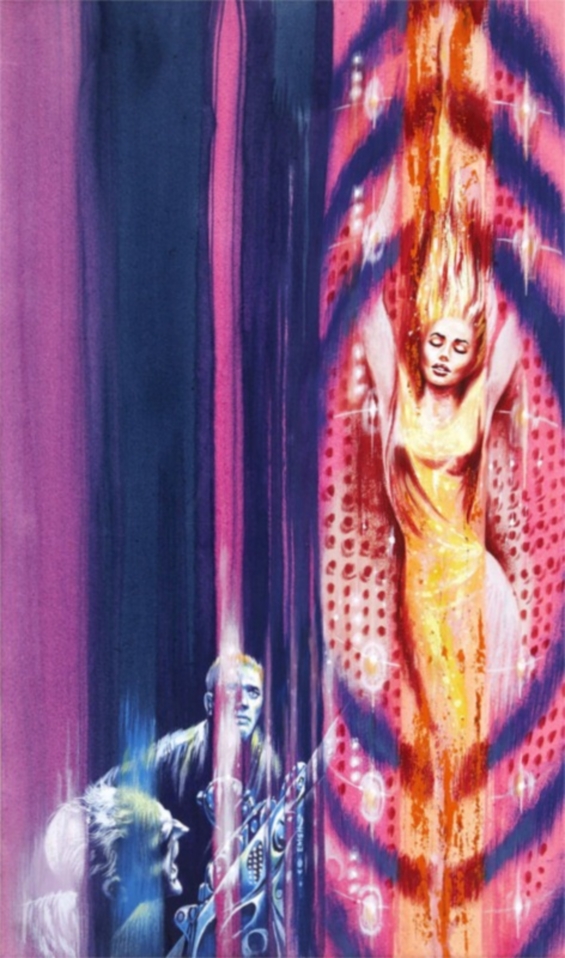
Ed Emshwiller cover illustration of Isaac Asimov's The End Of Eternity

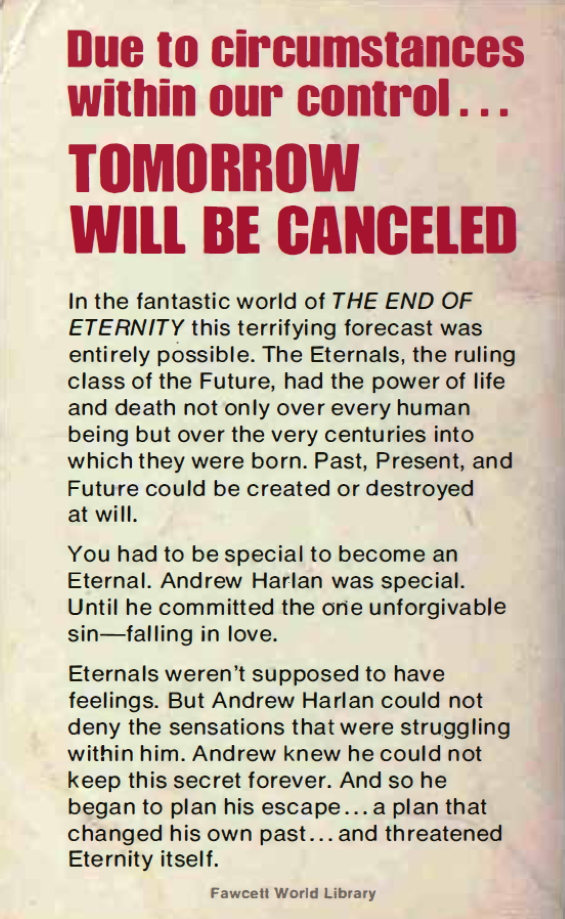
FAWCETT The End Of Eternity by Isaac Asimov

Posted by Jesse Willis