The Drama Pod: Adjustment Team by Philip K. Dick

SFFaudio Online Audio

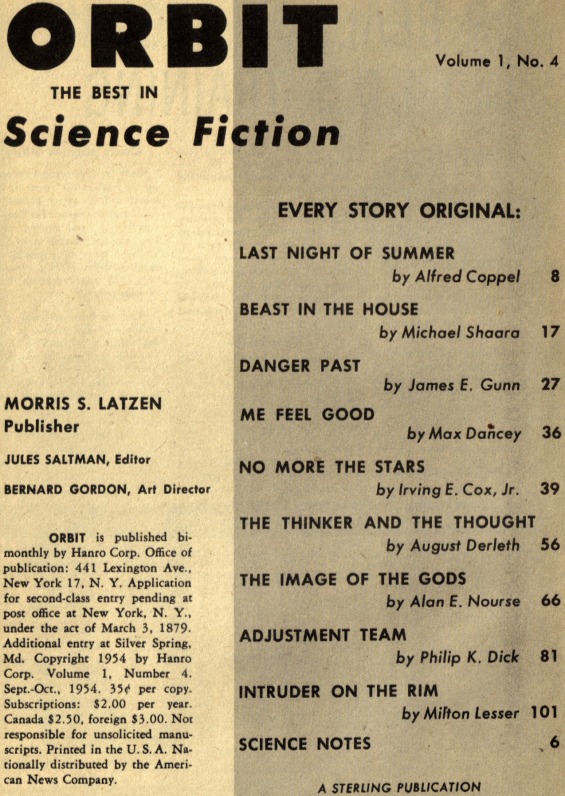
Look what the dragnet dragged in! This is a complete and unabridged recording of a story that’s been suppressed by threats of a lawsuit. Originally recorded for inclusion in a LibriVox collection of short Science Fiction stories, Adjustment Team was unjustly subject to DMCA takedown notifications |HERE| and |HERE|. The facts are these: The story wasn’t actually copyright renewed as evidenced by this falsified document RE190631 (page 2 back). We can see that the true first publication date of Adjustment Team was in Orbit Science Fiction No.4 Sept-Oct 1954 (not Imaginative Tales September 1955). Thanks Drama Pod!

The Drama PodAdjustment Team
By Philip K Dick; Read by Gregg Margarite
1 |MP3| – Approx. 59 Minutes [UNABRIDGED]
Podcaster: The Drama Pod
Podcast: November 14, 2011
“Something went wrong and Ed Fletcher got mixed up in the biggest thing in his life.” First published in Orbit Science Fiction, Sept-Oct 1954, No.4.

ETEXT Editions |SICKMYDUCK|WIKIMEDIA|WIKISOURCE|MOORINGPOST|

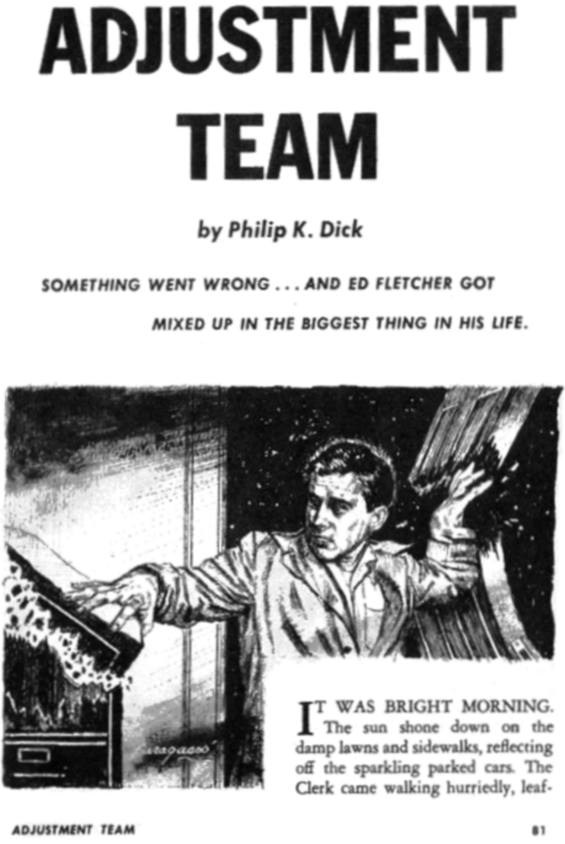
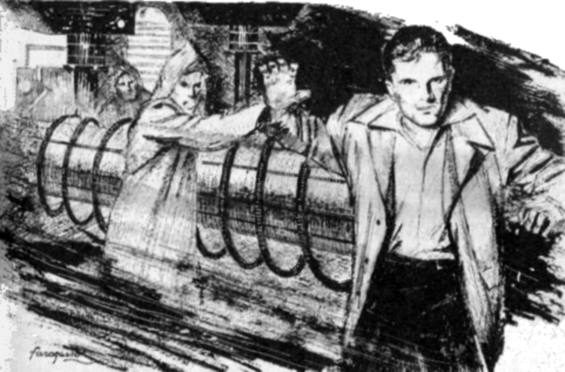
Illustrations by Faragasso:

Adjustment Team by Philip K. Dick

Adjustment Team by Philip K. Dick

[Thanks internet!]

Posted by Jesse Willis

The Diamond Lens by Fitz James O’Brien

SFFaudio Online Audio

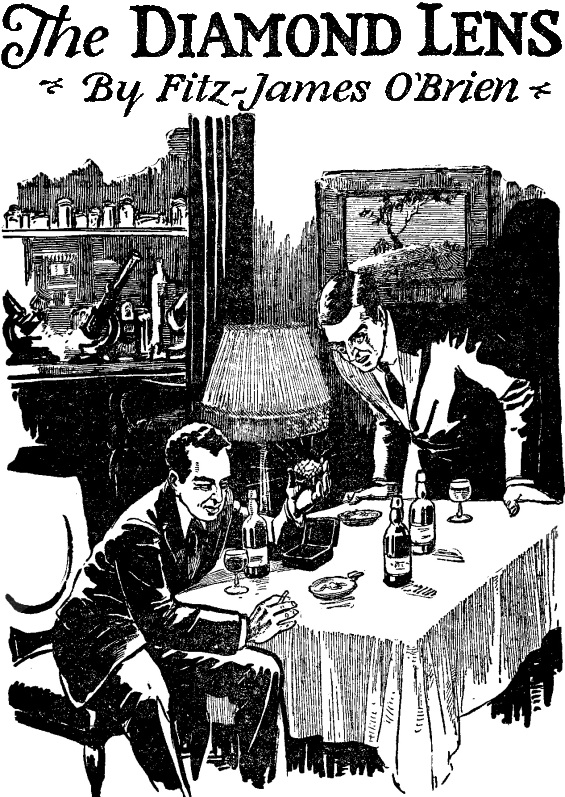
The Diamond Lens by Fitz James O'Brien - illustration uncredited - December 1926 issue of Amazing Stories

I’ve created a |PDF| from the printing in the December 1926 issue of Amazing Stories.

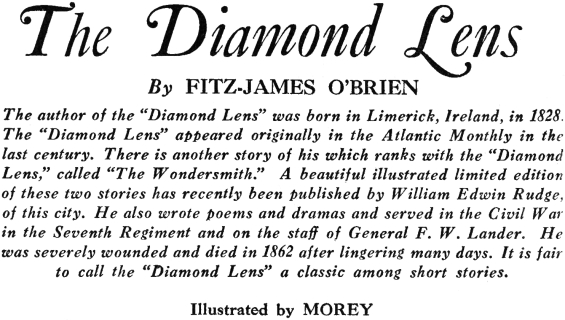
Introduction to the October 1933 issue of Amazing in which The Diamond Lens was published

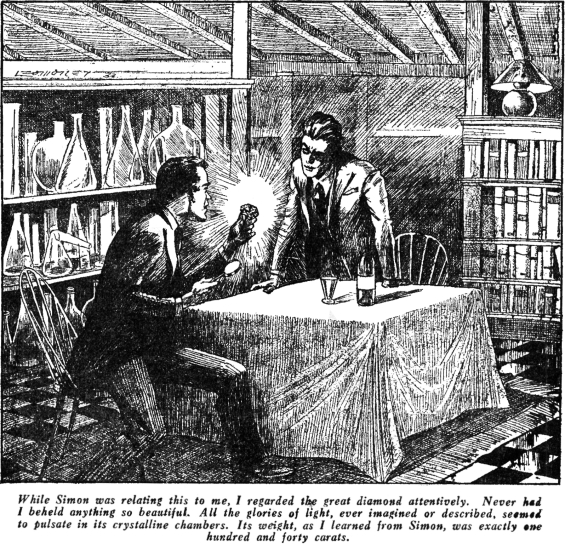
The Diamond Lens - Illustration by Morrey

I’ve created a |PDF| from the printing in the October 1933 issue of Amazing Stories.

In his introductory essay “Expanding The Lens“, found in to the story in The Road To Science Fiction: From Gilgamesh To Wells, editor James Gunn writes:

“[The Diamond Lens] is the first known story in which another world is perceived through a microscope… [this story] opened up another world, not just for readers, but for writers as well.” Gunn goes on to praise O’Brien’s “realistic treatment of the fantastic” and says that “‘The Diamond Lens‘” may be the first modern science-fiction story.”

LibriVox narrator Corrina Schultz describes The Diamond Lens this way:

“This story has a bit of everything – obsessive scientist, psychic medium contacting the dead, clever murder cover-up, racism, creepy stalker, college student shirking his studies, the painful results of pursuing forbidden knowledge, the noble savage…”

Atop those words I myself can heap a few other attractors:

1. The Diamond Lens is bizarre in both plot and focus, with episodic like writing <-Weird for a short story. 2. It has the sensibility of a foreign culture <-The 19th century attitude toward seances is pretty fucking foreign! 3. The protagonist is a mad microscopist. <-Perhaps he was demented by the illicit lure of science? 4. The story features a brutal killing. <-With a whackjob of added racism to complicate matters! 5. It has a noir ending. <-My favourite kind. As you may have guessed I quite enjoyed The Diamond Lens.

Stories like Harl Vincent’s Microcosmic Buccaneers (1929), Theodore Sturgeon’s Microcosmic God (1941) and both Sunken Universe (1942) and Surface Tension (1952) by James Blish all stem from the microscopic pioneering of The Diamond Lens. Whereas the theme, of an alien female object of adoration in an unreachable land, also brings to mind a mighty parallel with Jack Williamson’s The Green Girl (1930). And one final note, a quick read of the Wikipedia entry for Fitz James O’Brien makes me think some of the tale is autobiographical!

LibriVoxThe Diamond Lens
By Fitz James O’Brien; Read by Corinna Schultz
1 |MP3| – Approx. 57 Minutes [UNABRIDGED]
Publisher: LibriVox
Published: FORTHCOMING
A scientist, having invented a powerful microscope, discovers a beautiful female living in a microscopic world inside a drop of water. First published in the January 1858 issue of The Atlantic Monthly.

The Weird CircleThe Diamond Lens
Based on the story by Fitz-James O’Brien; Performed by a full cast
1 |MP3| – Approx. 25 Minutes [RADIO DRAMA]
Broadcaster: MBS, NBC, ABC
Broadcast: December 31, 1944
Provider: Archive.org

Arthur C. Clarke describes The Diamond Lens (from an article in Playboy)

Posted by Jesse Willis

The Thousand-And-Second Tale Of Scheherazade by Edgar Allan Poe

SFFaudio Online Audio

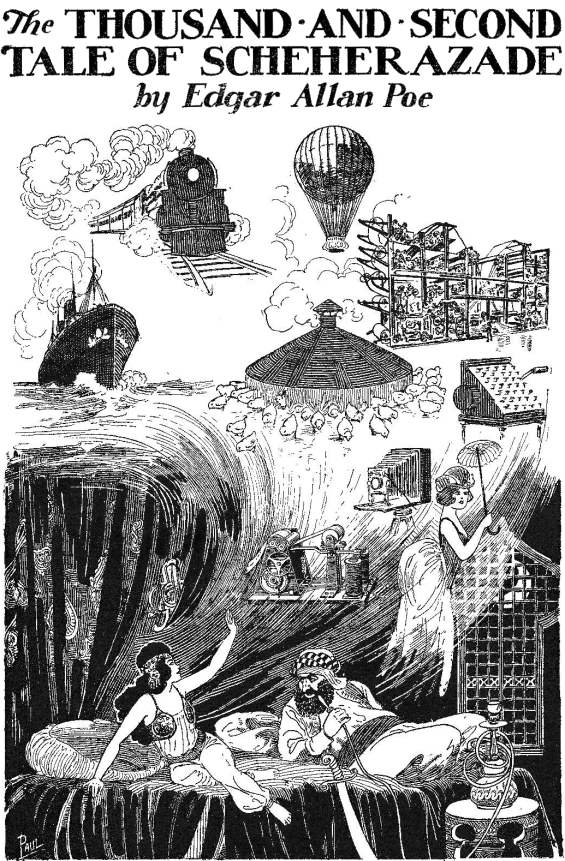
The Thousand-and-Second Tale of Scheherazade by Edgar Allan Poe - illustration by Frank R. Paul

Here’s the uncredited editorial introduction, presumably by Hugo Gernsback himself, to The Thousand-And-Second Tale Of Scheherazade as it appeared in the May 1928 issue of Amazing Stories:

“When we realize that this story was written nearly 100 years ago, we must marvel at the extraordinary fertile imagination of Poe. Poe was probably the inventor of “Scientifiction” as we know it today, and just because the story was written almost a century ago, certainly does not make it less valuable. On the contrary, it becomes more valuable as time passes. It is just as applicable to the modern man, who is mostly in the fog about what goes on around him in science today, as his predecessors were a century ago.”

Indeed, if you read it straight through, without pausing to read the footnotes, you’ll probably only get a vague sense of what’s going on in this story. And though I think I tumbled to the idea pretty early on, I still found myself in many places echoing the king’s many harrumphs. I’m not one to use the term “genius” lightly, but if anyone is worthy of the term, it is certainly Edgar Allan Poe. Even in his lesser works, like The Thousand-And-Second Tale Of Scheherazade, there is a wry brilliance that may be entirely matchless.

LibriVoxThe Thousand-And-Second Tale Of Scheherazade
By Edgar Allan Poe; Read by Gregg Margarite
1 |MP3| – Approx. 55 Minutes [UNABRIDGED]
Publisher: LibriVox
Published: October 1, 2009
First published in the February 1845 issue of Godey’s Lady’s Book.

And here’s the matching |PDF|.

Posted by Jesse Willis

Free Listens Review: The Willows by Algernon Blackwood

Review

The Willows by Algernon Blackwood

Length: 2 hours, 21 minutes
Reader: Michael Thomas Robinson


The book: Considered one of the greatest stories in horror literature, The Willows lives up to its reputation. Two friends canoeing down the Danube stop for the night on an island in the middle of a huge expanse of willow trees. The place seems mystic, almost otherworldly, and in the night the two interlopers find out why.

Blackwood could have set this story in any exotic river in the world, but he chose the Danube. This river, which runs through the heart of Europe, is the wildness that runs through what was then the epitome of civilization. As the atmosphere of this turns from idyllic to terrifying, Blackwood is showing that the unknown horrors of the world can be anywhere, even where we should be the most safe. This, I think, is the most horrifying realization of all.

Rating: 9 / 10

The reader: At first, I was not impressed by Robinson’s voice. He’s somewhat nasal, and starts the book with a bored, straightforward style. As the story went on, though, I realized the initial bored tone was probably intentional, contrasting with the building dread of the story. His pace quickens and slows to build the tension, drawing the listener into the horror of what the narrator is experiencing. Despite my early misgivings, I greatly enjoyed this reading.

Posted by Seth

LibriVox: The Monkey’s Paw by W.W. Jacobs

SFFaudio Online Audio

I read The Monkey’s Paw by W.W. Jacobs in the book called SHOCKS edited by Burton Goodman. It was different, less detailed, than the Project Gutenberg edition. There are five actors playing all the characters in the audiobook below.

LibriVoxThe Monkey’s Paw
By W.W. Jacobs; Read by David Barnes, Stuart Pyle, Cori Samuel, Jim Mowatt, Peter Yearsley
1 |MP3| – Approx. 25 Minutes [UNABRIDGED]
Publisher: LibriVox.org
Published: March 2, 2007
|ETEXT|

Podcast feed: http://librivox.org/bookfeeds/the-monkeys-paw-by-ww-jacobs.xml

iTunes 1-Click |SUBSCRIBE|

Posted by Kevin Long

The SFFaudio Podcast #125 – AUDIOBOOK/READALONG: The Horla by Guy de Maupassant

Podcast

The SFFaudio PodcastThe SFFaudio Podcast #125 – The Horla by Guy de Maupassant, read by Gregg Margarite (of LibriVox), followed by a discussion of the story – participants include Jesse, Tamahome and Jenny Colvin (of the Reading Envy blog).

Talked about on today’s show:
“c’est magnifique!”, is this Jesse’s favourite story from the 19th century?, H.G. Wells, is The Horla Science Fiction, aliens, ghosts, Guy de Maupassant is crafting our feeling on how the story should be interpreted, Mont Saint-Michel, Ladyhawke, Second Life, Normandy, Paris, France, ghosts, goats with human faces, biblical stories of possessed pigs, metaphor of the wind, the wind as a telekinetic force, invisibility, personal experience vs. faith, succubi, vampires, Jim Moon’s Hypnobobs podcast (reading of The Horla and Dairy Of A Madman), was Guy de Maupassant interested in science?, his prolific output, Sigmund Freud, is this a psychological drama?, the character in the movie vs. the short story, sleep paralysis and depression, is the unnamed protagonist of The Horla bioplar?, syphilis, H.P. Lovecraft, Benjamin Franklin, the character has a Science Fiction attitude (a disposition towards science), a story of possession (like in The Exorcist), glowing eyes, Rouen, “excuse my French”, external confirmation, diagnose yourself, São Paulo, Brazil, The Horla means “the beyond”, what lives beyond the Earth?, Jenny wasn’t thinking aliens at all, creatures from other dimensions, the Predator’s cloaking device, is the horla really Santa Claus?, hypnotism and hypnotists, post-hypnotic suggestion, confabulation, its a quasi-phenomenon, why can’t everyone be hypnotized?, Hamlet, did he burn down his house or did the horla do it?, noir, movies demand the defeat of evil, “Son Of The Horla and Spawn Of The Horla“, science and skepticism, who broke all the drinking glasses?, the Futurama version of a Twilight Zone episode,

“The vulture has eaten the dove, and the wolf has eaten the lamb; the lion has devoured the sharp-horned buffalo, and man has killed the lion with arrow, sword and gun; but the Horla is going to make of man what we have made of the horse and the ox: his chattel, his servant and his food, by the mere exercise of his will. Woe to us.”

Tamahome should read some H.P. Lovecraft, here’s H.P. Lovecraft’s description of The Horla:

“Relating the advent in France of an invisible being who lives on water and milk, sways the minds of others, and seems to be the vanguard of a horde of extra-terrestrial organisms arrived on earth to subjugate and overwhelm mankind, this tense narrative is perhaps without peer in its particular department.”

Lovecraft is using deep time to scare us instead of the supernatural, The Statement Of Randolph Carter, sorry I cant talk right now I’m being digested, Cthulhu’s guest appearance on South Park, the elements, space butterfly,

“We are so weak, so powerless, so ignorant, so small — we who live on this particle of mud which revolves in liquid air.”

a cosmic view, the Carl Sagan view, evil is everywhere, an allegory for science, Frankenstein, “men ought not meddle in affairs normally deemed to women”, the Frankensteinian monster, a warning against science vs. science is our only way of understanding the universe, we have one place to look and that is to science, the propaganda he’s pushing, “there are things we can’t explain”, gentlemen did science back then, Library Of The World’s Best Mystery And Detective Stories on Wikisource, the case of my body being haunted, Edgar Allan Poe, Diary Of A Madman, turn us into batteries, “this is a looking glass”, the main character holding a photograph of himself, foreshadowing, out of body experience, Tama fails the quiz of the lesson earlier, when we don’t know – don’t conclude, we ought not conclude anything from this scene, we are not supposed to know we know the answer, Harvey Keitel’s appearance on Inside the Actor’s Studio, becoming comfortable with the unknown, The Necklace by Guy de Maupassant, F. Scott Fitzgerald, Jesse proceeds to recount the entire plot of The Necklace, like a really sad O. Henry story, Somerset Maugham, Henry James, A String Of Beads, “Mais oui.”

The Horla by Guy de Maupassant

The Horla by Guy de Maupassant - illustration by Julian-Damazy

The Horla by Guy de Maupassant - illustration by Julian-Damazy

Guy De Maupassant's Le Horla 1908 Edition

Posted by Jesse Willis