Review of Red Mars by Kim Stanley Robinson

Science Fiction Audiobooks - Red Mars by Kim Stanley RobinsonRed Mars
By Kim Stanley Robinson, read by Richard Ferrone
17 cassettes / 24 hours [UNABRIDGED]
Publisher: Recorded Books
Published: 2000
ISBN: 0788740849
Themes: / Science Fiction / Hard SF / Future history / Mars / Space exploration / Space flight / Planetary colonization / Terraforming

If I were to play you the prolog from Red Mars, neither telling you the title nor showing you the case (with Olympus Mons shown actual size), you would know immediately that it came from a very large book. The mystical meditation on the red planet that opens this tome plumbs the depths of human history and the width of human culture, conjuring a sense of vast space for the story that follows.

And what follows is a massive dose of exhilarating hard science fiction, the first volume in an epic trilogy charting the future history of the colonization of Mars. It grabs us with an opening sequence of mid-novel action, then backs up to lead us more meticulously from the selection of the first one hundred explorer/settlers to their first attempts at independence from the faltering socioeconomic powers of Earth nearly twenty Martian years later. Told through the eyes of half a dozen of these “First Hundred”, the novel details the technical, political, and to some extent personal growth of the colonists through their training on Earth’s Antarctica, the long space voyage between the planets, the rise of the first settlements and buildings, the initial attempts at terraforming, the breakaway of some of the settlers to another colony, the arrival of the next, larger and more diverse waves of colonization, and on to a cataclysmic finale. The story covers a lot of ground with striking believability.

The strongest point of the novel is its marvelous set-pieces, such as the radiation storm scene on the voyage out, a nearly deadly encounter with a Martian dust storm in a dirigible, and a perilous escape down a canyon system that is being destroyed by a torrential flood. Some of the best would be slight plot spoilers to mention, so I won’t. But suffice it to say they are all lovingly crafted, filled with mental eye-popping detail, and yet integrated well into the plot. This is science fiction with its fundamental sense of wonder not only intact, but bursting from every page like an alien from the abdomen. As you might expect, some of this detail and the buildup to monumental scenes leaves a few slow parts in the narrative, but the payoffs are almost always phenomenal.

Also strong is the fundamental clash of old and new economic systems, which contrast idealized concepts of human worth with the dehumanizing iniquities of our international market economy pushed to its all-too-readily conceivable limits. I tend to cheer at any work that is not afraid to point out how the cancerous growth of international corporations in our modern world devours the planet’s resources yet returns nothing of value to the overall system. This book gave me a lot of alternative ideas to dream about, and some Darth Vader-sized economic evil to hiss at cathartically.

One thing I didn’t like was the huge number of fundamental breakthroughs that are made by the “First Hundred” in various fields of science after they leave the messiness of life on earth. That premise borrows a little too much from Frederick Pohl’s Jem, for one thing. For another, as someone who does science and engineering for a living, I don’t believe that if you separate a bunch of scientists and engineers from the mundane glop of real life, you suddenly end up with astounding technical breakthroughs. If it were that easy, you could get any amazing breakthrough you wanted just by throwing a bunch of scientists and engineers in a nice padded cell.

Also, as with most hard science fiction, you could quibble that the characters lack the depth of believable human beings, and that the necessities of the plot move the characters more than their individual natures and decisions determine the plot. But you shouldn’t be reading this book for the same reasons you’d read The Heart is a Lonely Hunter. Come on! Red Mars may do little to illuminate the unrequited yearnings of the human soul, but that’s not the point. It boils over with effervescent ideas, dynamic images, and inspiring speculation on what human minds and hands can achieve. The characters here may feel a little hollow, and their individual voices may be pretty much interchangeable, but they do their job: they lead us into an exciting, vibrant, thrilling future world.

I will admit that the weaknesses in characterization are not greatly aided by Richard Ferrone’s narration. Don’t get me wrong, I found his cigarette-charred, “In a world where…” voice (somewhat reminiscent of my grade school secretary Mrs. Byrd) to be reliably intriguing. And he can spit out the ten-dollar words and knotty concepts in the exposition with lucid authority. However, his voice characterizations are often indistinguishable. It is possible to find yourself confused about who is speaking when the dialog comes without tag lines. This is partly Robinson’s fault for failing to provide distinctive speech patterns for all the characters, but that’s exactly where the voice of the narrator is supposed to help most. For several characters, it does. But for many, it does not.

I consider the above detractions to be minor points, however. Overall, you will find so much to gasp at, delivered with such powerful enthusiasm by both the author and the narrator, that it would be a crime to miss it. I owe a significant fine just for pushing Red Mars down my reading list for so long. If you’re looking for a hard SF novel that will make you sit up and say “Wow!” out loud, then you should get your hands on this one immediately.

Posted by Kurt Dietz

Robert J. Sawyer dropped a few more hints about th…

SFFaudio News

Science Fiction Audio Drama - CBC EmanationsRobert J. Sawyer dropped a few more hints about the new CBC Radio One Science Fiction anothology radio drama series Emanations:
“Michael Lennick and I had a meeting at the CBC Broadcasting Centre to go over the second draft of our SF radio-drama pilot with the people Michael likes to refer to as “the boys downtown.” The script will be produced on March 17; our series is an anthology of standalone SF radio dramas with the overall title Emanations. The pilot script, “Birth,” deals with the accidental emergence of sentience among exploratory robots on Mars.”

Posted by Jesse Willis

Review of Martian Time-Slip By Philip K. Dick

Science Fiction Audiobooks - Martian Time-Slip by Philip K. DickMartian Time-Slip
By Philip K. Dick; Read by Tom Parker
6 Cassettes – 9 hours [UNABRIDGED]
Publisher: Blackstone Audio
ISBN: 0786113529
Date Published: 1998
Themes: / Science Fiction / Mars / Politics / Time-travel / Mental Illness / Aliens / Philosophy /

On the arid colony of Mars the only thing more precious than water may be a ten-year-old schizophrenic boy named Manfred Steiner. For although the UN has slated “anomalous” children for deportation and destruction, other people–especially Supreme Goodmember Arnie Kott of the Water Workers’ Union -suspect that Manfred’s disorder may be a window into the future.

While the Mars of our reality is a fascinating planet in its own right, the Mars of fiction is far more accessible, and nearly as alien! Ray Bradbury’s Mars was a walk through the pastoral and allegorical mind of Bradbury’s youth. Edgar Rice Burrough’s Mars, a fantasyland where many buckles were swashed and princesses were saved. But Philip K. Dick’s Mars is the strangest of them all, a place where everyday reality is malleable and where political corruption continues as it does on Earth. Martian Time-Slip, as read exceedingly well by Tom Parker, is a poignant and utterly fascinating journey both across the newly colonized Martian landscape and through the lives of its varied central characters. A journey not to be missed, I have no doubt that eventually the real colonists on the real Mars will be reading Philip K. Dick’s Martian Time-Slip – and a few of them may even be listening to Parker’s excellent performance of this amazing novel.

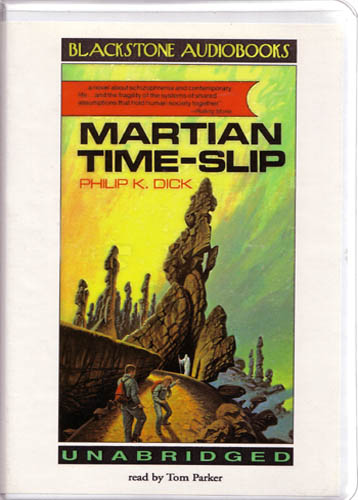
More and more it seems you can count on Blackstone Audio to pick a great book, match it with an appropriate narrator and follow through with high production values. Martian Time-Slip just adds to this reputation. It comes in a library style clamshell binding with a cool cover featuring the original art from the paperback release. And to top it all off this superb production includes every single word in the book, including the teaser back cover. There is little else to say except: Martian Time-Slip, highly recommended!

Posted by Jesse Willis

Review of Voyage by Stephen Baxter

Science Fiction Audio Drama - Voyage by Stephen BaxterVoyage
By Stephen Baxter; Directed/Produced by Dirk Maggs, Performed by a Full Cast
2 Cassettes – 2 hours [AUDIO DRAMA]
Publisher: BBC Audiobooks
Published: May 1999
ISBN: 0563552417
THEMES: / Science Fiction / Alternate History / Space Program / Mars / Moon / Politics /

Voyage is a work of alternate history, in which the seed is President John F. Kennedy’s survival of the attempted assassination in Dallas in 1963. The impact of this historical change on the United States Space Program is the focus of the story.

In one of the many striking scenes in this audio drama, a wheelchair bound Kennedy joins president Nixon in the Oval Office in sending a message of congratulations to Neil Armstrong and crew during the first moon landing. But Kennedy takes it a little farther than a simple greeting – he challenges humanity to go farther. He challenges NASA to send people to Mars. Nixon at first is appalled, then goes along with the program after an aide tells him the voters love the idea.

The story is about the struggle from that point on to send people to Mars, building up to and including the story of Project Ares, which lifts off in 1986 with a three-person crew headed for Mars.

Dirk Maggs directed the production which was absolutely first-rate. I put on a pair of headphones and was instantly taken away to this alternate history. I enjoyed every minute of it. I’d even go so far as to say that it solidified the power of audio drama to my ears – I couldn’t help but to think of the many excellent works of science fiction that could – and SHOULD – be done in this medium.

I also agree with the message of the story. It’s a unconscionable that humanity reached the moon 35 years ago and has gone nowhere since. Let’s get on with our own history!

Posted by Scott D. Danielson

Review of Protector By Larry Niven

Science Fiction Audiobook - Protector by Larry NivenProtector
By Larry Niven; read by Mark Sherman
5 cassettes – 7.5 hours [UNABRIDGED]
Publisher: Blackstone Audio
Published: 2003
ISBN: 0786123907
Themes: / Science Fiction / Aliens / Interplanetary Travel / Solar-System Civilization / Asteroid Belt / Mars / Evolution / Genetics / Biology / Ballistic Physics /

Phssthpok the Pak had been traveling for most of his thirty-two thousand years. His mission was to save, develop, and protect the group of Pak breeders sent out into space some two and a half million years before. Brennan was a Belter, the product of a fiercely independent, somewhat anarchic society living in, on, and around an outer asteroid belt. The Belters were rebels, one and all, and Brennan was a smuggler. The Belt worlds had been tracking the Pak ship for days, and Brennan figured to meet that ship first. He was never seen again, at least not by those alive at the time.

Humanity has become an interplanetary species; Luna, Mars, Mercury, the Asteroid Belt and the gas giants of Sol are the playground of mankind. But it wasn’t meant to be that way… an alien race from near the galactic core has set its sights on Earth and the cargo it brings will bear some really strange fruit.

Protector is absolutely bursting with awesome SF ideas, and the twists on them, everything from a precursor to Richard Dawkin’s “Selfish Gene Theory”, to realistic spaceship ballistics and sexual politics. Niven himself has been a giant in the SF field since the early 1970s, of the many living authors who still haven’t been bestowed with the honorific “Grand Master,” Niven is the most deserving. Protector was first published in 1973, and is a part of Niven’s ongoing “Known Space” series, one of the foremost continuing visions of the future by an SF author. Like Robert A. Heinlein’s Future History series, the Known Space novels and stories follow the expansion of humans into the galaxy. And Protector is perhaps the best of the Known Space novels, it offers some of the hardest of the Hard SF ever written, something Larry Niven has a particular talent for, and it’s a great story, both unpredictable and fun! But I can’t stress enough just how good this novel is, the plot is unpredictable but relentlessly logical and enthralling at the same time, even better this novel like Richard Matheson’s classic I Am Legend, has a deep psychological and philosophical impact on the reader, and it also has a similar twist ending. It’s simply fantastic!

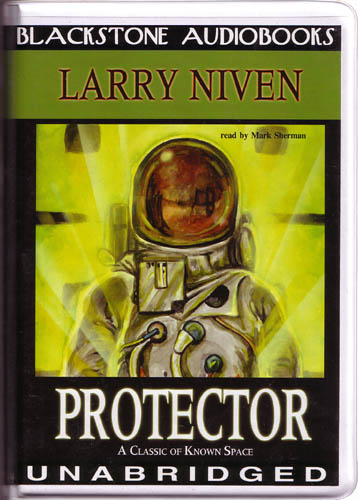
Reader Mark Sherman appears to have prepared well for what really could have been a very difficult reading. Larry Niven gave the alien names a real alien sound – I had no idea how to pronounce names like “Phssthpok”, but Mark Sherman does a great job in putting voice to it and numerous other unpronounceable words. Blackstone Audiobooks’s production is super smooth, sound quality is terrific, the cassettes come packaged in the awesome library style clamshell case and the original cover art is simply amazing to behold. For those who prefer other formats, Blackstone has also released Protector in two other media types, a 6 CD set or a single MP3-CD. Whatever format you choose you must choose one as this production of Larry Niven’s Protector is nigh unto perfect.

Posted by Jesse Willis

Review of Sci-Fi Private Eye edited by Isaac Asimov and Martin H. Greenberg

Science Fiction Audiobooks - Sci-Fi Private Eye edited by Isaac Asimov and Martin H. GreenbergSci-Fi Private Eye
Edited by Isaac Asimov and Martin Greenberg; Read by Bill Fantini and Nelson Runger
4 cassettes – 6 hours [UNABRIDGED]
Publisher: Dercum Audio
Published: August 1997
ISBN: 155656273X
Themes: / Science Fiction / Mystery / Utopia / Dystpoia / Sherlock Holmes / Mars / Berzerker / Time Travel / Artificial Intelligence / Covert Warfare /

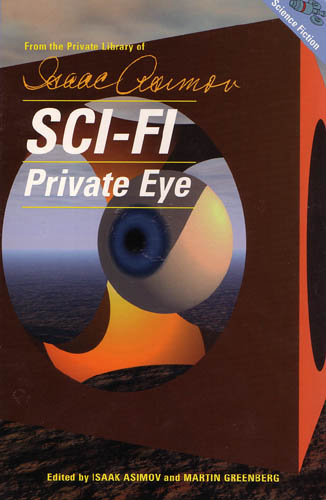
Decades ago, SF grandmaster Isaac Asimov noted the similarity between detective “whodunit” stories and science fiction “puzzle” stories. Avoiding some of the obvious pitfalls, he began to write stories that contain elements of both of these popular genres. Later as an anthologist, Asimov teamed up with Martin H. Greenberg to collect the best of this subgenre. Sci-Fi Private Eye was the happy result. Though obviously not recorded under perfect conditions, you can literally hear the pages turning, I was flabbergasted by the love and care that went into the recording of this audiobook. It starts off with a haunting original musical score, then, instead of simply reading the first story, as is typical with nearly every audiobook, it introduces the anthology with a brief but well composed essay on the subject of mystery science fiction! The packaging is not as good, while in a sturdy enough case, the original cover art falls into a category I call “computer designed abstract boring”. Even worse, they spelled Asimov’s name wrong. The cassettes themselves also lack important details (what story starts where and ends where). The stories though are so good that I’ve got to summarize and review them individually:

Stories Included:
Introduction written and read by Isaac Asimov
“Getting Across” by Robert Silverberg
“The Martian Crown Jewels” by Poul Anderson
“Of The Metal Murderer” by Fred Saberhagen
“Mouthpiece” by Edward Wellen
“War Game” by Philip K. Dick

Robert Silverberg’s “Getting Across” is a terrific SF short story told in the first person. It was originally published in the anthology entitled Future City (1973). A future society is in danger. To house the engorged human race, the Earth is entirely covered by one large metropolis. But it isn’t one big city so much as it is a million city-states abutting one another. Each district has its own government, its own customs and industries, and it’s own way of life. Contact between districts is restricted and often dangerous to those who attempt it. All districts rely on a master computer program for the smooth operation of these automated communities. So when Ganfield’s master computer program is stolen, things start to deteriorate quickly. Garbage starts piling up uncollected, food stops being delivered, the climate control system stops working, and the deactivated robotic police force cannot prevent the cannibalism that is only weeks away. The man whose “month-wife” stole the program is sent to find her and bring it back. His task is nearly impossible because even if he can get out of his district getting across will only be the first hurdle. Typical of Silverberg’s great work in the 1970s.

Poul Anderson’s “The Martian Crown Jewels” was first published in A Treasury of Great Science Fiction, Vol. 1 (1959). The Martian Crown Jewels have been stolen! The theft threatens to destroy diplomatic relations between Mars and Earth. Inspector Gregg, of the Earth police force stationed on Mars, is stumped. Who can solve the baffling locked spaceship mystery and avert a galactic catastrophe of cataclysmic proportions? None other than Mars’ greatest consulting detective, Syaloch, a seven-foot feathered Martian who lives at 221B “Street of Those who Prepare Nourishment in Ovens.” Most entertaining.

Edward Wellen’s “Mouthpiece” first saw print in the pages of Fantasy & Science Fiction Magazine’s February 1974’s issue. Most of the stories I’ve read by Edward Wellen tend to be focused on the workings of the human mind, and this one is no exception. This one fictionalizes a fascinating historical curiosity regarding the final hours of “Dutch” Schultz and takes it just that bit farther – into artificial intelligence – leaving us pondering the nature of personality, memory and thought. It’s also a great little mystery to boot!

Fred Saberhagen’s “The Adventure Of The Metal Murderer” was first published in Omni Magazine’s January 1980 issue, and is another in Saberhagen’s long running series of Berzerker short stories. It’s a time travel story that starts in the distant future and then goes back to 19th century London, England. A clever tale that will remind you of Michael Moorcock’s “Behold The Man”.

Philip K. Dick’s “War Game” was first published in Galaxy Science Fiction Magazine’s December 1959 issue. Earth’s traditional enemy, Ganymede, is at it again. They are trying to subvert and soften up the good people of Earth by selling potentially dangerous toys and games as a prelude to invasion. One toy appears to assemble itself over time into a nuclear weapon, another convinces the user that the virtual reality he or she is in is actual reality, and a third is a harmless variation on the board game Monopoly. But the market demand for the inventive Ganymedian games is pressuring the Earth customs to clear the toys for stocking in time for Christmas. If they follow the rules only one will get through to the store shelves. Typically Dickian and thus very entertaining.

Posted by Jesse Willis