News, Reviews, and Commentary on all forms of science fiction, fantasy, and horror audio. Audiobooks, audio drama, podcasts; we discuss all of it here. Mystery, crime, and noir audio are also fair game.
Shell Game, a short story by Philip K. Dick, is public domain.
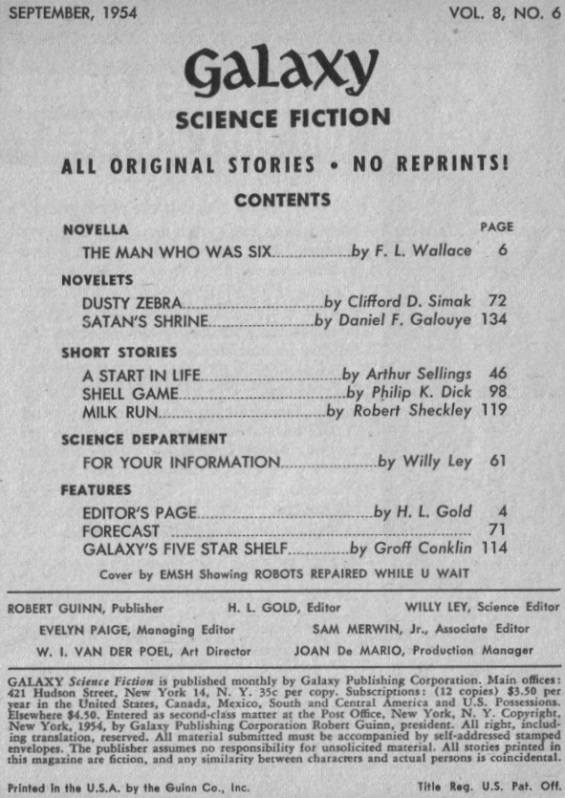
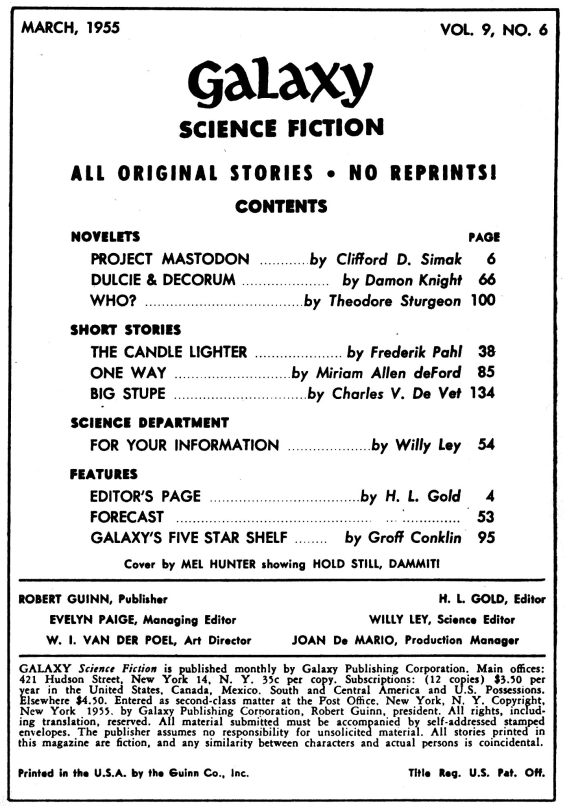
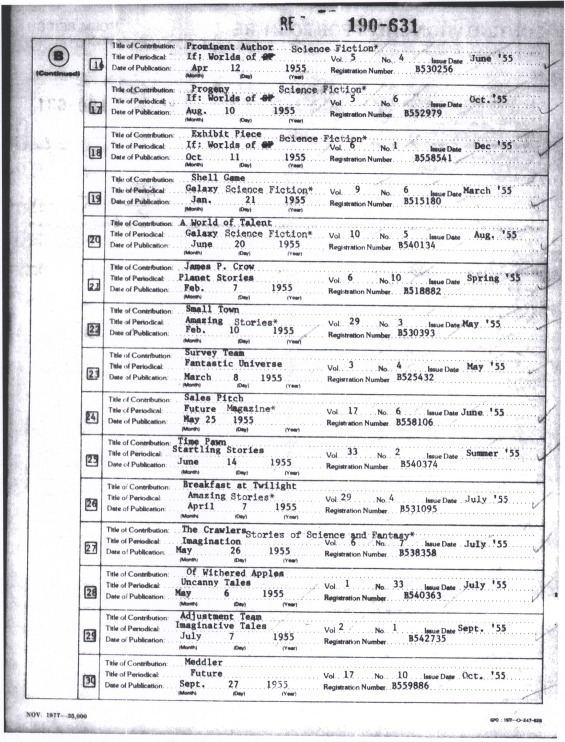
A comparison of the copyright renewal form HERE and the original publication of the short story, in Galaxy Science Fiction, September 1954 (below) proves that the copyright was not properly renewed.
Indeed, it appears that the copyright renewal was actually intentionally falsified so as to give the appearance that the story was still under copyright. An examination of the magazine from the issue where its renewers claim it to have been published DOES NOT CONTAIN the story.
Here is the table of contents from the issue where the claimants claimed it was published:
Recorded live in Toronto, this is a very faithful adaptation of Beyond Lies The Wub. It uses most of the dialogue and vocabulary from Philip K. Dick’s first published short story.
Beyond Lies The Wub
Adapted from the story by Philip K. Dick; Performed by a full cast
1 |MP3| – Approx. 45 Minutes [AUDIO DRAMA]
Podcaster: Radio Project X
Podcast: July 10, 2012
The slovenly wub might well have said: Many men talk like philosophers and live like fools. First published in Planet Stories, July 1952.
“In a remarkable short story, ‘The Grove of Ashtaroth,’ the hero finds himself obliged to destroy the gorgeous little temple of a sensual cult, because he believes that by doing so he will salvage the health and sanity of a friend. But he simultaneously believes himself to be committing an unpardonable act of desecration, and the eerie voice that beseeches him to stay his hand is unmistakably feminine.”
The Grove Of Ashtaroth was written by the fifteenth Governor General of Canada, John Buchan. Despite that high position, he was the viceregal representative of the Canadian monarch for five years in the 1930s, Buchan is probably better known today as the author of The Thirty-Nine Steps. Buchan’s novelette has been described as a “weird story” (by the makers of Escape) or as “high fantasy” (in The Fantastic Imagination) by editors Robert H. Boyer and Kenneth J. Zahorski, a 1977 anthology).
I’m not sure exactly what it is, except very interesting and certainly within the vague borders of the Fantasy genre. The Grove Of Ashtaroth reminds me of a short story by Philip K. Dick, Of Withered Apples.
You can judge for yourself what you think it is most like.
There’s a hurried, but unabridged, reading available |MP3|. It’s read by Libby Hill for the TV On The Internet podcast (beginning shortly after the twenty minute mark).
But your best bet, in audio, for the moment at least, is to listen to the 1948 Escape radio dramatization!
Escape – The Grove Of Ashtaroth
Adapted from the novelette by John Buchan; Adapted by Les Crutchfield; Performed by a full cast
1 |MP3| – Approx. 31 Minutes [RADIO DRAMA]
Broadcaster: CBS
Broadcast: February 29, 1948
Provider: Archive.org
Cast:
Paul Frees as John Buchan
William Conrad as Lawson
And if you were wondering, the only major difference between the original story and the dramatization is that the unnamed narrator is named (after Buchan himself) in the dramatization.
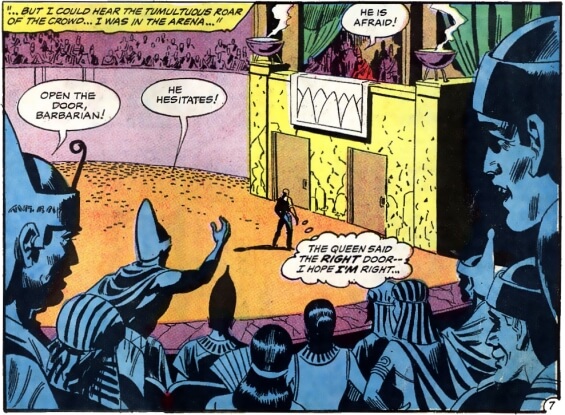
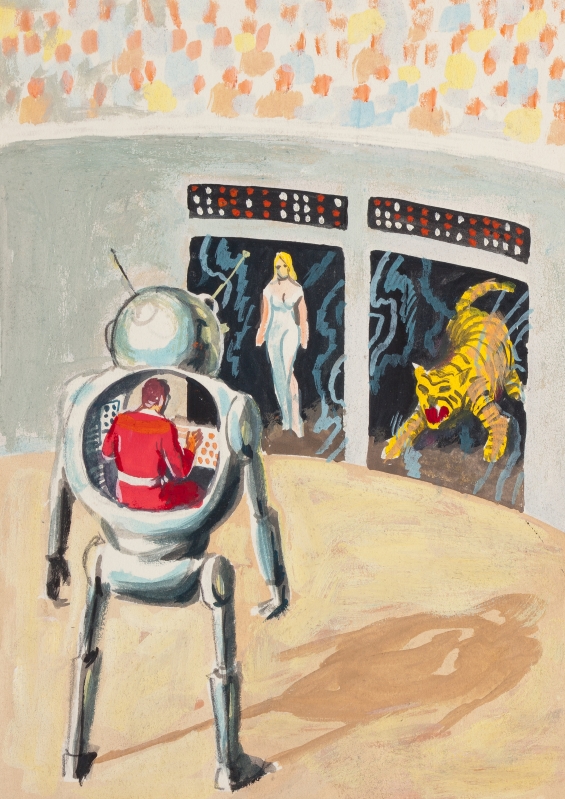
The SFFaudio Podcast #186 – An unabridged reading of The Lady, Or The Tiger? by Frank R. Stockton (17 minutes), read by David Federman – followed by a discussion of it. Participants in the discussion include Jesse, Tamahome, and Julie Hoverson (of 19 Nocturne Boulevard).
Talked about on today’s show:
Monty Hall, Let’s Make A Deal, a can of sardines, a donkey and a block of hay, the Dungeons & Dragons meaning of “Monty Hall”, use in schools, weighting the scales, what is the character of women?, equally loving and equally jealous, love vs. jealousy, how barbaric are women?, where are the female criminals, a fully barbaric king, trial by ordeal, a box with a viper, a box with a knife, the swift choice, a curious justice system, jaywalking into the people’s court, like father like daughter, women were so emotional, unmodernizable sexism, guilt, there are tigers behind both doors, The Price Is Right, imaginary morality in an imaginary land, fairness conflated with arbitrariness, “when he and himself agreed upon anything”, Julie’s problem with philosophy, game theory, a thought experiment, Ray Bradbury style stories convey Bradburian feelings vs. Rorschachian style stories which elicit only the reader’s feelings, The Discourager Of Hesitancy (a sequel to The Lady, Or The Tiger?), smile vs. frown, Batman, Two-Face’s decisions are not actually coin tosses, The Man in The High Castle by Philip K. Dick, I Ching, “the tiger does not eat the straw because the duck has flown away”, phone psychics should agree with their customers, “the cards are telling me…”, psychics as impartial observers, a Ponzi scheme, selection bias, is it a double bluff?, does the father know that the daughter knows?, what is the punishment for adultery?, obsolete pop-culture, zoot suit riots (not just a joke, seriously), “six of one, half a dozen of the other”, “as snug as a bug in a rug”, we have to invent rug technology, nitpicking, Bugs Bunny dialogue, Max Headroom (is still ahead of it’s time), “blipvert”, They Live, shantytowns in the Regan era, Shock Treatment, The Rocky Horror Picture Show.
The SFFaudio Podcast #184 – Jesse, Tamahome, Jenny, talk about the RECENT ARRIVALS in audiobooks.
Talked about on today’s show:
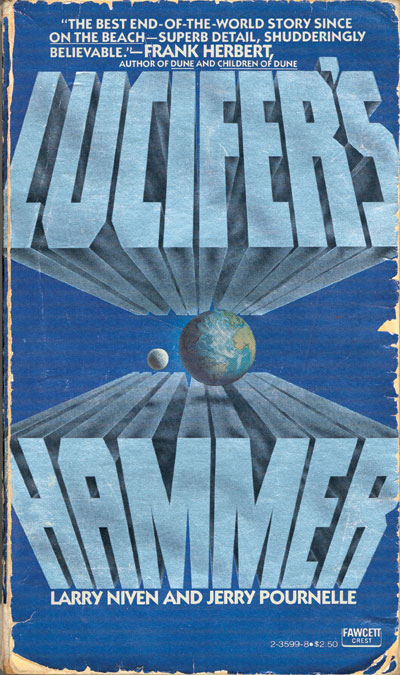
Is it new releases or recent arrivals?, Jenny’s pretty color-coded list, The Year’s Top Short SF Novels 2 edited by Allan Kaster, Angel of Europa by Allen M. Steele (is one of them), “it’s basic science fiction”, how to pronounce Mary Robinette Kowal, The Twelve (Passage #2) by Justin Cronin is literary vampire fiction, Cloud Atlas, The Walking Dead: The Road to Woodbury by Robert Kirkman and Jay Bonansinga, “I’m not going to end this story”, “our Scott?”, In the Tall Grass by Stephen King and Joe Hill, read by Stephen Lang, more manly than Stephan Rudnicki?, |READ OUR REVIEW|, “Stephen King has more pull”, Lucifer’s Hammer by Larry Niven & Jerry Pournelle is epic science fiction (24 hours), one of Luke’s favorites, (it’s post The Mote in God’s Eye actually), it was a best-seller, Seven Wonders by Adam Christopher, “I follow writers”, Kirkman’s Invincible comic, Breakdown by Katherine Amt Hanna, sounds like Death of Grass, which has a new BBC audiodrama, Embedded by Dan Abnett, he writes Warhammer 40K books, The Diamond Age and Snow Crash by Neal Stephenson, “I have both those feelings”, “Luke didn’t like it but everyone else did”, many Mongoliad disks, Jonathan Davis likes us, Tales From the Fire Zone by Jonathan Maberry, Julie’s review of Maberry’s first Joe Ledger book, Downpour.com audiobooks, “she liked them against her will”, Cold Days by Jim Butcher, James Marsters is back narrating, When We Have Wings by Claire Corbett, very Australian accent, “vampires for Christians”, Mockingbird by Chuck Wendig, a female Stephen King character, An Apple for the Creature is monsters in school, Ashes of Honor by Seanan McGuire, performed by Mary Robinette Kowal, Jesse sees the future, Nightwatch by Sergei Lukyanenko, it’s not in Russian, (Luke wasn’t thrilled), Death Warmed Over by Kevin J. Anderson, zombie p.i., a big stack of Philip K. Dick, The Man Who Japed, The Simulacra, The Crack In Space, Total Recall (We Can Remember It For You Wholesale), We Can Build You, Solar Lottery, The World Jones Made, minimalist covers, Gone by Randy Wayne White, chick that kicks ass, A Murder of Quality and Call For The Dead by John Le Carre, Jesse likes the narrator Michael Jayston, This is How You Lose Her by Junot Diaz, |READ OUR REVIEW|, Jenny liked his podcast appearance, Jenny loved Diaz’s The Brief Wondrous Life of Oscar Wao,Waging Heavy Peace by Neil Young, read by Keith Carradine who was in the movie Southern Comfort, Dream More by Dolly Parton, aphorisms at the end, Total Recall (autobiography) by Arnold Schwarzenegger, “how many pushups did he get for that?”, Pumping Iron documentary, Conan The Barbarian movie
This 4,712 word story may not be among Philip K. Dick’s best, but it is certainly worth looking at, and hearing!
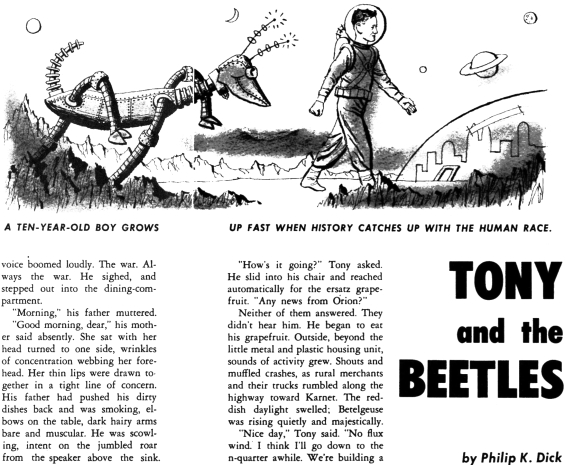
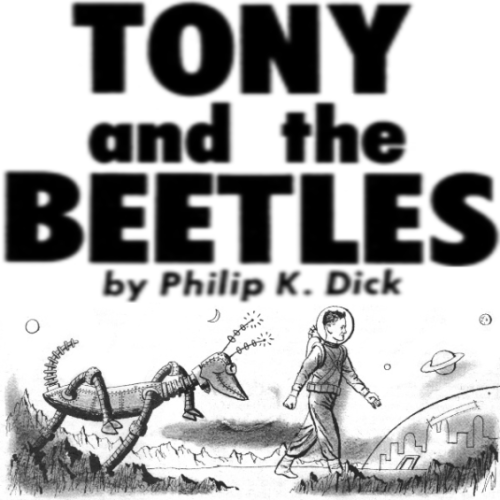
Tony And The Beetles is a bit unusual too, having an almost juvenile or YA feel to it. Maybe that’s because it’s not nearly as horrific as many of Dick’s fantasy tales – there are some frightening elements, but the general tone is that of an ungroundedness. I see Tony And The Beetles as a kind of historical allegory and I’m not the only one. Phil Chevernet, the narrator who recorded it for LibriVox, wrote “I think [Dick] was commenting on imperialism in the 40s and 50s.” I think he’s right, but I think the comment is somewhat ambiguous, rather depressing, and almost wholly unhopeful. Dick grew up during World War II and little PKD was a very sensitive fellow, kind of like Tony.
Here’s the setup:
Young Tony Rossi has grown up on an alien world. As a child he’s known little else than bubble helmets, pressure suits, and robot pets. His playmates and schoolmates have all been the non-human children of the planet, but around him swirl the forces of history and when news of the ongoing war breaks Tony’s parents don’t seem to hold the same opinions of what it all means.
Tony And The Beetles
By Philip K. Dick; Read by Phil Chevernet
1 |MP3| – Approx. 34 Minutes [UNABRIDGED]
Publisher: LibriVox.org
Published: October 16, 2012 A ten-year-old boy grows up fast when history catches up with the human race. First published in Orbit, volume 1 number 2, 1953.
And here’s a |PDF| made from it’s original publication in Orbit.