
The SFFaudio Podcast #345 – READALONG: Star Maker by Olaf Stapledon

Podcast

The SFFaudio PodcastThe SFFaudio Podcast #345 – Jesse, Paul Weimer, Bryan Alexander, and Professor Eric S. Rabkin talk about the Star Maker by Olaf Stapledon.

Talked about on today’s show:
1937, Jesse has a radical thesis, is this book a true story?, I’m not really happy I just think that I am, Alice In Acidland, drugs, what do we mean by true?, arachnoids and ikthyoids, a summary of Last And First Men, the unnamed narrator, astral projection, the contents of this book, not history but a personal experience (of imagination), standing on a hill, an interesting fantasia, considering the size of the universe, Star Trek with Nazi costumes is possible and perhaps even inevitable, The Truman Show, the nature of infinity, an Italian who would be perfectly happy to use the word true about this book, “Midway upon the journey of our life I found myself within a forest dark.”, bitterness, Dante Alighieri, a lyric poem, Olaf Stapledon was a philosopher, a blazing panoply, an image of the rose, OS, “One night when I had tasted bitterness I went out on to the hill.”, an abiding faith, the original meaning of comedy, comedies end in marriage, sitcoms, both narrators acknowledge their psychological state, an exponential rhythm, overhead obscurities in flight, a Doppler shift, the other Earth, Bvalltu, a composite character, planets – > solar systems -> galaxies, a fractal experience, an encompassing wisdom, marriage as a small atom of community, spirit inhabited rock, a World War I novel, 1986, Eric taught Star Maker to Bryan, memories imbricated upon each other, the preface, Stapledon was an ambulance driver in WWI, looming WWII, militarism, seeing the sunny side of a ruined planet, Merseyside, too smashed up to really be alive, a 1930s novel, fascism vs. communism, how to organize the self and society, a secular myth, a shock to civilization, the cycle of mechanization, terrible mutations, the onset of the tank, a sense of horror, WWI and WWII as two different episodes, the Spanish Civil War, shaking off colonialism, materialistic industrialization, the only wait out is an act of faith, how can we not think of the Star Maker as a monster, “struck dumb with shame”, limitations of the audio medium, Bryan’s keyboard, C.S. Lewis, why C.S. Lewis didn’t like Star Maker, a Lewis-nemesis, crusades, the Great War on Terror (2 decades old), mindless religious violence, anticipations of subsequent Science Fiction, The High Crusade by Poul Anderson, two 20th century philosophies, Freud and Marx, neurosis and sublimation, genitals with sense organs, radio pornography, the feelies from Brave New World, crisis of labour, ideologies as philosophical artifacts, not Dave Singer, separated by space and time, supplementary parentheses, adduction of Christianity, three linked universes, playing for the souls of the creatures, a timeless heaven and a timeless hell, Earth, Mars, and Venus in C.S. Lewis’ Space Trilogy, suffering for the redemption of the Earth, explicitly not a Christian view, C.S. Lewis’ Space Trilogy as a response to a paragraph in Star Maker, all the Christs of all the worlds, “a basket of Christs”, this is Arthur C. Clarke, a tour of Science Fiction in the future, this is The Mote In God’s Eye, The High Crusade, the novel itself is a universe, cosmos vs. universe, Jesse’s theory about the Game Of Thrones universe in the TV show, what Clarke does this in slight watercolours Stapledon paints in bold oils on a massive canvas, Arthur C. Clarke’s life changing moment, copying out the scales of magnitude, Bryan’s son, encapsulating, it is Stapledon, Dante is Dante in The Divine Comedy, The Divine Comedy as political revenge, Niven and Pournelle’s Inferno, Stapledon is not a punishment guy, when Lovecraft looks out of the universe…, when Stapledon looks at the same vista he’s not as melancholy about it, The Cats Of Ulthar, contemporaries, philosophical horror, long distance psychology, like Poe, fairy tales, handling fears, we get to feel, this is an education effort, quite special, a genre issue, the roller-coaster moment, looking at the vocabulary, eldritch and ichor, lucidity, feeling, the etymology of the word “vermin”,

I reflected that not one of the visible features of this celestial and
living gem revealed the presence of man. Displayed before me, though
invisible, were some of the most congested centers of human population.
There below me lay huge industrial regions, blackening the air with
smoke. Yet all this thronging life and humanly momentous enterprise had
made no mark whatever on the features of the planet. From this high
look-out the Earth would have appeared no different before the dawn of
man. No visiting angel, or explorer from another planet, could have
guessed that this bland orb teemed with vermin, with world-mastering,
self-torturing, incipiently angelic beasts.

the stellar wars, too lucid for more tribal patterns, sympsychic partnership, angelic vermin, more real than all the stars, like two close trees grown together, difference can be strength, the Orson Welles radio version of The War Of The Worlds, versus the Martians our differences don’t make a hill’s worth of difference, The Lord Of The Rings, looking for the Ents and the Entwives, there are Ents in Star Maker, the holy sex transmission that never got off, the ships worlds,

It was a strange experience to enter the mind of an intelligent ship to
see the foam circling under one’s own nose as the vessel plunged through
the waves, to taste the bitter or delicious currents streaming past
one’s flanks, to feel the pressure of air on the sails as one beat up
against the breeze, to hear beneath the water-line the rush and murmur
of distant shoals of fishes, and indeed actually to hear the
sea-bottom’s configuration by means of the echoes that it cast up to the
under-water ears. It was strange and terrifying to be caught in a
hurricane, to feel the masts straining and the sails threatening to
split, while the hull was battered by the small but furious waves of
that massive planet. It was strange, too, to watch other great living
ships, as they plowed their way, heeled over, adjusted the set of their
yellow or russet sails to the wind’s variations; and very strange it was
to realize that these were not man-made objects but themselves conscious
and purposeful.

Sometimes we saw two of the living ships fighting, tearing at one
another’s sails with snake-like tentacles, stabbing at one another’s
soft “decks” with metal knives, or at a distance firing at one another
with cannon. Bewildering and delightful it was to feel in the presence
of a slim female clipper the longing for contact, and to carry out with
her on the high seas the tacking and yawing, the piratical pursuit and
overhauling, the delicate, fleeting caress of tentacles, which formed
the love-play of this race. Strange, to come up alongside, close-hauled,
grapple her to one’s flank, and board her with sexual invasion. It was
charming, too, to see a mother ship attended by her children. I should
mention, by the way, that at birth the young were launched from the
mother’s decks like little boats, one from the port side, one from the
starboard. Thenceforth they were suckled at her flanks. In play they
swam about her like ducklings, or spread their immature sails. In rough
weather and for long voyaging they were taken aboard. At the time of our
visit natural sails were beginning to be aided by a power unit and
propeller which were fixed to the stern.

nothing like this in Science Fiction, Lloyd Abbey’s The Last Whales, an elegiac book, another sub-genre of Kindle based pornography, much of William Wordsworth’s poetry is admired too simply, Eric reads Lines Composed Upon Westminster Bridge, the houses with windows like sleeping eyes, watching the lives of dreams, the houses are sleeping not the people within them, the smokeless air, lying still, what makes the beauty, The World Is Too Much With Us, a cry for God, Fungi From Yuggoth (IX): The Courtyard by H.P. Lovecraft:

It was the city I had known before;
The ancient, leprous town where mongrel throngs
Chant to strange gods, and beat unhallowed gongs
In crypts beneath foul alleys near the shore.
The rotting, fish-eyed houses leered at me
From where they leaned, drunk and half-animate,
As edging through the filth I passed the gate
To the black courtyard where the man would be.

The dark walls closed me in, and loud I cursed
That ever I had come to such a den,
When suddenly a score of windows burst
Into wild light, and swarmed with dancing men:
Mad, soundless revels of the dragging dead—
And not a corpse had either hands or head!

deemed unfit, body horror, Robert E. Howard, M.R. James, ever more capacious mentalities, being taught by groups, the Star Trek: The Next Generation episode The Inner Light, The Horla by Guy de Maupassant as a horrible version of this, Passengers by Robert Silverberg, Boneland by Jeffrey Thomas, from a microscopic perspective, these things pass, bodyless timelords, a swarm of locusts, eugenics, Chapter 9, cultural and eugenical means, The King In Yellow (The Repairer Of Reputations) by Robert W. Chambers, the lethal chamber, Futurama, Providence, Alan Moore, criticism of Moore, turning everything Lovecraft hates into love, Last And First Men was a bestseller in 1930, the fifth generation, the Martian hive-mind, what is the moral ideal that Stapledon hopes that we move toward?, individuality in community, a literary allusion, a race on Venus, from epoch to epoch, that scaling thing again, the problem with fascism, fasces, is this a Darwinian book?, parasitism, symbiosis, evolution, Marx dedicated Capital to Darwin, getting rid of Harper, mutual aid, The World, the Flesh & the Devil by J.D. Bernal, astronomy, Peter Kropotkin (Mutual Aid: A Factor Of Evolution), mutual slaughter, profit in fraternization with the enemy, like Rod Serling The Monsters Are Due On Maple Street, gentleness as a religion, the entangled bank (in Origin Of Species), functional stability arising out of local possibilities of violence, virtue in the creator is not the same of virtue in the creature, a third position, the sense experience of a star, in the center of this paragraph, free will and determinism are compatible, always bigger, a selfless star, the normal voluntary motor activity of a star, if you empty your ego and just feel others, perfect selflessness allows entrance into perfect community, getting your karma clean, dark matter, the science is pretty damn good, the key word is “lucid”, the vast emptiness enables the insight into the stars, rubies lay behind me, the sky’s familiar diamonds, all possible light, watch Steven Universe, ageless like Star Maker, the tag cloud, world and worlds, Oswald Spengler, growth -> change -> decay, the myth at the end, the course of empire paintings, The Decline Of The West, Arnold J. Toynbee, future histories, we could see if we were lucid, a great Götterdämmerung moment, the Russian civil war, The White Goddess, The Golden Bough, subsequent Science Fiction, for those who haven’t yet read the book…, the most disliked and most liked book, what kind of a novel is this?, an epic poem crossed with a lyric poem, erroneous expectations, feel better about your fishwife and your step children, back to Lovecraft, a writer of ideas, Odd John and Sirius are more like regular novels, Jack London’s Star Rover, more swords fewer wives, Frank Herbert, God Emperor Of Dune, when you frame it that way…, Accelerando by Charles Stross, full time IT professionals writing SF, Ted Chiang and Cory Doctorow, Ted Chiang can do anything, lapidary, Jorges Luis Borges wrote an introduction for Star Marker, A Story Between Jest and Earnest, Love and Discord.

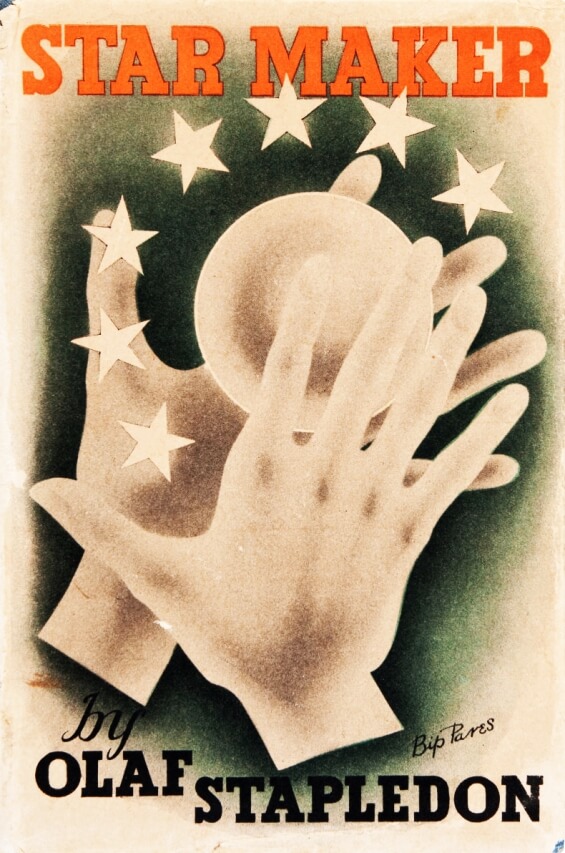
Star Maker by Olaf Stapledon

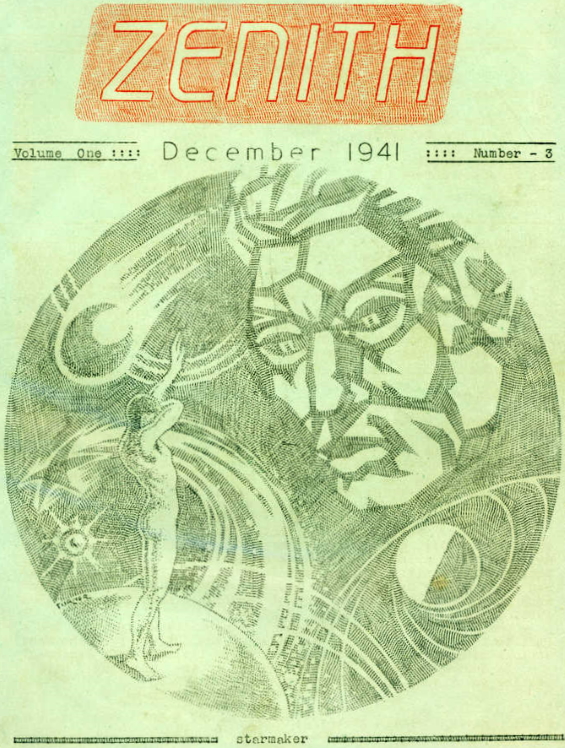
Harry E. Turner's Zenith - Starmaker

Posted by Jesse Willis

The SFFaudio Podcast #320 – READALONG: The Cosmic Puppets by Philip K. Dick

Podcast

The SFFaudio PodcastThe SFFaudio Podcast #320 – Jesse, Paul, and Marissa talk about The Cosmic Puppets by Philip K. Dick

Talked about on today’s show:
1957, 1983, early Philip K. Dick, A Glass Of Darkness, a Biblical reference, written prior to Solar Lottery, revision, refinement, rewrite, Ace Doubles, Sargasso Of Space, is this book a lot smarter than we are?, an ambitious book, Persian mythology, European publications, Virginia, Beamer’s Knob, why is this set in rural Virginia?, a Virginia novel, anywhere USA, PKD lived in D.C. as a kid, returning to your hometown, The Commuter by Philip K. Dick, collapsing the wavefront (?), a different couch, also a baby and a wife, the park and the cannon and “the Stars and Bars”, recreating the park, Ted’s superpower is a good memory, We Can Remember It For You Wholesale, Men In Black, Lilo & Stitch, my mere existence is my superpower, Ted saves the universe, the harpy wife, dispelling the Ahriman’s illusion, when only the town drunk agrees with you…, less doubt than usual, a pat ending, a typical Philip K. Dick character leaving the dull wife, he’s going to see her everywhere, Upon The Dull Earth, The Odyssey, bringing a dead wife back to life, she inhabits the bodies of everyone he meets, Being John Malkovich, everybody is Malkovich, what is the wife doing in this book?, phone calls can get through the barrier, a plot device, she’s the harridan wife, Stephen Brust’s characters martial problems, a dirty and sweaty wife, a passive aggressive way to get a divorce, he’s not present in the conversations, is Mary already manipulating him?, eighteen before …. how did Mary do this?, why mommy and daddy can’t live together, sluggy pus monster, a Lovecraftian shoggoth, this is Philip K. Dick’s The Shadow Over Innsmouth with a positive spin, the Dagon movie, Stuart Gordon, not an SF novel, not a typical fantasy novel, mythological fantasy?, more Neil Gaiman, fantasy horror, like the horror world in Eye In The Sky, Katamari Damacy, Expendable (aka He Who Waits) by Philip K. Dick is a kind of joke story, insects in a war with spiders, our allies the birds, The Outer Limits episode ZZZZZ, a honeytrap!, if Dick had been more of a horror writer, reality distortion, Steve Jobs’ reality distortion field, changing the reality of the world around you with your personality, all children have the superpower of imagination … then loose them as they grow up, action figures and dolls, unless you play role playing games, a consensual participatory hallucination, The Days Of Perky Pat by Philip K. Dick, Chew-Z, in game gold (bought using real world money) to buy things for your sims, League Of Legends, “skins”, virtual goods is a billion dollar business, a kind of a trap, we are manipulated by other people’s perceptions of us, a smart book, the wanderers, The Faith Of Our Fathers, competing realities, Flow My Tears The Policeman Said, meeting a girl who is an avatar of a god, this is a completely different kind of faith, false gods, Galactic Pot-Healer, Ohrmazd, ghosts, aren’t there any wanderers where you’re from?, rotting in the walls, the drunk, Zoroastrianism, The Builder by Philip K. Dick, the ultimate review of The Cosmic Puppets by Philip K. Dick, how would this book be appreciated in Iran?, a goddess with black hair, renewal, “Mary and Peter are in fact engaged in a low-intensity supernatural proxy war”, the forces of deception and corruption vs. clarity and sunlight, Ahrimati as a soil fertility goddess, the overturned logging truck scene, stopping time and boasting about it, Mary’s first interactions with Ted Barton, a real Mary and a golem of Ahrimati, the novel is a bit undercooked, golems for the gods, golems making golems, making men out of clay and women out of men made out of clay, Prometheus, religions as by the Brothers Grimm, Prometheus and Pandora’s box, Shiva and death metal, an essay by Barb Morning Child on The Cosmic Puppets, in the age of Wikipedia, a worthwhile book, how early is it?, too dualistic and too pat, by year of composition, The Cosmic Puppets is Dick’s 5th composed novel, height of his powers, The Man In The High Castle, Galactic Pot-Healer is Dick’s best novel (according to Jesse), a British-American cold war, L. Ron Hubbard’s Fear, when the IRS went up against the Church of Scientology, all of L. Ron Hubbard’s fiction are holy texts

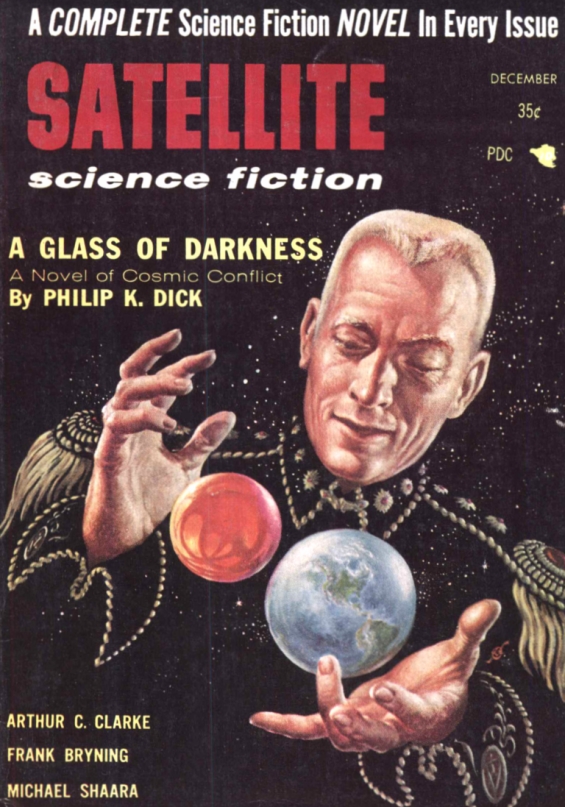
Satellite Science Fiction, December 1956 - A Glass Of Darkness by Philip K. Dick
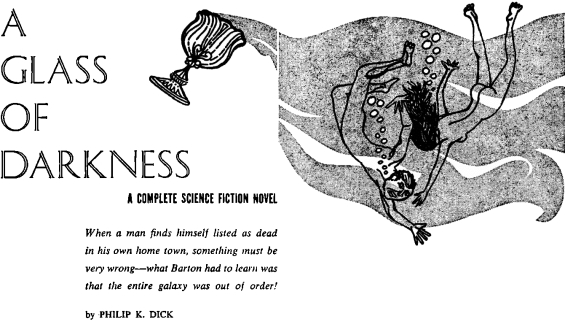
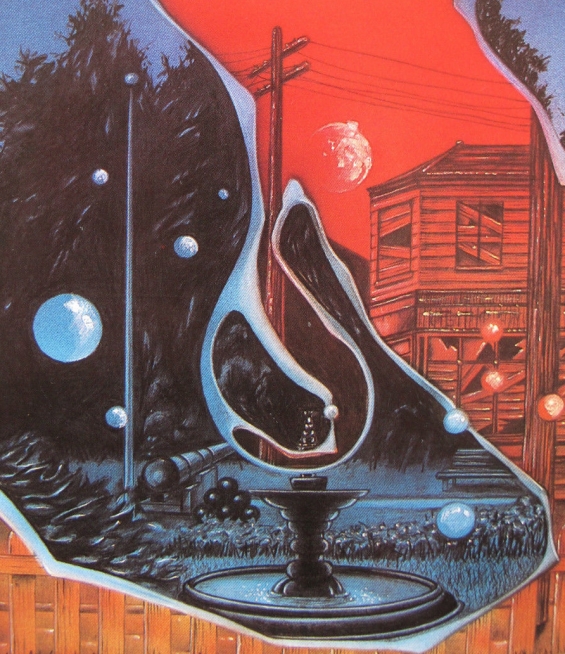
A Glass Of Darkness by Philip K. Dick - Satellite SF, December 1956 interior art
A Glass Of Darkness by Philip K. Dick - Satellite SF, December 1956 illustration by Arnold Arlow
Urania 280 - La Citta Sostituita A GLASS OF DARKNESS by Philip K. Dick
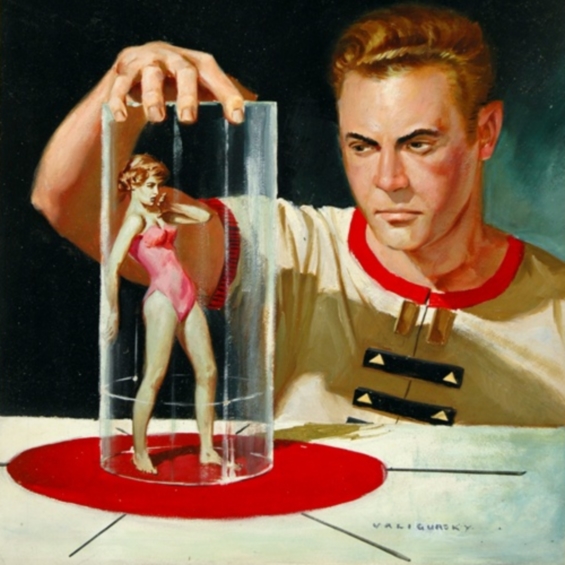
The Cosmic Puppets by Philip K. Dick - illustration by Ed Valigursky
The Cosmic Puppets by Philip K. Dick ENGLISH
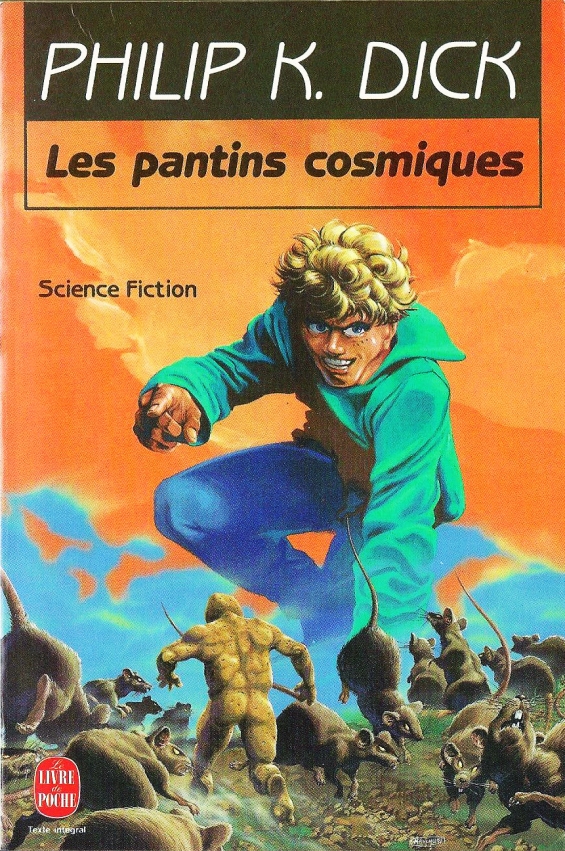
The Cosmic Puppets by Philip K. Dick FRENCH
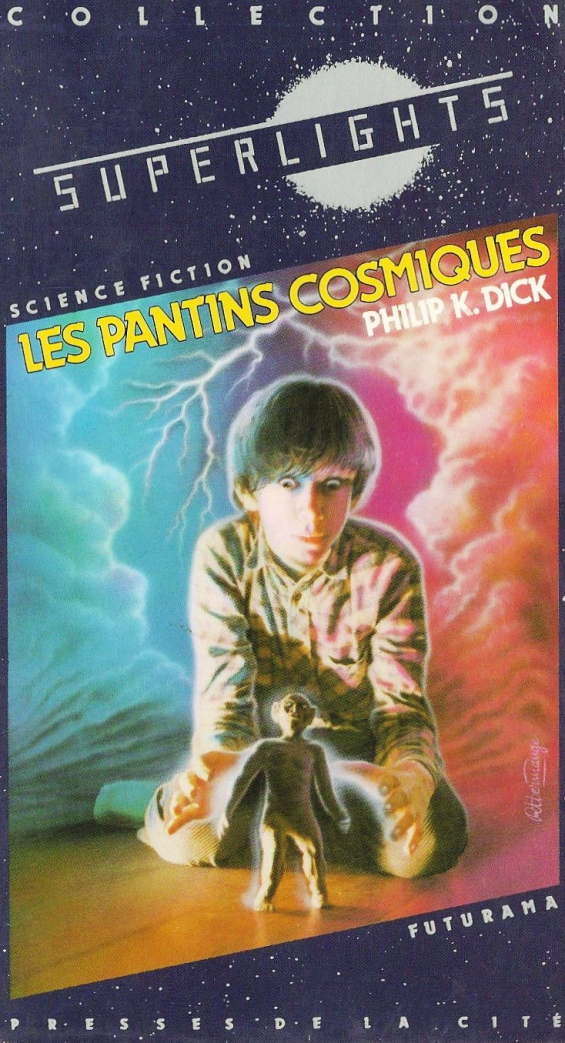
Les Pantins Cosmiques by Philip K. Dick
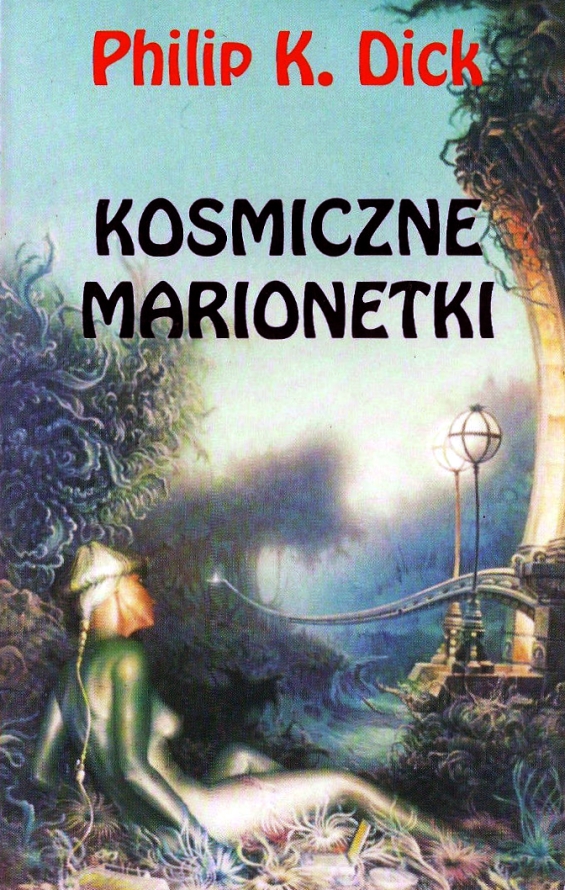
The Cosmic Puppets by Philip K. Dick POLISH

Posted by Jesse Willis

The SFFaudio Podcast #311 – AUDIOBOOK/READALONG: Ethan Brand by Nathaniel Hawthorne

Podcast

TheSFFaudioPodcast600

The SFFaudio Podcast #311 – Ethan Brand by Nathaniel Hawthorne; read by Fred Heimbaugh. This is an unabridged recording of the story (44 minutes) followed by a discussion of it. Participants in the discussion include Jesse, Julie, Seth, and Rose.

Talked about on today’s show:
The story as a “culminate chapter” to an unfinished novel; H.P. Lovecraft’s description of the story in his essay on supernatural fiction (see our Podcast of the Seven Gables); Ethan Brand as Byronic (anti)hero; Nyarlathotep by H.P. Lovecraft; the uncanny nature of laughter; Hawthorne’s Biblical allegory; “Puritans and sin, they go hand in hand”; Ethan Brand and Adam’s search for forbidden knowledge; the almost-total absence of women in the story; the vices of the townspeople in the story; Hawthorne’s regret of the Salem witch trials; parallels to House of the Seven Gables; Hawthorne’s sense of humor; similarities to Goethe’s Faust; the Jew and his picture box; how the Holocaust ruined our reading of literature; what exactly does Ethan Brand see in the picture box?; the biblical story of Job; the intersection of sin and evil; the sin of suicide–can it be absolved?; the ambiguity of the final laughter; morality vs. intellect; the multifaceted symbolism of the story’s final image; association with Cain and Abel; double meaning of the name Brand; the internal nature of Brand’s sin; the image of girls running off to join the circus is apparently timeless; The Heart of Ethan Brand 1944 radio drama by Weird Circle; is redemption possible?; relics, iconoclasm, and capitalism; fruitlessness of pursuing knowledge; the story’s roots in Hawthorne’s experience; staring into fire; the audio drama’s departure from evil; “Jesse does not eat babies–or even veal.”; using people as a means to an end; degrees of evil; the sin of pride; Paradise LostRappaccini’s Daughter; the story’s measured tone; Sinners in the Hands of an Angry GodDombey and Son; the dog chasing its tail; unconditional love; the alternate pronunciation of “kiln”; parallels in Oscar Wilde’s The Picture of Dorian Gray; contradictions in story’s final image; white as image of purity in Oscar Wilde’s The Happy Prince and other fairy tales; phantom limbs; more on The Happy PrinceThe Selfish GiantThe Centerville Ghost by Oscar Wilde; the power of audiobooks; “hair-raising image of corruption”; Ethan Brand as a novel.

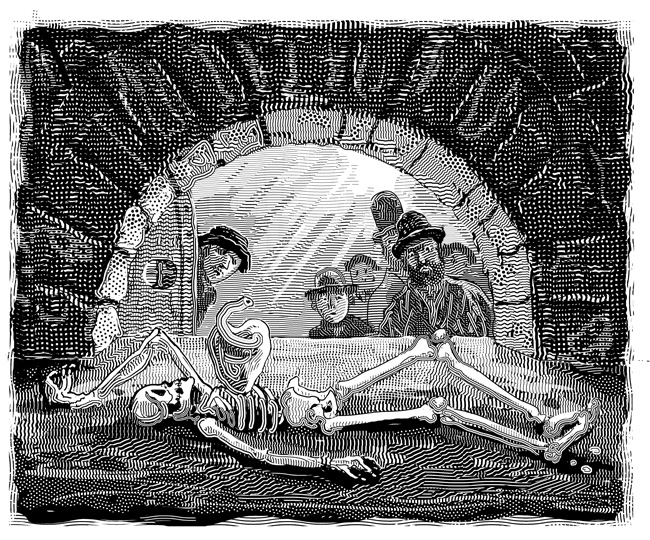
Ethan Brand - illustration by Elliott Banfield

Posted by Jesse Willis

The SFFaudio Podcast #310 – READALONG: Eye In The Sky by Philip K. Dick

Podcast

The SFFaudio PodcastThe SFFaudio Podcast #310 – Jesse, Paul, and Marissa talk about Eye In The Sky by Philip K. Dick

Talked about on today’s show:
1957, more Dick than non-Dick, Flow My Tears, The Policeman Said, Valis, Dick off the rails, The Exegesis of Philip K. Dick, a Bevatron is a thing, if you die in an unreal world does it have gravitas?, the gravitas comes with escape, puzzle solving vs. mortal peril, simulated lives, anime, Ergo Proxy, the Star Trek: The Next Generation episode “The Inner Light, the days of episodic TV, The Star by Arthur C. Clarke, eight worlds?, religious, Victorian world, horror world, communist world, mental beliefs, Mysterium by Robert Charles Wilson, gnostic Christianity, Bábism, Bahá’í religion, Harry Turtledove, Yazidis, the connection to languages, Hamilton’s religiosity, Ohm’s Law, a car manual as a prayer book, the whole place gets damned, angels, a cartoon of the Victorians, a horse wearing trousers, a cow did something very natural, abolishing, censorship world, the narrator, deleting things from the universe, metals!, they’ll kill the universe, the Star Trek: The Next GenerationRemember Me“, Delirious (1991), a house that eats people, the carpet licked them back, a consensual hallucination, role-playing game style, Chapter 14, the walls sweated saliva, The Twilight Zone: The Movie, It’s a Good Life by Jerome Bixby, banished to cartoon world, excrete some buttons on the back porch, a man-hater, middle-aged man dandruff, seeing miracles everywhere, seeing everyone as a predator, the cat!, Ninny Numbcat, a kind of peristaltic wave, “praying that it could be killed”, the most horrific thing ever, the Damon Knight story Four In One, gestalt, projecting on to the world, poor people, very odd, the Freudian psychology of it, a perverse pleasure, one of Dick’s themes, sexless creatures, playing records as a euphemism, wives are pretty rare, Dick’s perfect woman, being a communist, so McCarthyistic, the Red Scare, the super-patriots are the most easily manipulated, Total Recall, an errant earwig, oh heavens!, just a co-incidence, are they still trapped in the Bevatron?, how they make anime show titles, random, why do they keep looking at their food?, confusing and mysterious, René Descartes, cogito ergo sum, ergo = therefore, Django Wexler, boring and illogical, stilted conventions?, visual grammar, Yes Minister, the economy in The Fellowship Of The Ring, no anime Jesse has seen has an economy, gold pressed latinum, making the viewer at ease with thigh length boots, trapped in a universe that makes no sense, Skiffy and Fanty, Ghost In The Shell, Akira, Akira Kurosawa, Summer Wars, The Wings of Honnêamise, a weird logic, the Electronics Development Agency, phone lines to God, the visit to God, a Fall, the mundanity of Earth, the Book of Acts, inflating and deflating worlds, The Father-Thing, Invaders From Mars, The Hanging Stranger, feeling sexy, enjoying the prudish world, storks!, Santa Claus style lies, sublimating the urge for sex, the bowerbird, animal art, Shakespearean sonnets are about seduction, a playful book, a day off of work to take a cat to the pet show, a spinning-up of a world, rejecting the premises, Stranger Than Fiction (2006), Emma Thompson.

Ace - Eye In The Sky by Philip K. Dick
URANIA - Eye In The Sky by Philip K. Dick
Philip K. Dick's Eye In The Sky - Ace Books
Urania - Eye In The Sky by Philip K. Dick (ITALIAN)

Posted by Jesse Willis

Review of Mage’s Blood by David Hair

SFFaudio Review

mages blood coverMage’s Blood (The Moontide Quartet #1)
By David Hair; Performed by Nick Podehl
Publisher: Brilliance Audio
[UNABRIDGED] – 25 hours
Themes: / fantasy / crusades / religion /
Publisher summary:

Most of the time the Moontide Bridge lies deep below the sea, but every 12 years the tides sink and the bridge is revealed, its gates open for trade. The Magi are hell-bent on ruling this new world, and for the last two Moontides they have led armies across the bridge on “crusades of conquest”. Now, the third Moontide is almost here, and this time the people of the East are ready for a fight… but it is three seemingly ordinary people that will decide the fate of the world.

Overall, 2.5 stars. I prefer character driven stories, and this is definitely that. So why didn’t I enjoy it? The answer for me at least is the characters. I found most of them unenjoyable. If I have no one to really root for, the story has to be that much better or I’ll be bored. Don’t get me wrong, there are things to like about Alaron and Elena, but there is a lot not to like. I don’t need perfect characters who fall into the chosen one trope, but something about their faults really just rubbed me the wrong way and I often found them frustrating and unlikable.

The best character in the book was Alaron’s friend Ramon, who while he was basically a walking trope, was brought excellently to life by Mr. Podehl’s narration and added some nice comic relief to the story. Most of the other characters are flat, or too trope heavy. We have some mustache twirling bad guys, and the helpless Ramita who seems to merely be there to drive the plot as a goal/pawn for the other characters in the book.

The world building here was alright, but seems to borrow too heavily from actual cultures (in particular the Middle East, and religion of Islam) that it didn’t feel much like being transported to another world apart from the magic. And that was another issue I have. I guess Brandon Sanderson spoiled me for poorly developed magic systems, but it all felt just a bit too hand wavy to me.

Overall this book was just too uneven. There were some parts I really enjoyed, and there are questions I’d like to keep reading to get the answers too, but it’s just not worth it for me. There is too many other things I’d rather be reading.

This is my first audio book read by Nick Podehl. I’ve heard mixed, though mostly positive things about him as a narrator, especially for the Kingkiller series.

I thought he was excellent here, and really helped me get through the unenjoyable parts of this book. I think if I was reading this rather than listening, I might have quit the book without finishing.

I look forward to listening to other books read by him in the future, just not the other books in this series.

Review by Rob Zak.

The SFFaudio Podcast #282 – READALONG: Ancillary Justice by Ann Leckie

Podcast

The SFFaudio PodcastThe SFFaudio Podcast #282 – Jesse, Tamahome, Bryan Alexander, and Julie Davis discuss Ancillary Justice by Ann Leckie.

Talked about on today’s show:
a recent novel, Hugo Award, Nebula Award, a long novel, a genderless society, an absence of vocabulary, a politics-biology-language fusion, a light space opera, a murder mystery, a multi-body perspective, foreshadowing a sequel, confusing historical allusions, empire, imagination, personal story, dialogic, magnetic fiction in space, a puppet-like main character, mysterious actions, an unsatisfactory explanation, slave women, a fight for emancipation, Do Androids Dream of Electric Sheep? by Philip K. Dick, auxiliaries, the story of Spartacus, Roman family bonding, Jane Austen, dystopia, slaves into servants, expected violence, Roman colonization, a distinct approach to human ethics, the Old Testament, old-fashioned faith, short stories, key words, views of reality, spiritual progress, omnipotent deities, reconstructed ancient religions, J.R.R Tolkien, Lieutenant Ahn, Hindu deities, tea, Jo Walton, coffee, Japanese morality, Shintoism, Horrible Histories, Scholastic books, Frank Herbert, religious engineering, Hellstrom’s Hive by Frank Herbert, government religion, Dune by Frank Herbert.

Ancillary Justice by Anne Leckie WORD CLOUD

Posted by Jesse Willis