Here are a few of the new Audible Frontiers titles that are rapidly populating the Science Fiction and Fantasy section of Audible.com. First up, Robert J. Sawyer’s much acclaimed ‘Anthropological / Alternate Universe’ trilogy…
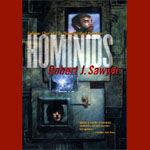 Hominids: The Neanderthal Parallax, Book 1
By Robert J. Sawyer; Read by Jonathan Davis
Audible Download – 11 Hours and 25 Minutes [UNABRIDGED]
Publisher: Audible Frontiers
Published: April 2008
Neanderthals have developed a radically different civilization on a parallel Earth. A Neanderthal physicist, Ponter Boddit, accidentally passes from his universe into a Canadian underground research facility. Fortunately, a team of human scientists, including expert paleo-anthropologist Mary Vaughan, promptly identifies and warmly receives Ponter. Solving the language problem and much else is a mini-computer, called a Companion, implanted in the brain of every Neanderthal. A computerized guardian spirit, however, doesn’t eliminate cross-cultural confusion; permanent male-female sexuality, rape, and overpopulation are all alien to Ponter. Nor can it help his housemate and fellow scientist back in his world, Adikor Huld, when the authorities charge Adikor with his murder. BONUS AUDIO: Author Robert J. Sawyer explains why Ponter Boddit is his favorite among all the characters he’s created.
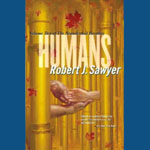 Humans: The Neanderthal Parallax, Book 2
By Robert J. Sawyer; Read by Jonathan Davis
Audible Download – 11 Hours 38 Minutes [UNABRIDGED]
Publisher: Audible Frontiers
Published: April 2008
Neanderthal physicist Ponder Boddit brings Canadian geneticist Mary Vaughan back to his world to explore the near-utopian civilization of the Neanderthals. Boddit serves as a Candide figure, the naive visitor whose ignorance about our society makes him a perfect tool to analyze human tendencies toward violence, over-population, and environmental degradation. The Neanderthals have developed a highly artistic, ethical, and scientific culture without ever inventing farming – they’re still hunters and gatherers – and this allows the author to make some interesting and generally unrecognized points about the downside of the discovery of agriculture. BONUS AUDIO: Author Robert J. Sawyer explains why one particular chapter of Humans is his very favorite.
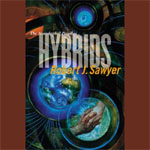 Hybrids: The Neanderthal Parallax, Book 3
By Robert J. Sawyer; Read by Jonathan Davis
Audible Download – 11 Hours and 53 Minutes [UNABRIDGED]
Publisher: Audible Frontiers
Published: April 2008
Scientists (and lovers) Mary Vaughan, who is human, and Ponter Boddit, who is Neanderthal, embark on the harrowing adventure of conceiving a child together. To overcome the genetic barbed wire of mismatched chromosomes, they must use banned technology obtainable only from a Neanderthal scientist living in the northern wilderness.
BONUS AUDIO: Author Robert J. Sawyer reveals the “secret history” of The Neanderthal Parallax trilogy.
I read this novel in paperbook format, it’s a very interesting exploration of both intelligent design and creationism. It’s like a visit to a natural history museum with Robert J. Sawyer…
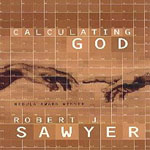 Calculating God
By Robert J. Sawyer; Read by Jonathan Davis
Audible Download – 12 Hours and 4 Minutes [UNABRIDGED]
Publisher: Audible Frontiers
Published: 2008
An alien walks into a museum and asks if he can see a paleontologist. But the arachnid ET hasn’t come aboard a rowboat with the Pope and Stephen Hawking (although His Holiness does request an audience later). Landing at the Royal Ontario Museum in Toronto, the spacefarer, Hollus, asks to compare notes on mass extinctions with resident dino-scientist Thomas Jericho. A shocked Jericho finds that not only does life exist on other planets, but that every civilization in the galaxy has experienced extinction events at precisely the same time. Armed with that disconcerting information (and a little help from a grand unifying theory), the alien informs Jericho, almost dismissively, that the primary goal of modern science is to discover why God has behaved as he has and to determine his methods. BONUS AUDIO: Author Robert J. Sawyer explains how the creationism vs. evolution debate informed the writing of Calculating God.
A Hugo Award nominee that I haven’t heard much about…
 Forty, Counting Down & Twenty-One, Counting Up
By Harry Turtledove; Read by Victor Bevine
Audible Download – 4 Hours and 14 Minutes [UNABRIDGED]
Publisher: Audible Frontiers
Published: April 2008
Harry Turtledove, the master of alternate history, turns to time travel in these two related novellas that range from fantastic to oddly familiar to eerily prescient.
Computer genius Justin Kloster travels to the past to stop himself from making a terrible mistake. But all actions have their consequences. Then, in Twenty-One, Counting Up, Kloster’s college life and romantic dreams are rudely interrupted when the 40-year-old Justin arrives from the future to save him from himself.
I distinctly remember reading this story in a paper SF magazine when it was first published. It’s a memorable Mediterranean adventure and a Hugo Award Winner!
 Down in the Bottomlands
By Harry Turtledove; Read by Victor Bevine
Audible Download – 4 Hours 13 Minutes [UNABRIDGED]
Publisher: Audible Frontiers
Published: April 2008
In the Hereditary Tyranny of Tartesh, what was once a vast sea basin is now a dried-out, unforgiving desert. When the kingdom’s enemies try to shake down the Barrier Mountains and let the ocean in, Trench Park tour guide Radnal vez Krobir must stop them or be destroyed along with everything he holds dear.
Winner of the Nebula and Hugo Awards for best novella, Mike Resnick, recommendation enough…
 Seven Views of Olduvai Gorge
By Mike Resnick; Read by Jonathan Davis
Audible Download – 2 Hours 20 Minutes [UNABRIDGED]
Publisher: Audible Frontiers
Published: April 2008
Thousands of years after mankind has become extinct, a party of alien archaeologists try to learn the mysteries of mankind as they excavate in a gorge on Earth. This Hugo and Nebula Award winning novella by Mike Resnick is a gripping exploration of human origins and motivations.
This should be very cool, and Audible Frontiers is adding more from this series…
 Starship: Mutiny, Book 1
By Mike Resnick; Read by Jonathan Davis
Audible Download – 7 Hours and 35 Minutes [UNABRIDGED]
Publisher: Audible Frontiers
Published: April 2008
The date is 1966 of the Galactic Era, almost three thousand years from now, and the Republic, created by the human race – but not yet dominated by it – finds itself in an all-out war. They stand against the Teroni Federation, an alliance of races that resent Man’s growing military and economic power. The main battles are taking place in the Spiral Arm and toward the Core. But far out on the Rim, the Theodore Roosevelt is one of three ships charged with protecting the Phoenix Cluster – a group of 73 inhabited worlds. Old, battered, some of its weapon systems outmoded, the Teddy R. is a ship that would have been decommissioned years ago if weren’t for the war. Its crew is composed of retreads, discipline cases, and a few raw recruits. But a new officer has been transferred to the Teddy R. His name is Wilson Cole, and he comes with a reputation for heroics and disobedience. Will the galaxy ever be the same?
Recipe for happiness: Give it a Hugo Award for Best Novel in 1958, wait 50 years, make audiobook…
 The Big Time
By Fritz Leiber; Read by Suzanne Toren
Audible Download – 4 Hours and 42 Minutes [UNABRIDGED]
Publisher: Audible Frontiers
Published: April 2008
Have you ever worried about your memory, because it doesn’t seem to recall exactly the same past from one day to the next? Have you ever thought that the whole universe might be a crazy, mixed-up dream? If you have, then you’ve had hints of the Change War.It’s been going on for a billion years, and it will last another billion or so. Up and down the timeline, the two sides, “Spiders” and “Snakes”, battle endlessly to change the future and the past. Our lives and our memories are their battleground. And in the midst of the war is the Place, outside space and time, where Greta Forzane and the other Entertainers provide solace and R&R for tired time warriors.
A single voiced narration (there is a FREE VERSION with multiple serial narrators)….
 The Sagan Diary
By John Scalzi; Read by Stephanie Wolfe
Audible Download – 1 Hours and 34 Minutes [UNABRIDGED]
Publisher: Audible Frontiers
Published: April 2008
Jane Sagan: Soldier. Killer. Lover. Dreamer. In John Scalzi’s best-selling Old Man’s War series of science-fiction novels, we see this warrior woman as the other characters see her: silent and strong, from the outside. But now The Sagan Diary shows us Sagan from another point of view – her own. As she prepares to leave military life and join her new husband and adopted daughter on a colony world, Sagan reflects on her life, in her own words – recalling friends, battles, and experiences; illustrating all the violence and wonder of her times; trying to fit “an entire life into this compressed space”. For fans of Scalzi’s works, it’s an intimate and surprising glimpse into one of his most popular characters. As read by Stephanie Wolfe, it’s unlike any other science-fiction story you’ll hear this year.
A new Tanith Lee novella, published in print last fall, now audiboook’d…
 Indigara
By Tanith Lee; Read by Amy Palant
Audible Download – 3 hours and 42 Minutes [UNABRIDGED]
Publisher: Penguin Group USA and Audible.com
Published: April 2008
Jet and her robot dog, Otis, have been taken to their planet’s film capital, Ollywood, and are soon catapulted into the unplumbed underworld that lurks below the studios and lots. Here lies the beautiful and sinister otherwhere of Indigara, which has spontaneously generated from the sets, costumes, models, and actual celluloid of rejected pilot fantasy and SF movies that never got made into series. Even while girl and dog try to survive the dangers and terrors below, their Indigaran mirror images have replaced them, and are running amok in the real world above.
Hey rook! Is a Gojirra auriobrook!
 Tim, Defender of the Earth
By Sam Enthoven; Read by Bryan Kennedy
Audible Download – 8 Hours and 42 Minutes [UNABRIDGED]
Publisher: Penguin Group USA and Audible
Published: April 2008
TIM, aka Tyrannosaurus: Improved Model, is the product of a top-secret government military experiment, and he couldn’t be more loveable. Sure, he’s an enormous monster to most, but at heart he’s just a big, awkward, 13-year-old who realizes he could be all that stands between the earth and total destruction. (Take that, Godzilla.) Now TIM must form an unlikely alliance with 15-year-olds Chris and Anna in order to save humanity from the greatest threat it has ever known: Anna’s father, the brilliant and demented Professor Mallahide, and his growing tide of vicious, all-consuming nanobots. Will TIM prevail and save the British Isles and the world from evil? We’ll all have to hold hands, read, and believe – in TIM, Defender of the Earth!
A sequel to Shadowmancer, now all we need is the original (oh HERE it is)…
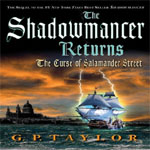 The Shadowmancer Returns
By G.P. Taylor; Read by Bryan Kennedy
Audible Download – 9 Hours and 47 Minutes [UNABRIDGED]
Publisher: Penguin Group USA and Audible.com
Published: April 2008
Kate and Thomas have barely escaped the evil sorcerer Demurral, and are sailing to London to make a fresh start. But someone knows they are coming, and is lying in wait to lure them into the darkest heart of the city. Meanwhile, Raphah, who has had a narrow escape of his own, sets out on a terrifying journey to find his friends, all the time haunted by a shadowy beast. Eventually, the friends’ paths meet on a cursed street, hidden from the world – a place where fates are decided and old enemies seek revenge. They thought it was over…but can evil ever be destroyed?
Spies, humor, and magic and a cool title….
 The Man With The Golden Torc
By Simon R. Green; Read by Stuart Blinder
Audible Download – 17 Hours and 15 Minutes [UNABRIDGED]
Publisher: Audible Frontiers
Published: April 2008
Meet Shaman Bond, aka Eddie Drood, scion of the ancient Drood family. He is devoted to protecting humanity from the forces of darkness. Protected by the secret weapon received at birth by all members of the Drood family – a magical gold torc (i.e., a neck ring) that turns into a suit of nearly impervious golden armor – Eddie faces arcane dangers with healthy doses of wry self-confidence and sarcasm. Then the family matriarch sends him on a mission that turns out to be a deadly setup. Declared a rogue, Eddie teams up with short-tempered witch Molly Metcalf to find out why he’s been betrayed.
Posted by Jesse Willis



 Calculating God