
Review of Beyond This Horizon by Robert A. Heinlein

SFFaudio Review

Beyond this Horizon by Robert A. HeinleinBeyond This Horizon
By Robert A. Heinlein; read by Peter Ganim
Publisher: Brilliance Audio
8 hours [UNABRIDGED]

Themes: / utopia / revolution / genetic engineering /

Publisher Summary:

Utopia has been achieved. Disease, hunger, poverty and war are found only in the history tapes, and applied genetics has brought a lifespan of over a century. But Hamilton Felix is bored. And he is the culmination of a star line; each of his last thirty ancestors chosen for superior genes. He is, as far as genetics can produce one, the ultimate man, yet sees no meaning in life. However, his life is about to become less boring. A secret cabal of revolutionaries plan to revolt and seize control. Knowing of Hamilton’s disenchantment with the modern world, they want him to join their Glorious Revolution. Big mistake! The revolutionaries are about to find out that recruiting a superman was definitely not a good idea.

Beyond This Horizon is classic science fiction with social commentary thrown in as you may expect from Heinlein.

Mankind has created a Utopian society where poverty and hunger are studied in school but don’t actually happen anymore. Mankind has also worked toward eliminating weaknesses in the human chromosome via gene selection and intentional breeding. There are still some normal people (referred to as “control naturals”) that could potentially provide new genetic mutations for the good of mankind.

Hamilton Felix genetically represents the best of what humanity has to offer. He gets wrapped up in a group plotting to overthrow the government that thinks only the best of humanity should thrive in society while the control naturals are destroyed or used for experiments. There is little risk or adventure in this society, so a bored Hamilton decided to act as a mole within this organization. It’s not really surprising that this novel came out in the 1950’s when eugenics and superiority of different races was a current topic.

While their society is Utopian and futuristic, they also have notions of honor and violence such that people can get into gun duels when slighted. I found Heinlein’s debate of honor and privilege in this to be interesting in much the same way as his notions of earning rights by military service in Starship Troopers.

I liked the main plot as described but thought it could have happily ended about halfway through. The main plot of the story wraps up and the second half of the book felt like a really long epilogue to me. Heinlein seems to spread himself a bit thin on so many different issues like government influence of the market, government spending, the meaning of life, telepathy, duels for honor, and the afterlife. There were a few long monologues/dialogues going into painful detail of chromosome selection where I had trouble paying attention and following the book.

On the audio book side of things, Peter Ganim does a good job. I thought he had a good conversational tone, did some decent voices (they didn’t differ much though), and was easy to understand. If you’re trying to decide whether reading or listening is preferable, I don’t think there is much benefit either way.

Helpful tip if listening to this book: Hamilton Felix (superman, star line, game making guy) is referred to as “Hamilton” in the first half of the book but people start calling him “Felix” later for some reason. This wouldn’t be confusing except that his friend Monroe-Alpha Clifford (finance, mathematician guy) also goes by “Monroe-Alpha” and “Clifford” at different times. Since Ganim’s voices aren’t very distinct, there were some moments where it took me a little bit to realize which character was talking.

Posted by Tom Schreck.

Review of Methuselah’s Children by Robert A. Heinlein

SFFaudio Review

Methuselah's ChildrenMethuselah’s Children
By Robert Heinlein; Read by MacLeod Andrews
6 CDs – 7 Hours [UNABRIDGED]
Publisher: Brilliance Audio
Published: July 2012
ISBN: 9781455878987
Themes: / space / genetic engineering / genetic modification / aging / death / interstellar travel / aliens /

Publisher Summary:

After the fall of the American Ayatollahs as foretold in Stranger in a Strange Land and chronicled in Revolt in 2100, the United States of America at last fulfills the promise inherent in its first Revolution: for the first time in human history there is a nation with Liberty and Justice for All.

No one may seize or harm the person or property of another, or invade his privacy, or force him to do his bidding. Americans are fiercely proud of their re-won liberties and the blood it cost them; nothing could make them forswear those truths they hold self-evident. Nothing except the promise of immortality….

This 1941 novel by Robert Heinlein is a short but epic space adventure about the Howard Families, a population of people who can live very long lives thanks to a history of selective breeding. Over the centuries, they took on different identities to hide their long-life nature from “short-lifers,” but eventually some of them decided to share their scientific achievement with the public.

However, instead of celebrating the Howard Families’ scientific achievement, the short-lifers suspect them of concealing the true secret to long life. This is where the story starts: when the government and the public begin to persecute the Howard Families, Lazarus Long (the kilt-wearing leader of the group who is more than 200 years old and who always has a knife strapped to his thigh) hijacks a city-sized starship so the families can flee Earth and go in search of a new home.

Despite its short size, this book covers a long length of time, is packed with ideas, and manages to explore deep themes such as aging, death, human genetic modification, and individualism, among others. There’s bound to be something in here for everyone, although personally I struggled with the first half because of the lengthy democratic meetings and the seemingly endless strategizing about what to do, how to do it, and when to do it. I also thought the discussions about the technicalities of interstellar travel or alien biology were a little tedious, but I’m sure hard-SF fans will love every moment.

I really got into the story later, when the families started arriving on other planets and things got weird. The alien cultures, worlds and philosophies were brilliant and often eerie. How can you not love aliens who say things like, “My people will like to see you and smell your skin.”

The human characters, on the other hand, were less lovable for me. They lacked depth and tended to speak literally and directly, without subtext. The narration on the audiobook didn’t help warm the dialog up either, because in the reading the characters sometimes sounded like they were barking lines at each other, and at other times odd words in the dialog were emphasized that I don’t think should have been.

The narrator McLeod Andrews did give a very clear reading though, and once I got used to his style the odd emphases were less noticeable. He did an awesome job of embodying the voice of grumpy but optimistic Lazarus Long, who was the most developed and interesting character.

Ultimately, even though not everything might be to your taste, there are just so many great ideas and themes squished into this book that you’re bound to find a ton to enjoy, despite its short length.

Review by Marissa VU

The SFFaudio Podcast #203 – READALONG: Footfall by Larry Niven and Jerry Pournelle

Podcast

The SFFaudio PodcastThe SFFaudio Podcast #203 – Footfall by Larry Niven and Jerry Pournelle is discussed by Scott, Jesse, Tamahome, and Paul Weimer

Talked about on today’s show:
Worlds Without End: Award Winners and Nominees in 1986, Tom Clancy said “nobody does it better”, how many alien invasion books are there?, Niven didn’t want to do an alien invasion in the Acknowledgments, came out of research for Lucifer’s Hammer, a mainstream The Mote In God’s Eye, too many characters (124!)?, character list in my Goodreads review, “put the screws to the president”, Sfsignal Mind Meld – science fiction writers on earth’s first contact team, Of Men And Monsters (The Men In The Walls) by William Tenn, would Stefan Rudnicki have lisping aliens?, the surrender position, alien science fiction writers, Russia nuking Kansas, is it an allegory?, Star Trek, The Burning City and Burning Tower were fantasy allegories, ‘what if’ stories, Oath Of Fealty has giant buildings, War Of The Worlds, Popular Alien Invasion Books, Heinlein’s The Puppet Masters, “high concept cool gee-whiz wow”, Lucifer’s Hammer could be more focused, idea books vs entertainment, characters and Stephen King’s The Stand,  Tuckerization of a real person into a story, Wrath Of God by Robert Gleason (from the acknowledgments?), how much would these inventions cost?, someone get Paul Krugman, Chapter 20 (Schemes) has all the ideas, Project Orion (nuclear propulsion), Kinetic Bombardment — Project Thor, Laser Propulsion, Niven on Prisoners Of Gravity, environmentalists and Fallen Angels, Pournelle for pope

Footfall by Larry Niven and Jerry Pournelle

Posted by Tamahome

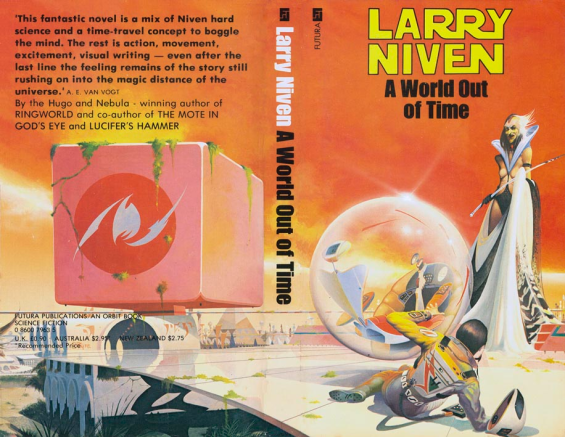
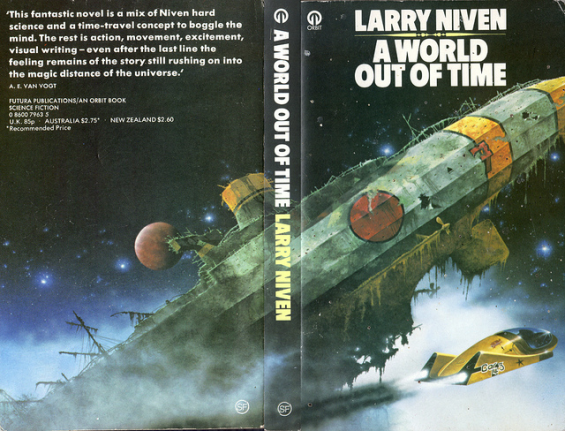
The SFFaudio Podcast #196 – READALONG: A World Out Of Time by Larry Niven

Podcast

The SFFaudio PodcastThe SFFaudio Podcast #196 – Scott, Jesse, and Tamahome discuss the Blackstone Audio audiobook of A World Out Of Time by Larry Niven.

Talked about on today’s show:
Tamahome is a third, Ender’s Game, 1976, Rammer by Larry Niven (1971), a fix-up novel, Infinivox, Pat Bottino, “his most perfect short story”, the novel ruins the short story (sort of), the anticipation is more interesting than the resolution, chapters 2 and 3 nullify the power of chapter 1, Corbell, Peerssa, the Clouds of Magellan, “a fuck you ending”, interesting social systems, a sciencey vocab, cryonics, Bussard Ram Jets, ergosphere, Protector, Beowulf Shaeffer, The Soft Weapon, the Technovelgy website, biological package probes, the bubble car, the empty man, gravity assisted subway, poster TV, RNA shots “don’t read Cliff Notes, eat Cliff”, planaria (flatworms) experiments, humans are wired for language, birds are wired for flight, young forever, Star Trek, null field, consciousness transferal, continuation of consciousness, Robert J. Sawyer, Rollback, Identity Theft (or Shed Skin), your robot body, we care about will, Four Worlds Of The Diamond by Jack Chalker, “there’s a mystery that needs to be solved, cloning, Lilith: A Snake In The Grass, Audible.com, The River Of The Dancing Gods, The Identity Matrix, Demons Of The Dancing Gods, G.O.D., Inc., Dancers In The Afterglow, Immortality, Inc. by Robert Sheckley, “who are you when you’re just some ground up hamburger?”, he’s treated like a criminal, why don’t the citizens want to make this trip?, a certain kind of person, Louis Wu, “a special sort of breed”, the two CBC Ideas shows on James Cameron, manned spaceflight, Playgrounds Of The Mind, “my favourite characters are all tourists”, “I demand to be a tourist”, The Integral Trees by Larry Niven, a whole world in zero gravity, “this guy is Mr. Physics”, Arthur C. Clarke, Hothouse by Brian Aldiss, Ringworld, The Ringworld Engineers, Robert A. Heinlein, Dan Carlin’s Common Sense, David Brin, passing a planet, “something on the order of that”, moving planets, Uranus, mathematically logical (but with non-existent materials), the air is full of the oceans, the null-rooms, a null-box, zero-entropy space, better sandwich storage, transporting the garbage out, Doctor McCoy, quantum communication and quantum teleportation, Think Like A Dinosaur by James Patrick Kelly, Seeing Ear Theatre, Dream Park, Oath Of Fealty, The Mote In God’s Eye, Inferno, Lucifer’s Hammer, Luke Burrage, Escape From Hell, Footfall by Larry Niven and Jerry Pournelle, an alien invasion story, Scott has a signed copy!, elephantine aliens with twin trunks, the audiobook of Footfall is available, a book written by people who care about science!, a septic tank full of books, Robert A. Heinlein, Dan Carlin’s Common Sense, David Brin, the DHS vs. the U.S. military, what would Larry Niven do as the head of the EPA?, a Death Star, Obama’s unemployed geekishness, Newt Gingrich, moonbase!, he loves himself because he’s surrounded by idiots, the idea of an idea man is fantastic, Douglas Adams, a thousand or ten thousand year project, focused on the current and the recent past, the deep time issue, time capsules, the Long Now Foundation, cathedral building, pyramid building, “on the cosmic scale”, the space race was motivated by military competition, Space X http://en.wikipedia.org/wiki/SpaceX , a private moonbase?, the ultra rich, science isn’t for profit, human existence isn’t for profit, space probes, hydro-electric dams, where is the Moonbase Kickstarter?, maybe we could have just one guy and his clone up there, Moon, real Science Fiction, Crashlander, Neutron Star, Peter F. Hamilton is an ideas man, Great North Road, five pages describing a weather change, another fix-up novel, Neutron Star, the animated Star Trek, Kzin, Alan Dean Foster, World Of Ptavvs, Algis Budrys, telepathy, Charles Stross, Advanced Dungeons & Dragons, Community, The Big Bang Theory, Dan Harmon’s keynote.

A World Out Of Time by Larry Niven

Posted by Jesse Willis

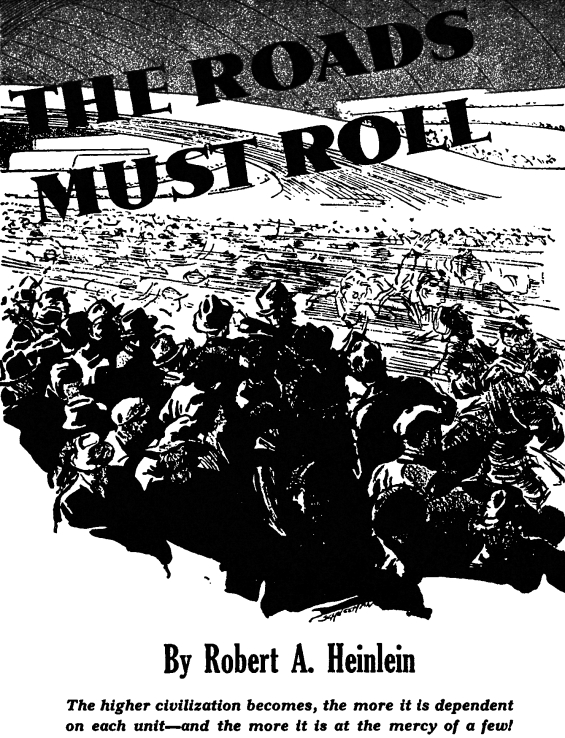
The Roads Must Roll by Robert A. Heinlein

SFFaudio Online Audio

The Roads Must Roll by Robert A. Heinlein - illustrated by Charles Schneeman

Robert A. Heinlein’s short story The Roads Must Roll features a future in which a small union of engineers seize control of the nation’s vital infrastructure. This replacement for the highway and railroad systems is a series of massive conveyor belts allowing for the flow of goods and people around the country.

Here’s the synopsis from ISFDB:

Set in a future where the automobile has been replaced by The Roads, a gigantic set of parallel conveyor belts. The belts run at different speeds allowing a pedestrian to enter the Road at slow speed, and make his way to the center, where speeds are in excess of 100 MPH. Follows the exploits of Gaines, the Transport Commissioner, as he tries to put down a strike by the Rolling Roads Guild.

Dimension XDimension X – The Roads Must Roll
Adapted from the novelette by Robert A. Heinlein; Script by Ernest Kinoy; Performed by a full cast
1 |MP3| – Approx. 30 Minutes [RADIO DRAMA]
Broadcaster: NBC
Broadcast: September 1, 1950
The more complex, the more integrated a civilization is, the more fragile it becomes to – sabotage! First published in Astounding, June 1940.

X-Minus OneX-Minus One – The Roads Must Roll
Adapted from the novelette by Robert A. Heinleinl; Script by Ernest Kinoy; Performed by a full cast
1 |MP3| – Approx. 30 Minutes [RADIO DRAMA]
Broadcaster: NBC
Broadcast: January 4, 1956
The more complex, the more integrated a civilization is, the more fragile it becomes to – sabotage! First published in Astounding, June 1940.

Posted by Jesse Willis

The SFFaudio Podcast #180 – READALONG: The Death Of Grass by John Christopher

Podcast

The SFFaudio PodcastThe SFFaudio Podcast #180 – Jesse, Tamahome, and Jenny Colvin talk about The Death Of Grass by John Christopher.

Talked about on today’s show:
post-apocalyptic, John Christopher’s real name was Samuel Youd, also known as No Blade of Grass, an anti-pot novel?, “it’s not my idea of a good time”, Stephen King’s The Stand, it’s almost like a play, there is a BBC audio drama adaptation, why not fish?, the Inuit, apocalyptic expert Jenny weighs in, John is like a feudal lord, moral lines are crossed, John’s transformation, the terrible 1970 movie version, “why hello I think I will come with you”, the cons of agriculture, Jenny’s quinoa granola, just drop a few bombs, can’t they make Soylent Green?, potatoes can let you down, real African grass virus, Paolo Bacigalupi’s Windup Girl, famines today, George R. Stewart’s Earth Abides |OUR READALONG|, David Pringle’s Science Fiction: The Best 100 Novels 1949-1984 and The Ultimate Encyclopedia Of Science Fiction, John Joseph Adams’s Wastelands, Pat Frank’s Alas, Babylon, Science Fiction: The 101 Best Novels 1985-2010, Octavia Butler’s Parable of the Sower, LeVar Burton loves it, women in the novel, Stockholm syndrome, The Walking Dead, “Dun dun dun!”, “maybe Luke can re-edit it”, Starship Troopers, Doomsday Preppers

Audible - The Death Of Grass by John Christopher

Sphere SF - The Death Of Grass by John Christopher

No Blade Of Grass by John Christopher

No Blade Of Grass The Saturday Evening Post April 27 to June 8, 1957

No Blade Of Grass The Saturday Evening Post April 27 to June 8, 1957

No Blade Of Grass The Saturday Evening Post April 27 to June 8, 1957

No Blade Of Grass The Saturday Evening Post April 27 to June 8, 1957

No Blade Of Grass The Saturday Evening Post April 27 to June 8, 1957

No Blade Of Grass The Saturday Evening Post April 27 to June 8, 1957

No Blade Of Grass The Saturday Evening Post April 27 to June 8, 1957

No Blade Of Grass The Saturday Evening Post April 27 to June 8, 1957

No Blade Of Grass The Saturday Evening Post April 27 to June 8, 1957

Posted by Tamahome