News, Reviews, and Commentary on all forms of science fiction, fantasy, and horror audio. Audiobooks, audio drama, podcasts; we discuss all of it here. Mystery, crime, and noir audio are also fair game.
Robert Sheckley’s Warrior Race was briefly mentioned on last week’s SFFaudio Podcast (#104). It’s available in audiobook form as on part of LibriVox’s Short Science Fiction Collection Volume 41. As is usual with so many of the Sheckley tales recorded for LibriVox it’s read by Gregg Margarite. YAY! And since we all seem to be in a pretty good Sheckley groove right now I thought I’d follow through with a pretty |PDF| edition of the story – it was constructed from a scan of the original Galaxy publication pages. This should be a fun read and listen!
Warrior Race
By Robert Sheckley; Read by Gregg Margarite
1 |MP3| – Approx. 27 Minutes [UNABRIDGED]
Publisher: LibriVox.org
Published: October 26, 2010
|ETEXT| Destroying the spirit of the enemy is the goal of war and the aliens had the best way! First published in the November 1952 issue of Galaxy Science Fiction.
The SFFaudio Podcast #104 – Scott, Jesse, and Gregg Margarite talk about two Robert Sheckley short stories, Untouched By Human Hands (aka One Man’s Poison) and Seventh Victim.
Talked about on today’s show:
extravaganza vs. jamboree vs. hootenanny, the absent article, The Tenth Victim, Is That What People Do? The Selected Stories Of Robert Sheckley, “one man’s poison is another man’s meat”, writing with your mind, On The Road by Jack Kerouac, Gregg has been on many bloody campaigns with his typewriter, Scott loves the pen and notebook, Jesse uses a camera, whiteboard technologies, our podcast about FOOD, Douglas Adams, “Sheckley is not as vaudevillian as Adams”, Tom Baker’s Doctor Who, The Pirate Planet, a building shaped like a doughnut, “food-worthy”, c-rations vs. sea rations, “fill all your stomachs and fill them right”, Hellman and Casker, how do you determine food from non-food, chemists have horribly burnt tongues, Geology exams require the use of tongues, giggling food, drinking vs. being drunk, short stories should throw off sparks, Alfred Hitchcock Presents, Untouched By Human Hands was sixty years ahead of its time, Laurel And Hardy vs. Gilligan’s Island, the SyFy channel is sixty years behind the times, Melancholy Elephants by Spider Robinson |READ OUR REVIEW|, Robert A. Heinlein, copyright, Mickey Mouse vs. Mighty Mouse, keeping murder alive, Sheckley’s late career, Stanton Frelaine = Stand In the Free Lane?, The Most Dangerous Game, Richard Connell, The Lottery by Shirley Jackson, The Lifeboat Mutiny by Robert Sheckley, The Leech, Warrior Race, Watchbird, La Decima Vittima, Marcello Mastroianni, New York, World War IV, World War VI, feminism, Mindswap, the economy in Seventh Victim, wordlbuilding in a short story, Spotters, Morger, the Tens Club, a game where people kill people, “there is no such thing as human rights”, are these rights not self-evident?, thou shalt not kill/murder, “the age of the half-believer”, Catholicism vs. protestantism, cherry-picking the beliefs from the old and new testament, the three legs of the scientific method (rational, empirical, scholastic), fads, should we require a degree in science to wear a lab-coat?, cargo cults, philosophy, the Emotional Catharsis Bureau, “damn women”, “gladiatorial events complete with blood and thunder”, does a desire to murder start wars?, Gregg thinks we are vehicles for genes, Professor Eric. S. Rabkin, Genesis, 2001: A Space Odyssey, is aggressiveness (or competition) a requirement to move on, the Space Race, the architects of tech during WWII, Michael Faraday isn’t getting any royalties, copyright vs. copyfight, seek technology got a patent!, For Us The Living: A Comedy Of Customs by Robert A. Heinlein, guaranteed minimum income, William Shakespeare, West Side Story, “there are only seven stories [basic plots]”, “we stray”, Frelaine’s reaction to the suicidal Victim, the purpose of catharsis, the deep unsatisfaction of an unfinished play, an unrequited kill, how many [TV] series are canceled before their plots unfold? (too many), Dexter vs. Babylon 5 vs. Lost, Game Of Thrones, Drive, The Wire is deeply unsatisfying every episode, ambivalent storytelling, “you can’t fix this neighborhood, move.”, The Corner, Firefly and Serenity, “he had a plan”, how to watch Babylon 5, what is the message of Seventh Victim, X-Minus One, Battlefield 2, do violent video games (and computer games) reduce violence?, Penn & Teller’s Bullshit, Killer: The Game Of Assassination, Gregg wants it with collateral damage.
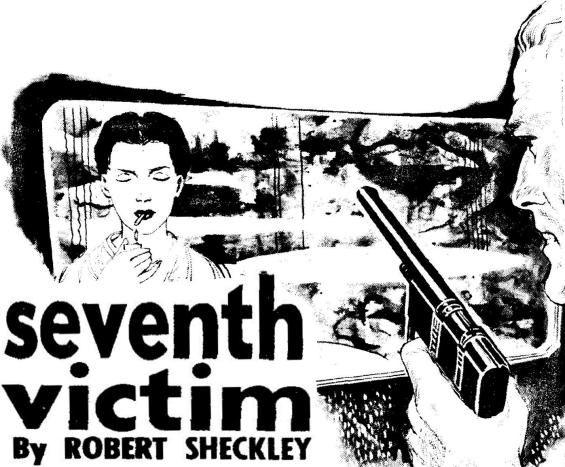
Going in, and liking Robert Sheckley, I was surprised how much I didn’t respond to his most famous short story Seventh Victim. Upon first reading it I didn’t think of it as terrific story. Nor did I think of it as having much in the way of intellectual heft. But, upon reflection, particularly after watching the film adaptation I am coming around a bit. Indeed, plenty of folks, it seems, think of Seventh Victim as an academic story. It’s been used in both introductory psychology and philosophy textbooks. It has been reprinted more than a dozen times in different anthologies or collections. The 1965 film adaptation, called The Tenth Victim (La Decima Vittima), prompted Sheckley to expand the short story into a novel under the same name (which spawned more novel sequels Victim Prime and Hunter / Victim.
Robert Sheckley’s short story Seventh Victim is the tale of a future earth in which men and women engage in a voluntary game of assassination. Upon its first publication Galaxy magazine’s editor, H.L. Gold, abstrusely compared it to Richard Connell’s The Most Dangerous Game. I see that. But I was more struck by its closer resemblance to the game played in the opening scenes of the 1985 film Gotcha!. That film was likely inspired by a 1982 movie, Tag: The Assassination Game – which itself certainly nodded towards The Most Dangerous Game (the name of the first victim in the film is Connally). And that movie, in turn, was likely inspired by a real game of fake murder played on university campuses at the time (it looks like it is still played today too). While the story itself isn’t available as an audiobook there are a couple of audio dramatizations (both use the same script):
Future Tense – The Seventh Victim
Adapted from a short story by Robert Sheckley; Adapted by Ernest Kinoy; Performed by a full cast
1 |MP3| – Approx. 27 Minutes [RADIO DRAMA]
Broadcaster: WMUK Special Projects
Broadcast: May 20th, 1974
Provider: Rimworlds.com “The most dangerous game, said one writer, is Man. But there is another still more deadly!” First published in the April 1953 issue of Galaxy Science Fiction.
X-Minus One – The Seventh Victim
Adapted from a short story by Robert Sheckley; Adapted by Ernest Kinoy; Performed by a full cast
1 |MP3| – Approx. 22 Minutes [RADIO DRAMA]
Broadcaster: NBC
Broadcast: March 6, 1957
Provider: Archive.org “Tonight we go forward in time to the days when war has been outlawed – and in its place there is a system of carefully controlled legalized murder.” First published in the April 1953 issue of Galaxy Science Fiction.
Cast:
Lawson Zerbe …. Freeline
Terri Keane …. Janet
Frank Maxwell … Emanuel Gale
Ian Martin ….
Arthur Hughes …. Jerry
Fred Collins …. Announcer
Meanwhile … over on the Wikipedia talk page for the entry for Philip K. Dick’s Adjustment Team there is a wonderful argument going on. Part of it is over an issue called “copyfraud” (false claims of copyright designed to control works not under copyright). I suspect that it just such awesomeness that is behind so much of the awesomeness that is Wikipedia. Check this response out from a Wikipedia editor named “Refrigerator Heaven”:
Oh, to answer the section’s question. As a long-time fan of Philip K. Dick who is familiar with his main themes and not very interested in the movies based on his writings, I do think the copyright stuff is more interesting and more Dickian than the movie [The Adjustment Bureau]. Perhaps I’ll add a quote or two from him after dinner. For a parting thought I’ll leave this with a quote he used in his Hugo Award winning novel, The Man In The Hight Castle [sic]. “Things are seldom as they seem, skim milk masquerades as cream.”
Now don’t get me wrong, I don’t think Wikipedia is wonderful for its quotes alone. It was there, on the Wikipedia entry, for instance – that I learned that Adjustment Team was public domain. That’s what prompted me to tell my favourite LibriVox narrator that it was PD and that is, in part, why he recorded it for LibriVox. Thank you Gregg Margarite and thank you Wikipedia!
Soon to be collected in LibriVox’s Short Science Fiction Stories Collection #044:
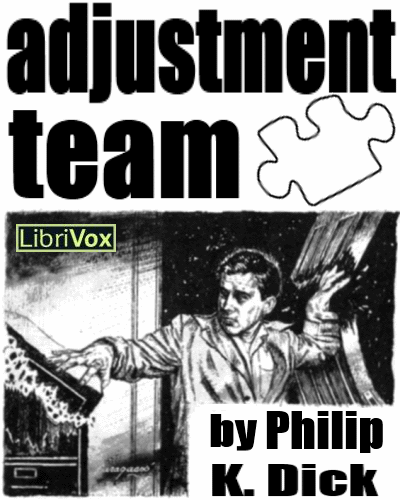
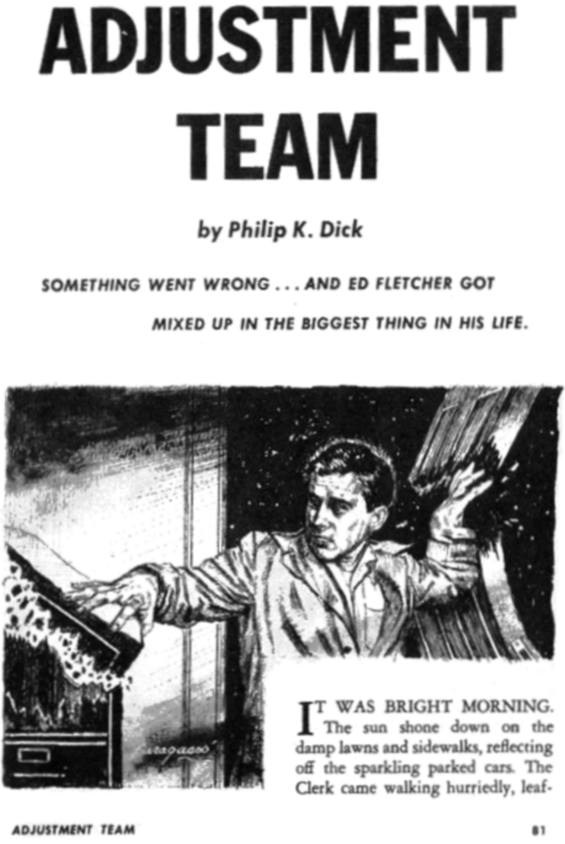
Adjustment Team
By Philip K. Dick; Read by Gregg Margarite
1 |MP3| – Approx. 1 Hour [UNABRIDGED]
Publisher: LibriVox.org
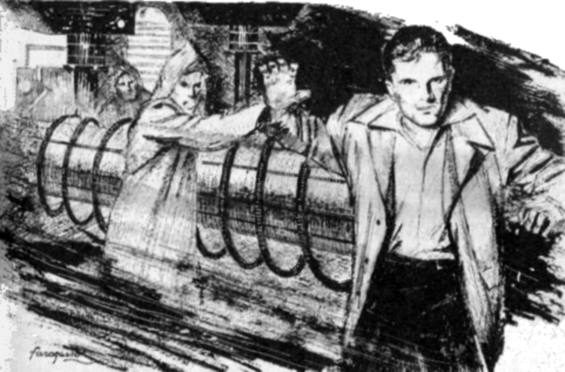
Published: NOT YET COLLECTED! “Something went wrong and Ed Fletcher got mixed up in the biggest thing in his life.” First published in Orbit Science Fiction, Sept-Oct 1954, No.4.
I don’t think Philip K. Dick and Hollywood are writing for the same audience:
The Adjustment Bureau movie trailer: Powerful, handsome bachelor boy meets cute girl -> handsome boy loses beautiful girl -> handsome boy is chased by powerfully fedoraed men -> handsome gets beautiful back again.
The Adjustment Bureau (aka Adjustment Team) audiobook: middle class schnook has quietly comfortable conversation with wife -> gets pushed around by insurance salesman -> weird shit happens -> freaks out -> runs home to his wife. PLUS: talking dog!
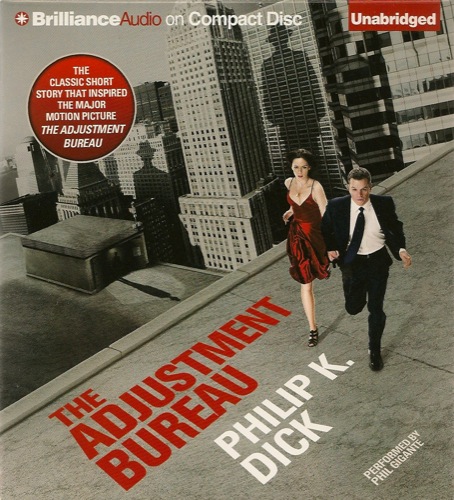
The Adjustment Bureau (aka Adjustment Team)
By Philip K. Dick; Read by Phil Gigante
Publisher: Brilliance Audio
Published: March 4, 2011
ISBN: 9781441894694
Sample |MP3| The Adjustment Bureau is a major motion picture based on Philip K. Dick’s classic paranoid story, The Adjustment Team. This is the short story, The Adjustment Team, which asks the question – Do we control our destiny, or do unseen forces manipulate us? Ed Fletcher is a real estate agent with a normal life, until one day he leaves the house for work a few minutes later than he should have. He arrives at a terrifying, grey, ash world. Ed rushes home and tells his wife, Ruth, who goes back to the office with him. When they return, everything is normal. But he soon realizes people and objects have subtly changed. Panic-stricken, he runs to a public phone to warn the police, only to have the phone booth ascend heavenward with Fletcher inside…
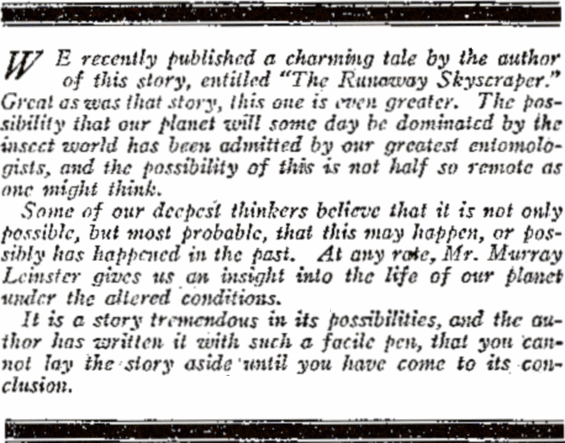
First published in the June 12, 1920 issue of Argosy, The Mad Planet was eventually to become one third of Murray Leinster’s fix-up novel The Forgotten Planet. But there were plenty of standalone republications too. It was, for instance, in the November 1926 issue of Amazing Stories – where it was published with this introduction by Hugo Gernsback:
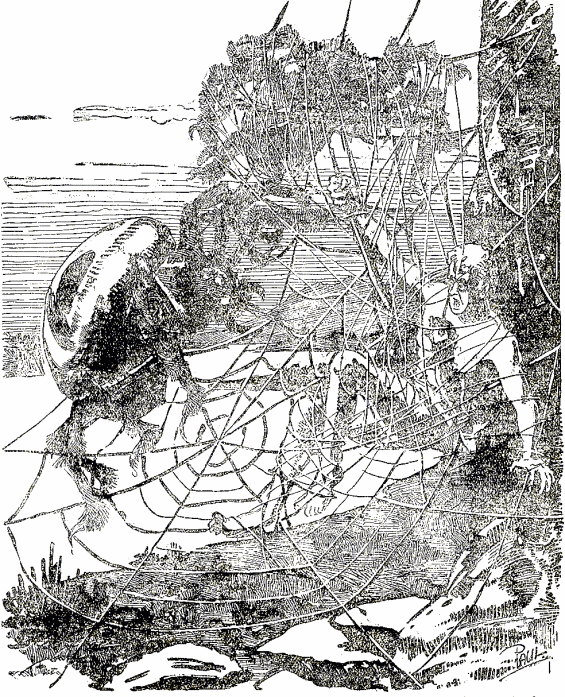
It ran with this art (by Frank R. Paul):
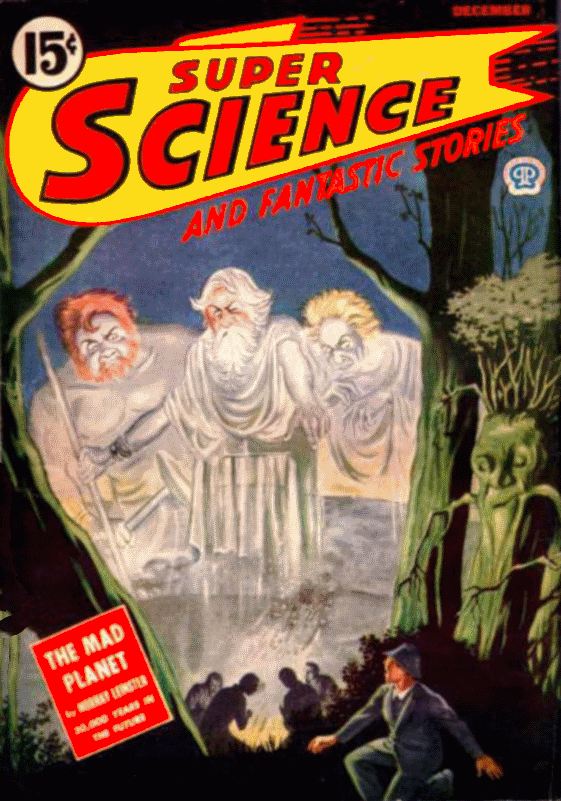
Super Science and Fantastic Stories, December 1944:
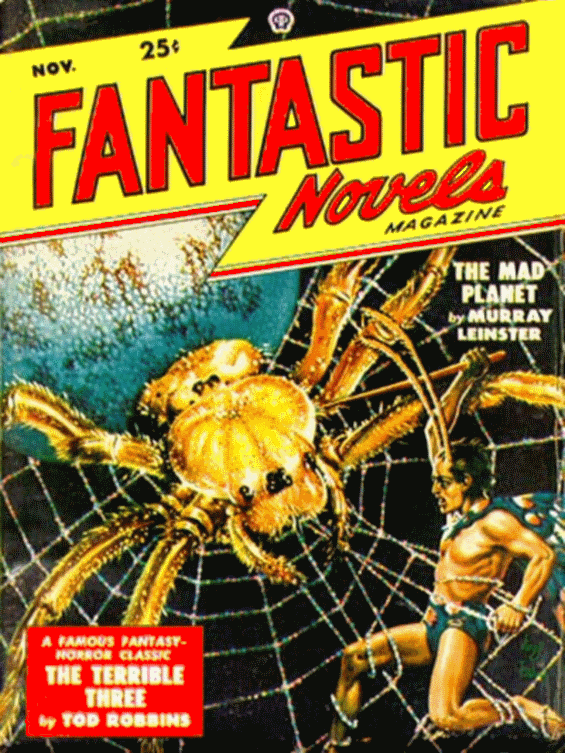
Fantastic Novels Magazine, November 1948:
And now available as a LibriVox audiobook:
The Mad Planet
By Murray Leinster; Read by Roger Melin 4 Zipped MP3 Files or Podcast – Approx. 2 Hours 46 Minutes [UNABRIDGED]
Publisher: LibriVox.org
Published: April 6, 2011
|ETEXT| It is 30,000 years following dramatically changed climate conditions on earth which had let massive amounts of carbon dioxide belch from the interior of the planet into the atmosphere. Over the millenia this would have quite devastating effects on life as it had once been known. Much of the human and animal population would not survive the climate change, and indeed those few humans who did survive knew nothing of all which their predecessors had learned and built. Indeed, they knew not even of their existence. On the other hand insects and fungi would flourish over time. And so those few remaining humans were unknowingly at the very beginning of the building of a tribal society, which at the time of the story of Burl simply meant food and survival. And so it was Burl who chose to travel beyond his small tribal community in an effort to hunt for something new and different to hopefully impress Saya, the young female of his tribe to whom he felt a peculiar attraction. The Mad Planet is Burl’s adventure.


 Robert Sheckley’s Warrior Race was briefly mentioned on last week’s SFFaudio Podcast (#104). It’s available in audiobook form as on part of LibriVox’s Short Science Fiction Collection Volume 41. As is usual with so many of the Sheckley tales recorded for LibriVox it’s read by Gregg Margarite. YAY! And since we all seem to be in a pretty good Sheckley groove right now I thought I’d follow through with a pretty |PDF| edition of the story – it was constructed from a scan of the original Galaxy publication pages. This should be a fun read and listen!
 Warrior Race
 Going in, and liking Robert Sheckley, I was surprised how much I didn’t respond to his most famous short story Seventh Victim. Upon first reading it I didn’t think of it as terrific story. Nor did I think of it as having much in the way of intellectual heft. But, upon reflection, particularly after watching the film adaptation I am coming around a bit. Indeed, plenty of folks, it seems, think of Seventh Victim as an academic story. It’s been used in both introductory psychology and philosophy textbooks. It has been reprinted more than a dozen times in different anthologies or collections. The 1965 film adaptation, called The Tenth Victim (La Decima Vittima), prompted Sheckley to expand the short story into a novel under the same name (which spawned more novel sequels Victim Prime and Hunter / Victim.
  Future Tense – The Seventh Victim
 X-Minus One – The Seventh Victim