LibriVox: The Stars, My Brothers by Edmund Hamilton

SFFaudio Online Audio

LibriVoxMy favourite new LibriVox up-and-comer is Gregg Margarite. I’m totally loving his reading of Harry Harrison’s Deathworld. After I finish that I’ll be turning my attention to this…

Edmond Hamilton (1904 – 1977) had a career that began as a regular and frequent contributor to Weird Tales magazine. The first hardcover publication of Science Fiction stories was a Hamilton compilation, and he and E.E. “Doc” Smith are credited with the creation of the Space Opera type of story. He worked for DC Comics authoring many stories for their Superman and Batman characters. Hamilton was also married to fellow author Leigh Brackett.

Published in the May, 1962 issue of Amazing Stories The Stars, My Brothers gives us a re-animated astronaut plucked from a century in the past and presented with an alien world where the line between humans and animals is blurred.

LibriVox Science Fiction - The Stars, My Brothers by Edmund HamiltonThe Stars, My Brothers
By Edmond Hamilton; Read by Gregg Margarite
2 Zipped MP3 Files or Podcast – Approx. 83 Minutes [UNABRIDGED]
Publisher: LibriVox.org
Published: April 26, 2009
“He was afraid—not of the present or the future, but of the past. He was afraid of the thing tagged Reed Kieran, that stiff blind voiceless thing wheeling its slow orbit around the Moon, companion to dead worlds and silent space.”

Podcast feed:
http://librivox.org/bookfeeds/the-stars-my-brothers-by-edmond-hamilton.xml

iTunes 1-Click |SUBSCRIBE|

Posted by Jesse Willis

LibriVox: Rebels Of The Red Planet by Charles L. Fontenay

SFFaudio Online Audio

LibriVoxPaul Campbell writes in to say:

Last year I read Rebels of the Red Planet for the Second Audiobook Challenge. Now Mark Douglas Nelson has just released his own recording of the same title through LibriVox.

Cool! I’m a big fan of Mark Douglas Nelson’s narration.

Check it out folks…

LibriVox Science Fiction - Rebels Of The Red Planet by Charles L. FontenayRebels Of The Red Planet
By Charles L. Fontenay; Read by Mark Douglas Nelson
9 Zipped MP3 Files or Podcast – Approx. 5 Hours 9 Minutes [UNABRIDGED]
Publisher: LibriVox.org
Published: April 24, 2009
Dark Kensington had been dead for twenty-five years. It was a fact; everyone knew it. Then suddenly he reappeared, youthful, brilliant, ready to take over the Phoenix, the rebel group that worked to overthrow the tyranny that gripped the settlers on Mars. The Phoenix had been destroyed not once, not twice, but three times! But this time the resurrected Dark had new plans, plans which involved dangerous experiments in mutation and psionics. And now the rebels realized they were in double jeopardy. Not only from the government’s desperate hatred of their movement, but also from the growing possibility that the new breed of mutated monsters would get out of hand and bring terrors never before known to man.

Podcast feed:

http://librivox.org/bookfeeds/rebels-of-the-red-planet-by-charles-l-fontenay.xml

iTunes 1-Click |SUBSCRIBE|

And check out Paul’s original recording too… it’s HERE and over on Podiobooks.com.

[Thanks Paul!]

Posted by Jesse Willis

LibriVox: Victory by Lester del Rey

SFFaudio Online Audio

From LibriVox and the reader of This Crowded Earth (Robert Bloch) and the Deathworld (Harry Harrison) comes…

LibriVox Science Fiction - Victory by Lester del ReyVictory
By Lester del Rey; Read by Gregg Margarite
2 MP3 Files – Approx. 1 Hour 38 Minutes [UNABRIDGED]
Publisher: LibriVox.org
Published: March 30, 2009
“It seemed Earth was a rich, and undefended planet in a warring, hating galaxy. Things can be deceptive though; children playing can be quite rough—but that ain’t war, friend!” – Victory is the story of an undefended Earth in a warring galaxy. First published in Astounding Science Fiction, August, 1955.
Part 1 |MP3| Part 2 |MP3|

Podcast feed:

http://librivox.org/bookfeeds/victory-by-lester-del-rey.xml

Posted by Jesse Willis

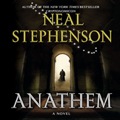
Review of Anathem by Neal Stephenson

SFFaudio Review

AnathemAnathem
By Neal Stephenson; Read by Oliver Wyman, Tavia Gilbert, William Dufris, and Neal Stephenson
Audible Download –  32 hours 30 minutes [UNABRIDGED]
Publisher: Macmillan Audio
Published: 2008
Themes: / alien invasion / philosophy / religion / alternate universe

After nearly two weeks of listening to this 2009 Hugo-nominated book during nearly every moment of my free time–getting ready for work in the mornings, sitting on the bus, tossing and turning in bed–I’ve finally finished Neal Stephenson’s latest tale of metaphysical adventure. Does the book measure up to Stephenson’s earlier work? More importantly, is it fun to read?

First, some background: Anathem is set on the planet of Arbre, a world much like, and yet unlike, our own. The tale opens in the year 3690 AR (After the Reconstitution), in the Mathic Consent of Saunt Edhar. Consents are much like the medieval monasteries of our own world, except that instead of contemplating religious matters the Mathic avout research and debate matters of math, science, and philosophy. The tale is told from the perspective of Fraa Erasmas, a young avout who has now lived at the Consent for ten years. A mysterious craft appears in the skies above Arbre, which is the driving force behind the plot, since it excites consequences and conflicts first in the Mathic world and then in the Saecular, or outside, world as well. The craft, it turns out, belongs to an alien race unknown to Arbre, and packs a significant military punch. The inhabitants of Arbre, Mathic and Saecular alike, must decide how to face this threat.

I can’t fully answer the first question, since the only other Stephenson novel I’ve read in full was his cyberpunk effort Snow Crash, which I thoroughly enjoyed. Stylistically speaking, comparing these two novels, though, is like comparing apples and oranges. The prose ofSnow Crash is taut, earthy, and vernacular, while that of Anathem is expansive, meandering, and somewhat more formal. Yet the two books share a tendency to veer into philosophical discourse that usually, but not always, has some relevance to the plot.

As to the second question, I wouldn’t quite characterize Anathem as “fun”. It certainly has many moments of intense action, wry humor, and emotional drama. These moments, however, are interspersed between long stretches of the aforementioned philosophical discourse. So one’s response to the novel largely depends on one’s tolerance for and appreciation of Stephenson’s vast store of scientific and theoretical knowledge. In this respect, as well as in its setting, Anathem resembles Umberto Eco’s equally challenging The Name of the Rose.

Those interested in such things will find here a treasure trove of insights (or “upsights” as they’re called in the world of Arbre) into the nature of reality, consciousness, and the universe. Without giving too much away, I’ll simply hint that the quantum physics principles that play such a large role in Philip Pullman’s His Dark Materials trilogy rear their hydra-heads here as well.

The book isn’t all dialogues and theorums and proofs. Much of Anathem‘s beauty stems from its likable characters. Fraa Erasmas is a young lad possessed of loyalty, imagination, and more heart than seems to be usual in the Mathic community. His best friend Fraa Lio, upon whom he bestows the epithet of “thistlehead”, takes a keen interest in the martial arts techniques, or vlor, of the Consent of the Ringing Veil. The cast of brothers is rounded out by the ambitious yet likable Fraa Jesry and the good-natured portly Fraa Arsibalt. Unlike medieval monastaries, Mathic consents are not segregated, so Erasmas and company are joined in their adventures by the capable but hot-tempered Suur Ala and the mild-mannered Suur Tulia. The real standout characters, though, are the enigmatic Fraa Orolo and Fraa Jad. The former has a fascination with cosmology and also with saecular speelies (read: movies), while the latter is first seen puzzling over a disposable razor from the outside world. Both these old men are reminiscent of Albus Dumbledore from the Harry Potter series in that they combine immense knowledge with eccentricity and childlike curiosity.

For a word nerd like myself, much of the pleasure from reading Anathem is derived from marveling at Stephenson’s ability to construct a linguistically coherent alternate reality that still has resonances in our own world. Take the word saunt, for instance, which denotes a Mathic avout who has made some sort of significant theoretical advance. As the book’s glossary explains, the word is actually a contracted form of the word savant, but also immediately brings to the reader’s mind the real-world word saint. I’m fairly certain that all these subtle layers of meaning were intentionally embedded, and this is just one example of many.

While there are endless avenues of literary, cultural, and philosophical allusions to explore and deep philosophical questions to unravel, I found myself a bit weary as I got to the end of the novel. Though certainly a more-than-capable storyteller, Stephenson seems more interested in advancing his scientific explorations, and overlays the story atop them. This is similar to sme of J.R.R. Tolkien’s writings, in which the story is made subservient to linguistic aims. I’m not quite sure where I fall on this “story-versus-substance” spectrum, but if I had to choose I think I’d lean towards the “story” direction.

Given its complexity of its language, Anathem poses a real challenge to audiobook producers. Fortunately, the narrators are up to the task. William Dufris performs the bulk of the novel, and he shifts easily from the erudite jargon of the book’s dialogues to its memorable emotional climaxes. Read by a less capable narrator, Anathem might be marketed as a surefire cure for insomnia, but Dufris brings every character to life as if they were in a speely, the Arbre equivalent of film.

Even with the few caveats listed earlier, it’s hard to underplay Neal Stephenson’s immense achievement with Anathem.

Posted by Seth Wilson

LibriVox: The Lost Continent by Edgar Rice Burroughs

SFFaudio Online Audio

LibriVoxHere’s another Edgar Rice Burroughs novel that I hadn’t heard of prior to its release on LibriVox. For fans like me who are daunted by the prospect of trundling through one of the many series books by Burroughs this is a good place to start as this is a standalone novel. First published in the February 1916 issue of “All Around Magazine.”


LibriVox Science Fiction - The Lost Continent by Edgar Rice BurroughsThe Lost Continent
By Edgar Rice Burroughs; Read by Lucy Lo Faro
9 Zipped MP3 Files or Podcast – Approx. 4.5 Hours [UNABRIDGED]
Publisher: LibriVox.org
Published: April 2009
Originally published under the title Beyond Thirty. The novel, set in the year 2137, was heavily influenced by the events of World War I. In the future world depicted in the novel, Europe has descended into barbarism while an isolationist Western Hemisphere remains sheltered from the destruction. The title Beyond Thirty refers to the degree of longitude that inhabitants of the Western Hemisphere are forbidden to pass.

Podcast feed:

http://librivox.org/bookfeeds/the-lost-continent-by-edgar-rice-burroughs.xml

iTunes 1-Click |SUBSCRIBE|

Posted by Jesse Willis

LibriVox: Deathworld by Harry Harrison

SFFaudio Online Audio

LibriVoxGregg Margarite is an up and coming narrator over on LibriVox.org. He recorded stories for five of the LibriVox “Short Science Fiction” collections as well as soloing on the Collected Public Domain Works Of Stanley G. Weinbaum! But it is his latest project that I suspect will be his most popular narration. Here’s how he describes it:

Deathworld is the first in a series of novels begun in 1960 and originally serialized in Astounding Science Fiction Magazine. It’s the story of Jason dinAlt a professional gambler with psionic skills who finds himself on Pyrrus the deadliest planet to be colonized by humanity. Violent weather, active tectonics, heavy gravity, abundant predators, and a hostile splinter group of colonists is only the beginning of Jason’s quest to learn the truth about Pyrrus.”

LibriVox Science Fiction - Deathworld by Harry HarrisonDeathworld
By Harry Harrison; Read by Gregg Margarite
28 Zipped MP3 Files or Podcast – Approx. 5 Hours 23 Minutes [UNABRIDGED]
Publisher: LibriVox.org
Published: April 2009
Some planet in the galaxy must—by definition—be the toughest, meanest, nastiest of all. If Pyrrus wasn’t it … it was an awfully good approximation! First published in Astounding Science Fiction magazine’s January, February and March 1960 issues.

Podcast feed:

http://librivox.org/bookfeeds/deathworld-by-harry-harrison.xml

iTunes 1-click |SUBSCRIBE|

Posted by Jesse Willis