Mr. Ron: A Jules Verne SPOOF & Twain’s Connecticut Yankee

SFFaudio Online Audio

Podcast - Mister Ron's BasementMr. Ron, of Mister Ron’s Basement podcast, has some exciting listening on offer. First up, and being serialized over the next four shows, is an extremely rare story. It’s a spoof of Jules Verne’s Science Fiction, written while Verne was still in his prime. Though it was credited to “Jules Verne, Jr.” it was actually written by Stanley Huntley. Huntley was an immensely popular 19th century newspaper humorist – though today he is now nearly forgotten. This tale, A Trip to the South Pole; Book One, was serialized for three weeks in 1880 in the legendary Brooklyn Eagle newspaper. Mr. Ron will offer it over the course of four episodes. Of it, he sez: “It is an insanely funny spoof of Verne, and the more familiar you are with Verne’s works, the funnier it is.” – and indeed it sounds like a dead -on parody of Verne!

A Trip to the South Pole; Book One
By Stanley Huntley; Read by Mister Ron
4 Parts – [UNABRIDGED]
Podcaster: Mister Ron’s Basement
Podcast: April 2008

Also, starting with Episode #1038, Mr. Ron will begin his serialization of Mark Twain’s A Connecticut Yankee in King Arthur’s Court. At the rate of one chapter a week, it will take nearly a year to complete it.

A Connecticut Yankee in King Arthur’s Court
By Mark Twain; Read by Mister Ron
? Parts – [UNABRIDGED]
Podcaster: Mister Ron’s Basement
Podcast: Begun April 2008 –

You can subscribe to this long running podcast , and get daily dispatches from the basement, via this feed:

http://slapcast.com/rss/revry/index.xml

Posted by Jesse Willis

Review of Mirror Dance by Lois McMaster Bujold

SFFaudio Review

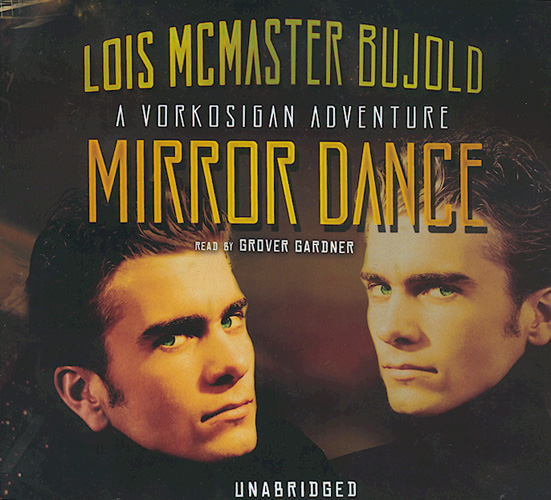
Mirror Dance by Lois McMaster BujoldMirror Dance
By Lois McMaster Bujold; Read by Grover Gardner
15 CDs – about 18 hours – [UNABRIDGED]
Publisher: Blackstone Audio
Published: 2007
ISBN: 9781433205699
Themes: / Science fiction / Space travel / Cloning / Military /

Mirror Dance may be many things, but it is primarily the story of a clone named Mark Vorkosigan and his struggle to discover his own identity. To find himself, he must come to grips with his tortured upbringing, his harrowing training to become a spy and assassin, and the long shadow of the man he was cloned from — a diminutive, homely, yet fiercely inspiring man named Miles Vorkosigan. In the process, he plans a daring infiltration that devolves into pitched battle on an enemy planet, all laid out with action, tactical clarity, and emotional impact that puts some so-called “military SF” I’ve heard to cowering shame. But that’s not all for Mark. He must also find his way through courtly intrigue, survive an uneasy adoption by Miles’s parents, perform some deft detective work, haltingly begin an unlikely little romance, and endure psychologically horrific torture.

Grover Gardner provides the voice that leads us on this tortuous journey. Giving distinct personalities to a pair of genetically identical protagonists is a tall order, yet between Bujold’s words and Gardner’s nuanced performance, the two lead characters remain effortlessly distinct. What’s more, the secondary characters are portrayed with the same care. It is hard to imagine a better reading of this material.

But is there really any doubt about the outcome of these crises? The liner notes are as comforting as a quick look at the final chapter: This book is part of a larger series with the same characters. I read that to mean there would be little chance the author would kill off a vital cash cow.

I know, I know, the demands of the publishing industry have made series works the lifeblood of genre fiction. I’m sure they bring in lots of new SF readers and maybe even some good books here and there, but what do we sacrifice in the process? In this book, it is any palpable sense of suspense or purposeful haste in the proceedings. In general, I think it is risky, new ideas that challenge and expand our concept of what SF and fiction can do. Are the larger sales numbers really worth the cost?

That doesn’t mean this book is a waste of time. The characters are well explored, the situations are thought provoking, and the tone ranges from disarmingly tender to chillingly perverted. You will care about Miles, Mark, their family, and their friends. You will hate their enemies. But at the same time, the sometimes languid pacing and the foreknowledge of the outcome will not make listening to this book an urgent necessity. Bujold can think, she can plot, and she can definitely write. But this book will leave you wishing she’d used all that talent to write something a little bolder.

Posted by Kurt Dietz

Rounding up Mike Resnick audio – it’s a feast for your ears!

SFFaudio Online Audio

Mike ResnickToday we’ve made another new addition to our AUTHOR PAGES. This time it’s all about SF superstar MIKE RESNICK! On the page about him you’ll find interviews with the man, convention panels with him on em, audiobook listings, and best of all an even dozen FREE MP3 short stories by Mike Resnick!
Check it all out HERE or by clicking the AUTHOR PAGES tab above.

Posted by Jesse Willis

Review of Mainspring by Jay Lake

SFFaudio Review

Mainspring by Jay LakeMainspring
By Jay Lake; Read by William Dufris
Audible Download – Approx. 13.5 Hours [UNABRIDGED]
Publisher: macmillan audio / audible.com
Published: December 2007
Themes: / Science Fiction / Fantasy / Alternate Universe / Steampunk / Religion / Angels / Science /

The mainspring of the Earth is running down, and disaster to the planet will ensue if it’s not rewound. To do the job the Archangel Gabriel approaches a young clockmaker’s apprentice and explains the problem. He can’t be that surprised, in a clockwork solar system, where the planets move in a vast system of gears around the lamp of the Sun – how could he be? This is a universe where the hand of the Creator is visible to anyone who simply looks up into the sky and sees the track of the heavens, the wheels of the Moon, and the great Equatorial gears of the Earth itself.

Clockmaker’s apprentice Hethor Jacques is graced by a visit from the Archangel Gabriel. Gabriel tells him that he’s been chosen to re-wind the running down mainspring of the earth. If it isn’t re-wound, the world will end – and as such he must find something called “the Key Perilous” (the Mainspring equivalent of our “Holy Grail”). A series of short introductions and good-byes later (with the help of a friendly librarian), Hethor is pressed into the service of a Royal Navy airship (the Bassett) and soon is heading south towards the equatorial wall, atop which the brass gear-works of the Earth and its orbital track meet. Beyond that barrier lies the mysterious ‘Southern Earth.’ Hethor’s quest will take him there and farther south – to the ends of the earth – one way or another.

In a clockwork world who could doubt the existence of God? None, but some still doubt the existence of angels. And that’s just what happens to Hethor. His master and betters think him at best a liar, at worst a thief, and poor young Hethor seems ill-equipped to save the universe. Luckily, a quick trip to the library and he’s on the right track…

Talk about hard to categorize! Jay Lake’s Mainspring offers an utterly unique vision of a world in which the Medieval ideas about how the universe works are literally manifest. Great premise, but it is an undercooked universe that I didn’t wholly buy. The alternate universe changes are interesting, but are not often well grounded. For instance, in the Mainspring world Jesus wasn’t crucified (nailed to a cross), he was ‘horofixed,’ (strapped to a wheel) – kind of makes sense right? Okay, that’s cool – but why, other than for style, did the United States never revolt from the English crown? Why the 19th century airships? Don’t get me wrong, I love airships, but there doesn’t appear to be a logic to their addition. We don’t find out much about the logic for the changes that aren’t obvious either. And that’s basically its problem. Mainspring has many elegant epicycles around its central action, but that action all lacks a core motivation. How can you suspend disbelief if the force of gravity is both an absent actor in the grand scheme (cosmically) but appears to act locally (people aren’t strapped down to the earth)? There are many flourishes, but there are also so many sidesteps to what should be natural consequences. This makes Mainspring have a mechanical, almost “rail-shooter”-novel feel to it. For instance, the novel insists that gravity isn’t what keeps the earth in orbit around the sun (it’s a massive brass clockwork instead), but what keeps the objects on the Earth on the ground? What keeps the airships up (or down)? None of this is answered – or even addressed. I kept hoping that some revelation, something central to the novel, would be revealed, right up to the final pages. Maybe this universe has an intensified magnetic force in it or something? Instead, no, nothing.

Also underdeveloped, and tragically so, is the religious thread. The consequences of seeing the mechanism of what is clearly “creation” in this world are not explored to any significant degree. Indeed, the ramifications from a created world, a world that ‘can run down’, are so lightly touched upon as to be non-existent. The focus is on the adventure of the naive Hethor, his meager beginnings and his sexual awakening. Mostly though, Mainspring is a series of encounters, and visual incredibilities. Like I was saying earlier, it is all undercooked. Jay Lake has vision and talent but this feels far more like his “Count Zero” novel than his “Neuromancer.”

Mainspring is one of the new batch of “exclusive to audible” titles. Veteran narrator William Dufris brings a calm assurance to the many characters who live in a world that seems normal to them, and crazy to us. Sound quality isn’t quite as good as from CD (but this title isn’t available on CD). Once installed, the audible.com download software and the audible checkout system integrate well. It isn’t quite “one click” ordering, but once you’ve made your choice you can have an audiobook on your portable media player and ready to play in less than 30 minutes. I use an iPod Nano, which displays the cover art and bookmarks the files perfectly. I could switch between a regular playlist, a podcast, and multiple audiobooks (from Audible) without losing my place. The experience of listening to and downloading an audiobook from Audible to your iPod is virtually identical to what iPod podcast users get.

Posted by Jesse Willis

BBC Radio 4 – Journey into Space – Frozen In Time

SFFaudio Online Audio

BBC Radio 4According to the latest issue of the Radio Times an all new show in the long loved Journey into Space series is set to air this weekend! Fans of JiT first heard the show on BBC airwaves back in 1953. This new program (written by the same guy) continues the tradition. For fans, this is something not to be missed, for those who haven’t heard of it before check out the Wikipedia article. This will be available for a week after the broadcast via the BBC R4 “listen again” service.

Journey into Space – Frozen In Time
By Charles Chilton; Performed by a full cast
1 Broadcast – Approx. 60 minutes [RADIO DRAMA]
Broadcaster: BBC Radio 4 / The Saturday Play
Broadcast: Saturday April 12th 14:30-15:30 (UK TIME)
“The crew of 1960’s spacecraft Ares awakes from suspended animation in 2008. Jet Morgan – played by David Jacobs from the original cast – has been the only one left awake for the past 30 years. Unwittingly caught up in seismic deception, the Earth’s future could be in peril.”

Also, there’s an informative article about the making of this show (along with some nostalgia on the venerable Journey Into Space lineage) over on the Times Online website |READ IT|.

[via SFFaudio’s secret agent in the UK CODENAME: R.O.Y.]

Posted by Jesse Willis

Commentary: The Metamor City Podcast

SFFaudio Commentary

Metamor City Podcast[Editor’s Note: In this commentary one of SFFaudio’s highly valued behind the scenes contributors, Nick Gassman, talks on the record about a recent podcast fiction series he’s been enjoying.]

Imagine a world where magic has developed alongside technology. A world where the fabric of a city is maintained not only by gravity and physics, but also by magic. That’s the world that Metamor City is situated in.

It’s also a city where the police chief is a wolverine, the chief medical examiner is a vampire (her ‘special’ attributes make her outstanding at her job), and where the normal people are called ‘mundies’, for ‘mundanes’, having no special skills or attributes. Mundies, and a potentially unlimited range of mythical and fantastic creatures live cheek by fang together, and in general manage to get along OK. But where there’s tension and conflict, usually between races (if that’s the right word), then that’s where the interest lies for the fiction.

It’s a city full of potential for the exploration of many themes, and one which the author, Chris Lester, exploits to great advantage. The Metamor City podcast is a thorough, in depth look at the characters and events of this fantastic metropolis. Lester’s style isn’t about fast moving action. The mix of short and long stories take their time to explain, explore, dissect, discover. The motivations of characters are important here, and there will be dwelling on detail if Lester feels it necessary to create a believable world – which it is.

The focus of the stories is the city itself, and all the rich variety that it contains, rather than a particular character. Stories are told from different perspectives, and characters could be major, minor, or absent from one story to the next.

The first few podcasts are narrated (well) by individuals, and then change to a cast who speak for each character, whilst Lester retains his role as the linking narrator. The quality is superb, with the ‘acting’ only a whisker away from full professional, and with nothing left to be desired from the production, and integration of music and sound effects. These sounds always add to the dramatic effect, unlike many podcasts (and, indeed, professional productions), where they can be intrusive, typically due to excessive volume or inappropriate material (cue very lengthy sound effect of footsteps).

If you want fast paced action, this isn’t for you. But if, like me, you hunger for great storytelling, great production, and a setting full of potential, then you’ll want to put this podcast high on your list of priorities.

Subscribe to the podcast via this feed:

http://feeds.feedburner.com/metamorcity

Posted by Nick Gassman