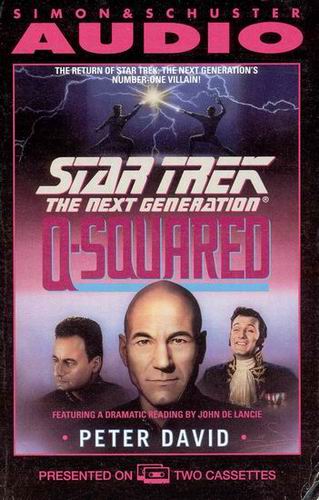
Review of Star Trek TNG: Q-Squared by Peter David

SFFaudio Review

Star Trek: Q-SquaredStar Trek: The Next Generation: Q-Squared
By Peter David; Read by John de Lancie
2 Cassettes – 3 hours [ABRIDGED]
Publisher: Simon and Schuster Audio
Published: 1994
ISBN: 0671891804
Themes: / Science Fiction / Star Trek / Q / Gods / Time / Multiple Universes /

You have no idea how screwed up this is.
— Q to Picard, Q-Squared

All the Star Trek talk floating around the internet has stirred my interest, so I dug out one of the first (and best) Star Trek audiobooks from my permanent stash. I sit here with hopes that the Paramount powers-that-be stop considering prequels. Does anyone want to see someone other than Nimoy play Mr. Spock? The future is wide open – pick a place out there and tell some great stories.

Before a cane stretches out from stage left to drag me off, I’ll get back to the review at hand. Q-Squared has everything I love in a Star Trek audiobook. First, it’s a big story. One that would be difficult to film for various reasons. Second, there are lots of pieces of Star Trek mythos throughout. You know, the kind of thing that makes a Trekker think “I remember that!” and sends him/her to watch the episode it occurred in. Third, the sound effects create the Star Trek feel without being overpowering. This is a luxury that these audiobooks have – the sound of a turbolift door, a few beeps, and the listener is on the bridge of the Enterprise without a sentence of prose. And fourth, an excellent reader. John de Lancie not only voices Q, the character he played on the screen, but he also skillfully portrays all the other characters.

In the book, Q has been given the difficult task of keeping an eye on Trelane who is a character from the Original Series episode entitled “The Squire of Gothos”. Peter David makes quick work of connecting Trelane to the Q Continuum. Unfortunately for Picard and crew, Trelane is even farther off plumb than he was in Kirk’s heyday – a fact demonstrated by the fact that he considers ripping apart the universe to be a valuable use of his spare time. To the Star Trek: The Next Generation characters, this results in the intersection of at least three well-conceived alternate universes. As the story moves forward, the universes flip like cards being shuffled in a deck.

Luckily, the audiobook is brilliantly abridged and edited. Though the universes shifted quickly, I had no problem keeping one Picard from another. This audiobook, if it was a Star Trek episode, would consistently be considered one of the finest the show had to offer. There are lots of copies of this one around – I urge you to find one.

Posted by Scott D. Danielson
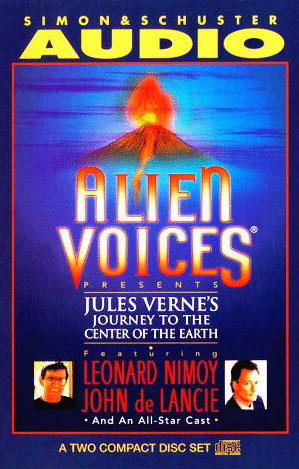
Review of Journey to the Center of the Earth by Jules Verne

SFFaudio Review

Alien Voices - Journey to the Center of the Earth by Jules VerneJourney to the Center of the Earth
By Jules Verne, performed by a full cast
2 Tapes, Approx. 2 hours – [AUDIO DRAMA]
Publisher: Simon and Schuster Audio
Published: 1998
ISBN: 0671872281
Themes: / Science fiction / Adventure / Exploration / Geology /

One should not drink from the same well of audio books in rapid succession. I recently listened to Alien Voices’ The First Men in the Moon, and found this one just a little too similar for my liking. The main characters in both consist of a crusty professor and a younger, more energetic helper; in both cases the professor is voiced by Leonard Nimoy and the younger man by John DeLancie; and in both cases the two men go off to explore some unknown world and discover amazing adventures.

This book suffers in the comparison not just because it came second, but because it isn’t quite as good. The plot involves a wild trip, but one that brings the characters into contact with only monsters and forces of nature, not other intelligences; whereas The First Men in the Moon brings us into an alien society that has chilling implications for our own. The soundscapes of this book are neither as rich nor as immediately immersive as the first, and the characters are not played that distinctly different. Leonard Nimoy is good, but he’s just so darned good-natured that his character only seems foul tempered by others’ report. His heart isn’t really in it, and Herr Doktor Liedenbrock comes off no less pleasant than the buzzing Professor Caver. And John DeLancie’s true talent comes in portraying morally suspect characters. Here, his sweet Axel, the Doctor’s nephew, never quite rings true.

Not to say either man does a bad job, or that the sound isn’t excellent, or even that the adaptation doesn’t rip right along and offer plenty of adventure, quaint as the concepts are. But it just doesn’t grab you in the gut, it doesn’t feel inevitable, and it doesn’t offer any fresh insight into the human condition. In short, it doesn’t bring a classic story from the dawn of science fiction into our living presence, and as such, it really isn’t worth the time. Based on my previous exposure, I think it would be a mistake to write off other Alien Voices titles, but I wouldn’t break any bones rushing out to get hold of this one.

Posted by Kurt Dietz

Review of Rally Cry: The Lost Regiment by William R. Forstchen

SFFaudio Review

Rally Cry: The Lost Regiment #1Rally Cry: The Lost Regiment #1
By William R. Forstchen; Read by Patrick Lawyor
11 Cassettes, 12 CDs or 1 MP3-CD – 15 Hours 30 Minutes [UNABRIDGED]
Publisher: Blackstone Audio
Published: 2006
ISBN: 0786145056(Cassette), 078617199 (CDs), 078617658X (MP3-CD)
Themes: / Science Fiction / Military / Civil War / Aliens / Early Civilizations / Alien World /

Click here for an audio sample —

“When Union Colonel Andrew Keane led his blue-coated soldiers aboard the transport ship, he could not have foreseen that their next port of call would be neither in the North nor the South but on an alternate world where no human was free.”

In this exciting Military Science Fiction book, we find a regiment of Union soldiers swept away into a tunnel of light to find themselves on an alien planet. These are battle-hardened and battle-weary soldiers who have paid the terrible price of war. Their leader, Colonel Andrew Keane, has not only lost an arm but also his only brother in conflicts with the South.

Their first encounter on this new world is with a society of humans. The society originally came from Earth through that same tunnel of light that brought Keane and his men to this planet. These people were transplanted out of Medieval Russia. The nobles and the Church rule over the peasant serfdom. Conflict ensues as these two different societies battle with weapons from different eras.

There is also a nomadic alien race that lords over the humans of this planet. They are coming to take one out of every five humans as their tribute. What do they do to these humans? Mostly they eat them.

This is the first novel in a long series known as The Lost Regiment. The action is strong and convincing. Patrick Lawford reads the novel with a good range of voices and accents. The story is written in third person omniscient, so we get into the heads of many of the characters. Each character has their own motivations that justifies their actions.

The only disappointment was the lack of alien-ness to the aliens and setting. Sure the aliens are tall fangy creatures that eat humans, but their culture is not much different than many primitive nomadic warrior tribes. They measure their virtue in bravery and prowess in battle. Maybe it’s not fair to expect an alien culture to be different, after all I haven’t encountered any real ones. Maybe primitive cultures of different planets would share many of the same traits, if they are universally advantageous to that species. The setting also lacks in alieness and is very much like Earth except that it has two moons.

Overall, this is a rousing tale with plenty of action. The battle scenes are exciting without glorifying war. The characters suffer real losses, and we feel their anguish. If you are Civil War buff or like Military SF this is a book not to be missed.

The audiobook is only available in library editions. This means the packaging is sturdier and more permanent. Unfortunately this makes the price expensive. A more affordable download version is available at audible.com. Better still, make a request to your local library to carry it (with dozens of other SFF titles, of course).

Review of Cell by Stephen King

SFFaudio Audiobook Review

Editor’s note: Our newest reviewer, a mysterious gent from the future known only as The Time Traveler, debuts on SFFaudio with this review of Stephen King’s latest. Be sure to sit down and read it before you pick up your cell phone.

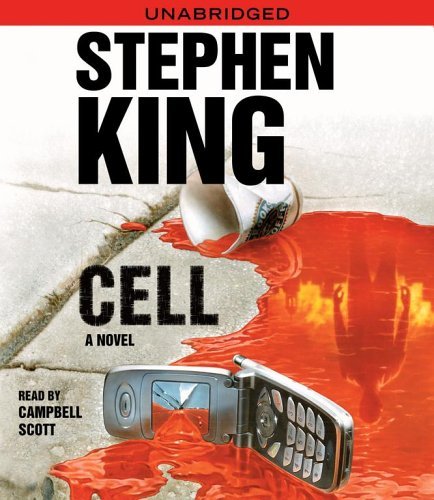
Science Fiction & Horror Audiobook - Cell by Stephen KingCell
By Stephen King; Read by Campbell Scott
8 Cassettes or 12 CDs – 12.5 Hours [UNABRIDGED]
Publisher: Simon & Schuster Audio / Recorded Books
Published: 2006
ISBN: 0743554329 (Cassette), 0743554337 (CD)
Themes: / Horror / Science Fiction / Apocalypse / Zombies/ Journey /
Survivors / Terrorism

There’s a reason why cell rhymes with hell.

Stephen King’s latest book is a return to form for this master of horror. In it, everyone with a cell phone goes stark raving mad after they receive some kind of pulse through their cell. The pulse, likely sent by terrorists, wipes the victims’ minds clean. This story takes no time to get started. Within the first few minutes, you are drawn into this nightmare scenario, steeped in gore and horror.

The main character, Clayton Riddell, finds himself in Boston when the pulse drives the majority of people biting, scratching, and murderously mad. He is joined by a band of likable characters as they set off to get out of Boston. Meanwhile the victims of the pulse start behaving more like Zombies and start flocking together and evolving with even more unexpected behavior.

Much of this material is familiar ground for King. But the narrative drive is strong, and it doesn’t drag with shear verbosity as King’s writing sometimes does. Campbell Scott reads the audiobook. Scott is a very competent narrator who’s also a film actor and has appeared in movies like The Exorcism of Emily Rose. His narration is restrained and subdued which works well with the apocalyptic horror being described. His Boston accents are excellent without being overdone. He’s also the son of the late George C. Scott.

I’ve got two qualms with the audiobook. If it’s unabridged, shouldn’t it contain the dedication? I picked up the hardcover edition at the store and found it was dedicated to George Romero and Richard Matheson. George Romero was the director and writer of the Night of the Living Dead and it’s sequels. Richard Matheson wrote the seminal post-apocalyptic vampire novel, I am Legend, in 1954. There is no dedication on the audiobook. Doesn’t unabridged mean word for word? The dedication definitely foreshadows what kind of novel Cell is to be.

Also there are places in the second half of the book where the narrative voice totally changes. It sounds as if they needed some pick-ups done, to fix small mistakes, and Mr. Scott was not available so they plugged someone else in. Overall these are small distractions, and the audiobook is a hard to turn-off listen.

Review of The Voice from the Edge: Midnight at the Sunken Cathedral by Harlan Ellison

SFFaudio Author of the Month

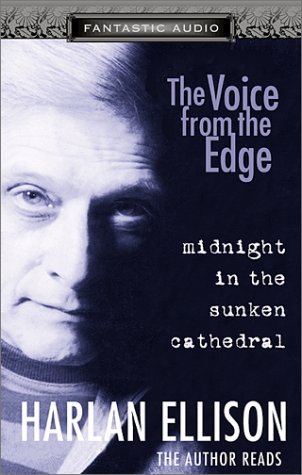
The Voice from the Edge: Midnight in the Sunken Cathedral by Harlan EllisonThe Voice from the Edge: Midnight in the Sunken Cathedral
By Harlan Ellison; Read by Harlan Ellison
5 CDs – 5 Hours [UNABRIDGED]
Publisher: Fantastic Audio
Published: 2001
ISBN: 1574534157
Themes: / Science Fiction / Fantasy / Horror / The Mob / Dreams /

Harlan Ellison will talk your ear off. After listening to the man perform 11 of his stories over the better part of five hours, I’ve come to the conclusion that he is not the type of guy that you’re going to be able to get away from easily; not once he’s started talking. But would you want to? Ellison is like the guy you sit down next in a bar only because it’s the only seat open, praying that he’ll leave you alone, but, sure enough, he turns to you and immediately begins to regale you with that “Car Talk” voice of his about his latest exploit. “Terminator? My idea. That sumbitch James Cameron tried to pass it off as his own, but I wasn’t having it.” Or, “I tell you I never met anybody more uptight than those guys over at Disney. I make one little joke… it was stupid, yeah, but just a joke! Of course nobody would really ever draw Tinkerbell doing that, but try telling those guys that you were only joking. Nope; there’s ol’ Harlan, out on his ass the same day he was hired.” Ellison seems to be one of those guys that are vastly entertaining to listen to, and to watch in action, but only as long as his perpetual low-level rage is never directed at you.

Which is what makes this collection perfect. You get to sit in your car, office, wherever, and hear Ellison tell you some of his best stories without ever worrying that you’re going to get more involved than you want to be. But, maybe you should be worried, just a little. While there are a few stories in this collection that are pretty light-hearted from beginning to end, most of them begin innocently enough, but then slowly become more and more disturbing until it’s almost impossible not to feel some sense of unease and trepidation, and then, when they end, almost palpable relief. “S.R.O.,” for example; what starts out as a cheery little tale of off-center entrepreneurship, read in Ellison’s best 1920’s gangster voice, begins to drift into a much more solemn treatment of beauty and the lengths to which people will go to experience it.

Then there are the stories which begin creepy and stay that way. “The Function of Dream Sleep” begins with the image a mouth opening in a man’s side, which is disturbing enough, but Ellison keeps on turning the “dread” knob up until even driving along an interstate in broad daylight seems somehow sinister and unreal. I’d be interested in reading these stories in text form to see how much of this sensation comes from the actual writing and how much comes from the sheer desperation Ellison puts into his performances. I wasn’t surprised to see that Ellison has a few acting credits to his name, (most awesomely, “man at orgy” in Godson); the range of character and emotion that are present in these readings rivals that of any “professional” reader. At times it’s apparent that Ellison’s familiarity with the stories allows him to enhance his performances by adding laughter, stutters, and other little bits of paralanguage that only he would be able to get away with. The postscript to “The Function of Dream Sleep,” in which Ellison explains some of the elements of his most autobiographical story, is also told in this extemporaneous manner. It’s like the old guy at the bar has finally started to wind down and is going casually toss off one last bit of terror that will keep you up for weeks before he empties his drink, slaps you too hard on the back, and starts shuffling for home.

Review of The Answer by Philip Wylie

SFFaudio Audiobook Review

Science Fiction Audiobook - The Answer by Philip WylieThe Answer
By Philip Wylie; Read by Joel Grey
1 Cassette – Approx. 90 Minutes [UNABRIDGED]
Publisher: Dove Audio
Published: 1996
ISBN: 0787105139
Themes: / / / / / / /

“What egotism, what stupid vanity, to suppose that a thing could not happen because you could not conceive it!”
– Philip Wylie & Edwin Balmer from When Worlds Collide

This audiobook of The Answer (subtitled A Parable For Our Times), was produced by Stefan Rudnicki. You should care because whenever Rudnicki gets involved with a project you’re pretty much guaranteed of two things: 1. A quality story. 2. A quality production. Rudnicki is himself a talented narrator, he’s been involved with some of the best short story collections on audio, won two big fistfuls of Audie awards and even a Grammy. Most impresive of all he was the mastermind behind the SFFaudio essential audiobook edition of Ender’s Game by Orson Scott Card! I was only vaguely familiar with Philip Wylie’s work prior to this novellette, I’d heard his dystopian novel The End Of The Dream and known that he had co-written the novel that became the feature film When Worlds Collide. So I did some research, The Answer was originally published in “The Saturday Evening Post” in 1955, adapted to television the same year and then republished several times in paper-book form since. The story was written in the shadow of the cold war the context for which the unstated question is asked – with that shadow faded the story still has power, but I suspect that it has been somewhat diminished.

Aboard a United States aircraft carrier in the South Pacific a distinguished team of nuclear scientists, politicians, naval and air-force officers await the impending test of an atomic bomb. The test, code named Operation Bugaboo, makes one officer question the very fabric of his belief, or rather his lack thereof. Major General Marcus Scott is an agnostic and skeptic, a veteran of WWII with a long and distinguished career behind him. But after the test is conducted and a single unforseen casualty is reported Scott’s entire worldview is shaken to its foundations. Discovered, as an apparent casualty of the tremendous hydrogen bomb blast is a winged figure, one even his ubelieving eyes can only describe as an angel.

While at first very satisfing on a level of sheer storytelling I noticed upon repeated listening Wylie’s writing scaffolding, the somehat forced structure upon which the story relies for power. For believability’s sake there are really too many coincidences. The scientifically testable circumstances, which are what you are buying when you listening to science fiction – are flushed away into circumstances no easier to swallow than ‘historical’ reports of angels, as the subtitle suggests “a parable for our times?”. Is it really meant to be a parrallel with historical reports of angels? Or is the structure simply in place to give narrative meaning to the story? I don’t know. But no matter how it was made, the story is only going to be offering comforting evidence to a believer, and however well meaning the point of the story, “the answer” of the title is at very best, in my opinion, only a wishful maxim. Flavour me unconvinced while still having been emotionaly involved by the tale.

An added music consists of a pipe organ, woodwind and stringed instruments. These are used to subtly underscore the emotions of the two viewpoints shown. Varied music gives ethereal holiness, timelessness or thoughtful reflection to specific scenes and to underscore others with their absence. Though generally I prefer unaccompanied readings it isn’t overwhelming here. Reader Joel Grey shines, by packing an emotional wallop witout doing much in the way of characterization. He’s able to confer the general mood of frustrated sadness that the story requires given the limited role the characters have. This audiobook is now out of print but you can still get it through Audible.com.

Posted by Jesse Willis