Review of The First Men in the Moon by H.G. Wells

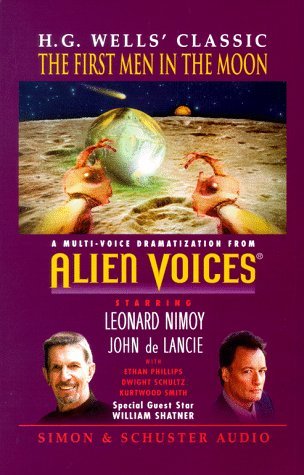
Science Fiction Audio Drama - The First Men in the Moon by H.G. WellsThe First Men in the Moon
By H.G. Wells, performed by a full cast
2 Tapes, Approx. 2 hours – [AUDIO DRAMA]
Publisher: Alien Voices
Published: 1998
ISBN: 0671872281
Themes: / Science fiction / Aliens / Sociology / Space Travel /

Oars slap against water and thud against wood, waves lap against a small boat bobbing in the ocean, and shore birds scree along the not-too-distant shore. You close your eyes and are transported to another time and place, a sonic virtual reality in which two fisherman sit to either side of you, discussing the catch and the mysterious steel sphere that falls from the sky. Such richly detailed soundscapes draw you into this adaptation of H.G. Wells’ The First Men in the Moon, and whisk you along from the familiar sounds of earth to the speculative sounds of deep space and the moon.

The acting is uniformly excellent, as well, with Leonard Nimoy and John de Lancie leading a talented cast with their spot-on characterizations of Professor Caver and Mr. Bedford. These two form a buzzing, absent-minded scientist and cool, craven capitalist odd-couple who develop a spaceship built around gravity-blocking shutters and then fly it to the moon. The civilization they discover beneath the moon’s surface is, well, substantially alien. This tale isn’t quite Wells’, but it is told with such ebullience and impressive audio depth that you can’t help liking it. In fact, the genial enthusiasm that suffuses the entire production proves both the greatest strength and the greatest weakness of the work: It makes for fun listening, but it winds up blunting some of Wells’ sharper observations about humanity and reason.

On the plus side, this adaptation does an admirable job of streamlining Wells’ sprawling narrative to lead us effectively from the thrill of invention to the uncertainty of exploration, from budding friendship to estrangement, and from difficult first contact to horrifying understanding. But there are several missteps along the way. For one thing, the voyage to the moon has been clumsily appended with a comet rendezvous that cheerily ignores even Newtonian physics and leads to an incomprehensible predicament with the Caverite shutters. What’s more, a staged “revolution” on the moon is utterly unconvincing, and even more disappointing, the Grand Lunar is transformed from a rational genius to a power-mad egomaniac.

But the most important transformation is thematic. Wells’ original compares human terrestrial civilization with the formic lunar one to contrast life as we know it with his vision of a completely rational society. Both have distinct horrors: We have war and poverty, the Lunarites have de-evolved sub-races and casual deactivation of inconvenient units. In this production, the comparison seems more like one between Capitalism and Communism, and it reverses the threat at the end to be something like a Red Scare, which makes no sense when you consider which society has the more demonstrably violent past.

On the whole, this is a fun production and a treat to listen to. Enjoy it for what it is, but do not attempt to substitute it for a reading of the original.

Posted by Kurt Dietz

James Patrick Kelly Men Are Trouble

news

Men Are Trouble By James Patrick KellyThe James Patrick Kelly Free Reads podcast has just launched chapter one of Jim’s newly-Nebula-nominated novellete Men Are Trouble! Jim promises to post a chapter a week for eight weeks making this another unabridged audiobook verison of his great stories. Since Men Are Trouble is a female first person POV story he felt it “wrong” to read it himself, so he’s hired actor Genevieve Aichele, Artistic Director of the New Hampshire Theatre Project to do the reading for him.

You can access the feedburner archives for Men Are Trouble (and his recently completed novella Burn too) at:

http://feeds.feedburner.com/freereads

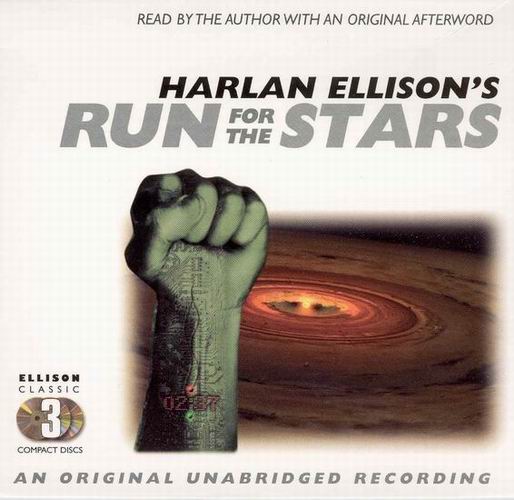
Review of “Run for the Stars” by Harlan Ellison

Science Fiction Audiobook - Run for the Stars by Harlan EllisonRun for the Stars
By Harlan Ellison; Read by Harlan Ellison
3 CD’s – 122 minutes – [UNABRIDGED]
Publisher: ReQuest Audiobooks
Published: 2005
ISBN: 1933299533
Themes: / Science Fiction / Alien invasion / Drugs / Insurgency /

It was recently announced that Harlan Ellison will be named an SFWA Grand Master at the Nebula Awards Weekend in May. Regular readers of this website should know that I’m thrilled with the decision, as Ellison is easily one of my favorite writers. He also happens to be one of my favorite narrators. His audiobooks are insistent, as if he is vocally grabbing your shoulders to make sure you have his full attention.

Ellison to me is Ellison – he’s his own genre. He takes his main character and dangles him so far in the wind that the reader can’t possibly imagine him coming back. Yet he does come back, but is invariably damaged along the way. It’s painful to hear, how we treat each other. Very difficult to look at. But Ellison shows it to us, even here in his early work.

“Run for the Stars” is the story of a man named Benno Tallant, a drug addict who finds himself in a position to fight back against the Kyben, an occupying alien race. Unlike most alien invasion stories, this is happening to a colony that is not so friendly to Earth, which is the aliens’ next stop. Tallant fights not only the aliens, but his fellow humans. And himself – the reader is never certain that he wants to save the Earth, or himself for that matter.

The audiobook also includes some commentary from Ellison about the origins of the story, and how it got published. Commentary like this in an audiobook really enhances its value in my eyes. I enjoyed it as much as I did the story itself.

“Run for the Stars” is a fabulous listen – the first title we’ve reviewed from ReQuest Audio. In the hopper are two other ReQuest titles – “Eye for Eye” by Orson Scott Card and “Tales from Nightscape” by David Morrell. You can find their website here. I hope to hear much more from them in the future.

Posted by Scott D. Danielson

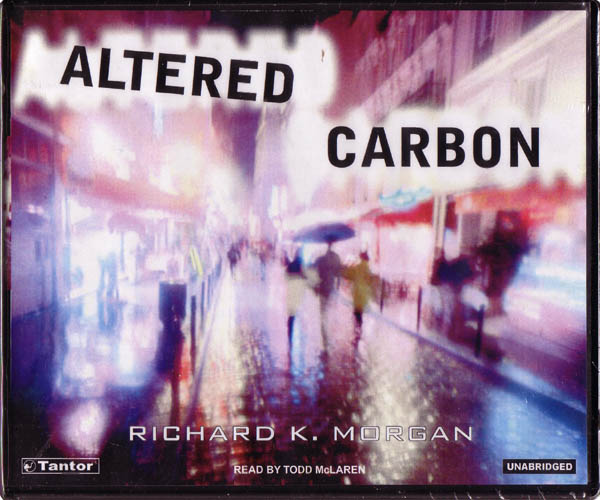
Review of Altered Carbon by Richard K. Morgan

SFFaudio Review

Science Fiction Audiobook - Altered Carbon by Richard K. MorganAltered Carbon
By Richard K. Morgan; Read by Todd McLaren
14 CDs or 2 MP3-CDs – 14 Hours 54 Minutes [UNABRIDGED]
Publisher: Tantor Media
Published: 2005
ISBN: 1400101379 (Retail CDs), 1400131375 (Library CDs), 1400151376 MP3-CDs
Themes: / Science Fiction / Mystery / Cyberpunk / Immortality / Artificial Intelligence / Galactic Civilization / Conciousness Uploading / Hardboiled Fiction / Noir Fiction /

“Fuelled by every crime noir novel I’d ever read, plus swabs of French and Japanese cinema, the work of William Gibson and M. John Harrison, early Poul Anderson and Bob Shaw, and last but not least the colossal impact of Bladerunner, this was my take on future noir. Fast forward to middle of the new millenium, and down where it counts, nothing has changed, because neither have we. Enter Takeshi Kovacs.”
–Richard K. Morgan

Altered Carbon is a stunning debut novel. A near classic, it boils over with solid SF ideas all encased in violent and vivid prose as told in a hardboiled first person narration. Set a few hundred years in the future, humanity has started colonizing the galaxy under the supervision of the United Nations. From one such world comes Takeshi Kovacs, an ex-U.N. Envoy (interplanetary special forces) who’s been brought to Earth in order to work as a private detective for a murdered “Meth”. Meths are the ultra rich, able to afford new cloned bodies so that they can live forever. This is achieved by means of the “cortical stack” technology, a backup harddrive for one’s mind, implanted in the skull shortly after birth. Most people can’t afford to be “re-sleeved” after they die, and so languish in storage for centuries. Convicted criminals have their bodies sold out from under them.

Interplanetary travel is done by way of “needlecast”, a form of faster than light transmission of data. No bodies are transported – visitors from distant planets are re-sleeved in a local body. With these technologies many of society’s values have changed. “Real death” is rare, “organic damage” is far more common. And even real death, the destruction of a cortical stack, isn’t necessarily the end since the ultra rich keep backups. Needlecast transmission of stack’s data on a regular basis makes one virtually immortal. Like working with any fallible system though you just have to remember to backup, and frequently.

Laurens Bancroft, a centuries old tycoon brought Kovacs to Earth in order to investigate his apparent suicide, something the Meth thinks was really a murder – though he can’t say for sure as he was backed up 48 hours before his death. The investigation leads Kovacs into a tangled web of politics, prostitution and power games with stakes as high as an immortal lifespan can offer. Thrown into the mix is a dirty cop, his driven parter, an artifically intelligent hotel, and a whole lot of bloodshed.

Though at first blush this appears to be a straight out neo-cyberpunk novel, it has more depth. The mystery and hardboiled elements are a direct homage to Raymond Chandler’s The Big Sleep with Kovacs in the Philip Marlowe role. Like The Big Sleep, Altered Carbon is complicated and hard to follow, with many characters double and triple-crossing each other. SF elements, like the conciousness uploading, are not particularily new, but Morgan’s take is, and it is well integrated into the plot. One scene which has Kovacs “cross-sleeved” into a female body for investigative purposes illustrates just how wild the concept of this kind of mind swapping can be.

There are several lengthy sex scenes and even more combat scenes. I liked the way they were handled (some of the descriptions were positively Gibsonian) but I grew fatigued at their numerousness and frequency. Another problem was the over-use of “neuro chem” as a cure all for crisis situations. UN Envoy training allows envoys to battle harder and smarter than anyone without such training, so whenever things get rough for Takeshi, and they get rough frequently, he falls back on his “neuro chem.” The problem there is it ends up working like an inexaustible turbo boost – he’s too powerful, too skilled for sustained anxiety on the part of the reader. Like Neo in the second and third Matrix movies, we stop caring. On the other hand, the plot twists delightfully defy expectation and are cleverly rendered. The way the story is told is reminiscent of the best kinds of noir fiction. It is as solid a modern science fiction novel that reads better than any first novel has any right to be.

Tantor sent us the Library bound CD edition, which came in a clamshell stlye plastic case. Durable and easily accessed. Sound quality is near flawless with high recording levels. Narrator Todd McLaren is Takeshi Kovacs, and his reading is cool and smooth like the confident interstellar hard-case he’s portraying. There are at least a half dozen female roles he’s equally adroit with, some of which required breathy libidinousness, some irate rage. I look forward to an encore performances in the sequel, Broken Angels.

Incidentally, Tantor Media snapped up all four of the Richard K. Morgan novels released so far, you can check them out HERE along with more than a dozen other Science Fiction and Fantasy titles available so far. Tantor is becoming a solid source for SF&F audio goodness.

Posted by Jesse Willis

SF has an influence in the real world. Need proo…

Online Audio

SF has an influence in the real world. Need proof? Big Brother isn’t just an idea in an George Orwell novel. Political Science Ficion is good stuff and finally there’s someone out there proving it…

Good old Doc Brown (Professor Courtney Brown Ph.D) of Emory University in Georgia (USA) is offering a Political Science course entitled Science Fiction and Politics (Political Science 190) and he’s making the lectures available as a podcast. The spring 2006 semester has already started, but don’t worry there’s no cost to audit. SFFaudio gives it an A+!

Lectures already available include:

Class #01: Introduction and Overview |MP3|
Class #02: Foundation by Isaac Asimov (1 of 2) |MP3|
Class #03: Foundation by Isaac Asimov (2 of 2) |MP3|
Class #04: Foundation And Empire by Isaac Asimov |MP3|
Class #05: Second Foundation by Isaac Asimov |MP3|
Class #06: Brave New World by Aldous Huxley (1 of 2) |MP3|
Class #07: Brave New World by Aldous Huxley (2 of 2) |MP3|
Class #08: The Left Hand Of Darkness by Ursula K. Le Guin (1 of 2) |MP3|
Class #09: The Left Hand Of Darkness by Ursula K. Le Guin (2 of 2) |MP3|
Class #10: The Uplift War by David Brin (1 of 2) |MP3|
Class #11: The Uplift War by David Brin (2 of 2) |MP3|
Class #12: Darwin’s Radio by Greg Bear (1 of 2) |MP3|
Class #13: Darwin’s Radio by Greg Bear (2 of 2) |MP3|
Class #14: How to write your essays |MP3|
Class #15: Ender’s Game by Orson Scott Card (1 of 2) |MP3|
Class #16: Ender’s Game by Orson Scott Card (1 of 2) |MP3|
Class #17: The Forever War by Joe Haldeman (1 of ?)|MP3|
Class #18: ??? |Forthcoming|
Class #19: ??? |Forthcoming|
Class #20: ??? |Forthcoming|
Class #21: ??? |Forthcoming|

Forthcoming lectures will cover Neuromancer, Do Androids Dream of Electric Sheep? and The Moon Is A Harsh Mistress.

Were I attending the classes in person I’d have banged my shoe on the desk and insist we talk about a Mack Reynolds novel. Maybe later in the course?

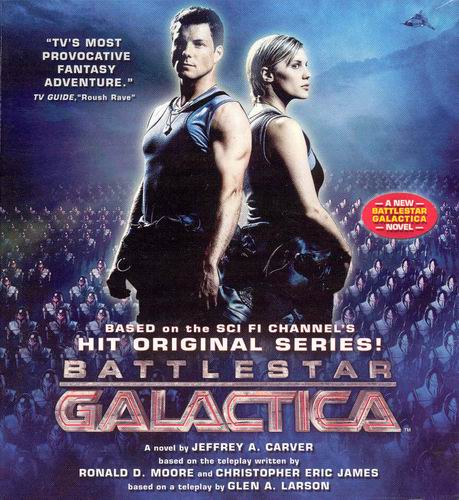
Review of Battlestar Galactica by Jeffrey A. Carver

SFFaudio Review

Science Fiction Audiobook - Battlestar GalacticaBattlestar Galactica
By Jeffrey A. Carver, based on the teleplay written by Ronald D. Moore and Christopher Eric James, based on a teleplay by Glen A. Larson
Read by Jonathan Davis
4 CD’s – 4 hours [ABRIDGED]
Publisher: Audio Renaissance
Published: 2005
Themes: / Science Fiction / War / Robots / Military / Government / Space Travel / Mythology / Religion /

Has anyone else noticed how good television has become during the past ten years? Well, 13 years. In 1993 Babylon 5 first aired, ushering in a new wave of science fiction and fantasy television that is both smart and damned entertaining. Following B5 was Joss Whedon’s Buffy the Vampire Slayer and Firefly. Many would put Farscape and Stargate in the same category. I haven’t seen enough of either to make that judgment. We could quibble about the list of this new wave all we want, but currently at the crest of that wave is the Sci-Fi Channel’s Battlestar Galactica, which is, without doubt, the best science fiction show currently in production.

This audiobook is an abridgement of the novelization of the first Battlestar Galactica show, which was a 4-hour mini-series that originally ran in 2002. I admit that even typing that makes me wince. An abridgement of the novelization of a television show. How much farther from Shakespeare can a person get? Not exactly high falutin culture here.

But this story is edgy, tense, and complex. It opens with a complacent human race that has gotten used to life without their enemy, the Cylons. The Cylons were human-built machines that rebelled, then accepted an armistice agreement around 40 years before the beginning of this audiobook, which is primarily about the sudden unexpected attack on humanity by the Cylons. The attack leaves the Battlestar Galactica as one of the very few ships that survives, and the immediate aftermath sets up several storylines that are followed in the television series.

Jonathan Davis, who keeps pretty busy with the many Star Wars audio titles, narrates, and does his typical and excellent job with it.

I’m a fan of this series, and was happy to receive this audiobook. Though the audio offers nothing new over the miniseries itself, it was an enjoyable way to experience the story while driving. I’m not sure if Audio Renaissance plans to continue releasing Battlestar Galactica titles, but because of the nature of the series, they would have to release every episode since each one is dependant on what takes place before.

Posted by Scott D. Danielson