Review of The Hitchhiker’s Guide to the Galaxy: Tertiary Phase

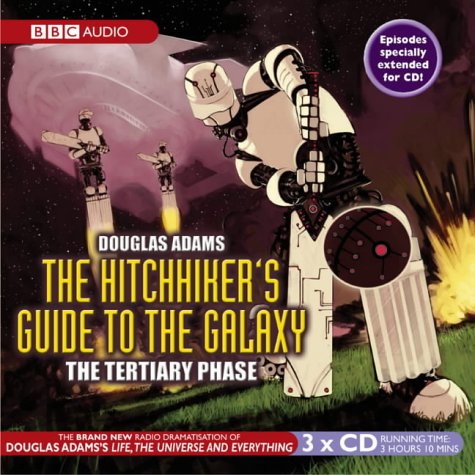
Science Fiction Audio Drama - The Hitchhikers Guide to the Galaxy Tertiary PhaseThe Hitchhiker’s Guide to the Galaxy: Tertiary Phase
By Douglas Adams, adapted by Dirk Maggs, performed by a Full Cast
3 CD’s, 3 hours [AUDIO DRAMA]
Publisher: BBC Audiobooks
Published: 2005
ISBN: 0792735919
Themes: / Science Fiction / Comedy / Time travel / Space travel /

A review by Steven H Silver

When The Hitchhiker’s Guide to the Galaxy originally appeared on the BBC from 1978-1980, it consisted of twelve episodes (called “fits”). The first six of these fits were later refashioned to form the novels The Hitchhiker’s Guide to the Galaxy and The Restaurant at the End of the Universe. Turning his back on the medium of radio for several years, Douglas Adams continued the story with the novels Life, the Universe and Everything, So Long, and Thanks for All the Fish, and Mostly Harmless. This caused continuity problems when the decision was made to return the series to its original medium.

Following in the footsteps of Arthur C. Clarke, who decided to write a sequel to the more widely known film 2001 rather than his book of the same title, the BBC produced a radio sequel to the books Adams wrote rather than to the radio series. The result is the complete disregard for fits 7 through 12 of the radio broadcasts as the beginning of The Hitchhiker’s Guide to the Galaxy: The Tertiary Phase picks up where the now retitled The Hitchhiker’s Guide to the Galaxy: The Primary Phase left off. There is a slight attempt to explain Zaphod’s adventures in those missing fits, but not Arthur nor that of Ford.

The BBC has successfully put together the surviving cast from the first series, which was more than they did for the second series. Simon Jones, Stephen Moore, and Mark Wing-Davey, who played Arthur Dent, Marvin, and Zaphod Beeblebrox on both radio and television, and Geoffrey McGivern (Ford Prefect) return for their third series. Susan Sheridan, who portrayed Trillian in the first series has returned to the role for the third series. The replacement of Peter Jones (the Book) by William Franklyn and Richard Vernon (Slartibartfast) by Richard Griffiths works well.

The inclusion of Adams’s own voice for the character Agrajag is a nice touch. Since Adams died before the series could begin production, a recording of him reading Agrajag’s lines from the audio version of Life, the Universe and Everything was used with some resampling which allowed it to fit in quite well with the general flow and sound of the broadcast.

Unfortunately, one of the problems with the Tertiary Phase is the same as one of the problems with the novel upon which it is based. Notably, although it contains the characters Adams created for the Hitchhiker’s Guide series, the story itself is a plot originally created by Adams for the television series Doctor Who. Another difficulty with the Third Phase is that because it is based on the novel, Life, the Universe and Everything, it lacks the sense of originality of the first two series, which formed the basis of everything that came after.

The Tertiary Phase strives to recreate the feel of the original series broadcast twenty-five years ago, and manages to achieve that goal. However, both the dialogue and the plot lack the originality of wit which caused those first two series to be so successful and launch Adams’s career. Fans of the Guide will enjoy listening to the broadcast, and will eagerly await the final phase, but it won’t recreate the feeling of listening to The Hitchhiker’s Guide to the Galaxy in the late seventies.

This review is copyright 2005 by Steven H Silver, and first appeared on SFSite in January, 2005.

Review of The Hitch-Hiker’s Guide to the Galaxy By Douglas Adams

Science Fiction Audio Drama - The Hitchhiker's Guide to the GalaxyThe Hitch-Hiker’s Guide to the Galaxy
By Douglas Adams, performed by a Full Cast
6 Cassettes, 6 hours [AUDIO DRAMA]
Publisher: The Mind’s Eye
Published: 1988
ISBN: 0881425671
Themes: / Science Fiction / Audio Drama / Humor / Aliens / Space travel / Time travel /

I have to cringe whenever an important milestone in Dr. Seuss’s surprisingly robust afterlife comes around, because it is inevitably greeted with a hundred grating “Seuss-like” paeans from every journalist, columnist and otherwise admittedly illiterate citizen who makes the amazing discovery that the English language is crammed to bursting with words that rhyme. More, even, if you make up a few of the words yourself. Douglas Adams can be similarly “inspirational”. Much of what is written about him is filled with disorientingly obscure citations and facile imitations. I appreciate why: He and Seuss made it look so easy, we can scarcely resist attempting to recreate their magic ourselves. But I will admit right now that if I could write like Adams, I wouldn’t be sitting here bashing out brief audio book reviews for an utter lack of pay. I will also admit that I have incorporated much of Adams’ prose into my own genome, and hope to transfer it genetically to my offspring (an aspiration my wife does not seem to regard with the same urgency). I will not, however, take a crack at trying to impress you with my abilities to mimic and quote. I don’t want to embarrass myself.

These tapes are of the very first incarnation of The Hitch-Hiker’s Guide to the Galaxy, the Ur-myth that inspired a trilogy of four novels, a diabolical computer game, a television show, and an upcoming movie. More than just a recording of a funny radio play, these tapes represent the annunciation of Douglas Adams as the major talent in science fiction humor: a veritable shot heard round the world. The story itself is an ambling monstrosity of interplanetary adventure, time travel, and hidden questions about the meaning of the universe and the origin and fate of the planet earth. Of course, with all successful humor, what it is really about are the characters (in this case, chiefly Arthur Dent, Ford Prefect, Zaphod Beeblebrox, Trillian, and Marvin the android) and the way they interact and bicker as wave after wave of crazy crap happens to them. The prose is exquisite (“They hung in the air exactly the way bricks don’t.” Oop! That was a quote, wasn’t it?), the settings range from imaginative (Magrathea) to bizarre (Milliways), and the information provided by the Guide itself is always tangential and hilarious.

But for fans of the books or the television show, what is truly remarkable about the first and second half of the tapes (the primary and secondary phases of the radio play) is not their utter perfection, but Adams’s uncanny ability to tweak them to even greater heights. The escape from Milliways is an excellent example. In these tapes, the use of an alien navy commander’s space ship is a little weak, but in the latter versions, the material Adams adds about the band “Disaster Area” and their cataclysmic concerts not only makes a better doomed escape, but contains some of the most memorable lines and images in the whole series. And the way he combines the primary and secondary phases of the radio show to produce an interweaving of the Dent/Prefect and Beeblebrox/Zarniwoop story lines in the novels not only increases the dramatic tension more organically, but also fills many of the logic holes that perforate the second half of these tapes. It’s like a graduate-level class in editing, only funny.

Of course, this radio play is not simply a virtuoso performance by the author, but a monumental ensemble production, as well. Mark Wing-Davey’s spacey portrayal of Zaphod Beeblebrox makes even Bill Murray’s Peter Venkman look pretty well plugged in, and Stephen Moore’s Marvin the android is a walking mechanical disaster of painfully amusing dimensions. Those are my two favorite performances, but the others are similarly tight: Simon Jones captures the bewilderment and hysteria of Arthur Dent perfectly; Geoffrey McGivern delivers a Ford Prefect who is helpful, roguish, and enigmatic; Peter Jones gives the voice of the book a zany, reassuring sound like a kindly but mad uncle; and Susan Sheridan provides a smart yet seductive Trillian Add in the myriad voices of mice, computers, doors, and smug waiters; the wonderful special effects of the BBC Radiophonic Workshop; and the loopy grandeur of the Eagles’ “Journey of the Sorcerer” as the main theme and you have a work of audio magic that will tickle your brain and delight your ears.

But don’t believe for a minute that we all walk around quoting this radio play in our daily speech simply because it provides hours of silly hijinx.. Adams ventures beyond situational and linguistic surprise to grapple with the humiliating vastness of the universe and the mind-boggling possibilities of infinity, and it is this theme that anchors the series so firmly in the subconscious. Philosophy, religion, and calculation are shown to be helpless before the unrelenting immensity of everything, and the only response we are left with is either suicidal hopelessness or laughter. We are forever indebted to Douglas Adams and the BBC cast for saving us with laughter. So I urge you to buy, rent, or steal these tapes as soon as you can and begin stuffing as much of the prose into your memory as it will hold. What else are you saving all that underpowered gray matter for?

Posted by Kurt Dietz

Review of A Walk in the Sun By Geoffrey A. Landis

Science Fiction Audiobooks - A Walk in the Sun by Geoffrey LandisA Walk In The Sun
By Geoffrey A. Landis; Read by Amy Bruce
1 CD – 51 Minutes [UNABRIDGED]
Publisher: Infinivox
Published: 2004
ISBN: 1884612318
Themes: / Science Fiction / Hard SF / The Moon / Survival /

A haunting piano melody cascades into the shimmering electronic signature music of Infinivox’s “Great Science Fiction Stories” series. IT IS EPIC… and deservedly so. This Hugo Award winning short story is a poignant and ingenious tale of a stranded Astronaut on the moon. Theoretically Trish Mulligan’s smashed spaceship’s contains everything she needs to survive; maps, food, water and her solar-powered spacesuit. She manages to broadcast a distress signal to Earth, but to survive until they arrive she’ll also need to outrun the sunset. If the sun sets, her suit’s automated life support system will stop working and she’ll die on the moon….. So, she’ll have to race the sun. On Earth it would be an interminable marathon pace but at least there she wouldn’t be alone. Though author Geoffrey Landis is only a part time science fiction writer, he works for NASA as his day job; you wouldn’t know it by this story. A Walk In The Sun reads like it was written by a Grandmaster! I really enjoyed this problem-solving story, I can see why it won the Hugo award!

This is a relatively unadorned production, but there are voice effects, echoing, static etc., but they don’t hurt the story at all. Sound quality on this CD release is 100% perfect – with a pair of headphones on you’ll be right there in the moment. Musical interludes are used now and again throughout the reading to effectively suggest the passage of time.

While narrator Amy Bruce is no vocal chameleon, her range is limited, the emotional investment she gives her reading delivers the goods. This Infinivox re-release (the original was published on cassette in 1998) is a threefold improvement on the same production. Packaging. This CD comes in an ingenious slimline case that securely sandwiches the disc – but allowing you to see it at the same time. The cover art for the audiobook is the disc itself! This saves space, stores easier and safer and costs less. What is not to love? Even better, in celebration of these new CD format, Infinivox has placed all their titles (cassette and CD both) on sale for 50% off. At that price I couldn’t resist, I bought one of each, even though I already owned most of them on cassette! Also of note is the attention to fixing problems – Infinivox staff have corrected an error in the packaging copy for these CD releases – the original cassette edition mistakenly stated A Walk In The Sun was a “Nebula Winner”, when it was in fact a “Hugo Winner”. Better sound quality, better packaging, lower price, an AWESOME story, what is not to love?

Posted by Jesse Willis

Review of The Nine Billion Names Of God by Carter Scholz

Agony Column - The Nine Billion Names of GodThe Nine Billion Names Of God
By Carter Scholz; Read by Carter Scholz
RealAudio Download LINK
13 Minutes 40 Seconds [UNABRIDGED]
Publisher: The Agony Column
Published: 2003
Themes: / Science Fiction / Metafiction / Plagarism /

Rick Kleffel’s “Agony Column”(http://trashotron.com/agony/) is the source for this unabridged reading of author Carter Scholz dadistic tale of a science fiction publishing. Sholz’s “The Nine Billion Names of God” is a truly odd experimental meta-science-fiction short story about an author named “Carter Sholz” who has submitted a word for word copy of Arthur C. Clarke’s famous short story to the editor of Novus Science Fiction Magazine in hopes of publication. This story – of that story – recounts the epistolary letters between the unbelieving editor, who of course rejects the story, and the obtuse author who insists that that although his story may be identical in every way to Clarke’s, it is, in fact, distinct. Subsequent revisions and resubmissions of the exact same story – letter unchanged – by Scholz makes for an amusing jape. Though to laugh it off as all merely a joke would be to ignore the quasi-profound ending – which itself parallels Clarke’s eponymous tale. By the way, it is not nearly as confusing as it sounds. Carter Scholz, though not a professional narrator, reads his story with aptitude. One must wonder however given his predilection for embellishment who exactly is reading the story….?

Posted by Jesse Willis

Review of Gravity By Tess Gerritsen

Gravity by Tess GerritsenGravity
By Tess Gerritsen; Read by Campbell Scott
4 Cassettes – 4.5 Hours [ABRIDGED]
Publisher: Simon & Schuster Audio
Published: 2002
ISBN: 0671046187
Themes: / Science Fiction / Disease / Disaster / Biology / Scientist / Medical /

Emma Watson, a brilliant research physician, has been training for the mission of a lifetime: to study living beings in space. Jack McCallum, Emma’s estranged husband, has shared her dream of space travel, but a medical condition has grounded and embittered him. He must watch from the sidelines as his wife prepares for her first mission to the International Space Station. Once aboard the space station, however, things start to go terribly wrong. A culture of single-celled organisms known as Archaeons, gathered from the deep sea, is to be monitored in the microgravity of space. The true and lethal nature of this experiment has not been revealed to NASA. In space, the cells rapidly multiply and soon begin to infect the crew-with agonizing and deadly results

If I had to write a review of this novel in one sentence it would read: “Gravity is like Blood Music for people who’ve never heard of Greg Bear.” Gravity is described by the publisher as “A Novel Of Medical Suspense”, which to me sounds like a crooked way of saying “science fiction for people who don’t like to get caught reading science fiction.” I used to have contempt for the writers of such deceptive doublespeak, but these days I’m more likely to save my contempt for the people who in actuality demand their literature be named in such disingenuous ways. The publishers really aren’t to blame. If they label it as science fiction it won’t get reviewed in the mainstream media – and it won’t be purchased by the fickle public who’d willfully pass up a book with a “science fiction” label in favor of a “medical thriller” or “techno thriller” label. Can someone please explain to me what is so wrong about being caught reading a novel with the words “science fiction” on the spine? I’ve heard people say they won’t buy books because the cover looked too “science-fictiony”. I suggest to you that to not like science fiction is to shut one’s self off from ideas. And though many people claim not to like science fiction, I think if they’d look critically at what they are reading they’d find themselves reading it – just under another name. Be honest with yourself, admit it, you do like it, that is all I ask.

But I stray from the path. Gravity reads a bit like Robin Cook’s Coma, but the major theme has more in common with Michael Crichton’s The Andromeda Strain than it does with hospital politics. The abridgement here is successful and Tess Gerritsen’s descriptions are clear but a bit dumbed-down. As an M.D. she should be fully capable of ratcheting up the science-speak, but for one reason or another chose not to. Despite this, I have few complaints. This is a good time passer. The story has an interesting setting and overall I was left with a satisfactory feeling. That said, I felt no pressing need to track down more of Gerritsen’s ‘Novels Of Medical Suspense.’

A few other problems: Simon & Schuster Audio has not spaced the tapes properly. Each side is of unequal length requiring much fast-forwarding. They also declined to mention when a side is ending, so the reading of a sentence ends as if it were simply a thoughtful pause and then tape plays on for many minutes. This is bad planning – for such a big company there are no good excuses.

Reader Campbell Scott’s precise intonation and clinical reading matches the medical perspective taken by Gerritsen in Gravity. Scott is no cuddly-dear of a voice, nor is he a cuddly-dear of a film actor and yet I find myself always pleased to spend some time with him now and again – he always manages to somehow draw me in even though his stiff demeanor makes me want to shy away.

Posted by Jesse Willis

Review of Cally’s War by John Ringo and Julie Cochrane

Cally's War by John Ringo and Julie CochraneCally’s War
By John Ringo and Julie Cochrane
Read by Christine Marshall and William Dufris
1 MP3-CD – Approx 13 Hours 15 Minutes [UNABRIDGED]
Publisher: Paperback Digital
Published: 2004
ISBN: 1584390034
Themes: / Science Fiction / Alien invasion / Secret agent / War /

She walked over to the body and tilted her head appraisingly a moment before carefully and deliberately spitting on it. “The name’s Cally O’Neal, and that’s for trying to kill me when I was eight.”

Cally is a member of the sisterhood of the Bane Sidhe, which is a group of underground warriors. It’s immediately apparent that she is a warrior who can withstand all manner of assault on her body in the name of completing her mission. I couldn’t help but to mentally insert Uma Thurman in the role of Cally, as the character’s complete indifference to violence and sex (both of which appear in this book in copious amounts) is reminiscent in ways to characters from Quentin Tarantino’s Kill Bill.

Cally operates in this novel in a complex post-invasion world. She meets all manner of interesting folk while solving a mystery of her own. The events in the first chapter provided a good running start into the novel, but the rest of the book never matched that potential. I was never interested again as the story took a decided turn for the expected.

The audiobook itself is done in a style that at first turned me off, but then won me over in a big way. Christine Marshall and William Dufris take turns narrating, depending on the point of view of the story. This is a technique that I generally enjoy. But during each other’s narrating duties, the other plays a role. Whenever Cally speaks, for example, it’s Christine Marshall doing the speaking whether she’s narrating at the moment or not. This is a technique that I generally abhor – I find it annoying and distracting nearly every time it’s tried. But… it works very well here for two reasons – first, they didn’t follow up every piece of dialogue with he saids and she saids – words which are as transparent with a single narrator as they are on the page, but with dual narration can become annoying. Second, the sheer skill of these two narrators makes the dialogue portions of the audiobook work wonderfully. Both narrators performed several believable characters each, and there was never any doubt who was speaking. The dialogue was snappy and well paced.

This is definitely science fiction of a sort that I don’t sample too often in print, since I feel like I get enough of this kind of story on the screen (big or small). The technical production, though, was absolutely first rate – among the best in the business – which makes me eager to hear titles from Paperback Digital that are more to my taste.

Posted by Scott D. Danielson