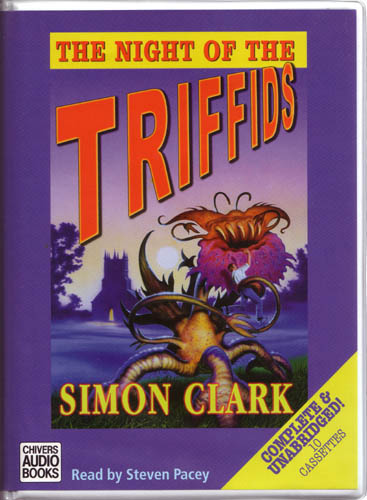
Review of The Night Of The Triffids By Simon Clark

The Night of the Triffids by Simon ClarkThe Night Of The Triffids
By Simon Clark; Read by Stephen Pacey
10 Cassettes – 12 Hours 30 Minutes [UNABRIDGED]
Publisher: Chivers Audio
Published: 2002
ISBN: 0754007669
Themes: / Science Fiction / Disaster / Society /

I was twelve years old when I discovered John Wyndham’s awe-inspiring The Day of the Triffids. For me, standing between the world of childhood and the mysterious new world of adulthood, it was a revelation [it] wasn’t merely a good story; it was such a powerful transforming experience that the hero’s struggle for survival has stayed with me ever since.”
-Author Simon Clark

Chock full of adventure, action, politics, revolution, and romance, The Night Of The Triffids is horror author Simon Clark’s sequel to the venerable 1951 John Wyndham novel The Day Of The Triffids. Wyndam’s story was about a confluence of two natural disasters – the appearance of some strange green lights in the sky that blinded anyone who looked at them and the subsequent rampage of a carnivorous walking plant called a Triffid – which was previously only a curiosity. The narrator of that tale was Bill Masen, a man who by pure chance managed to avoid becoming blinded like 99% of humanity. At the end of The Day Of The Triffids, the hero, Bill Masen and his wife and four-year-old son David leave the British mainland to join a new colony on the Isle of Wight. In a way that story was a kind of retelling of The War Of The Worlds, excepting that the aliens weren’t from Mars. That novel was a powerful disaster tale heavily influenced by the cold war era in which it was set. Simon Clark’s sequel takes place twenty-five years. It is told by David Masen, Bill Masen’s now grown-up son, who is an aviator in the fledgling Isle of Wight Airforce. The Masen family, along with a handful of other British survivors, have started rebuilding society on that Island off the south of Britain. But when a new disaster strikes humanity in its weakened state may not survive.

There are very few genuine science fiction elements in this book, the closest being the soft science fiction idea of adopting new values for new situations. As an example, the few remaining people have decided to take a crash effort to increase the population – and in so doing have created something called “Mother Houses”. These are convent-like homes where fertile women give birth and infertile women raise babies – all in an effort to maximize the birth rate. I’m not sure if Clark knew it or not but frighteningly, the Nazis’, had something similar – the “Lebensborn,” which were mother houses, set up by Heinrich Himmler to care for unmarried pregnant women whose “racial” characteristics (blond hair, blue eyes) fit the Nazis’ Aryan ideal. “Racially pure” SS members were encouraged to visit often and sire many young children for the Fuhrer. Horrific as such a baby factory sounds in The Night Of The Triffids this is but one of the ‘necessary evils’ that society is experimenting with. The good news is that it all manages to replicate
much of the feel of The Day Of The Triffids, but where Clark really stumbles is with the plotting. The opening scene and the ensuing couple of chapters are very interesting, and made me wonder where it all was going. But that mystery was dropped until a throw away explanation in the final chapter. And as the Brits say that ‘just isn’t cricket’. The whole book has a stumbling along bumbling along plot that doesn’t allow you to guess where it might be going – perhaps this was in part due to what I would assume was to be its target audience – preteens and young teens – heck it may have even been a stylistic choice. I don’t know.

What I do know is that what success Night Of The Triffids does have is due in no small part to the first person perspective. English narrator Stephen Pacey does good work with the compassionate everyman David Masen, his other voices including variously accented Americans are good too, though they were fairly easy to tell that it was a ‘put-on’ accents. If you’re not expecting it to surpass much less equal the original The Night Of The Triffids will be acceptable entertainment.

Posted by Jesse Willis

Review of Dune: An Interview with Frank Herbert and David Lynch

Dune: An Interview with Frank Herbert and David LynchDune: An Interview with Frank Herbert and David Lynch
1 Cassette – Approx. 1 Hour [INTERVIEW]
Publisher: Waldentapes
Published: 1983
ISBN: 0681308958
Themes: / Interview / Science Fiction / Moviemaking / Politics / Messiah / Power structures /

After reviewing Recorded Books unabridged Dune by Frank Herbert, Jesse suggested that I listen to this cassette which contains 2 interviews. One with Frank Herbert and David Lynch, the director of the first Dune movie, and an interview with Frank Herbert alone.

The interview with Lynch and Herbert shows how pleased Herbert was with Lynch’s film. The interview was recorded before the film’s release, and Lynch expressed nervousness while Herbert expressed satisfaction, along with some discussion of the difference between film and print, and the process of getting one to the other.

To me, the interview with Herbert alone (the bulk of the cassette) was the most interesting. Of Dune he said that what he wanted was “something that showed the impact of a messiah on history as the creator of a power structure.” His theory was that a messiah creates a power structure that attracts corruptible people, no matter how well-meaning the messiah might be. This led into a discussion of how a messiah is accepted by a culture in the first place, then into the nature of the power structure a messiah leaves behind, and into how this applies to contemporary power structures in government.

Another tidbit I picked up that I didn’t know is that Herbert considered Dune, Dune, Messiah, and Children of Dune one book, with Dune, Messiah being the pivotal book. I have not read past the first novel, so now I’ve got a couple more books on my TBR pile.

The entire program was interesting enough to listen to twice. If you are a fan of Dune, find yourself a copy of this! I think you’ll enjoy it.

Posted by Scott D. Danielson

Review of Night On Mispec Moor By Larry Niven

Night on Mispec Moor by Larry NivenNight On Mispec Moor
By Larry Niven, Read by Warren James
ARCHIVED ONLINE – Click here to visit Hour 25 and listen
27 Minutes [UNABRIDGED]
Publisher: Hour25Online.com
Published: 2001
Themes: / Horror / Science Fiction / War /

“Now I know that most of you quite rightly associate Larry’s writings with hard SF, not horror. But that doesn’t mean he can’t write a cracking good horror yarn when he sets his mind to it. But being one of the premiere writers of hard SF; when he writes horror it’s with his own unique twist. In Night on Mispec Moor Larry tells a tale about a man trapped in a place where the fog lies thick and close to the ground and where the dead really return to life. And though this story is most certainly horror, it is also hard SF. Way cool and highly memorable.”
-Warren James, Hour 25

For the 2001 Halloween broadcast of Hour 25, Warren James, the show’s host, with the kind permission of author Larry Niven, read the short story “Night On Mispec Moor”. This excellent tale was first published in Vertex Magazine‘s August 1974 issue. Thankfully, internet archiving allows us to still listen to this gem of a story! And though Warren James is not a professional audiobook narrator, his reading is a good! One minor issue though – as with any Hour 25 broadcast the volume has to be turned way up and there is some digitization to the sound. James also includes a short introduction to the story, and its well worth hearing. So if your in the mood for a really spooky hard SF horror story check it out.

Posted by Jesse Willis

From the Toot Our Own Horn Department… Announcing…

SFFaudio News

Deuce AudioFrom the Toot Our Own Horn Department… Announcing Deuce Audio!

The first two titles from our very own audiobook company, Deuce Audio, are available as of today for download from Fictionwise! They are: The Retrieval Artist by Kristine Kathryn Rusch, read by Stefan Rudnicki (2 hours, $4.99) and Shed Skin by Robert J. Sawyer, read by Stephen Hoye (45 minutes, $2.99).

Our goal is produce great audiobooks using excellent stories, performed by professionals, and at the best possible price. We hope you like them!

Though we’ve taken this baby step into publishing, be assured that SFFAudio will continue. Because we do this for the love of the stories and how they are told, we don’t expect our Deuce Audio publications to influence our objectivity when reviewing other titles. We certainly won’t review our own titles here (unless we find an independent voice to do so), nor will we fill your screen with “Buy me!” pop-ups. SFFAudio is a site for fans of science fiction and fantasy audio in all its forms, and it will remain just that.

All my best, everyone, and thanks for visiting SFFAudio!

Posted by Scott D. Danielson

Review of Ringworld’s Children by Larry Niven

SFFaudio Review

Ringworld's Children by Larry NivenRingworld’s Children
By Larry Niven; Read by Barrett Whitener
8 CDs – Approx. 9.5 Hours [UNABRIDGED]
Publisher: Blackstone Audio
Published: 2004
ISBN: 0786185384
Themes: / Science Fiction / Hard SF / Physics / Genetics / Aliens / Nanotechnology / Evolution /

The Ringworld is a landmark engineering achievement, a flat band three million times the surface of the Earth, encircling a distant star. Home to trillions of inhabitants, not all of whom are human, and host to amazing technological wonders, the Ringworld is unique in all of the universe.

The blurb above is a bit of a lie, no longer is Ringworld unique. There is Rama, Arthur C. Clarke’s giant tube shaped alien habitat, Bob Shaw’s Orbitsville, a huge Dyson’s Sphere built by mysterious aliens and the hungry alien construct called Gaea of John Varley’s Titan. Indeed, there have also been three other books in the Ringworld series – admittedly all of them are set on the same Ringworld. But the first Ringworld novel, published in 1970, was the first of this new kind of SF novel; the novel of the big big thoughts, or as David Gerrold calls it, “the enormous big thing”. An idea, a ‘what if’ so massive and so imaginative, so rife with unforeseen consequences that the characters must investigate it just as we do. Kind of like science fiction for science fiction characters! Ringworld was such a big idea in fact, that the three sequel novels were published in an effort to examine the impossible gigantitude of the consequences of its existence. In this the fourth, and perhaps final installment of the Ringworld series, we see more of the problems of existence of such a structure fixed, visit with old characters (Louis Wu, Acolyte, The Hindmost and Tunesmith being major players) and meet some new ones too. There are some genuine surprises here, and some edge of your seat excitement, but as with the previous two sequels the biggest surprise is still the same one from the first novel – and that of course is, just how massively huge the Ringworld is! Its size still staggers the imagination… a narrow ring, only 0.997×10⁶ miles wide, with two perimeter walls climbing 1000 miles high, to hold in the air, the ring itself is 93 million miles in radius, a single spinning world shaped like a ribbon around a star – with a habitable area of over 3 million Earths. What couldn’t happen in a place that big?

Author Larry Niven cemented himself as the standard barer of Hard Science Fiction, with the publication of Ringworld. If he had done nothing else, he’d still be thought of as a prodigious figure in the field. But he’s not rested upon his laurels; he’s expanded, refined and continued the Ringworld adventure. In a way, that was a mistake. You can’t top an idea this big by telling more adventures about the same world. On the other hand, I personally wouldn’t have had it any other way. I enjoyed nearly every minute of the nine and a half hours of listening in Ringworld’s Children. In fact, I would have been happy with another nine hours! There were a few parts that were dry, sure, but they didn’t last very long and they moved the plot along. I do wish Niven had spent some more time exploring the inhabitants of his creation; we meet only a few new hominid species, and unlike in previous installments, we don’t get a full sense of their ecological niches. But given that much of the action takes place in space around the Ringworld perhaps it couldn’t be helped. Much of this action is necessary though as many threads from the previous two sequels needed tying up, especially if this is indeed the final chapter in the Ringworld series.

Barrett Whitener, who seems to be recording nearly every Blackstone science fiction title coming out these days, was actually not a great choice as reader for Ringworld’s Children. It’s not that his reading is poor – it wasn’t. In fact, I like the way Whitener read it, I just think that his tone was all wrong for this particular novel. His various alien voices didn’t sound at all alien. Mark Sherman, who did such a terrific job with the alien voices in Larry Niven’s Protector (also recorded for Blackstone Audio) would have been a much better choice to give voice to Ringworld’s Children and its many alien characters. That said, I still enjoyed the heck out of the audiobook, and I can’t fault Whitener’s performance in the least. When the numbers and the physics are coming fast and furious it’s nice to be given the words by a good reader who can handle the text. Ringworld’s Children, all in all, is truly a worthy addition to the Ringworld novels. Long live Larry Niven!

Posted by Jesse Willis

Review of Adventures in Time and Space with Max Merriwell by Pat Murphy

Adventures in Time and Space with Max Merriwell by Pat MurphyAdventures in Time and Space with Max Merriwell
By Pat Murphy; Read by Johanna Ward
7 Cassettes – Approx. 9.5 hours [UNABRIDGED]
Publisher: Blackstone Audio
ISBN: 0783128577
Date Published: 2004
Themes: / Science Fiction / Quantum Physics / Pseudonyms / Multiple Universes / The Nature of Fiction /

In this novel by Pat Murphy, the main character (Susan) and her friend Pat (er… Pat Murphy) take a cruise from New York to Europe. On this cruise is a fiction writer named Max Merriwell who offers a writing class that an uncertain Susan is eager to take. Max Merriwell writes not only under his own name, but also under the pseudonyms Mary Maxwell and Welton Merrimax. Rather quickly, Welton Merrimax starts to appear at various places on the cruise ship, and so does Mary Maxwell, which confuses everyone because, well, they’re supposed to be just pseudonyms. Thus begins an entertaining, wild ride of a novel in which alternate realities intersect and events from Max’s novels start to become real.

I visited Pat Murphy’s website and was pleased to find out that the novel is the third book in a wild experiment. Pat Murphy says, “Adventures in Time and Space with Max Merriwell is an adventure story about the nature of fiction.” This nugget opened up so much more of the novel for me – enough so that I’m eager to listen again. It turns out that Murphy published three novels: There and Back Again by Max Merriwell (which is described as the story of The Hobbit retold as space opera), Wild Angel (which “borrows its premise from Tarzan of the Apes“) by Mary Maxwell, and this novel, Adventures in Time and Space with Max Merriwell by Pat Murphy. All the novels were published as written by Pat Murphy because her publisher felt the confusion would be too great to overcome here in the real world.

Click here for some notes from Pat Murphy (who apparently is real) to unravel the full story.

With all that said, this delightfully quirky novel works stand-alone. I enjoyed it enough to desire the added depth that finding and reading these other two books and re-listening to this one will undoubtedly provide. Listening again will be a pleasure because Johanna Ward performs well, deftly handling the mayhem that must have had her scratching her head a time or two during production. Her voice is pleasant and a very nice match to this material.

Posted by Scott D. Danielson