
Review of Willful Child by Steven Erikson

SFFaudio Review

Willful Child by Steven EriksonWillful Child
By Steven Erikson; Read by MacLeod Andrews
Publisher: Brilliance Audio
[UNABRIDGED] – 9 hours

Themes: / science fiction / space / spoof / homage /

Publisher summary:

These are the voyages of the starship A.S.F. Willful Child. Its ongoing mission: to seek out strange new worlds on which to plant the Terran flag, to subjugate and if necessary obliterate new life-forms, to boldly blow the.…And so we join the not-terribly-bright but exceedingly cock-sure Captain Hadrian Sawback and his motley crew on board the Starship Willful Child for a series of devil-may-care, near-calamitous and downright chaotic adventures through ‘the infinite vastness of interstellar space.’The New York Times bestselling author of the acclaimed Malazan Book of the Fallen sequence has taken his lifelong passion for Star Trek and transformed it into a smart, inventive, and hugely entertaining spoof on the whole mankind-exploring-space-for-the-good-of-all-species-but-trashing-stuff-with-a-lot-of-high-tech-gadgets-along-the-way, overblown adventure. The result is an SF novel that deftly parodies the genre while also paying fond homage to it.

Willful Child by Steven Erikson tells the rambling adventures of Captain Hadrian Sawback and his crew after his appointment to the A.S.F. Willful Child. It’s a broad comedy Star Trek spoof that feels as episodic as the TV show with no bigger story arc to tie everything together. What begins as an often interrupted quest to bring an AI to her home system (a quest that turns out to be pointless as the AI neither learns nothing of her origins nor cares) becomes a haphazard rescue mission requested by the seemingly unrelated, quickly forgotten characters from the prologue. But in a book like this, the plot is obviously a vehicle for the antics of our heroic captain.

Hadrian Sawback, the recently assigned starship captain, is much like if Captain Kirk was played by Stan Smith from American Dad. While possessing all of lewdness of Captain Brannigan, he lacks his naivety and instead acts with reckless abandon and no thought as to the consequences of his actions. His crew, chosen from head shots, is either incompetent or disapproving. Like most of the secondary characters, they are underdeveloped and reactionary. One of the exceptions is the rather disgusting, mucus-y aliens who are the main villains of the story. While their body fluid-based comedy is not to my taste, they do have their own goals and help provide a sense of continuity. However, they do not provide much of a challenge to Sawback, who, to be fair, experiences little difficulty with anything.

The whole story relies heavily on science fiction tropes and gets more and more slapstick as it goes. Erikson is a good writer but your enjoyment of the book will be dependent on your sense of humor. If you enjoy excessive alien mating, awkward cross-dressing and frequent Star Trek parodies, this you’ll love this book. MacLeod Andrews does a wonderful job with the narration and manages to bring life to even the most minor characters. It’s a perfect light summer read.

Posted by Rose D.

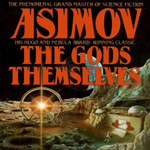
Review of The Gods Themselves by Isaac Asimov

SFFaudio Review

Gods ThemselvesThe Gods Themselves
By Isaac Asimov; Narrated by Scott Brick
Publisher: Random House Audio
Release Date: January 2014
[UNABRIDGED] –  11 hrs, 26 mins

Themes: / science fiction / aliens / annihilation / survival /

Publisher summary:

Only a few know the terrifying truth – an outcast Earth scientist, a rebellious alien inhabitant of a dying planet, a lunar-born human intuitionist who senses the imminent annihilation of the Sun… They know the truth – but who will listen? They have foreseen the cost of abundant energy – but who will believe? These few beings, human and alien, hold the key to the Earth’s survival.

Though a science fiction novel, The Gods Themselves is also primarily about magic.

Throughout the courses I took for my my undergraduate degree in Economics, we talked a lot about the driving forces behind the choices people make. One of the greatest is magic. We all want to find that magical thing that makes us not have to work as hard; magic makes life easier.

This quest for magic has helped us innovate on a grand scale and use the resources around us for our own benefit. Whether it’s been good in the long run, I’ll not get into just this second.

In The Gods Themselves, a magic is found which makes life easier and it’s the Electron Pump. Somehow, some beings have reached across the universe, time, or something, to impress themselves upon our world and made possible an endless energy source, which benefits all of humanity.

The only problem is whether it is really for our benefit and what happens when the worst is found out? Would humanity easily give up such a gift?

It’s interesting to read this book, published in 1972, in light of today’s problems with humanity’s stewardship of the world. I’m sure, actually, that Mr. Asimov thought his day was bad.

This book is told in three separate parts, each of which was published independently in Galaxy Magazine and Worlds of If. They focus on three quite different groups of people and their interaction with the Electron Pump.

The first focuses on the physicists who discover and deal with the Electron Pump. The second focuses on those others and it’s absolutely otherworldly, so much so, that it was quite difficult to read at first until you understood what was going on a bit more. It reminded me a little of Orson Scott Card’s Mithermages series.

The final part focuses on a human colony on the moon. One of the parts I can talk about without spoiling things is the description of gravity on the moon. Those who’ve lived there all their lives are essentially trapped there because their bones couldn’t survive Earth’s gravity and those who travel there have to take frequent, excruciating, trips home to Earth to keep their bodies in shape. After listening to a Star Wars book, it’s interesting to note how little they care about the different gravities of worlds. Must be some hyper-technology that accounts for it right?

Because Asimov is himself a scientist, the physics are competently explained, at least to a lay person like myself, and the dire consequences of humanity’s actions are understood … through science. Amazing!

And a note on the audiobook reader, Scott Brick. Brick has been around the block, I don’t know how many times I’ve come across his recordings. You can always trust him to bring the gravitas to any recording and you’ll find nothing less here.

This cleverly named book won both the Nebula Award in 1972 and the Hugo in 1973. And as the origin of the name of the book says, quoted from Friedriech Schiller, “Against stupidity the gods themselves contend in vain.” (for the German speakers: “Mit der Dummheit kämpfen Götter selbst vergebens.”)

As apt today as it was … when it was written.

4 out of 5 Stars (highly recommended)

Posted by Bryce L.

The SFFaudio Podcast #305 – AUDIOBOOK: The Night Land by William Hope Hodgson

Podcast

The SFFaudio PodcastLibriVoxThe SFFaudio Podcast #305 – The Night Land by William Hope Hodgson, read by Mark Nelson.

This UNABRIDGED AUDIOBOOK (18 hours 40 minutes) comes to us courtesy of LibriVox.

The Night Land was first published in 1912.

For our discussion of The Night Land check out episode #288

The Night Land by William Hope Hodgson

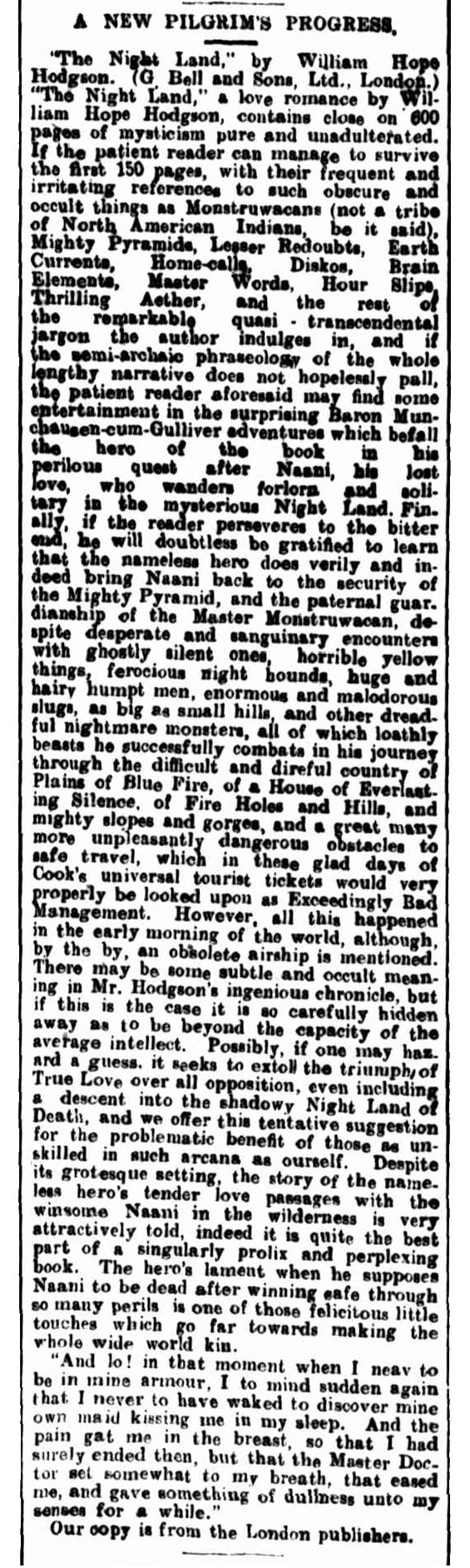
Review of The Night Land by William Hope Hodgson from the Western Mail (Perth), June 1, 1912

Posted by Jesse Willis

Review of River of Blue Fire by Tad Williams

SFFaudio Review

River of Blue FireRiver of Blue Fire (Otherland #2)
By Tad Williams; Narrated by George Newbern
Publisher: Penguin Audio
Publication Date: 30 October 2014
[UNABRIDGED] – 24 hours, 24 minutes

Themes:  / cyberpunk / virtual reality / science fiction /

Publisher summary:

Otherland. In many ways it is humankind’s most stunning achievement: a private, multidimensional universe built over two generations by the greatest minds of the 21st century. But this most exclusive of places is also one of the world’s best kept secrets, created and controlled by an organization made up of the world’s most powerful and ruthless individuals, a private cartel known – to those who know of their existence at all – as The Grail Brotherhood. Though their purpose in creating Otherland is still a mystery, it may not remain so for long. For they have exacted a terrible price from humanity in the process, and even their highly organized global conspiracy cannot hide the nature of their crimes forever. And now a small band of adventurers has penetrated the veil of secrecy that prevents the uninitiated from entering Otherland.

But having broken into the amazing worlds within worlds that make up this universe, they are trapped, unable to escape back to their own flesh-and-blood bodies in the real world. And as dangers and circumstances split their party into small, widely scattered groups, their only hope of reuniting lies in returning again and again to the River that flows – in one form or another – through all the worlds. But the odds seem to be completely against them as they – and the one outsider with whom they might join forces – become hopelessly lost in realms where an Ice Age tribe’s fears can only be quenched in blood – where insects are as large and deadly as dinosaurs – where they are caught in the war between a man made of straw and one made of tin – where cartoon ads take on a life of their own – where humans strive to survive in the aftermath of an alien invasion – and where one among their party is actually The Grail Brotherhood’s most terrifying weapon – a sociopathic killer who has never failed and whose current mission is to make certain that not even one member of this little invasion force lives long enough to reveal the truth about Otherland to the people of Earth.

Review:

The sequel to City of Golden Shadow and the 2nd book (of 4) in the Otherland series, River of Blue Fire is a solid “middle book” in the series.

Picking up where City of Golden Shadow left off, this book moved the pieces of all the players in the story without seeming to progress the plot too much. This is a common feature of “middle books” so was expected, though made the reading (listening) slow sometimes. At the point that City of Golden Shadow left off, the “hero” group was somewhat divided, with Renie and Xabbu in one simulation, Orlando and Fredericks in another, and the rest of the “hero” group in yet another sim. Paul Jonas’ sim, too, went through a few worlds, separated from the rest of the crew. Much of this book was spent with them still spilt, each learning more about the rules of the simulation world through their experiences in the world. Martine’s character, and her disability, were explored in detail in this book, bringing her to the forefront of the third hero group as a main character (to go along with Renie and Orlando). The bad guys also moved, and some of their motives were identified…and the mysterious Sellers, while staying in one (hidden) location, seemed to be doing more to try to help bring down the Otherland.

All in all, there isn’t much to say about this book that I didn’t say about City of Golden Shadow. I enjoyed this book, though didn’t think it was as strong as the first book in the series. In this book, author Tad Williams had some fun with the simulation worlds, making alternate worlds of popular stories such as The War of the Worlds and The Wonderful Wizard of Oz. It was fun to go through the book and try to see what book was referenced (if any) for each sim world. The book was fun and the cyberpunk ideas were interesting, but there was nothing new introduced in this book. The rules were better defined through the course of the plot, but there wasn’t a lot of actual progression towards the heroes saving the day (or not).

The audiobook was great to listen to, if the narration was slightly slow. I listened to it slightly sped up (using the 1.5x feature for spoken word playback on my iPhone) and it seemed perfect. The only downside to listening to these books in audio is that now I want the 3rd book in the series, Mountain of Black Glass to come out in audio…I’m not sure when or if it will be done, but I hope that it does come soon so that I can continue listening instead of having to switch to some printed media. Audiobooks are a great way to experience this series (so far).

Posted by terpkristin.

The SFFaudio Podcast #304 – READALONG: Time Out Of Joint by Philip K. Dick

Podcast

The SFFaudio PodcastThe SFFaudio Podcast #304 – Jesse, Paul, and Marissa talk about Time Out Of Joint by Philip K. Dick

Talked about on today’s show:
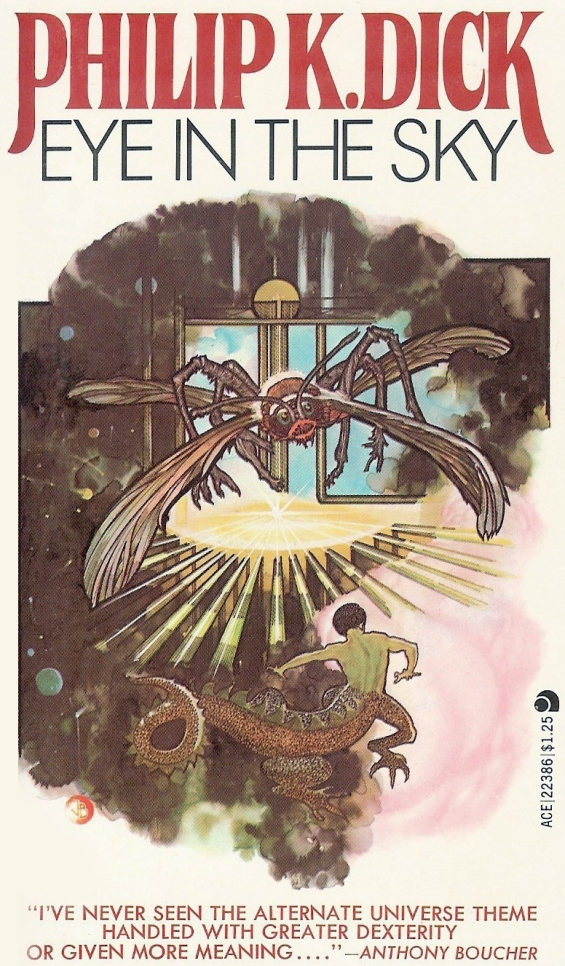
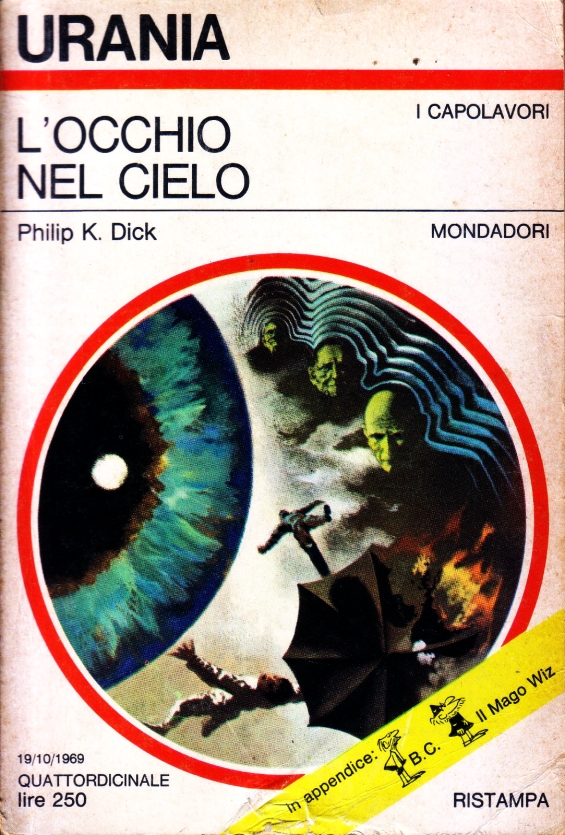
1959, New worlds, the Wikipedia entry, the New Worlds triptych, facial tattoos, A Clockwork Orange, Back To The Future II, body modification, terrible lifestyle choices, patois, Ragle Gumm, drugs, themes, the most 1950s story ever, Marilyn Monroe, fear of nuclear war, why keep evolving the culture?, no radio, Lawrence Olivier, The Prince And The Showgirl (1957), The SF Masterworks cover, Life magazine, The Truman Show (1998), pens, Mrs. Kittlebine is a Lunar spy, the model, the planted magazines, who was Ragle’s minder, The Prisoner, Mr. Black’s real wife, Philip K. Dick was extremely interested in cheating wives, marital infidelity, the breakdown of the nuclear family, being a writer, “your channeling yourself here Phil”, living in a false reality, mental illness, The Thirteenth Floor (1999), a horror trope, The Matrix (1999), Craig Bierko is a leading man from an alternate universe, “everything is a little off”, the colour palettes are off, very 1999ish, the future (2024) is the present, a much more coherent Matrix, it came from an alternate world, a little too much dancing, eXistenZ (1999), The Restoration Game by Ken MacLeod, The Tunnel Under The World by Frederik Pohl (from 1955), running advertizing experiments, what is the purpose of simulated worlds?, rough day at work? … go out and be a serial killer (in a simulated world), they’re working from home (like Ragle Gumm), The Space Merchants by Frederik Pohl and C.M. Kornbluth, Pohl worked on Madison Ave., robots, was the world physically real?, the slips of paper, the bus isn’t quite really there, the bus station, the solider, endless problems, progress is never made, one step forward three steps back, the diner, the malt, is he on a treadmill with hypnosis?, are they in drawers?, it’s in Wyoming, Kemmerer, Wyoming, technically insane, more insane?, Brazil (1985), Sucker Punch (2011), which reality is real?, any clues?, there’s no satisfaction, Do Androids Dream Of Electric Sheep?, stacked problems, the guy learning to be a patrolman, the bus driver who doesn’t know how to drive a bus, they’re actors, brainwashing, falling through the cracks, mirrored scenes, ‘it borrows unapologetically’, thinking hard, we’re all happy at the end of The Truman Show, the outside world, our future is in the stars, Time Out Of Joint could never be a Hollywood movie, imagine The Truman Show minus the love interest, conservative endings, science class in a fake high school, there’s no existential crisis, Truman’s soul, he wanted to be an explorer, shilling the products, product placement, his happy ending is to escape the simulation, the rich father-in-law, 0% crime, how would they know?, turtles all the way up?, the granddaddy of all these stories, Hamlet, William Shakespeare was the original meta-man, to catch the conscience of the King, The Taming Of The Shrew‘s induction, Christopher Sly, it’s Trading Places (1983), a very weird framing device, plays within plays, Gödel, Escher, Bach by Douglas Hofstadter, a really good conversation, Dick’s worst books, Dick’s early books, Dr. Futurity, Eye In The Sky, carbon tetrachloride, coffee, the lasagna, existential crises, after his safe was blown up, an invitation from V-Con, X-Kalay, pretending to be a heroin addict, amphetamines, a mind like a Ferrari, Dick’s unsold mainstream novels, suburban 1950s reality falling apart, Ragle Gumm’s name, a character named Phil, half a prison of his own making, choosing to return to reality, the power station, The Kettlemen’s, surreal and weird, based on a real incident, monitoring devices, a mad person ranting, are they faking?, how brainwashed can they be?, borderlands, defense in depth, “this is Ragle Gumm”, the whole business with the light-cord, “I have to get back to my base,” he said. “Phil and I have to be in by eight o’clock or we’re AWOL.”, “Is that you Wade?”, author insert, post-it notes, 3M, “soft drink stand”, “SOFT-DRINK STAND, DOOR, FACTORY BUILDING, HIGHWAY, DRINKING FOUNTAIN, BOWL OF FLOWERS”, virtual reality, so intuitive, pattern recognition skills, nonsense, white noise, paranoid psychosis, another Jim Carrey movie, The Number 23 (2007), creepy and weird, on the list, Virginia Madsen, Eternal Sunshine Of The Spotless Mind (2004), Adjustment Bureau vs. Adjustment Team, a dog falls asleep, a talking dog, the least good, Imposter (2001), the short film, the original story, a robot that thinks its a scientist, why him?, Total Recall, We Can Remember It For You Wholesale, implanted memories, don’t watch the remake, machinations, a secret agent, false endings, which story is the real one?, sitting on a park bench, why is this whole world being built up?, consider the scene…, the fake pressure, even if…, back to Shakespeare, the whim of a Lord, an essential skill, for advertizing, Rene Descartes, cogito ergo sum, imagine an evil demon, post-religious people, we don’t require a purpose, our purpose is to read Philip K. Dick books and drink coffee and watch old movies, a poetic polish by J. Michael Straczynski, Bishop Berkeley, its not a toaster its a post it with the word “toaster” on it, a rock on the dark side of the Moon’s existence isn’t contingent on our perception of it, God perceives everything, the elevator scene, their building up the world as it goes, Dick’s thinking hard and we’re thinking with him, the object or the word, Friedrich Nietzsche, Tibor McMasters from Deus Irae, “this book [Time Out Of Joint] doesn’t end it disintegrates” -Frederik Pohl, missing words, narrator Jeff Cummings, this book requires more study or less, 110.5 slips of paper, the Truman Show delusion, why they’re Tweeting so much, Skype is completely transparent to the NSA (computers), The Thirteenth Floor is beautiful to look at, what our reality is like, computer games, not knowing the difference, does the world (the GAME SERVER) exist when you’re not playing it?, what if it’s robots (AIs) running around in there?, Minecraft, when they built an 8-bit computer inside Minecraft, a giant physical object in a simulated world, there will be a computer program inside the Minecraft computer that can run Minecraft, what’s wrong with The Thirteen Floor, the time is wrong, a simulated world within a simulated world would take more time every time they go up a level, assuming the laws of physics, Inception does that, an infinity of time as a moment, all Science Fiction can be tied together by this novel, is it a Masterwork, it itself is not luminous but it is a conductor of light, it feels very inspired by, a good book for people who’d never read Science Fiction, a peek behind the curtain of reality.

BELMONT Time Out Of Joint by Philip K. Dick
Time Out Of Joint by Philip K. Dick - illustrated by Brian Lewis
Time Out Of Joint by Philip K. Dick, 1959
Zeit Aus En Fugen (Time Out Of Joint) GERMAN
Time Out Of Joint by Philip K. Dick (FRENCH)
Philip K. Dick profile from New Worlds Science Fiction #89, December 1959

Posted by Jesse Willis

Review of City of Golden Shadow by Tad Williams

SFFaudio Review

City of Golden ShadowCity of Golden Shadow (Otherland #1)
By Tad Williams; Narrated by George Newbern
Publisher:  Penguin Audio
Publication Date: 30 October 2014
[UNABRIDGED] – 28 hours, 42 minutes

Themes: / cyberpunk / virtual reality / science fiction /

Publisher summary:

Surrounded by secrecy, it is home to the wildest dreams and darkest nightmares. Incredible amounts of money have been lavished on it. The best minds of two generations have labored to build it. And somehow, bit by bit, it is claiming the Earth’s most valuable resource – its children.

Review:

I hate to admit this, but I judged this book by the cover at first. I knew nothing about the book when I started listening, I hadn’t even read the blurb in the description. I saw a fantastical-looking image on the cover and, knowing that Tad Williams typically writes fantasy novels/series, I just assumed it was a fantasy novel. I was wrong. This is actually a cyberpunk book, a quite good one at that. There was only one downside to the book, which I may as well get out of the way now: it’s not a complete story. The book ends with no plot lines resolved and more questions than answers…so, if you read this book, be prepared to read at least the next book in the series (River of Blue Fire. I say “at least” because I have only just started that book (and it’s 24.3 hours long!), and I have no idea if it resolves any of the story. There are 4 books in the Otherland series in total (City of Golden Shadow, River of Blue Fire, Mountain of Black Glass, and Sea of Silver Light, the first two of which are available in audio so far).

The plot is intriguing. In a future-world setting (the book was written in 1996), virtual reality (VR) in the form of using an avatar to explore the “net,” is fairly commonplace. Many people, instead of congregating/living in cities with malls and town centers and such, live good parts of their lives in the virtual world. At least, the younger people seem to do this. Main character Reny (a nickname for Irene) is a teacher of computer science/VR manipulation at a university. One day she comes home to find her little brother, Steven, comatose after spending some time in the VR world. Setting out to try to figure out what left him in the coma, she comes across a hint of a world called “Otherland,” a world within the VR world. In parallel, a kid named Orlando is exposed to “Otherland” in a part of his online video game. They find themselves searching for answers on Otherland, enlisting the help of some others who have also found out about the mysterious world, all seeking answers for what it is and why it’s harming kids. There is another story in the book, of a man named Paul. He may or may not have been a soldier in World War II, but somehow has found himself stuck in the world of Otherland without the ability to escape. There is also the story of those running Otherland, some with more nefarious reasons than others…

The entire plot is engaging, if sometimes a little confusing to keep track of who is where (especially at first, as the world and characters are introduced). That said, the book drew me in more or less from the get-go, and I found excuses to listen more as I went about my days. Williams, unlike many authors I’ve read recently, is able to describe the world and the technology organically through the telling of the story. Where some people would spend time info-dumping, Williams is able to make the world comprehensible by explaining things to characters, or having the reader go along with the process of discovery with the characters. For a book written in 1996, Williams was somewhat a visionary of technology and how people use it. In the book, there are VR systems (think: Oculus Rift taken to the extreme), normal day-to-day use of the internet, tablets, videophony…things that are in the early years of widespread adoption now.

The characters in this book are very interesting. I’ve read a lot of complaints, recently, from people who wish that there were more women and/or minorities in the books that they read, especially genre fiction. This book doesn’t have that problem. Reny is a South African black woman, and one of her closest friends through the story is a native African. One of the main villains is Australian and there seem to be people from across the globe involved in either the world or trying to study the world. When Reny needs help, she turns to another woman (another professor in computer science-type fields) for aid, and though men are involved, they are on an equal footing with the women. While I normally don’t fault a book for having weak female characters, it was refreshing to have such diversity in the book.

George Newbern’s narration was fantastic, if a little slow. I found that I had to bump up the playback speed slightly, otherwise it felt like the pauses were a little too long, the speech a little too slow. This made some of the characters or world aspects a little hard to understand at times (pronunciation-wise), but that didn’t detract from the story. It was always easy to keep track of who was talking and what was going on, thanks to Newbern’s voices for the characters and for the main narration.

All in all, I really liked this book. I wish it had come to some form of closure, or at least given some more hints on the motives of the villains, but that’s a minor complaint. I’ve already started the second book and can’t wait to see where the story goes.

Posted by terpkristin.