Review of Alien Honor by Vaughn Heppner

SFFaudio Review

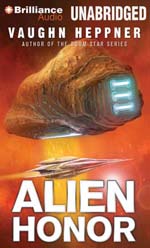
Alien Honor by Vaughn HeppnerAlien Honor (A Fenris Novel #1)
By Vaughn Heppner, Read by Jeff Cummings
Publisher: Brilliance Audio
[UNABRIDGED] – 11 hours

Themes: / interspecies slavery / telepathic FTL spaceships / galactic colonizing / Philosoraptors / science fiction / space / aliens /

Publisher summary:

2457 AD. The longest space voyage in history has begun: 230 light years from a ravaged Earth to the pristine star system of New Eden — a beacon of hope following the Doom Star days. Aboard the ship are human colonizers, the Space Navy, fierce “Monitors” once bred to fight Cyborgs, and four “Specials” — humans with psionic abilities, capable of ripping holes in space to jump vast distances. But one Special has his own agenda and when an alien presence makes an offer he can’t refuse, the entire mission takes a deadly turn. Cyrus Gant, a former Dust-dealing gang member from Earth’s subterranean slums, is onto the renegade Special. And while his psi powers aren’t as strong as he might like, Cyrus’s street smarts more than make up for this seeming disadvantage. This will be crucial, because as the ship makes the final, frightening leap toward New Eden, Cyrus is everyone’s last hope for survival.

Alien Honor is Vaughn Heppner’s opening book in the Fenris series, which is set in 2457 AD. Humans are using telepaths to power FTL (faster-than-light) spaceships. The majority of the book focuses on Cyrus Gant, a gritty gang boss who was plucked out of the slums and trained in a special program for the development of telepathic humans. Earth sends a colonizing ship 230 light years to the New Eden star system with hope for a new beginning. Of course, things go horribly wrong and we encounter dinosaurs in space posing as philosopher-kings, as one does when venturing into space.

Vaughn Heppner is ambitious. SF is a genre known for tackling issues of social inequality set against an alien backdrop as a means of providing alternative perspective. We encounter interspecies slavery, telepath typecasting, and military stereotypes reinforcing the old misguided mantra of stronger=bigger=better. Unfortunately, Heppner’s near continual use of contemporary language/slang became an increasing source of irritation. The story is set over four hundred years in our future, yet Heppner has characters dropping insults like “prick” and “bastards.” Anytime I stumbled across characters using present-day language and contemporary idioms, it yanked me out of Heppner’s world.

Jeff Cummings narrates the audiobook and does a fair job. As a reader, he never becomes bigger than the story. There were times when I felt his delivery was overdramatic and slower in pace than I am accustomed to, but this is minor.

Personally, I felt things picked up nicely when the dinosaurs came on the scene. I mean come on, space Velociraptor cast as philosopher-king. You know what that means, right? Philosoraptor, YEAH-BABY!!!

And yes, I’m a proud owner of a Philosoraptor t-shirt.

Posted by Casey Hampton.

Review of Ender’s Game Alive by Orson Scott Card

SFFaudio Review

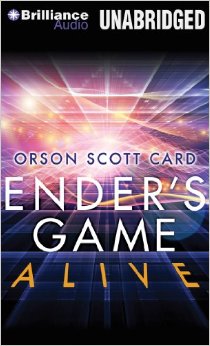
Cover for Ender's Game Alive

Ender’s Game Alive
By Orson Scott Card; Performed by a full cast
Publisher: Skyboat Media
Published: 2013
7 hours 24 minutes [UNABRIDGED]
Themes: / science fiction / childhood / aliens

Sometimes you hear about something and can’t wait to get your hands on it because you want to experience it, to touch it, see it, whatever. You have expectations and hope like mad that in the end, you won’t be disappointed.

for me, the new audio drama adaptation of Orson Scott Card’s novel Ender’s Game fits the above description perfectly. The fact that Card wrote the script himself only made the anticipation worse because the bar went higher. It was raised further when I found out who was producing it: the folks at Skyboat Media. To find out whether or not they succeeded, the end result, (enemy’s gate), is down.

An important note for Ender’s Game fans, I am going to be limiting my scope to the book when reviewing this audio play. For the purposes of this review, the film does not exist. I want to tackle that challenge under its own merits. Any references to it will be made in passing if at all. With that said, our gate is open; on with the review.

The setup: a young boy at the age of six is taken from his home to attend a school for brilliant minds; to turn the “little dorklings” into soldiers and commanders because there is a war going on. This is the third such conflict with this alien race and our protagonist (unknown to him at the onset), is being groomed to be the commander that leads the entire fleet, hopefully, with good results. If not, the human race is doomed.

Our story follows Andrew Wiggin (nicknamed “Ender” by his sister) from the very beginning of his journey; even before that when the decision is made by his parents to have him with the full knowledge that this goes against the population policy in place.

“No more thirds.”

Of course, because this is the international fleet (I.F.) making the request; the rules are bent. All they have to do is sign on the dotted line and fill out the forms. If they don’t, genetic material will be seized and used until the right child is born and sent to battle school; a space station that prepares its students for lives spent as part of the fleet.

Ender’s parents are a special case because their first two children , Peter and Valentine, are geniuses. Why the first wasn’t chosen for the school, (as explained by the commander in charge), is because the kid is plum psycho. Why the sister isn’t picked is because she’d break under actual battle pressure when real losses come her way. And thus the fleet wants the parents to give it another go or else. This is the world Ender is born in. He’s at a disadvantage from the start. The running theme is, “Let’s see how ender handles it.”

The audio play does a great job of setting the appropriate pieces on the chessboard and letting the game play out. The story to tell is Ender’s story. Where it deviates from the book is the fleshing out of the interactions between the staff observing his progress. This is a necessary change since the book mostly takes place from Ender’s mind and point of view. This may seem like The Cabin in the Woods kind of gimmick but it is an important evolution in the way the story is being told. The play has to present things from a different angle and come to the same conclusions; adjusting things as needed to fit the plot’s progression.

the second major deviation is the focus on the other Wiggin children subplot. There are hints to it but it is treated almost as an afterthought. The reasoning for this change is sound; political debates and research would only drag down the story and make the listening experience tedious in places.

All in all, the major plot points of the novel are hit home like a well-aimed shot. There are subtle clues to other works that have been written since Ender’s Game came out in 1985. There are adjustments to some scenes to give the audio play a different feel than just a retreading of the original story step for step. This gives us something a little unexpected and fresh as we take the 7 hour, 24 minute journey.

If you have listened to the audio book of Ender’s Game, several of the casting choices will be no surprise. You hear a particular person’s voice and feel a sense of familiarity that makes the experience that much more enjoyable. Each character is brought to life. You know them, understand them, will not always agree with them or the decisions they make, but can listen to these portrayals and feel like you are the proverbial fly on the wall throughout the story. And when you listen to a scene as heart-felt as when Ender breaks down before his next assignment to command school, you really connect with the emotions in the room. This is how good storytelling becomes great by simply allowing the actors to raise the bar by their performances. The scenes before build up to a moment that is devastating in its impact.

The sound design and score never distract from the dialogue. And for the most part, the editing of the words spoken is top notch. Occasionally, you will hear the hum of the studio where lines were being recorded. If this issue were a constant refrain, I wouldn’t have enjoyed the play as much. As it stands, I only noticed such things myself when listening to the play a second time. That just shows you how engaging the whole packages when listening to it. Even though I noticed these issues, I wasn’t distracted.

At the end of the original audio book, Orson Scott Card said that it was the definitive way to experience his novel. With Ender’s Game Alive, that statement may (and should) be revised. It is a masterful work of audio fiction. Of course, this is in part to the source material. But the transformation from novel to audio play is not an easy undertaking. Orson Scott Card’s background in theatre shines through in this presentation; letting the dialogue drive the story forward. The many actors take on the roles and bring them to life. You won’t mind when adults are playing children. You just want to hear where the story goes. Aside for the minor audio issues, (studio hum in a couple scenes which I won’t spoil here and the inconsistent panning of characters when talking to each other), the production is definitely a recommended listen if you are a fan of Ender’s Game. I give it five out of five toon leaders; that’s one victory ritual.

Posted by Allen Sale
Minds Of Terminus

SFFaudio Online Audio

Minds Of TerminusMinds Of Terminus is a new audio drama podcast that seems inspired by a number of recent novels (Kiln People, Saturn’s Children). Here’s the elevator pitch:

“In the world of Terminus, technology has advanced beyond contemporary understanding or explanation. Nanotechnology is at its peak, common and ubiquitous. The fields of Artificial Intelligence and Nanorobotics have matured, and swarm intelligences maintain roads, buildings, monitor traffic, collect advertising data, nurse the sick… the applications are nearly endless. It has even become possible for a human being to upload their intelligence and personality into an artificial neural matrix. These copies, however, aren’t seen in the way that a modern-day trans-humanist from our time might regard them. For example, no one regards these mind uploads as a way to attain immortality of any kind. The original lives on, after all, and the copy is regarded as… something other than human.

Something less.

Applying advanced neuroscience, these uploaded personalities can be pruned and teased into any number of purpose-built, utilitarian shapes and designs, and this has become the preferred way to program the robotic helpers used every day in all walks of life, from heavy industrial machines to nannies.

Then one day, all of the humans are gone. The streets are quiet. The AIs begin waking up, but their masters have left them. Who and what are they, when all of the humans are gone? Are they all just bad copies of dead humans?”

Episode 1 |MP3| – Approx. 27 Minutes [AUDIO DRAMA]

Podcast feed:

http://www.mindsofterminus.com/category/podcasts/feed/

Posted by Jesse Willis

Review of The Gods Themselves by Isaac Asimov

SFFaudio Review

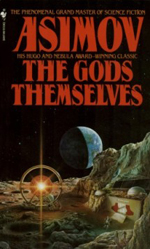
asimovThe Gods Themselves
By Isaac Asimov, read by Scott Brick
Publisher: Random House Audio
Publication Date: January 2014
[UNABRIDGED] – 11 hours, 26 minutes

Listen to an excerpt: | MP3 |

Themes: / aliens / electron pump / cosmic egg / multiple universe theory / sex in space /

Publisher summary:

Only a few know the terrifying truth – an outcast Earth scientist, a rebellious alien inhabitant of a dying planet, a lunar-born human intuitionist who senses the imminent annihilation of the Sun… They know the truth – but who will listen? They have foreseen the cost of abundant energy – but who will believe?These few beings, human and alien, hold the key to the Earth’s survival.

– Disclaimer –
I’m no physicist. This book, in parts, kind of torqued my noggin.

Isaac Asimov’s The Gods Themselves won the 1972 Nebula then the 1973 Hugo. The premise? Pretty straight forward. Will we destroy the universe?

I like this book. The first 2/3 kept me running. The last 1/3, I slowed to a stroll and enjoyed the pace change. The time spent with the aliens was intriguing, both in the differences and similarities to humanity. Asimov packs a punch, tackling the question of energy versus environmental cost. In some ways it’s comforting imagining that even in the future, we humans still salivate over a dangled free lunch. The characters in the other universe are stunning. I could have read twice the content volume on that environment alone. When I reached the lunar colony, it took some time to cultivate an interest in the people and their situation. By the time I was interested, it was ending. This left me feeling off-kilter and only slightly irritated. Don’t ask me to explain, but I found the chocolate bar with almonds scene very touching.

Scott Brick narrates this release. Early on, I didn’t know if I could handle listing to Brick’s performance. He has a nice voice, but he has a habit of injecting unneeded drama into almost anything he reads. Fortunately, within the first twenty minutes, I found Brick’s style quite suited to the content. After finishing and reflecting, I think Brick was the right choice for narrator.

Posted by Casey Hampton.

The SFFaudio Podcast #249 – AUDIOBOOK: Scanners Live In Vain by Cordwainer Smith

Podcast

The SFFaudio PodcastThe SFFaudio Podcast #249 – Scanners Live In Vain by Cordwainer Smith, read by J.J. Campanella.

First published in Fantasy Book, #6 in 1950. Scanners Live In Vain has been anthologized in such collections as The Science Fiction Hall of Fame, Volume I, Science Fiction 101 (aka Robert Silverberg’s Worlds Of Wonder), and The Great SF Stories 12 (1950).

This UNABRIDGED AUDIOBOOK runs (1 Hour 35 Minutes). We will discuss it in SFFaudio Podcast #250.

Scanners Live In Vain by Cordwainer Smith

Posted by Jesse Willis

The SFFaudio Podcast #248 – AUDIOBOOK/READALONG: Goliah by Jack London

Podcast

The SFFaudio PodcastThe SFFaudio Podcast #248 – Goliah by Jack London; read by Gregg Margarite. This is a complete and unabridged reading of the short story (57 minutes) followed by a discussion of it. Participants in the discussion include Jesse, Bryan Alexander, Seth, and Maissa Bessada

Talked about on today’s show:
Colossus: The Forbin Project; title’s reference to biblical Goliath; story’s title a reference to the famous Pacific steam ship; colonial capitalism; the story’s Gilded Age context; child labor; Eugene Debs and American socialism; Karl Marx; Thomas Hobbes’s Leviathan; the story’s fictional energon evocative of Transformers energon; Nikola Tesla; Goliah has a palantir; Goliah as Santa Claus; the story’s invented island Palgrave in the South Sea; parallels to London’s other speculative fiction including The Iron Heel; the story’s unreliable narrator; Asgard; origin stories and foundation myths; nineteenth-century racism rears its ugly head again; Übermenschen; contempt for military and militarism; The Unparalleled Invasion; Seth works too hard; the theoretical increase of productivity through automation; 1984Twilight casting a sparkly shadow over modern culture; Edward Bellamy’s Looking Backward as a possible influence; Karl Marx’s German Ideology; the importance of laughter; Herland; the story as a response to nihilism; similarities between Guy de Maupassant and Friedrich Nietzsche; The Scarlet PlagueCanticle for Leibowitz; the medieval investiture controversy; animal metaphors in Goliah; accurate predictions of World War I; structural similarity to the Book of Job; “you don’t get a lot of laughter in the Old Testament”; Arslan by M.J. Engh; The Bookman literary magazine; It’s a Good Life by Jerome Bixby; steampunk by tag cloud; we make a dismal attempt at discussing the Stock Market; the dark underbelly of Goliah’s utopia; the unrealistic perpetuation of a utopia; Autofac and Pay for the Printer by Philip K. Dick; With Folded Hands by Jack Williamson; Star Trek: The Next Generation; Lenin’s dying wish; Jules Verne; Goliah relinquishing power; Hot Fuzz; more on the palantir and the NSA; “grumblers grumble”; attitudes toward the criminally insane; “Goliah has spoken”; nukes not MOOCs; Cuban Missile Crisis; Douglas MacArthur biography American Caesar by William Manchester; Doctor Who episode “The Happiness Patrol”; Japanese Manga Death Note; the “bread and roses” U.S. labor strike contemporary with Jack London; the Pax Romana; The Better Angels of Our Nature by Stephen Pinker, a discourse on lethal violence; the Franco-Prussian War; Earle Labor’s Jack London: An American Life available in audio.

Colossus The Forbin Project

Posted by Jesse Willis