CBC: The Vanishing Point: J.G. Ballard’s The Dead Astronaut

SFFaudio Online Audio

The Dead Astronaut by J.G. Ballard

The Dead Astronaut is a part of a larger subset of J.B. Ballard stories adapted for the long running CBC radio series The Vanishing Point. This tale of a haunted Cape Kennedy is typically Ballardian, surreal, full of abandoned buildings, abandoned people, and abandoned dreams.

CBC - The Vanishing PointThe Vanishing Point – The Dead Astronaut
Adapted from the story by J.G. Ballard; Dramatized by Lawrence Russell; Performed by a full cast
1 |MP3| – Approx. 28 Minutes [RADIO DRAMA]
Broadcaster: CBC Radio
Broadcast: 1988
First published in Playboy, May 1968.

Cast:
Gordon Clapp … Philip
Donna Goodhand … Judith
Peter McNeil … Quentin
Tom Duckworth … the voice

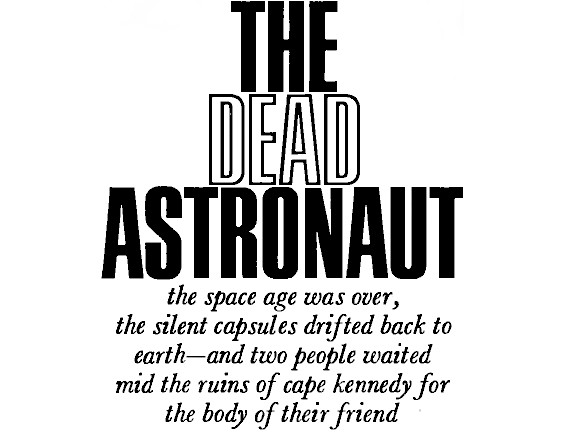
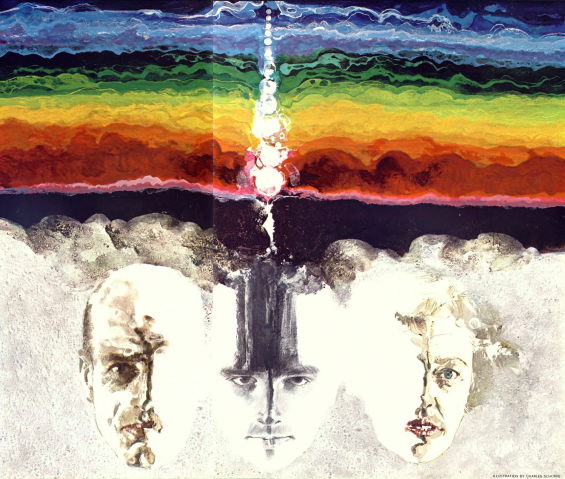
Here’s the original art that accompanied the story’s publication in Playboy:

Playboy, May 1968 - illustration by Charles Schorre

[via JGBallard.ca]

Posted by Jesse Willis

The SFFaudio Podcast #169 – TALK TO: Jonathan Davis

Podcast

The SFFaudio PodcastThe SFFaudio Podcast #169 – Jesse and Luke Burrage (from the Science Fiction Book Review Podcast) talk to audiobook narrator Jonathan Davis.

Talked about on today’s show:
Not the Jonathan Davis of Korn, favourite audiobook narrators, Luke’s real job (juggling), how to become an audiobook narrator (or a professional juggler), acting, theatrical acting, voice over, New York, Testament by John Grisham, Brazil, Portuguese vs. Brazilian Portuguese, Gone For Soldiers by Jeff Shaara, long form narration, Snow Crash by Neal Stephenson, urban samurais and Aleutian assassins, binaural recording, The Shadow Of The Torturer by Gene Wolfe, The Windup Girl by Paolo Bacigalupi, London, Paris, Iowa City, Thailand, genetic engineering, Japan, accessory dogs, GMO food, graphic sex scenes in mid-juggle, Glamorama by Bret Easton Ellis, Zoolander, American Psycho, a 12 page sex scene, Star Wars, Genghis Khan And The Making Of The Modern World by Jack Weatherford, straight readings vs. impersonations, Yoda, Ewan McGregor, Liam Neeson, Luke re-edits Star Wars, alien languages, Calculating God by Robert J. Sawyer, When Gravity Fails by George Alec Effinger, Ian Mcdonald, North Africa, Egypt, Arab Spring, Bedouin, narration styles, straight narration vs. theatrical performance vs. cinematic narration, Michael Caine, scalpel vs. laser, Mike Resnick’s Starship series, voice based books, Star Trek, David Copperfield, Oliver Sacks, The Watchers by Jon Steele, Kirinyaga, The Scar by Sergey Dyachenko and Marina Dyachenko, Starship: Mutiny, Elinor Huntington, existential resonance, Harry Potter, conspiracy, dystopia, Ray Bradbury, Cool Air by H.P. Lovecraft, Starship: Rebel, no research, just fun, language, audiobooks as a collaboration between an author, a narrator and a listener, Walking Dead by Greg Rucka, espionage, comics, Neil Gaiman, Catch And Release by Lawrence Block, Hex Appeal, Jim Butcher, The Dresden Files, studio time, The Book Of The New Sun, “do your homework”, “suddenly revealed to be a Texan”, an Aleutian Rastafarian, Hiro Protagonist, Minding Tomorrow, revealing voices, American Gods, George Guidall, “the perfect audiobook experience”, Woden (aka Odin aka Mr. Wednesday), The Stand by Stephen King, reading with your ears, preferred narration styles, The Hundred Thousand Kingdoms by N.K. Jemisin, racism, Dune, Zoo City by Lauren Beukes, Johannesburg, South Africa, fantasy fiction shouldn’t have an American accent, Luke’s SFBRP review of The Scar, House Of Suns by Alastair Reynolds, an Arkansas accent, inner monologue vs. dialogue, the Sling Blade voice, Casaundra Freeman, audiobook narration is difficult, learning the characters over a series, George R.R. Martin, A.J. Hartley, Act Of Will, Will Power, working with authors, Cyteen by C.J. Cherryh, Book Of The Road, male and female narration, Gabra Zackman, Jonathan is the infodumper, Full Cast Audio, a one man show vs. theatrical collaboration, Scott Brick, Feyd-Rautha, a Jamaican brogue?, The Brief Wondrous Life of Oscar Wao, do you like computer games?, Max Payne 3, Tron, “that’s my neck fat”, Vladamir Lem, Armando Becker.

Posted by Jesse Willis

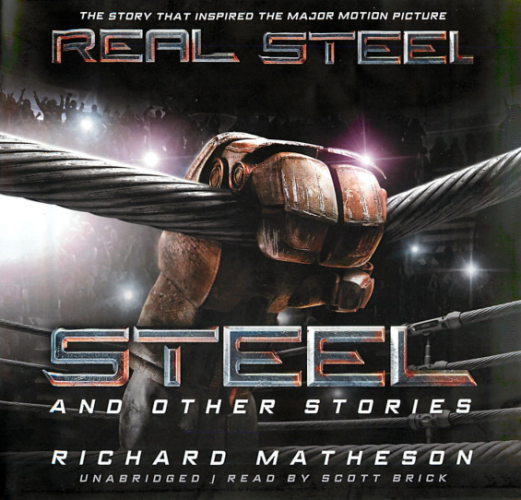
Review of Steel by Richard Matheson (from Steel And Other Stories)

SFFaudio Review

BLACKSTONE AUDIO - Steel And Other Stories by Richard MathesonSteel And Other Stories – Steel
By Richard Matheson; Read by Scott Brick
Approx. 59 Minutes [UNABRIDGED]
Publisher: Blackstone Audio
Published: 2011
ISBN: 1455112127
Themes: / Science Fiction / Boxing / Robots /

Steel, a novelette, was first published in the May 1956 issue of The Magazine of Fantasy & Science Fiction.
The editorial introduction preceding it described Steel as a “tale of strength and endurance” and as “a science fiction sports story so realistic, simple and powerful that it should prove moving even to sports-loathing readers who have never let a boxing bout darken their television screens.” The story would just a few years later, in a 1963 adaptation as an episode of the Twilight Zone brighten the living rooms of many. And, in 2011 it would inspire the big budget movie Real Steel. So, how does the original novellete, stand up to repeated blows of history?

Pretty well. If you like Matheson’s writing Steel is definitely worth hearing. This story captures in a relatively short space the oddity, the kind of quirk that Matheson seems forever working on. It’s something I’ve noticed in practically every story by Matheson that I’ve read. His main characters always seem to want to make a human connection with strangers, and in their efforts to do so always fail – and always for the same reason. In their desire to be heard, and be understood, they always disregard the needs and desires of those strangers. I’ve never seen a writer tackle anthing like this, over and over, like Matheson always seems to. Let’s tale Steel as our example. One of the two main characters, Paul, goes to great lengths to get engage an uninterested stranger in a conversation about the exploits of his dilapidated robot boxer. That the stranger, who doesn’t know anything about boxing, doesn’t care about boxing, and has never even heard of Paul’s robot, is obviously completely uninterested in what Paul is saying. This doesn’t seem to occur to Paul. It’s as if Paul’s own need to reach out and be heard – to be something – is greater than the interests of the stranger – whatevber those interests might be. It’s not so much a Science Fiction issue as it is an existential one. It’s almost as if Matheson is using his fiction to try to find a way to navigate around a massive blind spot in human relations. Like in his novel The Incredible Shrinking Man Matheson has the plot of Steel be a manifestation of a character’s internal difficulties.

Scott Brick narrates this bare bones dialogue driven story. I’m often ambivalent about Brick’s narrations. Sometimes he works for me, sometimes he doesn’t – and I think I’ve finally realized why. Brick is excellent at delivering emotion. But if the emotion is from a third person perspective it comes across as too operatic. But, if the story is told in first person perspective then it work well. In Steel there are basically only two voices – Paul’s and Kelly’s. And when Brick voices either one I can’t readily enough distinguish difference between them. Yet when a story is told in first person Brick’s narration really works. Take this sample |MP3| from Nelson DeMille’s The Lion’s Game (which is first person perspective). And now compare it with this |MP3| from Steel.

I came away feeling somewhat unsatisfied with Steel. It’s not that the story is uninteresting, or unoriginal, Steel is both original and interesting. Kelly and Paul are a pair of boxing enthusiasts – and I’m more of an enthusiast of ideas. There’s just not enough intellectual heft to their journey. I think The Twilight Zone adaptation, penned by Matheson himself and starring Lee Marvin, does the story better mostly because it’s a lot quicker too it. The movie version is hardly an adaptation, being much more of a family father and son traditional conservative values tale than an existential exploration. None of versions of the story did what I wanted them to do, namely get into the robot’s POV. The fact that none of the adaptations treat the robot as anything other than an external manifestation of their root interests is kind of depressing. But then again, I don’t go to Matheson for uplifting, I like his depressing ideas.

Posted by Jesse Willis

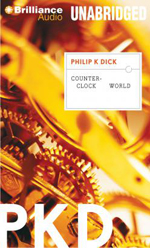
The Skull by Philip K. Dick

SFFaudio Online Audio

The Skull by Philip K. Dick

The first time I read Philip K. Dick’s The Skull, it took me a couple of attempts to really get into it. But with PKD you out to give it a couple of good attempts. So I kept trying. Reading along with the text helped, and after about 150 words or so I could manage the story without the extra textual assistance. I guess this is one of those stories that doesn’t translate to audio that well. That said, once I did get into it it I did find it worthwhile. The Skull is a time travel story that makes a nice companion piece to Michael Moorcock’s Behold The Man. It’s about a future criminal who goes on a mission to kill a religious revolutionary from the 1960s.

The Skull by Philip K. DickThe Skull
By Philip K. Dick; Read by Gregg Margarite
1 |MP3| – Approx. 50 Minutes [UNABRIDGED]
Publisher: LibriVox.org
Published: November 01, 2009
Conger agreed to kill a stranger he had never seen. But he would make no mistakes because he had the stranger’s skull under his arm. From If Worlds of Science Fiction, September 1952.

|ETEXT| Wikisource
|ETEXT| Gutenberg
|PDF| Made from the publication in IF.

Recently a friend pointed out a 1962 French short film, done in photomontage style, called La Jetée. It’s nicely comparable and totally French:

[Thanks Mel!]

Posted by Jesse Willis

I, Mars by Ray Bradbury

SFFaudio Online Audio

Barton’s younger selves lived on, tormenting him for his living proof that their hopes were dead!

I, Mars by Ray Bradbury
I, Mars by Ray Bradbury - illustration by Hannes Bok
First published in Super Science Stories, April 1949, here’s Jim Moon’s 26 minute unabridged reading of I, Mars by Ray Bradbury. I first encountered this story under it’s alternative title, Night Call, Collect.

|MP3|
|PDF| made from its publication in Super Science Stories.

[Thanks to WonderEbooks!]

Posted by Jesse Willis

The SFFaudio Podcast #166 – TOPIC: SFF FORMS (Short Story, Novella, Novellete, Novel, Fix-up, Trilogy, World)

Podcast

The SFFaudio PodcastThe SFFaudio Podcast #166 – Jesse, Luke Burrage, and Eric S. Rabkin discuss, at length, the SFF FORMS (Short Story, Novella, Novellete, Novel, Fix-up, Trilogy, World). Here’s the premise:

Science Fiction Forms: Short Story, Novella, Fix-Up, Novel, Trilogy, and World. Respectively, they might be exemplified thus: Short Story (“Mars Is Heaven!“), Novella (“Flowers for Algernon“), Fix-Up (The Martian Chronicles, which contains a revised version of “Mars Is Heaven!” or The Seedling Stars, Accelerando, and Beggars In Spain, all of which began as novellas), Novel (originals, like 1984, and derivatives like Flowers for Algernon or Varley’s novel Millennium coming from his short story “Air Raid“), Trilogy (original Foundation series), World (the ultimate Foundation world or Heinlein’s Future History [shared with others] or Banks’s Culture or LeGuin’s Hainish series [created just for the authors, but let’s not forget about fan fiction]). What are the special challenges and rewards in reading and writing in these diverse forms? What special challenges or rewards attend on reusing material in another form? Is the formal plasticity of SF unique among literary genres?

Talked about on today’s show:
Eric’s suggestion, literature with a capital “L”, The Dead by James Joyce, The Portrait Of The Artist As A Young Man, Doomsday Book by Connie Willis, Luke’s Science Fiction Book Review Podcast, the format, the themes, the variability of short story form, the feghoot, Day Million by Frederik Pohl, Accelerando, Stories Of Your Life And Others by Ted Chiang, The Tower Of Babel, stripped away vs. embellished to the nth degree, Flowers For Algernon by Daniel Keyes, Understand by Ted Chiang, The Bells by Edgar Allan Poe, The Black Cat, fantasy, the unexplicit story, valid reactions, the etymology of “text”, Earth Abides by George R. Stewart, a persuasive existential journey, The Scarlet Plague by Jack London, San Fransisco, short stories as objects of frivolity or training, the brilliance of an idea is not always enough, a novel can act as a community to an individual, Fahrenheit 451 by Ray Bradbury vs. The Fireman by Ray Bradbury, is the novel inherently more participatory than a short story?, the failure of technology vs. the power of nature, The Masque Of The Red Death, teaching Science Fiction with short stories and novels, The Science Fiction Hall Of Fame (Volume 1), the composite novel, Winesburg, Ohio by Sherwood Anderson, A.E. van Vogt, the fix-up, The Martian Chronicles by Ray Bradbury, Accelerando by Charles Stross, Lobsters by Charles Stross, the cat changes function, “an intellectual framework”, Robert A. Heinlein’s future history, the composite novel, Isaac Asimov, future history vs. psychohistory, Michael Moorcock, I, Robot, Robbie, the three laws, Stephen Byerly and Susan Calvin, unAsimovian assumptions, the full dose of SF, Reason, The Evitable Conflict, is Stephen Byerly a robot or a man?, the Mérode Altarpiece (a medieval iconographic trope), art history, Luke doesn’t think Asimov is that clever, R. Daneel Olivaw, the three laws are fairytale laws, positronic brains are positive, the three laws are for people (not just robots), The Bicentennial Man, Asimov’s powers, Asimov’s business acumen, Brandon Sanderson, shared worlds, gods, Mormonism, Daniel Clowes, The Death Ray, Elantris, “The Alexandria Quartet” by Lawrence Durrell, reading The Martian Chronicles backwards, Luke’s fiction, Alastair Reynolds, Sherlock Holmes, Baker Street Irregulars, whodunit ain’t the attraction, The Adventure Of The Speckled Band, a matter of cutting, A Clockwork Orange, it’s better without the extra chapter, the commercial effect (or the effect of commercialism), popular literature, the flabby novel, Robert J. Sawyer, Hominids, Calculating God, William Shakespeare, The Royal Ontario Museum, horse evolution, God needs a starship!?, where to find a paleontologist, “a hundred pages of nothing happening”, a circular argument, writing to the story’s demands, Kevin J. Anderson, commercial constraints shouldn’t be points of pride, the thickness of books, The Lord Of The Rings, does more succinct = more better?, novellas are novels with threads missing?, The Hobbit, the ambition of the author, Luke is rejecting the basic premise, The Stand by Stephen King, is it a better story short or long?, changes and updates and additional material, don’t let Asimov near a typewriter unless you want something written, Against The Fall Of Night by Arthur C. Clarke, The City And The Stars, expanding everything, Monster Story, “it came to me in a dream”, Minding Tomorrow, Nightfall (the short story) vs. Nightfall (the novel), “it’s a lot like a perfectly nice novel that eventually becomes a masterpiece”, The Lion of Comarre, it’s not a commercial podcast, a civil rowdiness, Eric’s Coursera course: Fantasy and Science Fiction: The Human Mind, Our Modern World, rechunking, forums, essays, 18,000 registered students, University of Michigan, only the competitors are qualified to judge the competitors, a history of the U.S. Civil War, Luke’s kitchen, grades, “there is no absolute abstract grade for anything”, Science Fiction and Politics (Courtney Brown), the governor of a steam engine, Luke confuses two professors, “yes, by golly, that was a very good thing of it’s kind”, The Odyssey by Homer, a foundational classic, The Bible, the Benjamin Franklin bible, there should be an SFBRP review of The Odyssey, Luke’s Matthew Mark Luke Skywalker, Star Wars, Joseph Campbell, time for coffee!

The Mérode Altarpiece

Startling Stories, November 1948 - Against The Fall Of Night by Arthur C. Clarke

Against The Fall Of Night by Arthur C. Clarke (page 11 of Startling Stories, November 1948)

Against The Fall Of Night by Arthur C. Clarke (page 12 and 13 of Startling Stories, November 1948)

Posted by Jesse Willis