
The SFFaudio Podcast #264 – READALONG: The Martian by Andy Weir

Podcast

The SFFaudio PodcastThe SFFaudio Podcast #264 – Jesse, Jenny, Tam, Julie, Bryan, and Mike discuss The Martian by Andy Weir.

Talked about in this episode:
Dust on Mars is too thin to allow for sandstorms; terpkristin says NASA would never build a faulty antenna; and we finally introduce the book; is The Martian science fiction?; the one-way Mars mission Mars One; reminiscent of Heinlein’s Farmer in the Sky; Mike tracks Watney’s journey through Google Mars; why NASA picks boring locations to land their first missions; Andy Weir on Science Friday; the most far-fetched element of the book is its lack of budgetary concerns; Bradley Cooper in the film adaptation?; The Martian and Gravity have depressing implications; the novel’s (Heinleinian?) lack of character development; Mark Watney is in “full on Macgeyver mode”; most pilots are boring; many LOLs in the book; Andy Weir’s webcomic Casey and Andy; strong language in the novel; stoichiometry; feasibility of plot points; engineer-as-hero motif pitted against bureaucracy; Martian Odyssey by Stanley G. Weinbaum; Robinson Crusoe by Daniel Defoe; Robinson Crusoe on Mars starring Adam West; The Makeshift Rocket by Poul Anderson, a spaceship powered by beer; From the Earth to the Moon by Jules Verne and First Man on the Moon by H.G. Wells; Robinsoniad; Thunder and Lightning series by John Varley; Rocket Ship Galileo by Heinlein, featuring Nazis on the Moon!; the United States falling behind in the Space Race; Stephen Hawking on the dangers of artificial intelligence; Mars Attacks!; the novel’s lack of Earth focus makes it literally escapist; Heinlein’s prophetic Destination Moon; send more potatoes to space; pop culture references; “I’m a space pirate.”; The Case for Mars by Bob Zubrin, a non-fiction proposal for reaching the Red Planet; Red Mars and other Kim Stanley Robinson novels; Marooned starring Gregory Peck; GravityApollo 18, a found-footage horror film; Falling Skies; Bruce Campbell and Martin Koenig in MoontrapPrincess of Mars by Edgar Rice Burroughs; A Walk in the Sun by Geoffrey Landis; Transit of Earth by Arthur C. Clarke bears a strong resemblance to The Martian; new party game: “You an astronaut on Mars. What’s the last music you listen to before you die?”; We Who Are About To by Joanna Russ; hope in fantasy and science fiction; Jesse hopes they don’t make a sequel; locked-room scenarios; Portal; would Earth really expend so many resources to save a single human being?; Ascent by Jed Mercurio; T-Minus: The Race to the MoonLimit by Frank Schätzing; PlanetesThe Souther Reach by Jeff VanderMeer for more botanist action; The Apollo Quartet by Ian Sales; Voyage by Stephen Baxter, dramatized by BBC Radio.

The Martian by Andy Weir

The Martian by Andy Weir (Mars Itinerary)

Posted by Jesse Willis

The SFFaudio Podcast #256 – READALONG: Have Space Suit—Will Travel by Robert A. Heinlein

TheSFFaudioPodcast600The SFFaudio Podcast #256 – Jesse, Tamahome, Luke Burrage, Seth, and Mark Turetsky talk about the audiobook of Have Space Suit—Will Travel by Robert A. Heinlein (as narrated by Mark Turetsky for Blackstone Audio)!

Talked about on today’s show:
On the book title’s proper spacing and hyphenation; Have Gun, Will Travel TV show; Heinlein’s last “juvenile” novel; Mark “over the moon” about the opportunity to record the book; novel nominated for Hugo in 1959; parts of the novel are hard SF; Philip K. Dick’s completely unrelated story The Father Thing; ways of manipulation in the novel; Mark’s favorite character voices; correlations between the Earth characters and space characters; debunking the possibility that the story was all a dream or imaged à la Wizard of Oz; cross-novel characters in Heinlein’s novels i.e. Space Family Stone; novel followed up by Starship Troopers; detailed description of the space suit possibly inspired by Heinlein’s work on bomber pilot pressure suits during World War II; The Martian by Andy Weir; casual drug use in the novel; Mark didn’t do the helium voice in space suit scenes; comparison to full cast audio version; Kip’s conversations with inanimate space suit bear resemblance to Gravity; on the novel’s setting in time and its world building flaws; slip sticks and slide rules; slide rule “the best invention since girls”; Kip’s dad should “get off his ass and get a job”; Jerome K. Jerome’s Three Men in a Boat and its inspiration on Connie Willis’s To Say Nothing of the Dog via its appearance in this novel’s opening lines; Heinlein’s infallibility; going Galt; the father is an asshole; the father is Heinlein; money in fiction; money baskets in Stranger in a Strange Land; old men hooking up with young women in Heinlein; Podkayne of MarsTime for the StarsTunnel in the Sky is a mash-up of Lord of the Flies and The Hunger Games; the story’s narrative perspective; on learning outside of school, “I’m gonna learn this shit on my own”; novel encapsulates Luke’s life philosophy, “There’s no such thing as luck. There is only adequate or inadequate preparation to cope with a statistical universe.”; the novel’s accelerating plot; The Puppet Masters; on adapting the novel to the silver screen; PBS’s adaptation of Ursula K. Le Guin’s Lathe of Heaven; the relative weakness of the novel’s last section; Bill and Ted’s Excellent Adventure; time travel “breaks” fiction; Lisa Simpson would read this book; John Scalzi’s blog post An Anecdotal Observation, Relating to Robert Heinlein and the Youth of Today; people today don’t read books (or read the wrong kind of books); is science fiction the most enlightened of fiction genres?; phone books are useful for starting fires; Luke tells an inspiring story about the Magellanic Cloud; “the cure for boredom is curiosity”; where animals keep their brains.

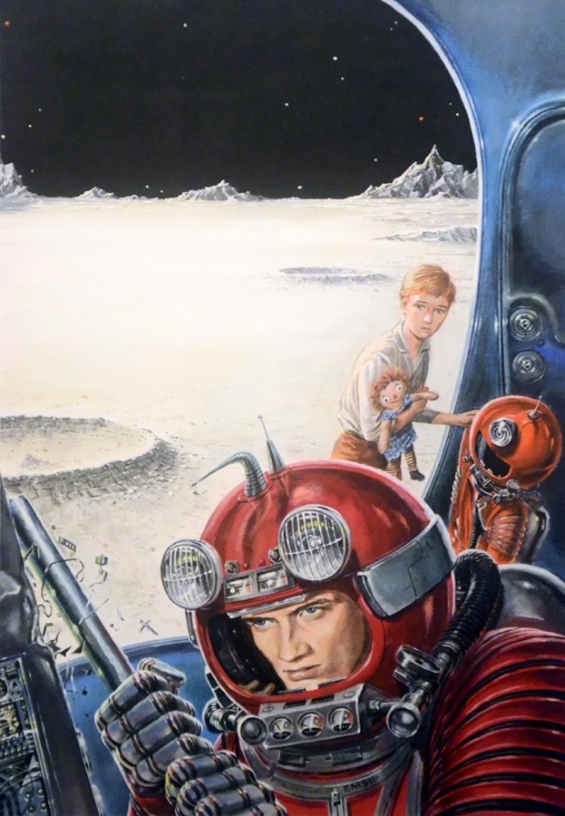
Have Spacesuit - Will Travel - illustration by Ed Emshwiller

Emsh interior illustration for HAVE SPACE SUIT - WILL TRAVEL

Ed Emshwiller illustration of Have Spacesuit, Will Travel

Kelly Freas -  Have Spacesuit, Will Travel

Posted by Jesse Willis

The SFFaudio Podcast #249 – AUDIOBOOK: Scanners Live In Vain by Cordwainer Smith

Podcast

The SFFaudio PodcastThe SFFaudio Podcast #249 – Scanners Live In Vain by Cordwainer Smith, read by J.J. Campanella.

First published in Fantasy Book, #6 in 1950. Scanners Live In Vain has been anthologized in such collections as The Science Fiction Hall of Fame, Volume I, Science Fiction 101 (aka Robert Silverberg’s Worlds Of Wonder), and The Great SF Stories 12 (1950).

This UNABRIDGED AUDIOBOOK runs (1 Hour 35 Minutes). We will discuss it in SFFaudio Podcast #250.

Scanners Live In Vain by Cordwainer Smith

Posted by Jesse Willis

Clarkesworld: Guest Of Honor by Robert Reed

SFFaudio Online Audio

I first heard Robert Reed’s outstanding novelette, Guest Of Honor, as an audiobook in the mid-1990s. It was narrated by Amy Bruce for Infinivox (get that version HERE).

It blew me away.

Guest Of Honor is undeniably GREAT SCIENCE FICTION, the kind of which only seems to show up once or twice a decade. If you haven’t already heard it, prepare yourself for some pure idea fiction.

There’s no official description for this astounding story so here’s mine:

When immortality is on the table accidents are naturally the uppermost fear on your mind. As an immortal you wouldn’t do anything nearly so dangerous as space travel, but all the same as an immortal you’d necessarily crave such new sensations so as to offset the boredom of an infinite future. And that’s where Pico comes in, she’s an adventurer gathering experiences for the immortals who sponsored her back on Earth. Her story, or stories, even if they are only vicarious, will be cherished by the many and she will be the guest of honor when she returns.

Clarkesworld MagazineClarkesworld Magazine #79 – Guest Of Honor
By Robert Reed; Read by Kate Baker
1 |MP3| – Approx. 1 Hour 21 Minuites [UNABRIDGED]
Podcaster: Clarkesworld
Podcast: April 22, 2013
First published in The Magazine of Fantasy and Science Fiction, June 1993.

Podcast feed: http://feeds.feedburner.com/clarkesworldmagazine/podcast

iTunes 1-Click |SUBSCRIBE|

Posted by Jesse Willis

Review of Venus by Ben Bova

SFFaudio Review

Science fiction Audiobook - Venus by Ben BovaVenus (The Grand Tour Series)
By Ben Bova; Read by Stefan Rudnicki
10 CDs – Approx. 11.7 Hours [UNABRIDGED]
Publisher: Blackstone Audio
Published: February 2011
ISBN: 9781441775726
Themes: / Science Fiction / Hard SF / Near future / Space travel / Planets /

The surface of Venus is the most hellish place in the solar system, its ground hot enough to melt aluminum, its air pressure high enough to crush spacecraft landers like tin cans, its atmosphere a choking mix of poisonous gases. This is where the frail young Van Humphries must go—or die trying. Years before, Van’s older brother perished in the first attempt to land a man on Venus. Van’s father has always hated him for being the one to survive. Now, his father is offering a ten-billion-dollar prize to the first person who lands on Venus and returns his oldest son’s remains. To everyone’s surprise, Van takes up the offer. But what Van Humphries will find on Venus will change everything—our understanding of Venus, of global warming on Earth, and his knowledge of who he is.

Venus by Ben Bova was first released on audio in abridged format in 2002. I reviewed in it 2004, and from what I wrote there I liked it just fine. This unabridged version (no surprise) was a different and better experience.

I am a fan of Ben Bova’s didactic Grand Tour novels. I like how I come away from each of these novels with a better understanding of how space travel works at our current level of knowledge. I also like how Bova uses what we know about the planets before he starts speculating.

In Venus, eccentric billionaire Martin Humphries summons his son, Van Humpries, to the moon. Prior to the story, Martin’s oldest son Alex had crashed on Venus and was presumed dead. Martin tells Van that he’s offering $10 billion to the person who can retrieve Alex’s remains and that he’s paying for it by cutting Van off financially. Van surprises his father by taking up the challenge himself. There is one other taker, so two teams vie for the prize. Two ships, separately designed and built to withstand the extreme conditions on Venus, race to snag human remains off the surface.

The plot is interesting and satisfying (though with a bit of clunky foreshadowing), but the star of the story is Venus. Bova’s characters reach Venus quickly, so the bulk of the novel is spent floating in their ships. It’s incredibly hot, and the atmosphere thick and roiling. Both ships were designed as dirigibles. Once the crafts reached the atmosphere, they floated like airships through the currents, sinking slowly toward the surface. Of course, it’s not that easy. There are plenty of surprises.

Stefan Rudnicki narrates, and yet again I enjoyed him. He’s one of the best narrators we have. I’m always pleased to hear him perform a good piece of science fiction.

Posted by Scott D. Danielson

Review of The God Engines by John Scalzi

SFFaudio Review

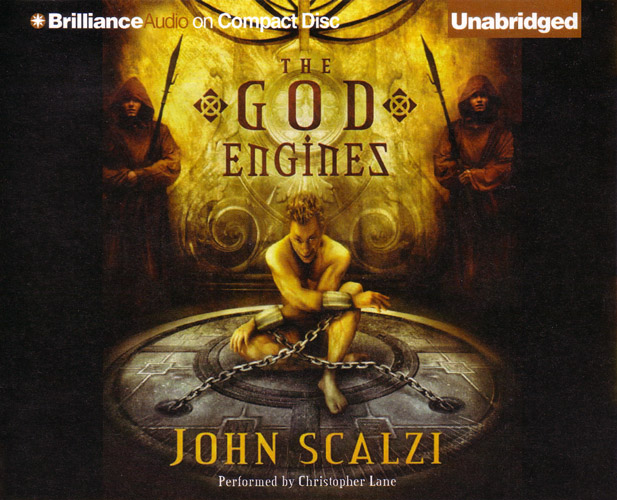
BRILLIANCE AUDIO - The God Engines by John ScalziThe God Engines
By John Scalzi; Read by Christopher Lane
3 CDs – Approx. 3 Hours 15 Minutes [UNABRIDGED]
Publisher: Brilliance Audio
Published: December 2010
ISBN: 9781441890795
Themes: / Science Fiction / Fantasy / Religion / Galactic Civilization / Space Travel / War /

Captain Ean Tephe is a man of faith, whose allegiance to his lord and to his ship is uncontested. The Bishopry Militant knows this — and so, when it needs a ship and crew to undertake a secret, sacred mission to a hidden land, Tephe is the captain to whom the task is given. Tephe knows from the start that his mission will be a test of his skill as a leader of men and as a devout follower of his god. It’s what he doesn’t know that matters: to what ends his faith and his ship will ultimately be put — and that the tests he will face will come not only from his god and the Bishopry Militant, but from another, more malevolent source entirely… Author John Scalzi has ascended to the top ranks of modern science fiction with the best-selling, Hugo-nominated novels Old Man’s War and Zoe’s Tale. Now he tries his hand at fantasy, with a dark and different novella that takes your expectations of what fantasy is and does, and sends them tumbling. Say your prayers… and behold The God Engines.

The God Engines is the strongest John Scalzi audiobook since Old Man’s War |READ OUR REVIEW|. It provokes thought, flies off in an unexpected direction and doesn’t overstay its welcome. The setting is in an unnamed galaxy, at an unknown time. But space travel, interstellar communication, and bodily healing aren’t technological developments. Instead, they are derived from a rigorous faith in actual, existing gods! These gods are so real, so embodied, that there is one in the center of each starship. It lies their enslaved, guarded and harnessed so as to achieve the ends to which they are put. Command over these powerful beings is achieved by a combination of torture and reward. Their masters are human beings, members of a religion with their own completely manifested god. Their purpose is to war with other religions, enslave new gods and bring more human beings to the worship of their own god. It is an unending holy war, in a fully realized universe, and it works.

I like to see the examination of an interesting idea, without an endless parade of pointless activity to dilute its core of goodness. We have that in this book. There’s something very neat about the running of what is essentially the starship Enterprise on faith. To hear that an officer is changing his prayers to adjust what’s showing up on the viewscreen – that’s something definitely worth seeing. Scalzi’s universe is run on prayer, faith, and relgious belief. It’s a kind of realization of what religions always claim, but shown to be actually functioning in a replicable manner. It’s theology as physics. The whole story feels like it comes from the same place J. Michael Straczynski’s Babylon 5 came from. Where Arthur C. Clarke’s Childhood’s End came from. There’s an indisputable space opera with Lovecraft vibe to it, but unlike so much space opera, the thinking just isn’t mushy and placative. In fact, there was nary a moment where I wasn’t completely engaged with this made up Fantasy/SF tale. The storytelling is expertly intertwined with a careful exposition of the universe’s rules. This works to fully enrich the ideation without coming off as merely a writer going through a checklist. I’d love to see Scalzi, or any other SF writer, write a dozen more books just like this – take a break from the series universe, and write some more idea based SF. Take a simple little premise or vignette, throw in a few characters and have them explore the concomitant interestingness of that idea. The God Engines does exactly that. It shows, very simply what SF storytelling is supposed to look like. This audiobook stands well, on its own, though I could easily imagine it as one half of an old Ace Double. This is very good work. Well done Mr. Scalzi.

Narrator Christopher Lane has about five major characters to play with. The captain is commanding and thoughtful. The second in command is calm and loyal. The ship’s high priest (who also acts as a kind of political commissar) is jealous but clever. The one female role, a rook (which is kind of a cross between a ship’s whore and a priestess), is wise and womanly. But it’s the unnamed god’s voice that is the real standout. Lane’s god is tortured, twisted and devious. It is a very precise performance, one that allows for the sympathy Scalzi was aiming at. The art for the cover comes from Vincent Chong‘s illustration of the Subterranean Press edition.

Posted by Jesse Willis