News, Reviews, and Commentary on all forms of science fiction, fantasy, and horror audio. Audiobooks, audio drama, podcasts; we discuss all of it here. Mystery, crime, and noir audio are also fair game.
The SFFaudio Podcast #106 – Jesse and Tamahome talk about audiobooks, books, comic books, movies and technology.
Talked about on today’s show:
Scott is away, Warrior Race by Robert Sheckley, the guilt tactic, Robert Sheckley’s The Victim From Space, M. Night Shamylan, Alfred Hitchcock Presents, Star Trek: The Next Generation, the limits of sympathy and empathy, Lethal Weapon, civil disobedience, Ghandi, Ahisma, Gregg Margarite, Lauren Bacall, the future of self-published ebooks and curation, SFsignal’s anthology reviews, novels vs short stories, LibriVox, rating systems, Gil T. Wilson, SFSite, Avatar, Coraline, The Graveyard Book, Neil Gaiman’s narration, William Gibson, Where is the Neuromancer audiobook?, The Matrix, What is noir in film or books?, Do Androids Dream of Electric Sheep?, Memento, a podcast about noir films (Noircast.net), Limitless aka (The Dark Fields) movie vs book, director Neil Berger, The Illusionist, The Prestige, Christopher Priest, Existenz, WWW: Wake, WWW: Wonder, Robert J. Sawyer, many spoilers in this podcast, Sawyer’s next novel is Triggers, research then write, the Webmind, Jesse doesn’t like series (usually), the ‘talking Dinosaur’ series (the Quintaglio Ascension series), is the WWW series YA?, Cory Doctorow, characters, Golden Fleece is a murder mystery in space, more dino, would anyone make the dinosaur series into a 3D animated film?, Robert J. Sawyer’s Rollback was on CBC Radio One’s Between The Covers podcast, Galileo’s Dream, Red Mars, Michio Kaku, futurism, climate change, Pacific Edge by Kim Stanley Robinson, can a domestic story be thrilling?, Austin Powers, “one million dollars!”, the trap of inflating the stakes, Tim Pratt on Dragon Page podcast (7½ minutes in), the ‘speech thriller’, what’s in the suitcase?, Kiss Me Deadly, “make each sentence do two things”, Midnight Riot (aka Rivers Of London), British lingo, “snog”, series and trends at bookstores, Peter Watts‘s openness, Flashforward TV show, The Gong Show, bring back the hook, Crysis 2: Legion the novel and the game, the economics of hard covers vs ebooks, Kindle openness, the VLC app was removed from the iTunes App store, the Android OS, Embedded, ROM person, the Comics Code Authority repealed!, Mark Millar, Nemesis, The Ultimates, Ex Machina, Chronicles Of Wormwood, Garth Ennis, Howard The Duck, death of superheroes, Superman left America (Action Comics #900), “truth, justice, and the American way”, Superman: Red Son, Battlefields, The Boys, The Punisher with the guy from Hung (Thomas Jane), Warren Ellis wrote a novel (Crooked Little Vein), can we make Peter Watts audiobooks?, synthesized voices on archive.org, Linux for all e-readers, Philip K. Dick, The Electric Ant comic, Tom Merritt, Sword and Laser, TWIT, Munchcast.
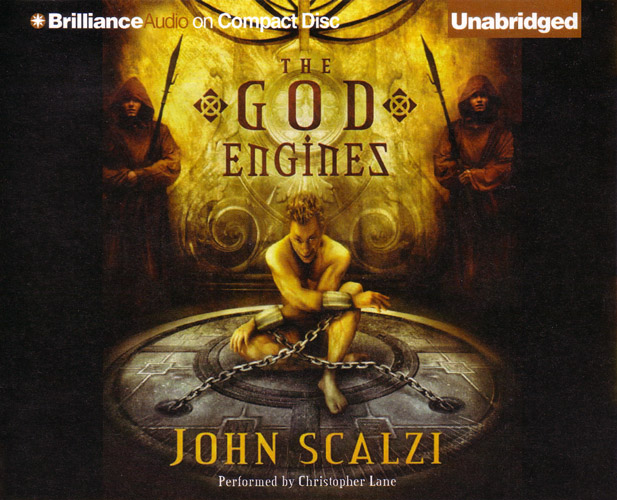
The God Engines
By John Scalzi; Read by Christopher Lane
3 CDs – Approx. 3 Hours 15 Minutes [UNABRIDGED]
Publisher: Brilliance Audio
Published: December 2010
ISBN: 9781441890795
Themes: / Science Fiction / Fantasy / Religion / Galactic Civilization / Space Travel / War /
Captain Ean Tephe is a man of faith, whose allegiance to his lord and to his ship is uncontested. The Bishopry Militant knows this — and so, when it needs a ship and crew to undertake a secret, sacred mission to a hidden land, Tephe is the captain to whom the task is given. Tephe knows from the start that his mission will be a test of his skill as a leader of men and as a devout follower of his god. It’s what he doesn’t know that matters: to what ends his faith and his ship will ultimately be put — and that the tests he will face will come not only from his god and the Bishopry Militant, but from another, more malevolent source entirely… Author John Scalzi has ascended to the top ranks of modern science fiction with the best-selling, Hugo-nominated novels Old Man’s War and Zoe’s Tale. Now he tries his hand at fantasy, with a dark and different novella that takes your expectations of what fantasy is and does, and sends them tumbling. Say your prayers… and behold The God Engines.
The God Engines is the strongest John Scalzi audiobook since Old Man’s War |READ OUR REVIEW|. It provokes thought, flies off in an unexpected direction and doesn’t overstay its welcome. The setting is in an unnamed galaxy, at an unknown time. But space travel, interstellar communication, and bodily healing aren’t technological developments. Instead, they are derived from a rigorous faith in actual, existing gods! These gods are so real, so embodied, that there is one in the center of each starship. It lies their enslaved, guarded and harnessed so as to achieve the ends to which they are put. Command over these powerful beings is achieved by a combination of torture and reward. Their masters are human beings, members of a religion with their own completely manifested god. Their purpose is to war with other religions, enslave new gods and bring more human beings to the worship of their own god. It is an unending holy war, in a fully realized universe, and it works.
I like to see the examination of an interesting idea, without an endless parade of pointless activity to dilute its core of goodness. We have that in this book. There’s something very neat about the running of what is essentially the starship Enterprise on faith. To hear that an officer is changing his prayers to adjust what’s showing up on the viewscreen – that’s something definitely worth seeing. Scalzi’s universe is run on prayer, faith, and relgious belief. It’s a kind of realization of what religions always claim, but shown to be actually functioning in a replicable manner. It’s theology as physics. The whole story feels like it comes from the same place J. Michael Straczynski’s Babylon 5 came from. Where Arthur C. Clarke’s Childhood’s End came from. There’s an indisputable space opera with Lovecraft vibe to it, but unlike so much space opera, the thinking just isn’t mushy and placative. In fact, there was nary a moment where I wasn’t completely engaged with this made up Fantasy/SF tale. The storytelling is expertly intertwined with a careful exposition of the universe’s rules. This works to fully enrich the ideation without coming off as merely a writer going through a checklist. I’d love to see Scalzi, or any other SF writer, write a dozen more books just like this – take a break from the series universe, and write some more idea based SF. Take a simple little premise or vignette, throw in a few characters and have them explore the concomitant interestingness of that idea. The God Engines does exactly that. It shows, very simply what SF storytelling is supposed to look like. This audiobook stands well, on its own, though I could easily imagine it as one half of an old Ace Double. This is very good work. Well done Mr. Scalzi.
Narrator Christopher Lane has about five major characters to play with. The captain is commanding and thoughtful. The second in command is calm and loyal. The ship’s high priest (who also acts as a kind of political commissar) is jealous but clever. The one female role, a rook (which is kind of a cross between a ship’s whore and a priestess), is wise and womanly. But it’s the unnamed god’s voice that is the real standout. Lane’s god is tortured, twisted and devious. It is a very precise performance, one that allows for the sympathy Scalzi was aiming at. The art for the cover comes from Vincent Chong‘s illustration of the Subterranean Press edition.
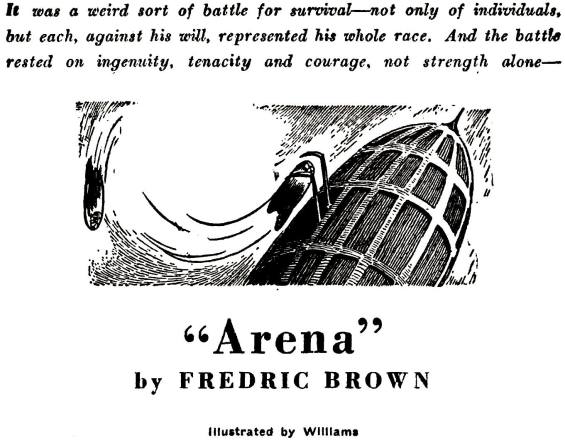
For nearly a year I’ve been studying the extensive influence of Fredric Brown’s 1944 short story, Arena. It took a recent article, on roughly the same topic, over on the excellent bare•bones e-zine blog, to prompt me to actually finish writing up this post – which is essentially a collection of inspired by and/or similar stories. That other post, by Jack Seabrook, mostly covers the Outer Limits‘ response to Arena – which is something that I’ve only briefly mentioned. Seabrook’s article and the thoughtful comments it’s spawned are well worth looking at |HERE|. One of the comments there also points out the connection to Richard Connell’s The Most Dangerous Game (but that’s another post altogether). My post on Arena begins here:
Arena (noun) – [Latin harēna, arēna, sand, a sand-strewn place of combat in an amphitheater, perhaps of Etruscan origin.] -1. An enclosed area, often outdoor, for the presentation of spectacular events -2. The part of a Roman amphitheater that was covered with sand to absorb the blood spilled by the combatants.
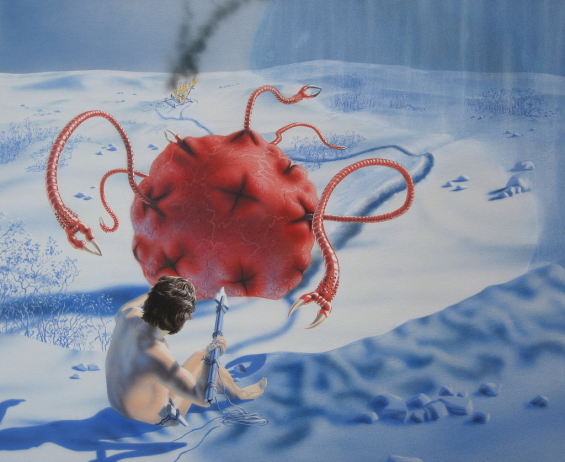
The SFFaudio Podcast #051 had a brief primer, by Professor Eric S. Rabkin, on Fredric Brown‘s spectacular short story Arena. Rabkin pointed out the curious description of the alien, and the year in which the story was first published (1944). The story being a fascinating metaphor for the Pacific War. The description of the alien, a “red sphere with several dozen fully retractable thin tentacles” is nicely comparable it with the Imperial Japanese battle ensign…
War flag of the Imperial Japanese Army:
Now if we keep looking for symbols, we can certainly find them. Take the blue sand of the arena itself. If Carson represents the USA, and the alien represents Japan, would the pervasive blue sand not therefore be representative of the Pacific Ocean? Of course it would!
Next, check out the original story, available in an unabridged audiobook version created by Rick Jackson (aka The Time Traveler) for The Time Traveler Show podcast…
Arena
By Fredric Brown; Read by William Spurling
1 |MP3| – Approx. 1 Hour [UNABRIDGED]
Podcaster: The Time Traveler Show
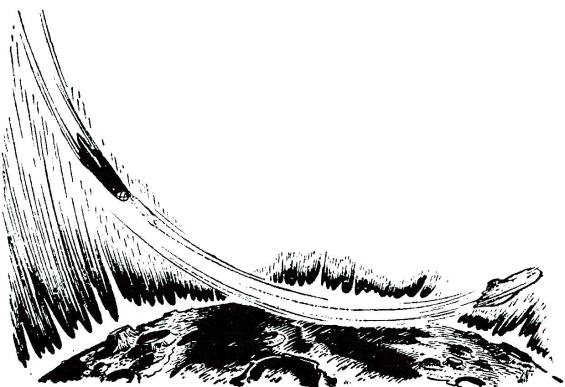
Podcast: July 23rd, 2006 The mysterious Outsiders have skirmished with Earth’s space colonies and starships. Their vessels are found to be faster and more maneuverable, but less well armed. Survivors of these encounters are able to provide little other information about the enemy. Fearing the worst, Earth builds a war fleet. Sure enough, scouts report a large armada approaching the solar system. Earth’s defenders go to meet them. All indications are that the two fleets are evenly matched. First published in the June 1944 issue of Astounding Science Fiction magazine.
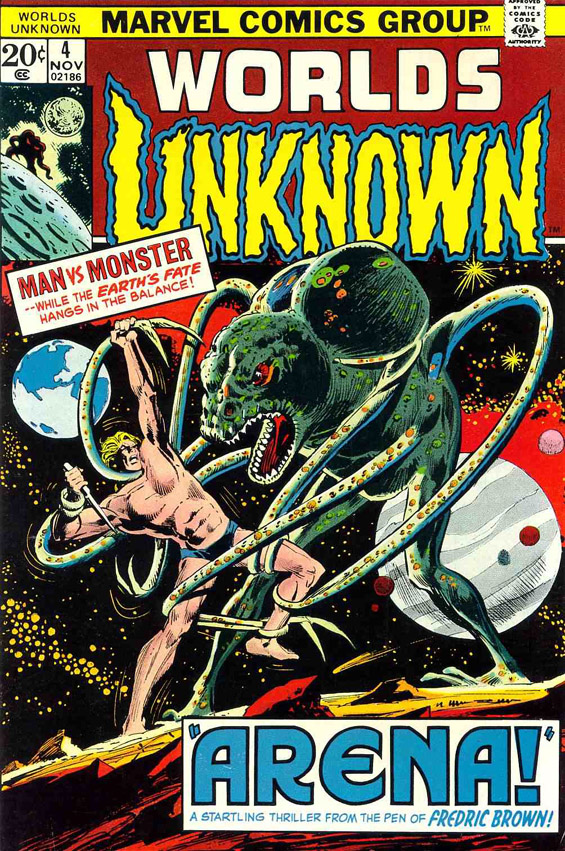
In the comics department, there was a 1976 Marvel Comics magazine adaptation in Unknown Worlds of Science Fiction. Of it, Pete Doree (Of The Bronze Age Of Blogs) sez:
“Arena is one of my all-time favourite one-off comic stories, from Roy Thomas’ short-lived Worlds Unknown. Rascally Roy obviously liked it as much as me, as he reprinted it in the last issue of his b/w follow up Unknown Worlds Of Science Fiction. What I like about it is that it’s storytelling pared right down to the bone: One man. One monster. Winner takes all. It’s that simple, and that elegant. The set up is so primal that you’re practically dealing in archetypes. Plus you get the amazing pairing of John Buscema & Dick Giordano on art. It was adapted from a story by Frederic Brown, a great old school sci-fi writer.”
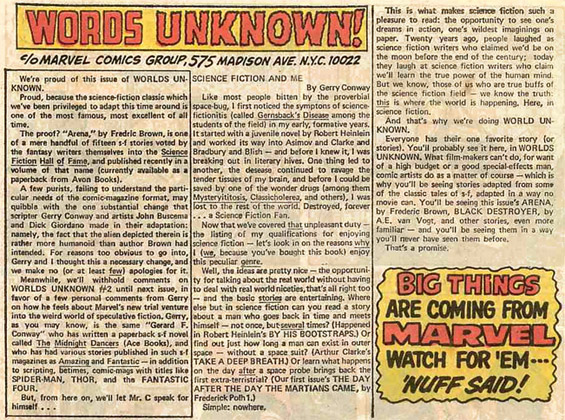
And, check out this editorial from Marvel Comics issue 4 of Unknown Worlds:
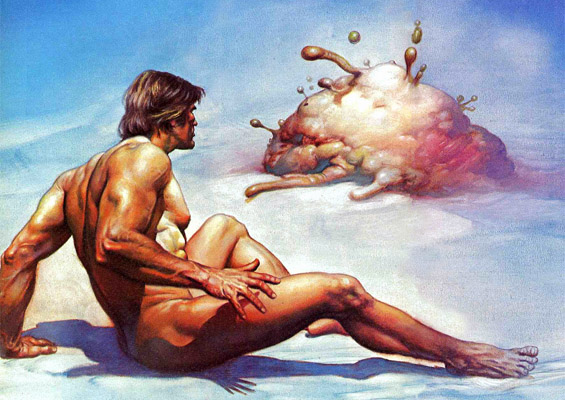
Keeping with the art theme, there’s Boris Vallejo’s depiction from the March 1977 Starlog Magazine printing of Arena (more on that |HERE|):
TV, movies and other SF authors also seem to have taken inspiration or paralleled Fredric Brown’s Arena too:
Star Trek: Arena:
Outer Limits: Fun And Games:
The one man against one man theme, as developed in Arena, departed the SF genre entirely with the 1968 film Hell In The Pacific. The movie stars Lee Marvin and Tishiro Mifune as shot down American and Japanese fighter pilots who make WWII more personal.
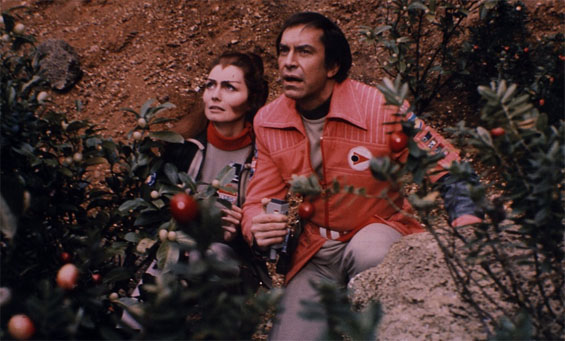
The meme sunk to its lowest low with the frighteningly awful (and least faithful) variation in “The Rules Of Luton” episode of Space 1999.
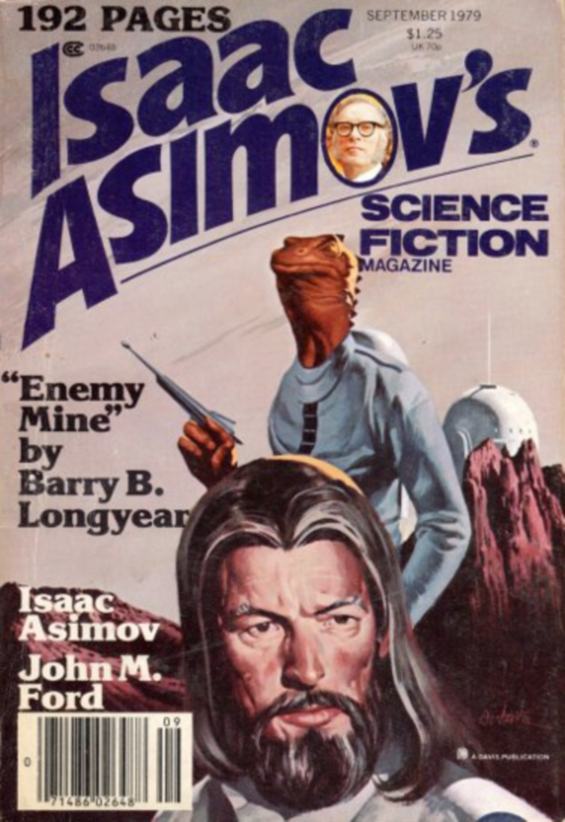
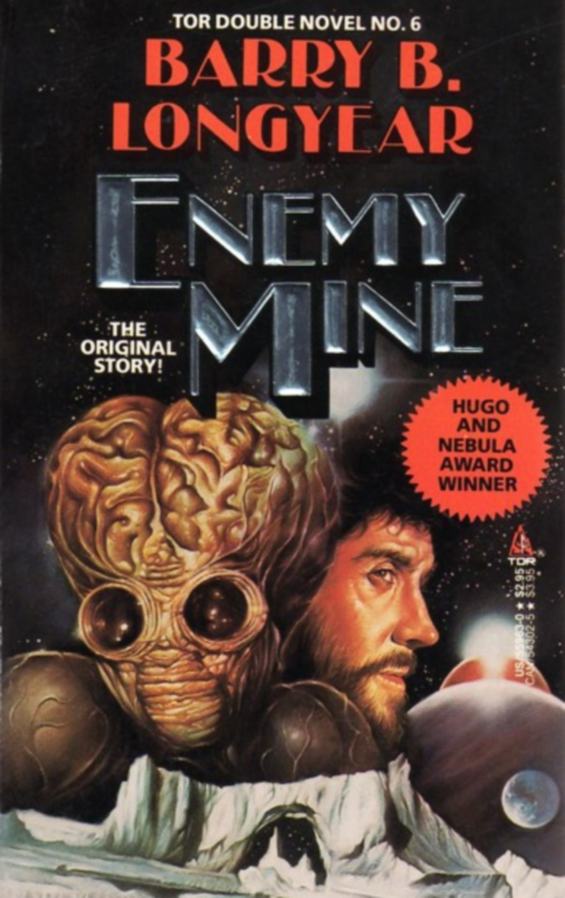
The meme transmogrified back into a man vs. alien confrontation for Barry B. Longyear’s 1979 novella Enemy Mine. Willis Davidge, a human fighter pilot, is stranded along with Jeriba Shigan, a Drac, on a hostile alien planet foreign to them both.
The movie version of Enemy Mine, 1985, magnified the allegory with a theme of racial brotherhood.
In 1989, Star Trek: The Next Generation first adopted the idea for an episode entitled “The Enemy“.
Another variation, in 1991, in an episode of Star Trek: The Next Generation called “Darmok” nearly eliminates the physical conflict, replacing it with an intellectual puzzle on the difficulties of communication.
Star Trek: Enterprise, in an attempt to recycle every previous Star Trek series plot, did their own take with the 2003 episode entitled Dawn:
Update:
David Schleinkofer illustrated the Reader’s Digest Edition of Arena in the early 1980s:
The SFFaudio Podcast #089 – Jesse talks to James Campanella, Ph.D. Jim is an associate professor in the department of Biology and Molecular Biology at Montclair State University in New Jersey. He’s also an audiobook narrator, and podcaster.
Talked about on today’s show:
J.J. Campanella watches very little TV, Lost, The Big Bang Theory, Antarctica, MSU, molecular biology, genetics, plant genetics, philology vs. phylogeny, the Science News Update podcast, “a funny Geordie sounding dude” (Tony C. Smith), duck penises, cloaca, sexing birds, African Grey parrots, ants, What Technology Wants, technology as an extension of evolution, “microscopic brains”, plant intelligence, tropism, phototropism vs. gravitropism, auxins, The Secret Life Of Plants, dowsing, plant signaling (with jasmonic acid), StarShip Sofa, The Merchant And The Alchemist’s Gate by Ted Chiang, knitting and cross-stitching, narrating skills, Uvula Audio, I, Libertine, The Call Of The Wild by Jack London, L. Frank Baum is seriously weird, violence vs. bloodless violence, the Tin Woodsman and his enchanted axe, goiing from cyborg to robot (via a Ship of Theseus metaphor), Sky Island, genocide in kids books, Doc Savage, The Avenger, Lester Dent, Hamlet And Eggs by J.J. Campanella, a comedic detective story, Georgia, 9/11, how to be always wrong, private detectives, The Code Of The Poodles by James Powell, what accent would a talking dog have?, The Friends Of Hector Jouvet by James Powell, Monaco, A Dirge For Clowntown by James Powell, Ellery Queen’s Mystery Magazine, Divers Down by Hal Gordon, were kids in the ’70s were more respectful?, the Rick Brant series, Tom Swift, The Rocket’s Shadow (Rick Brant #1) by John Blaine, Jonny Quest, adventure, The Venture Bros., The Flintstones, Harold L. Goodwin, serial books, house names, The Bobbsey Twins, Edward Stratemeyer, “electronic adventures”, who read and bought those serial books?, the end of the pulp era, The Mystery Of The Stratemeyer Legacy, Nancy Drew, has paranormal romance replaced kids books?, the Twilight series, the Harry Potter series, Rick Riordan, The Wizard Of Oz, H.P. Lovecraft, Stephen King, the rich and amazing language of Lovecraft, Miskatonic University, Craig Nickerson, At The Mountains Of Madness by H.P. Lovecraft, Professor William Dyer, The Shadow Out Of Time by H.P. Lovecraft, Brazil, proper Portuguese pronunciation, “lethp listhping”, Doctor Who, Silurians, yithians, Horror vs. Science Fiction, Astounding Stories, time travel, “shoggoths etc.”, The Statement Of Randolph Carter, a really serious (and difficult) question: Are zombies Science Fiction or Fantasy?, Romero-style zombies, 28 Days Later, real zombies in nature (mostly in the insect world), Herbert West, Re-Animator, the source matters, if the zombie was dead then it is Fantasy, why are zombies so popular?, people like the idea of being able to kill without remorse, mummies vs. werewolves vs. vampires vs. zombies, Zombieland, Bill Murray, contemporary Fantasy, Neil Gaiman, comics, sword and sorcery, Elric, the Thomas Covenant series, Stephen R. Donaldson, Douglas Adams, American Gods |READ OUR REVIEW| vs. The Long Dark Tea-Time Of The Soul, James Alan Gardner, Expendable is an “absolute masterpiece”, Star Trek, why are there no James Alan Gardner audiobooks?, Lara Croft Tomb Raider: The Man Of Bronze is terrible, The Girl With The Dragon Tattoo by Stieg Larsson |READ OUR REVIEW|, Jim Campanella describes it as “turgid”, Metropia, “photo-realistic Swedish anime”, baby eyes, Steamboat Willie, the evolution of Mickey Mouse’s appearance, infanticide, why do your big eyes prevent me from kill you?, saccharin, the sucralose story (is in the Dec. 2010 podcast of Science News Update).
WATCH OUT FOR THE FALSE ENDINGS (mostly attributable to Luke)
Talked about on today’s show:
Role playing game names, “Tom And His Friends” Dungeons And Dragons comedy (aka Farador), SFFaudio Challenge #2, Rebels Of The Red Planet by Charles L. Fontenay, Mars, martian rebels, Podiobooks.com, Cossmass Productions, Mark Douglas Nelson, Dan Simmons’ Hyperion, the least interesting vs. the least fitting, I’m Dreaming Of A Black Christmas by Lewis Black, Christmas = Fantasy?, The Daily Show with Jon Stewart, Suck It, Wonder Woman |READ OUR REVIEW|, Star Wars, what makes Star Wars Science Fiction is a sense-of-wonder?, Star Trek, METAtropolis: Cascadia, Star Trek The Next Generation narrators vs. Battlestar Galactica narrators, Wil Wheaton as a narrator, Dove Audio, Levar Burton as a narrator, liking Star Trek for all the wrong reasons, Theodore Sturgeon, Harlan Ellison, assimilation is a neat idea, “who the hell are the Borg?”, The Unincorporated Man by Dani Kollin and Eytan Kollin |READ OUR REVIEW|, The Unincorporated War, “is there true Science Fiction to be found in sequels?”, The Hunger Games by Suzanne Collins, Peter F. Hamilton’s The Void Trilogy, Blackout by Connie Willis, The Doomsday Book by Connie Willis |READ OUR REVIEW|, Firewatch, dragging the story out, Whiteout by Connie Willis, World War II, Katherine Kellgren as a narrator, Jenny Sterlin as a narrator, Recorded Books, Brilliance Audio, Audible.com, Amazon.com, Earth Abides by George R. Stewart, Deep Six by Jack McDevitt, introductions to audiobooks, the introduction as an apology for the book, Slaughterhouse Five by Kurt Vonnegut Jr. |READ OUR REVIEW|, The Stainless Steel Rat by Harry Harrison, The Time Traders by Andre Norton, H.G. Wells, The First Men In The Moon, Around The Moon, Jules Verne, continuing characters rather than continuing series, Sherlock Holmes, Khyber Pass vs. Reichenbach Falls, Sir Arthur Conan Doyle, The Valley Of Fear, The Hound Of The Baskervilles, Lois McMaster Bujold’s Miles Vorkosigan series, does reading a series defeat the hope of being surprised? Priest Kings Of Gor by John Norman, A Game Of Thrones by George R.R. Martin |READ OUR REVIEW|, fun vs. funny, crime and adventure vs. ideas, A Princess Of Mars by Edgar Rice Burroughs, Bill The Galactic Hero, Slippery Jim DiGriz, The Stainless Steel Rat’s Revenge, This Immortal by Roger Zelazny, The Speed Of Dark by Elizabeth Moon, Books On Tape, Grover Gardner, Gregg has a grumbly voice, The Space Dog Podcast, The Science Fiction Oral History Association, Gordon Dickson, Isaac Asimov, Arthur C. Clarke, Cordwainer Smith, Scott Westerfeld, Ben Bova, Luke’s next podcast project, NaNoWriMo, what podcast schedule should you have?, Robert Silverberg AUDIOBOOKS are coming from Wonder Audio, the old stuff vs. the new stuff, Jay Snyder as a narrator, a Science Fiction story that has little SF content, autism, Charly, Understand by Ted Chiang, Flowers For Algernon, interacting with the world, I Am Not A Serial Killer by Dan Wells, psychopathy, an unreliable first person narrator, young Dexter, Asperger syndrome, The Curious Incident Of The Dog In The Night-Time by Mark Haddon, a detached (but reliable) narrator, the two audiobook versions of The Curious Incident Of The Dog In The Night-Time, Quicksilver by Neal Stephenson, the Baroque Cycle, Anathem, John Allen Nelson as a narrator, Phat Fiction, The Way Of Kings by Brandon Sanderson, The Towers Of Midnight by Robert Jordan and Brandon Sanderson, walking around central park as a retired person as my new career, who listens to audiobooks?, working the unworked niche, they really like Gregg’s voice!, no RSS-feed = soooo sad, Sam This Is You by Murray Leinster, Black Amazon Of Mars by Leigh Brackett, The World That Couldn’t Be Clifford D. Simak, The Idiot by John Kendrick Bangs, The Hate Disease, Asteroid Of Fear, Industrial Revolution by Poul Anderson, A Horse’s Tale by Mark Twain, anthropomorphic fiction, A Dog’s Tale by Mark Twain, Gregg has bugles lying around, Jonathan Swift, Gulliver’s Travels, Thought You Were Dead by Terry Griggs, Iambik Audio‘s upcoming Science Fiction audiobooks, LibriVox, working with small press publishers, Extract From Captain Stormfield’s Visit To Heaven, Blackstone Audio, The Many Colored Land by Julian May, Bernadette Dunne as a narrator, time travel, The Pliocene Epoch, sequel and prequel fatigue, flooding the Mediterranean, Blake’s 7: Zen : Escape Veloctiy is a Science Fictiony audio drama series, Firesign Theatre? (he means Seeing Ear Theatre), The Moon Moth based on the story by Jack Vance, Don’t Crush That Dwarf, Hand Me The Pliers, Mistborn, Terminal World by Alastair Reynolds, Lord Of Light by Roger Zelazny, Finch by Jeff Vandermere, Flood by Stephen Baxter, thematic exploration vs. bad writing, GoodReads.com, Eifelheim by Michael Flynn |READ OUR REVIEW|, Luke’s books should be audiobooks, The Fifth Annual SFFaudio Challenge, all the cool Science Fiction ideas in Luke’s books, Gregg Margarite is a secret author with a secret pseudonym, Eric Arthur Blair, the publishing industry headache is intolerable to many, good writers + savvy marketers = sales success?, Redbelt, David Mamet, drowning in an ocean full of crap, the Jesse Willis bump?, catering to the listeners (or readers) desires vs. publishers desires, Pogoplug, Out Of The Dark by David Weber, artificial robots vs. natural robots, What Technology Wants by Kevin Kelly, art and techne, does evolution have goals?, the Cool Tools blog, eyes vs. I, natural selection, zero-point energy, the Cat in Red Dwarf was pulled to the fish dispensing vending machine, if you won’t give me eyes at least give me bilateral symmetry, goals vs. patterns or positions, starfish vs. Inuit, technology is a function of evolution, Luke re-writes The War Of The Worlds in under 20 minutes, red weed and green mist, stomach-less martians, “the final final part” and the musical version, flipping over the narrative is fun, Ender’s Game vs. Ender’s Shadow, what do the martians have against doors?, keeping the martian cannon canon, The Dragon With The Girl Tattoo by Adam Roberts.
The provocative sequel to the Hugo and Audie Award-nominated METAtropolis features interconnected stories by today’s top speculative fiction writers, performed by a galaxy of Star Trek ® stars.
As the mid-21st century approaches, the Pacific Northwest has been transformed — politically, economically, and ecologically — into the new reality of Cascadia. Conspiracies and secrets threaten the tenuous threads of society. The End of Days seems nearer than ever. And the legend of the mysterious Tygre Tygre looms large.
METAtropolis: Cascadia is the creation of Hugo and World Fantasy Award nominee Jay Lake; Mary Robinette Kowal, winner of the John W. Campbell Award for Best New Writer; New York Times best-selling author Tobias S. Buckell; Hugo Award winner Elizabeth Bear; Aurora Award winner Karl Schroeder; and critically-acclaimed author Ken Scholes.
The team of narrators is any sci-fi fan’s dream: Star Trek’s Rene Auberjonois (“Odo”), Kate Mulgrew (“Capt. Kathryn Janeway”), Wil Wheaton (“Wesley Crusher”), Gates McFadden (“Dr. Beverly Crusher”), Jonathan Frakes (“Cmdr. William Riker”), and LeVar Burton (“Geordi La Forge”). Jay Lake, who also served as Project Editor, introduces this stunning sequel, written and produced exclusively for digital audio.
Exciting! Audible is also offering one of the stories from last year’s METAtropolis for free – |DETAILS HERE|. And |HERE| is our review of that excellent collection.

 The SFFaudio Podcast #106 – Jesse and Tamahome talk about audiobooks, books, comic books, movies and technology.