Review of The Plot to Save Socrates by Paul Levinson

Science Fiction Audiobook Review

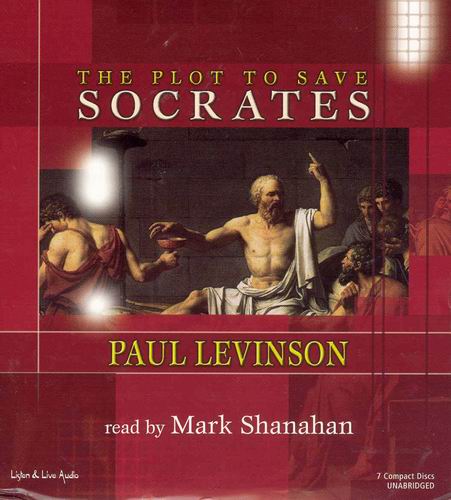
The Plot to Save Socrates by Paul LevinsonThe Plot To Save Socrates
By Paul Levinson; Read by Mark Shanahan
7 CDs – 10 Hours [UNABRIDGED]
Publisher: Listen & Live Audio
Published: 2006
ISBN: 1593160747
Themes: / Science Fiction / Time Travel / Cloning / Philosophy / Ancient Greece / Ancient Rome / Ancient Egypt / 19th Century New York /

“Think not those faithful who praise all thy words and actions;
but those who kindly reprove thy faults.”
Socrates (c.470 BC – 399 BC) Greek philosopher

2042 AD. Sierra, a young classics scholar has discovered a lost Platonic scroll. Its contents will lead her to attempt to trounce the awful punishment that was imposed upon Socrates, the pre-eminent philosopher of the golden age of Greece. Joining her is her fiance Max, her thesis advisor Tom, Alcibides (a famous Greek orator and friend to Socrates), 19th century New York publisher W.H. Appleton, as well as the famously talented inventor, Heron of Alexandria.

Levinson opens the novel well with grad student Sierra Waters discovering a lost Socratic dialogue. It is a terrific opening, and I think this is what got my hopes so high. This isn’t a terrible novel, it just doesn’t grab me like I wanted it to. It is, rather, a workman-like time travel adventure. I was hoping it would be something deeper. In terms of pace, there is at least one too many characters. And none of them, including Socrates, engaged me as they should have. This is doubly troubling considering that the ideas weren’t sufficent for the novel length. Both the time travel itself and the mechanism of the time travel (a set of chairs created by a mysterious time traveler from the future) are sidelined and remain virtually unexplained. There are some interesting reveals sprinkled here and there and Levinson gives a decent twist-ending but it is only satisfying on one level and doesn’t and fufil the promise I thought it had. I never became enraptured by the story. There are unfilled gaps in the narrative. It feels as if the novel were abridged, though the packaging copy assures me that it wasn’t. The biggest single disapointment for me was the lack of more than a surficial philosophical content. Socrates reasons for allowing himself to be executed by an Athenian jury are only lightly touched upon. Levinson has an interest in philosophy, but Socrates and the Socratic method deserve a stupendous Science Fiction showcase and not this – a light adventure yarn. Had the spartan but solid contents of the plot been rendered to novellete or novella length the story would probably have worked far better. To his credit Levinson includes Socrates’ distrust of the written word. The written word is fixed, something that can’t be quibbled about as easily as can the thoughtful power of spoken word. Had Socrates known about audiobooks I think he’d have questioned the recorded word too.

Narrating duites on this one are by Mark Shanahan. Shannahan has a decent range, offering some distinction between the many characters. His job however was made more difficult than it should have been; Levinson’s characters aren’t fully dimensional. The narration is accompanied by sound effects and a situational background noise. I was disapointed with the inclusion of sound effects. If the text says “the doorbell rang.” you don’t need the sound effect of a doorbell ringing. If the narrator then reads the line “the doorbell rang.” not only don’t you need the sound of a doorbell ringing it interupts the flow of the story to include it. Less intrusive, but certainly no less unnecessary is the occasional inclusion of background noise designed to be appropriate to where a scene takes place. A pub, with a humm of clinking of glasses and the buzz of distant conversations, a seaside with the cry of seagulls and the slosh of waves. I get it, we’re in a pub or on a beach. But the absence from the rest of the narrative makes these scenes stand out in a way they shouldn’t and thus paradoxically distances the listener rather than drawing him or her in. The music is actually pretty good and definitely works better than the rest of the production details. The music fades in and out, bookending scenes. There are also one or two sentences that were missed in the final pass. Shannahan will read a line, and then read it again.

Upon reading other reviews scattered around the net I see that more people seem to have become caught up in the novel than I did. I envy them. I wanted to like this novel a lot more than I did. One reviewer pointed out that Levinson’s characterization and was like that of Isaac Asimov’s. I don’t disagree, I just think that was one of Asimov’s few weakness. Another reviewer pointed out how well constructed the chronology of the time travel was. Again, I don’t disagree, it was well woven. Maybe my problem is that most of my favorite time travel stories are of a much shorter length. If that is your problem too, bear that in mind joining in on The Plot To Save Socrates

Posted by Jesse Willis

Review of Alien Voices: The Time Machine

Science Fiction Audiobook Review

Science Fiction Audiobook - Alien Voices - H.G. Wells' The Time MachineH. G. Wells’ The Time Machine
By H. G. Wells, performed by a full cast
2 Cassettes, 2 CDs, Approx. 2 hours – [AUDIO DRAMA]
Publisher: Simon and Schuster
Published: 1997
ISBN: 0671575538 (cassettes), 0671575546 (CDs)
Themes: / Science fiction / Time Travel / Evolution / Future /

When a time traveler seeks a better world 802,000 years in the future, his optimism is shaken when he discovers that the human race has turned upon itself in a primal display of horror.

For their first adaptation, Alien Voices choose one of the most important stories ever written in SF. And with Leonard Nimoy as the time traveler and John DeLancie as the narrating friend of the time traveler, we’re among the pantheon of SF deities.

This adaptation is very faithful to the original story. A gentleman of the late 19th century invents a time machine. Over a dinner conversation with colleagues he explains that time is the fourth dimension. At their next dinner engagement he comes in bedraggled and tells them the amazing tale of his journey in time. The story he tells is of the year 802,000. He meets a gentle race called the Eloi. A Garden of Eden of sorts, but the Eloi are as simple as small children, but without their curiosity or enthusiasm. Another threatening race live in subterranean tunnels. They are the Morlocks and feed upon the innocent Eloi. After befriending a female Eloi, named Weena, and losing her during a battle with the Morlocks, the time traveler returns home to tell his tale to his colleagues.

The dramatization is well produced. Nice original music and crackling sound effects. But one effect was totally distracting and detracting to the story. The Eloi all spoke with this strange chorusing effect to their vocals. It reminded one of an alien or telepath, certainly not the sound of a child-like being described in the story. It’s as if their voice boxes bifurcated into a strange mutated form. This destroys the illusion that they are simple child-like.

Much of the time is spent with the time traveler reciting his adventure in long monologues of his future adventure. And although this is faithful to the book and Leonard Nimoy’s voice is golden, it does not take advantage of a cast recording and is more reminiscent of a traditional audiobook for long stretches at a time.

Review of The Time Machine by H.G. Wells

SFFaudio Review

Science Fiction Audiobooks - The Time Machine by H.G. WellsThe Time Machine
By H.G. Wells; Read by James Spencer
MP3, OGG or AAC files download – 3 hours, 2 minutes [UNABRIDGED]
Publisher: TelltaleWeekly.org
Published: 2004
Themes: / Science Fiction / Time Travel / Math Fiction /

I felt assured that the Time Machine was only to be recovered by boldly penetrating these underground mysteries. Yet I could not face the mystery. If only I had had a companion it would have been different.

Sounds suspiciously like the plot of every Doctor Who episode doesn’t it? But The Time Machine isn’t just about exciting time-travel adventures, it’s also about the class struggle in Great Britain in the late 19th century, the widening gap between rich and poor, what Humans have control over and what they don’t. Doctor Who has been known to tackle these ideas too, one of it’s serials even has H.G. Wells as a character, but the fact that The Time Machine did it first, and so well, speaks volumes.

Scientifically explained SF stories of time travel take their cue for explanation, when they do it at all, from this novel. Prior to its publication stories of travel in time went unexplained, the Connecticut Yankee, of Mark Twain’s comedic time-travel novel got a knock on his head that sent him back to Middle Ages England – and that was explanation enough in its way. But The Time Machine isn’t played for comedy, Wells’ futures are allegories for his worries about capitalism and communism, for his notation about gender blurring in the industrial age and his realization that not only are all men mortal, but so in fact is Mankind itself!

In just three hours Wells posits two futures: 1. A relative near term future humanity which has bifurcated into two distinct species (Eloi and Morlock) – they stand as the evitable result of aristocrat and proletariat class calcification present in the political theory at the time of it’s writing. 2. A vision of a far future Earth, showing the inevitable and unavoidable physical reality of the universe. Were this not a public domain text, and were not the plot so familiar to us we’d have to think ourselves blessed by this excellent reading. As it is, and as cheap as it is this classic of science fiction can be judged only by it’s audiobook. Thankfully the reading keeps pace with the text.

Sound quality is excellent, but the reader, James Spenser, doesn’t have much to do in the way of voices. He does however a marvelous job engendering anticipation, fear, disgust and sympathy through pacing. Spencer’s lack of an English accent for this Englishman’s tale doesn’t really matter, only one character in the novel is named, she couldn’t sensibly be called English and she doesn’t even have a speaking part. Much of the difficulty in this story comes from the stilted way it is rendered. Told in first person by an unnamed witness to the recounting of the main events, we are regaled second hand with the time traveler’s adventures in time. I can charitably call it “quaint.” Arthur C. Clarke later took up this kind of storytelling with his “Tales Of The White Heart” series of short stories, likely I think in homage to Wells. I’ve heard several audiobook renditions of The Time Machine now, of the non British reader’s Spencer’s is “the definitive edition.” And at just $5.00 it’s a deal.

Posted by Jesse Willis

Review of House of Bones by Robert Silverberg

Science Fiction Audiobooks - House of Bones by Robert SilverbergHouse Of Bones
By Robert Silverberg; Read by Jared Doreck
1 CD – [UNABRIDGED]
Publisher: Infinivox
Published: 2005
ISBN: 1884612431
Themes: / Science Fiction / Time Travel / Prehistory /

Another stunning audio achievement from Infinivox! House Of Bones is a unique time-travel story that imbues a deep sense of satisfaction on nearly every level. A top shelf reading by a dynamic reader, a dynamite story and an elegant production combine to make pure aural delight! House Of Bones is a modest tale, recounting the unfortunate fate of the world’s first and perhaps last time traveler. After a misguided test run he’s become trapped 20,000 years in our past, unequipped for survival his future is uncertain. What’s worse he’s surrounded by people so primitive they don’t even have a written language. So primitive they take in his unworthy and skilless self and accept him into their society. This glimpse of what life might have been like for Cro-Magnon man in the late Pleistocene epoch shows us precisely why we can’t judge a society by it’s lack of tool based technology. Silverberg skillfully extrapolates a fascinating working culture out of what little modern archaeologists and paleoanthropolgists know of these people, our ancestors and creates in the process something to think about when using words like “primitive”. House Of Bones is kind of a mirror image of Isaac Asimov’s The Ugly Little Boy. And like that tale this one is a keeper.

Posted by Jesse Willis

Review of The Pocket and the Pendant by Mark Jeffrey

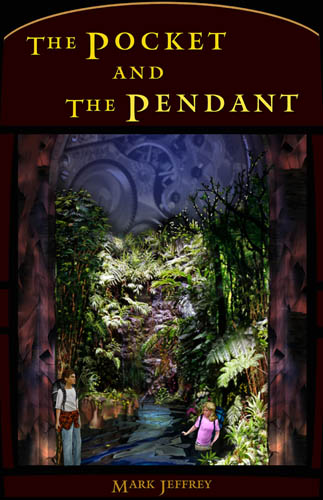
Fantasy Audiobooks - The Pocket and the Pendant by Mark JeffreyThe Pocket And The Pendant
By Mark Jeffrey; Read by Mark Jeffrey
13 MP3 Files – 10 Hours 25 Minutes [UNABRIDGED]
Publisher: markjeffrey.typepad.com / Podiobooks.com
Published: 2005
Themes: / Science Fiction / Young Adult / Physcics / Immortality / Time Travel / Aliens / Time / Ancient Astronauts /

“On April 8th at exactly 3:38 in the afternoon the world STOPPED.”

It is one of the fundamental constants of the universe – every second thrift store one enters will contain a lonely shelf somewhere in the back with a battered paperback copy of Chariots Of The Gods? by Eric von Däniken on it. That is a terrible, terrible book. I encourage you – only partially in jest – to burn down any store that has one. Chariots Of The Gods is a massive failure in every way but one, it’ll help me tell you about a certain 1970s pop culture concept – the “ancient astronauts” theory. This is a speculative/delusional hypothesis that posits that extraterrestrial aliens are responsible for the ancient civilizations of Earth. Basically it argues that ancient people with their distinctive lack of heavy diesel powered machinery, could not possibly have constructed things like the Pyramid of The Sun at Teotihuacán and so the relics of archeological wonders throughout the world must have been constructed by aliens with a ‘higher’ technology. It is of course a ridiculous notion, wholly unsubstantiated by any evidence that wasn’t manufactured by fraudsters. That said, it can occasionally makes for a cool basis for fiction.

Mark Jeffrey’s The Pocket And The Pendant uses the concept of ancient astronauts to very good effect. This is the story of Max Quick a very odd little boy and his companions, other children who’ve found themselves trapped living in a frozen instant of time. Has this time “pocket” has been caused by the strange aircraft in the skies above the USA? What about the almost magical books that everyone who isn’t frozen seem to be after? Only the aptly named “Mr. E.” knows the answer. Weaving together a carefully researched history with an intriguing and well executed scenario Mark Jeffrey has put together an engaging and satisfying adventure that while aimed at a younger audience never talks down to it. Basically Jeffrey does for science fiction what Harry Potter does for fantasy – I’d say he does it better by layering in facts and mythology from many sources. He takes the whacked out theories of Zecharia Sitchin and asks “what if they were true?”, mixes it up with action like The Matrix, the premise of the Doctor Who “Key To Time” arc and with a couple dutiful nod to the 1959 and 1985 The Twilight Zones.

Jeffrey is very inventive with solving the problems he’s created. But there was one thing that bothered me about the story, if Max and his companions are trapped in time how can they see? Let me explain, this is basically the same nitpick I had with H.G. Wells’ The Invisible Man, without light hitting a retina you can’t see. If time is stopped then the light has stopped (in The Invisible Man the title character’s retinas are transparent!). I’m nitpicky.

Jeffrey reads the novel himself, doing accents, adults children boys girls and aliens. The sound quality is very good and well leveled, but there is one caveat, a constant musical score underlies the reading (almost always keyed to characters and events in the tale). In this case it is fairly benign, and certainly allows an atmosphere of emotion to build in the story – but not having heard the tale without music I’m not sure if it wouldn’t have been better just as a clean reading.

SFFaudio COMMENT: This is the second “Podiobook” we’ve reviewed on SFFaudio, and the quality is WAY, WAY UP THERE, not just in terms of podcast novels, but in terms of novels on audio. Combine this fact with the price, which is just a request for a donation if you enjoyed the experience, and you’re literally crazy by not listening to them. The worst that can happen is you listen, enjoy the heck out of it and then feel guilty for a few years because you were to cheap to throw a few $$$ towards the producers. Go ahead now, give yourself a gift, subscribe to Morevi: The Chronicles Of Rafe And Askana and The Pocket And the Pendant you’ll marvel at your own generosity.

Posted by Jesse Willis