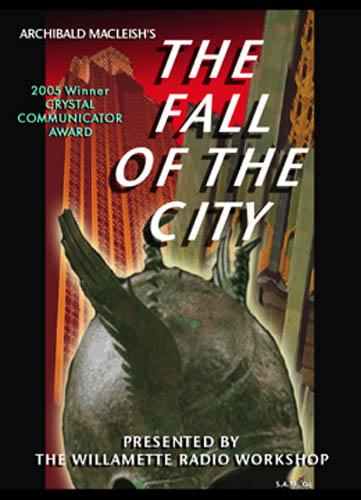
Review of Archibald MacLeish’s The Fall Of The City

SFFaudio Radio Drama Review

Science Fiction Radio Drama - The Fall Of The City by Archibald MacLeishThe Fall Of The City
Based on the script by Archibald MacLeish; Perfomed by a full cast
1 CD – 32 Minutes 11 Seconds [RADIO DRAMA]
Producer / Publisher: Willamette Radio Workshop / LodestoneCatalog.com
Produced / Published: 2004 / 2006
Themes: / Fantasy / Allegory / Prophecy / Utopia / Dystopia / Totalitarianism /

“- In a time like ours seemings and portents signify -“

What few of the pre-WWII fantasy radio dramas produced tended to be allegorical, The Fall Of The City is no different in that respect. This one however has a unique feature – it was written as an extended dramatized poem “verse for radio” as they called it. The original production starred the then ubiquitous Orson Welles and a number of other Hollywood stars. This is the modern re-recording of the original 1937 radio drama. The folks at Willamette Radio Workshop have put the results to CD, but it was actually broadcast on WMNF 88.5 FM in Tampa, Florida in the fall of 2004. The production asks several questions appopriate for totalitarian times: ‘What freedom is worth?’ ‘What is freedom?’ And most importantly, “freedom from what?”

As Fall Of The City begins, a ghostly almost prophetic figure has appeared in city’s cemetary for three days running. When she finally speaks to the gathered mob she fortells the arrival of a conqueror, warning “The city of masterless men will take a master, there will be shouting then, blood after.” The citizenry, shocked that their advanced state may be under dire threat are agitated into a debate about the possible actions they might take to ensure their continued freedom. I found it an experience not unlike that of a staged Greek tragedy, thus it is all three high-browed, reflective and wise. To say more might be to reveal to much. What I can say without fear of spoiling the experience for you is that this is an artful production, sound design and music are beautifully rendered with voice acting in absolute top form. I’d be interested to hear if the team at Willamette will be taking on MacLeish’s 1938 follow up Air Raid another of his poetry dramas.

Posted by Jesse Willis

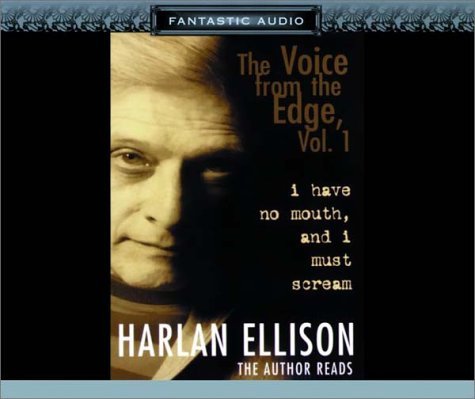
Review of The Voice from the Edge Vol. 1: I Have No Mouth and I Must Scream by Harlan Ellison

SFFaudio Author of the Month Review

Science Fiction Audiobooks - The Voice from the Edge: I Have No Mouth and I Must ScreamThe Voice from the Edge Vol. 1: I Have No Mouth and I Must Scream
By Harlan Ellison, read by Harlan Ellison
5 CD’s – 6 hours [UNABRIDGED stories]
Publisher: Fantastic Audio
Published: 2002
ISBN: 1574535374
Themes: / Science fiction / Collection / Series / Post-Apocalypse / Artificial intelligence / Utopia / Dystopia / Magic Realism / Love / Hell /

ed. – This is one of two Harlan Ellison collections that were released by Fantastic Audio. The second is called The Voice from the Edge: Midnight at the Sunken Cathedral.

There are two basic reasons to invest in a short story collection by a single author. The first is to experience first hand the stylistic, thematic, and technical contributions the author has made to his genre and to literature in general; the second is to sample the dynamic range the author covers, to gauge the extent of his palette.

This audio book delivers the first in spades. With Harlan Ellison’s friendly, yet curmudgeonly introduction, we are thrust immediately into the gritty rawness he helped bring to science fiction. Such stories as the harrowing, lurid, complex title story, the gleefully offensive misogyny and sociopathy of “A Boy and His Dog”, the pop-cultural, pejorative ranting of “Laugh Track”, and the sophomoric sexual preoccupation of “The Very Last Day of a Good Woman” clearly delineate the dark, adult-oriented themes he introduced, as well as his predilection for unlikable anti-heroes who often leave us feeling a bit less comfortable about ourselves. And on such material, his distinctive narrative style shines. He curses with conviction, and his voice handles guilt, revenge, and damnation with seeming familiarity.

In the overall story choice, we also have a remarkable demonstration of the range of Ellison’s writing. Compare the patient, redemptive power of “Paladin of the Lost Hour” to any of the stories mentioned above, and you’ll see what I mean. Throw in the sly, haunted twist of “The Time of the Eye”, the overwrought post-modernism and tedious beatnik vamping in “’Repent Harlequin!’ said the Tick-Tock Man”, the sublime, hellish search for love in “Grail”, and the puzzling juxtaposition of the truly horrific and the trivial in “The Lingering Scent of Woodsmoke”, and you cover quite a swath of not only the science-fiction spectrum, but the fiction spectrum in general.

Unfortunately, the use of a single narrator for all these stories blurs their uniqueness, especially since that narrator is Harlan Ellison. His delivery style can be enjoyable, but it is so raw, so exaggerated, and so pervasive that it tends to flatten the relief of the work itself. I can’t say that I question the wisdom of having Ellison narrate, for on any single story his voice adds the confident insight that only an author can bring to his own work. But this is a collection, and the diverse stories deserve a wider range of vocal performance to truly showcase their differences. My advice is to make the best of this paradox by taking the collection slowly. The quality of the material, the exceptionally crisp sound and the fine, user-friendly packaging make this an audio book you should not miss. Just make sure to pace yourself.

James Patrick Kelly, Hugo Award Winning Science …

SFFaudio Online Audio

James Patrick Kelly, Hugo Award Winning Science Fiction author and Asimov’s Science Fiction Magazine columnist, has started to podcast his new novel entiled Burn!

“On a distant planet in the far future, the last remaining true humans have come together to form a Utopia based on the principles of Walden. The post-human population resists human encroachment by setting fire to their terraformed forests.”

You can download directly from the Free Reads Podcast page or subscribe FOR FREE by plugging this into iTunes:

http://feeds.feedburner.com/freereads

Way to go Jim!

Posted by Jesse Willis

Review of ENGLISH 3020 Studies In Narrative: Science Fiction & Fantasy

SFFaudio Review

Science FictionIndependent and Distance Learning – ENGLISH 3020 Studies In Narrative: Science Fiction & Fantasy
Lectures by P.C. Hodgell and Michael Levy
20 MP3 Lectures
LINK: http://lrc.lib.umn.edu/Engl3020.htm
Approx 19 Hours [UNABRIDGED]
Publisher: University Of Minnesota
Published: 2002 (But recorded over several years)
Themes: / Non-Fiction / Science Fiction / Fantasy / Horror / Time Travel / Gothic Horror / Utopias / Dystopias / Religion / Vampires / Urban Fantasy / High Fantasy / Sword and Sorcery / Cyberpunk / Messiah / Apocalypse / Future War / Supermen / Robots / Feminism / Computers / Robots / Androids / Cyborgs / Dungeons & Dragons / Aliens /

Pat Hodgell and Mike Levy discuss the details of SF&F’s history in under 20 hours – no mean feat. Though in amongst the broad academic strokes there are many nice discussions listeners should note. These are academic university lectures, and not an entertainment talk show so the evidentiary schema is the primary focus.

The lectures are vaguely sequential to the history of science fiction and fantasy. The first lectures by Levy discusses the origins of Science Fiction, tackling the progenitive triumverate of Mary Wollstonecraft Shelley, H.G.Wells, and Jules Verne. The second lecture explores the early and mid twentieth century figures in the field: Edgar Rice Burroughs, Hugo Gernsback, John W. Campbell, Robert A. Heinlein. For the third and fourth lectures Fantasy author Pat Hodgell and the course’s instructor presents the origins of modern Fantasy from its roots in gothic novels and romanticism and then the various 19th century fantastic writings.

Levy’s turn on the fifth lecture covers the early Utopian and Dystopian stories with particular attention to the novels We, 1984 and Brave New World. His insightful commentary continues into the sixth lecture and covers post World War II SF with Astounding Vs. Galaxy Science Fiction Magazines, and the novels Frederik Pohl and C.M. Kornbluth’s The Space Merchants, Kurt Vonnegut’s Player Piano and John Brunner’s Shockwave Rider. For lectures seven and eight Hodgell investigates English Fantasy authors Charles Williams, C.S. Lewis and J.R.R. Tolkien. Handing off to Levy again for lectures nine and ten covering the general theme of Religion and the specific themes of Messiah and Apocalypse with the novel examples of James Blish’s A Case Of Conscience, Walter M. Miller Jr.’s A Canticle For Leibowitz, Arthur C. Clarke’s Childhood’s End and Robert A. Heinlein’s Stranger In A Strange Land.

Lecture eleven covers the theme of evolutionary Supermen – homo superior in his early fictional incarnations and where the strange motivation to write about them comes from. Lecture twelve is similar to eleven except its focus is on the manufactured heirs to humanity in the form of Computers, Robots, Androids and Cyborgs. This is also the first lecture to include a guest, SF author William F. Wu! Lectures thirteen and fourteen cover the ever popular Time Travel theme, including Connie Willis’ Firewatch, Mark Twain’s A Connecticut Yankee In King Arthur’s Court, Michael Moorcock’s Behold The Man and two of Heinlein’s excellent SF short stories All You Zombies and By His Bootstraps.

Lectures fifteen and sixteen investigate fantasy fiction after Tolkien’s influence covering the various themes of Horror, Vampires, Urban Fantasy, High Fantasy, Sword and Sorcery and the influence of the role playing game Dungeons & Dragons. Among the stories specifically discussed are Fritz Leiber’s Smoke Ghost, Richard Matheson’s I Am Legend, Ursula K. Le Guin’s “Earthsea” novels, Terry Pratchett’s “Discworld” novels and Robert E. Howard’s “Conan” stories. Lectures seventeen and eighteen examine women’s role in science fiction, with the themes of Utopias and Feminism, discussion of the novels Venus Plus X by Theodore Sturgeon and The Left Hand Of Darkness by Ursula K. Le Guin, as well as discussion of it’s authors, the likes of Joanna Russ, Ursula K. Le Guin, James Triptree Jr. and Octavia Butler.

Lecture nineteen breaks from the lecturing professor mold with Pat Hodgell doing an interview in the home of Minnesota SF author Gordon R. Dickson. He talks about how he writes, where he gets his ideas (from history dontcha know) and about the writing process – and this is a very valuable interview as Dickson is now deceased. Dickson novels discussed include among others Dorsai! and Soldier Ask Not. Pat Hodgell concludes the lecture series with a roundtable discussion with herself, Levy and SF author Elanor Arnason. Together they talk about Cyberpunk, William Gibson’s Neuromancer and the film Blade Runner, the use of Aliens in SF and some final thoughts about where they thing SF and F is going.

The sound quality of these lectures isn’t great. There are many background noises, people whispering, lecturers too close and too far from the mic, Gordon R. Dickson coughs a bit and various other aural annoyances are legion. But, it was recorded at a good level and I don’t think I missed one word that was above a whisper – these are lectures and they are free so don’t complain! The funny thing is after hearing these lectures I feel a very strange urge… to learn more about Minnesota. I’ve never had that urge before but Pat Hodgell and Mike Levy manage to include so many Minnesota references and connections into their lectures they sold me on the whole ‘10,000 Lakes to Explore’ deal! Hmmm, maybe these lectures are being given away for free because their underwritten by the Minnesota Tourism Bureau? In any case I heartily recommend you give one or some of these lectures a try they are good listening and good edjamacation.

Here’s a breakdown of the lectures::

Lecture 1 – 29 Minutes 6 Seconds – SF FOUNDATIONS
(LINK: http://lrc.lib.umn.edu/dai/P131_1A.MP3)

Lecture 2 – 27 Minutes 8 Seconds – SF FOUNDATIONS
(LINK: http://lrc.lib.umn.edu/dai/P131_1B.MP3)

Lecture 3 – 26 Minutes 46 Seconds – FANTASY
FOUNDATIONS
(LINK: http://lrc.lib.umn.edu/dai/P131_2A.MP3)

Lecture 4 – 27 Minutes 10 Seconds – FANTASY
FOUNDATIONS
(LINK: http://lrc.lib.umn.edu/dai/P131_2B.MP3)

Lecture 5 – 26 Minutes 7 Seconds – THE FUTURE
(LINK: http://lrc.lib.umn.edu/dai/P131_3A.MP3)

Lecture 6 – 26 Minutes 3 Seconds- THE FUTURE
(LINK: http://lrc.lib.umn.edu/dai/P131_3B.MP3)

Lecture 7 – 28 Minutes 2 Seconds- HOBBITS AND INKLINGS
(LINK: http://lrc.lib.umn.edu/dai/P131_4A.MP3)

Lecture 8 – 27 Minutes 9 Seconds- HOBBITS AND INKLINGS
(LINK: http://lrc.lib.umn.edu/dai/P131_4B.MP3)

Lecture 9 – 27 Minutes 18 Seconds- SCIENCE FICTION AND
RELIGION
(LINK: http://lrc.lib.umn.edu/dai/P131_5A.MP3)

Lecture 10 – 26 Minutes 57Seconds – SCIENCE FICTION
AND RELIGION
(LINK: http://lrc.lib.umn.edu/dai/P131_5B.MP3)

Lecture 11 – 27 Minutes 18 Seconds – SUPERMEN
(LINK: http://lrc.lib.umn.edu/dai/P131_6A.MP3)

Lecture 12 – 28 Minutes 11Seconds – ROBOTS, ANDROIDS
AND CYBORGS
(LINK: http://lrc.lib.umn.edu/dai/P131_6B.MP3)

Lecture 13 – 26 Minutes 7 Seconds- TIME TRAVEL
(LINK: http://lrc.lib.umn.edu/dai/P131_7A.MP3)

Lecture 14 – 27 Minutes 11 Seconds – TIME TRAVEL
(LINK: http://lrc.lib.umn.edu/dai/P131_7B.MP3)

Lecture 15 – 28 Minutes 2 Seconds – MODERN FANTASY AND
HORROR
(LINK: http://lrc.lib.umn.edu/dai/P131_8A.MP3)

Lecture 16 – 43 Minutes 47 Seconds – MODERN FANTASY
AFTER TOLKIEN
(LINK: http://lrc.lib.umn.edu/dai/P131_8B.MP3)

Lecture 17 – 27 Minutes 30 Seconds -WOMEN IN SCIENCE
FICTION
(LINK: http://lrc.lib.umn.edu/dai/P131_9A.MP3)

Lecture 18 – 27 Minutes 57 Seconds -WOMEN IN SCIENCE
FICTION
(LINK: http://lrc.lib.umn.edu/dai/P131_9B.MP3)

Lecture 19 – 44 Minutes 16 Seconds – AN INTERVIEW WITH
GORDON R. DICKSON
(LINK: http://lrc.lib.umn.edu/dai/P131_10A.MP3)

Lecture 20 – 43 Minutes 46 Seconds – CYBERPUNK AND
ALIENS
(LINK: http://lrc.lib.umn.edu/dai/P131_10B.MP3)

Posted by Jesse Willis
Review of The Voice from the Edge Vol. 1: I Have No Mouth a…

SFFaudio Review

Science Fiction Audiobooks - The Voice from the EdgeThe Voice from the Edge Vol. 1: I Have No Mouth and I Must Scream
By Harlan Ellison, read by Harlan Ellison
5 CD’s – 6 hours [UNABRIDGED stories]
Publisher: Fantastic Audio
Published: 2002
ISBN: 1574535374
Themes: / Science Fiction / Collection / Series / Post-Apocalypse /Artificial intelligence / Utopia / Dystopia / Magic Realism / Love / Hell /

There are two basic reasons to invest in a short story collection by a single author. The first is to experience first hand the stylistic, thematic, and technical contributions the author has made to his genre and to literature in general; the second is to sample the dynamic range the author covers, to gauge the extent of his palette.

This audio book delivers the first in spades. With Harlan Ellison’s friendly, yet curmudgeonly introduction, we are thrust immediately into the gritty, rawness he helped bring to science fiction. Such stories as the harrowing, lurid, complex title story, the gleefully offensive misogyny and sociopathy of “A Boy and His Dog”, the pop-cultural, pejorative ranting of “Laugh Track”, and the sophomoric sexual preoccupation of “The Very Last Day of a Good Woman” clearly delineate the dark, adult-oriented themes he introduced, as well as his predilection for unlikable anti-heroes who often leave us feeling a bit less comfortable about ourselves. And on such material, his distinctive narrative style shines. He curses with conviction, and his voice handles guilt, revenge, and damnation with seeming familiarity.

In the overall story choice, we also have a remarkable demonstration of the range of Ellison’s writing. Compare the patient, redemptive power of “Paladin of the Lost Hour” to any of the stories mentioned above, and you’ll see what I mean. Throw in the sly, haunted twist of “The Time of the Eye”, the overwrought post-modernism and tedious beatnik vamping in “’Repent Harlequin!’ said the Tick-Tock Man”, the sublime, hellish search for love in “Grail”, and the puzzling juxtaposition of the truly horrific and the trivial in “The Lingering Scent of Woodsmoke”, and you cover quite a swath of not only the science-fiction spectrum, but the fiction spectrum in general.

Unfortunately, the use of a single narrator for all these stories blurs their uniqueness, especially since that narrator is Harlan Ellison. His delivery style can be enjoyable, but it is so raw, so exaggerated and so pervasive that it tends to flatten the relief of the work itself. I can’t say that I question the wisdom of having Ellison narrate, for on any single story his voice adds the confident insight that only an author can bring to his own work. But this is a collection, and the diverse stories deserve a wider range of vocal performance to truly showcase their differences. My advice is to make the best of this paradox by taking the collection slowly. The quality of the material, the exceptionally crisp sound and the fine, user-friendly packaging make this an audio book you should not miss, just make sure to pace yourself.

Posted by Scott D. Danielson

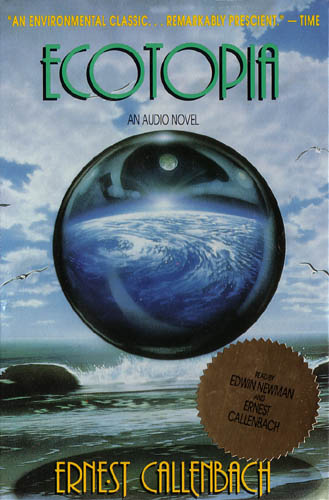
Review of Ecotopia – An Audio Novel By Ernest Callenbach

Science Fiction Audiobooks - Ecotopia by Ernest CallenbachEcotopia – An Audio Novel
By Ernest Callenbach, Read by Ernest Callenbach and Edwin Newman
2 cassettes – 3 hours [UNABRIDGED AUDIO ADAPTATION]
Publisher: Audio Renaissance
Date Published: April 1990 – Out of Print
ISBN: 1559270527
Themes: Science Fiction / Utopias / Environmentalism / Ecology /

Dateline — the early 21st Century. The nation of Ecotopia — made up of what was once Washington, Oregon and Northern California — has been independent of the United States for 20 years. Now, for the first time since its secession, this mysterious society is allowing an outsider to enter its borders and report on its way of life.

William Weston is a journalist from the eastern United States, the first person to be granted permission to enter Ecotopia since its breakaway from the rest of the USA 20 years earlier. The news reports he transmits from Ecotopia describe the strange customs, practices and beliefs of the Ecotopians. Meanwhile, his personal journal doesn’t try to remain objective as he comes to terms with his personal response to this strange new society.

Ecotopia is less a novel than it is an extended essay on how we could live if we would just all become environmentalists. The basic premise is simply an environmentalist version of Sir Thomas More’s literary classic Utopia. While listening to the story I never once got lost in the tale. I was always aware that this was directly inspired by More’s famous work – heck, even the title jars the suspension of disbelief, its like naming the first moon colony “Moonbase Alpha” and then expecting us all to take it seriously. But Ecotopia isn’t exactly a modern retelling of More’s work. Unlike his utopia, Ecotopia is earnest, real earnest – and in a way only a true environmentalist or an evangelical vegetarian can be. But don’t get me wrong, I enjoyed the story and liked a lot of the ideas in it. But the story is a complete daydream, with no chance of it ever happening, at least any sort of revolutionary way as Callenbach has it. I shouldn’t overstate the flaws. Ecotopia was written in 1975, and here nearly three decades later a significant portion of the population has adopted at least some of the mindset set out in the novel.

I must tell you I’m no true-believing granola-cruncher myself, but I concede that much of the novel has great power and is persuasive. Ecotopians enjoy 20-hour work weeks, have a stake in the product of their labor and live in a society that has abolished patriarchy. The greatest criticism that I can have against the story is that it’s completely unrealistic – it ain’t gonna happen, not like he’s written it. Now normally this wouldn’t be an issue at all. Many fantasy novels are set in worlds which are absolutely physically impossible, but nobody says “elves don’t exist so I can’t accept the story”, but in this case I think the criticism is apt. Ecotopia isn’t fantasy fiction, it’s utopian fiction – and the charge of implausibility is much much stickier when it comes to utopian stories especially when they’re earnest. Dystopian tales on the other hand, like George Orwell’s 1984 need not be plausible. They are vaccinations against future problems. By taking our modern moral and technological problems to an extreme in utopian/dystopia stories like Aldous Huxley’s Brave New World or Ira Levin’s This Perfect Day we are immersed in a complex vision of the problems and benefits such a society would have. Utopian dystopias demonstrate how good ideas can be ruined by unforeseen consequences and how taking some of the bad with the good might not be such a bad thing. But straight earnest utopian literature has to be laid out in such a way as to explain how we get there from here. Author Ernest Callenbach doesn’t do that. He doesn’t even wave his hands or use a throwaway excuse, and that shortcoming is a huge hurdle. All his characters are true believers, no one rails against the obvious implausibility of it all, so it is we, the listener who must. In Kim Stanley Robinson’s utopian novel Pacific Edge (1988), for example, a similar ecological balanced society is pondered, but it manages to explain how the self same human nature that we have in a consumer mad society like ours can also become an ecological utopia and it does it in a much more plausible and immersive fashion.

Callenbach himself narrates Ecotopia with help from Edwin Newman, they take turns reading the first person account of William Weston’s journey through Ecotopia and the dispatched news reports respectively. Both do very competent work presenting the story and have pleasant reading voices. The original cover art is attractive, the packaging adequate. Overall, this is a good package but not exceptional. Worth a listen but by no means a classic.