The SFFaudio Podcast #858 – AUDIOBOOK/READALONG: The Tissue-Culture King by Julian Huxley, read by Brian Fullen (1 hour), AND The Tachypomp by Edward Page Mitchell, read by Ben Tucker (33 minutes), both for LibriVox. The discussion of both with Jesse, Will Emmons, and Tom Pace begins at 1 hour 33 minutes.
Talked about on today’s show:
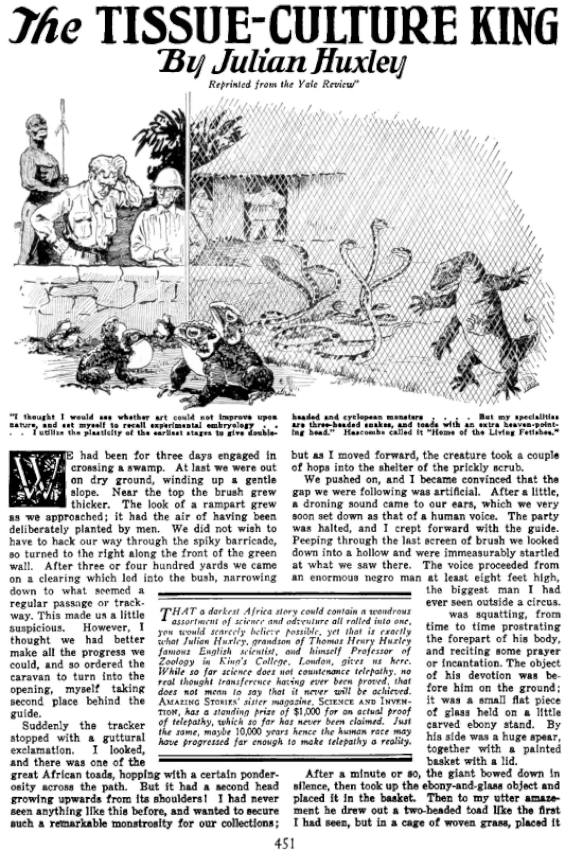
a mistake at the end of the recording [excised], Steven Page Mitchell, musician?, Canadian band?, singer songwriter, Bare Naked Ladies, the music at Jack Layton’s funeral, narrator, weird story Will, even more racist, super rich with one central idea, publication, important to the text, 3 publications very early, Amazing, August 1927, Yale Review, 1926, Cornhill Magazine, suspicious, a different text, we’re getting the Amazing text, Yale and Amazing are in the states, 15,000 words, 6,000 words longer, the rest of the paragraph is missing, a swamp the size of Yorkshire, and so on throughout the day, steamy mess, at last we were out, dotted with big trees, like a fortification, a word change, spiky barricade, the green wall, trackway, alert, caravan, guttural exclamation, ponderosity, second head, remarkable monstrosity, supernumerary eyes, lost to view, a man-made path, abridging, doesn’t damage the text, redundant writing, some details, description of the man they’re peeping on, added stuff, the voice proceeded from an enormous negro man, 7 foot 6 or 8 foot high, prayer or incantation, a little carved ebony stand, about the size and shape of a microscope slide, what the fuck’s going on?, the exact location: equatorial Africa, cut down for the American publication, pretty amazing for some things, there’s stuff in it, tin-foil hat, not called tinfoil, not for microwaves, for telepathy, pretty interesting, what you want out of science fiction, a mishmash, biological ideas, hypnosis and psionics, interesting historically, not interesting as science fiction, can we treat it metaphorically, telepathy, Astounding, a dominant thing in science fiction, The Demolished Man, entirely dependent on telepathy, John Wyndham, as a metaphor, setting aside the racism, a little thread from January 2024 on last year, edited by Leonard Huxley, his dad?, subtitled “a biological fantasy”, a more general meaning, a science fiction story in the style of H.G. Wells, the father of Julian and Aldous, super dystopia book, utopian, before the white men got there, tissue culturing, I’m an old man, drops the mic and runs away, what the core of this story is, “tissue culture”, when it was getting really popular, late 19th and early 20th century, produced this way, tissue cultured garlic, a university in New York explicitly referenced, “an institution”, Halcombe, The Rockafeller Institutes, higher education for medical people, buncha women, service these cultures, make the king everywhere, culture the king’s flesh, focus on the really interesting part, a cellular network of mind control, alive or dead exists in tissue cultures and controls the state, genetic experiments on people, fat thighs, big asses, nicki minaj, making dwarves and giants, and perfect dwarves, metaphorical way of looking at it, science is evil, scientists are evil, propaganda, on the money?, science is integral to everything going on, this pure thing, I believe in science, always doing something, working for someone, one set of powerful people here, The Tachypomp, one tutor doing everything, Edisonian mythology, massive staff, prop up the god king stuff, ancestor worship, not exclusive to one group, pretty west African, China, burning money to give to your ancestors in the other place, the one word, pointed out to Boogala, the doctrines of kingship, archive.org, multiply the king’s tissues indefinitely, quantity, mode of life, agreeable to the king, undreamt of power, such innovation, great resistance, the average businessman in their lack of prejudice, as a dig, read this subversively, the end, as to the best methods, in our scheme, scientific advertising, war propaganda, regal tissues, from the ranks of the nobles, sacred tissues, laborious and expensive, a portion of the royal anatomy, sub-culturing, a new way of doing your religion, totalitarianism, making the king everywhere, the television watching you in Nineteen Eighty-Four, Kira on Deep Space 9, the caste system, revert to that, damaging to our society, just goes along with it, a terrible artist, reintroducing the caste system, suspicion of religion, submission to authority greater than yours, do my own research, super-evil, using science to do the job of religion, science has more potent effects, a very valuable story, invented the *tinfoil hat*, where is the other story, abridged, story, tended to be the redundancy of the writing, getting to the ideas, overly long as it is, 40 minute long ideas, could have been shorter, the characters are horrible, some more clues, the Amazing text, a microscope, it’s a tissue culture being observed, why is the toad there, genuflecting to the god, pray to the god, growing properly, almost like a cargo-cult version of what’s going on at that Rockafeller Institute, African empire hidden by a swamp, a modern day lost world, intrigue stuff, important, this is the kind of tech, Facebook and Twitter and Bluesky, ai, television, radio, ai, influencing and mind controlling people, the complementary thing, public religion, research would be limited, more resistance, the state is controlling what science is doing, the way the state is fleshed out in this story, eugenics, they were racist about it, clung longer, after WWII, racists like it, too hubristic, the state telling people who should breed together, sterilize those people, the mistake is that it is unwise, unintelligent behavior, so called smart people, what good genes are, special susceptibility to hypnotism and telepathy, our ideas about losing themselves in weird primitive dances, bound up together, the Plateau of Leng, the deep darkest deserts of Australia, underground in Wales, not on any map, 3 days of swamp, 10 years later?, not Julian Huxley, Planet Stories, set on another planet, analog, bootstrapping stuff and using it to get to places farther ahead, even more impressive, early doing a lot of stuff, you could almost question, public domain, fell asleep, fell into a daze, imagined this situation, just like The Tachypomp, a nightmare, this Robert E. Howard story we started with, less seriously racist, hefty, a mature man wrote this, a plan rather than a story, this man should be fought, If I Were Dictator, Thyroid Dictator, evil on the level of Fauci evil, their religion, moderating thing, full of slaving, accidentally got time traveled to the American south during slaving, do something illegal, arm slaves, foment rebellion, monetary means, a colonialism story too, Rwanda, the outer scientist, Hascombe attained to an unsurpassed degree, but to what end did all this power serve?, will to power, a perfectly good end, fasten the yoke of a false religion, religions as true or false, true and false in this connection, truer or falser, the telepathy actually working, the obvious moral, gradually being accumulated for them, the truth about the way things work, condemning institution science, took a little piece of King Charles, when Ferengis die, tissue culture style trays, little discs with a lid, collectibles, pulp magazines in slabs, relics, a piece of Quark, a parody of us, they don’t even bury themselves, sell the body parts, a very solid story, not a good story for Scott Miller, what do I do with this story?, did a podcast on it, pre-show threads, much lighter and also fun, a Will problem, explain this story like I am dumb, not a math guy, it was all a dream, the tutor, the stand in for Edward Page Mitchell, C. August Dupin, Edgar Allan Poe, 1878, a precursor to Sherlock Holmes proper, the sweetest girl, the daughter of his math professor, reason to worry, experiences a dream, increasingly eccentric, not perpetual motion, how to reach infinite speed, layers of linear accelerators, the smoking car, keep stacking linear accelerators, wind resistance, making a vacuum tunnel, essentially invented a particle accelerator, a rail gun, the one at CERN, donut shaped one, they didn’t have the curves, near lightspeed, in inventing that, solved the problem of how to get to infinite speed, pretty simple, dream framework, the simplicity of the idea, square the circle, our inner hero, before he goes into the dream, like a Frank R. Stockton The Lady Or The Tiger?, electrically expensive, when electricity is just starting be the normal thing, all a thought experiment, an expectation that it is real, his friend, awesome excitement, get paid too, students who are not asleep, teach things and learn things, discounting ordinary intelligence, the stern father’s good will, crunchy writing, meager reward, Jean Marie Rivarol, Gutenberg Australia, Alsace, Teuton in nature, by education a German, the dumb guy, good vocab, bad math, Stanley G. Weinbaum’s, Von Manderpootz, Pygmallion’s Spectacles, Manderpootzian, Francis Stevens, half German half Japanese scientist, falls into a vat of some sort of metal, Samson, mix two races, two personalities, Jules Verne, this people are like this, the Germans are rockheaded, Professor Rockhead, Phileas Fogg = Fog Lover, obsessed with time, precision, clockwork, Paspartou, very French, stereotypes about people, mix them together and get science, Lorraine, profession: omniscience, foreordained mysteries, Tahoe water, Lake Tahoe?, unmitigated stupidity, the skirts of the university, a plethora of purse and paucity of ideas, the awesome Jesse hero, transplant brains, occasional in, the names have to be jokes, students good at math, just there, all the other students are good, injection, early Simpsons episode, the gifted school, all the kids laugh, Bart is bad is school, Lisa is good at school, high vocab, we’re dumb, we’re living in a time of stupidity, Polyp University, Professor Surd, Abbie Surd, fun stuff, a comedy piece, The Senator’s Daughter, The Man Without A Body, wired teleportation, a funny story, a science fiction idea, about the problem of how to get to infinite speed, as long as you don’t believe in later stuff like Einstein, this is impossible, a very fun fun thought experiment, what he cares about, my uncle is a judge, nothing to worry about, just needs to come from a good family and be rich, Mr. Furnace, an angle close to The Raven, Poe is influencing here, The Purloined Letter, Murders In The Rue Morgue, central Frenchman, a proto-Sherlock Holmes, sees and observes, one of the most popular characters ever created, explore the idea of can we get to infinite speed, an infinite number of cars, there’s problems with space that could prevent that, acceleration problems, energy required goes up, 40,000 trains going forward, what defeats this story’s idea ultimately, as a kid, nothing that can faster than the speed of light, The Raven is a psycho-pomp, speed, let us discuss the tachy-pomp, quickly send, takes your psyche to the place of the afterlife, the ferryman Charon is a psychopomp, the Neil Gaiman Sandman stories, still haven’t defeated this idea, a special triangular ruler, they tell me I can’t communicate faster than the speed of light, ansibles, subspace communications, make it as long as the distance to another star, instead of sending things along it you turn it left or right, received data on the other side faster than the speed of light, you can’t make a ruler that long, you can’t build one that long, sort of been replicated in some effects of twinning atoms and electrons, make them harmonize with each other, their reactions, what you do to one effects the other, a potential form of this kind of communication, on a subspace level, some fundamental law of the universe level, written that up as a giant triangular stick, knocked out by neptune and space debris, a metaphor for the understanding, he’s right, if Newtonian physics were the ruling physics of the actual universe, subsequent beliefs about what’s going on, made frivolousness, for the entertainment of it, a hole dug, a natural phenomenon, came up through a trap door, clogged up with financial creditors, Kerguelen Islands, the antipodes, what becomes of any poor devil, a comfy looking chair, skeletal arms wrap around you, the only thing you’ll ask for is the bill, a hole through earth’s center, suspected it, Huygens, 1400 fathoms, you stand upon it, Mrs. Grimler’s Cellar, a galvanic experiment on a cat, Re-Animator, a yawning shaft, came up again, the angry Grimler, acquired momentum, 8000 odd miles, time after time, oscillation of a pendulum, I am not slow, a creditor of the trap, a touch of rhyme, outside my chamber door, Poe was getting pretty popular, in the center of the hole, so much air resistance, over that long journey, even if he threw it, velocity in the other direction, follows the same logic, invents with his mind, the antipodes of the Kerguelen, near Antarctica, find Sri Lanka on a map, a couple Iles Crozet, Kerguelen cabbage, a lot of the places there are named after Jules Verne things, explored and named, the Kerguelenn archipelago, where this story is presumably set, to make the train happen, New York, the border of Saskatchewan and Alberta, real but fudging, electrical energy supply, what squaring the circle is, a mathematical thing, alchemy, hermetic philosophy, numbers are a real thing in that they are self consistent and predictable, Pi, what appears to be infinity, we’re doing approximates, the functional version of the theoretical approximate, the perfect perfection that is numbers, fallen asleep, perpetual motion, trip him up, entirely imaginary, tutored in his home, plaster busts of Artistotle, Archimedes and Comte, the benign brow of Martin Farquhar Tupper, he always roosts there, a bird of no ordinary mind, ab is a root meaning from, ab-stract, cut from, cut from the absurd, cut from the same cloth, so funny, my masterpiece, an android, only partially complete, confute the schools, Albert Magnus, Roger Bacon, Sylvester the 2nd, a Brazen Head that held discourses, Thomas Aquinus got wrathful, laws as definite, this is chatbots, this is ai chatbots, a manakin, Reverend Dr. Alchin, Paul Anapest, vulgar fractions, compose sonnets, talk to you about positivism, Mr. Mitchell is good at craft, supposed to be fluffy, startlingly early stuff, sending DMs to Bill Christensen, older science fiction stories, the tin-foil hat thing, not a household name with regard to people who know about science fiction, doesn’t take itself seriously, Douglas Adams is very good at science fiction, a discourse/conversation/fight on Red Dwarf, time travel, implanted memories, played for comedy, idiots and selfish, serious in that it takes its ideas seriously, it doesn’t negate the story, keeps it light, made Will have to do it, so be it, fantasy and science fiction and what the genres do, indie authors, indie publishers, science fiction as different window dressing for fantasy, boring and for nerds, dorks, disprove this point, we’re dorks, dorky, a third story, The Last White Man, not for dorks, for people who like adventure fiction, not fantasy, both of these are pure quill science fiction stories, 1878 no such thing existed, Julian Huxley, maybe H.G. Wells, need not be, scientific romances, for novels, science fiction after the fact, a real thing, do it without self-consciously doing it, seeing how they work, in the context of society, doing something totally different, gotta save the girl, the sword is I got some money, Kurt Metzger on Joe Rogan, Ctrl Alt History, The Terminal Man by Michael Crichton, a brain implant that fucked a guy up real good, ethical stuff, wrapping tinfoil around his head, microwave transmissions, to control his mind, mind control shit, the mind control implant, standing in front of a bull, brain-chip, a little transmitter, what happens in the book, a really great read, experimental brain surgery or face prison for murder, makes a plan to escape, a feedback loop, a killing machine, fugue states, very interesting, two meanings for terminal, through a remote terminal, a keyboard and a monitor, dumb machines that just connect to google.com, what google chromebooks are, none of the processing is happening on your computer, you are a terminal people, can program you remotely, programmed, i’m 50 now I need to get the shingles vaccine, just gonna cause a rift between us, gonna increase your chance of getting shingles, not the common knowledge, people are programmed by society and corporations and governments, perverse incentives, repeating talking points you heard from youtube, state funded media, a very unpopular youtube channel, or from RFK, a righteous underground, do you want to get shingles?, for you to get that, look into it, when you look into it, where’d you get that, lotsa research, wouldn’t give it if you asked for it, not the right age, shingles vaccine, BC health link, a series of 2 doses, flu vaccine, covid vaccine, CDC, all adults age 50 and older, what are the benefits?, the best way to protect you, prevents more than 90%, 70-90%, after being immunized, just so we’re clear, that’s not a traditional vaccine, the NDP has been paid off by Pfizer, Dr. Bonnie Henry, what’s the percentage of people who get shingles?, weakened immune systems, preservatives etc., what caused Paul to drop the podcast, the facts are COVID vaccines increase your chances of getting shingles, this isn’t a zero sum gain, gene therapy, bad things, blood clots, from personal experience, hurt from these lies, Fauci is not a good person, we knew this, not number one on Trump’s list, the flu vaccine, one cut above homeopathy, a reaction to bad medicine, huge abuses went on there, institutions are institutional, turning regular humans into robots, most doctors don’t do any research after they graduate, too uppity about it, why are they pushing it, time usually reveals, why were black people in the USA more resistant to COVID vaccines, they were experimented on before, maltreated by lying doctors, The Constant Gardner (2005), Kenya, a movie to watch, the fictionalized story is what literally happens, PayPal, ebay account, almost 30 years old, before ebay bought it, a reputation, stealing, banning, you can’t send money to truckers, get your account frozen, their Billpoint system, cheques, not an institution in the same sense, still owned by ebay?, probably an evil corporation public traded, an individual, the closely held, family owned business, very trusting of the family in general, grandma vs. a hospital, the bad outliers, bad grandmas, homeopathy grandma, needed a blood transfusion, the local newspaper (now gone), during COVID, a mother and father disputing whether their newborn should get the COVID shot, the judge did way less research than the dad did, this is how you get autism at the massive rates that we have, by what standard does the judge make the decision, two parents in dispute, set a precedent, not mandatory for babies to get vaccinated, 6 months olds and higher, developmental disabilities, the vaccine schedule, the amount of autism has matched, the reason we have more queer people, more free now, more autism friendly, we diagnose them more, a Philip K. Dick novel, it was rare, now it is normal, reboot of Doogie Hauser, The Good Doctor, idiot Savant, an American show based on a Korean show, such a serious problem now, what’s going on here, measles used to be considered a good thing, now it is considered a deadly disease, not yet, adult onset autism doesn’t appear to be a thing, less than 3%, aspergers included, not diagnosed anymore, sometimes the disease are defined away, a “dis ease” as opposed to a “syndrome”, downs disease vs. downs syndrome, old eggs?, just look into it, I should be more skeptical, a lot of money on the line, the devil’s website, the NIH, that NPR chatbot podcast reader, convenient for that, a conversation about an audiobook, a better digestion, sometimes it glitches, the fake laugh, as Terence [Blake] pointed out, put Jesse out of work, for older kids?, more out of work, kids raised by LLMs, language learning model, a prison therapist, when kids have been institutionalized, sent to school, public or private, do these exercises, the hurt, goes in the trash, make a drawing of a horse, I’m putting this on the refrigerator, very rare, publish it in a journal or something, a litmag, The Capilano Review, the number of students, can’t really have care, student teachers ratios, most of the population involved in educating children, watching youtube videos, very obscure channel, very interested in reading, what he’s been reading about, very American based, conspiratorial, psychic surgery craze of the 1960s, dudes in the Philippines and Brazil, seems pretty sus, uses his hands to psychics remove tumors and stuff from your body, exposes after the fact, James Randi, famous for debunking claims of magic, fishguts, not doing it for money, non-financial incentives, the number of people want it, you really don’t want surgery, an invasive healthcare system, injections, replacements, forget about youutube and NIH, what doctors have done to her, left a drill bit in there, we’ll try to get it out another time, put bolts in your ankle, prednisone, a steroid, a whole bunch of that stuff, addictive, causes problems, my cat is on that, a shot every five weeks, the solution to muscles spasm is botox, kills the muscles, immensely painful, full of preservatives, hair falls out, horrible things happen, falling and breaking some ribs, second covid shot, almost die from bloodclots that immediately happen, all actually what happened, a frozen, leg, at age 70 whatever, if you’re just a regular person, not as skeptical as she should be, more interested in breeding chickens than finding out the truth of these things, cases where your relative gets cancer and they don’t have cancer after a number of years, incompetence and institutional stuff, re-reading, Edward Bernays’ propaganda, rich, 2004 introduction, all about real serous guiding, the invisible government, secret influencers of society, heavily invovled with the tobacco industry, poisonous, he made his money he could move on, turn the tables on it, how do you produce a true truth, a corporate truth, LibriVox, well worth doing, it has to be an active sonar or radar, it can’t be passive, actively trying to understand, going to buy a car, you’re fucked, what cars are being made where or why or how, was the case, Japanese cars were the best, year over year improvement, keep refining it, change the direction, this commitment to refinement, a Toyota from the 1990s you can’t go wrong, swapped the engine for a Ford, commitment to year over year improvement was unparalleled, people are there to try and fuck you, perverse incentives everywhere, okay dad, more of an uncle, beautifully naive, the canny individual, being wrong many times, defer to other people’s judgement, two kinds of oil, synthetic or regular, either one will work, fuck and find out, the consequences of that are possibly dangerous, take it to an expert, a corporate outlet, a mom and pop, in it for the longhaul, getting bought up and destroyed, sold his business to a chain of carguys, owned by Blackrock or Vanguard [or Blackstone], not a conspiracy or everybody knows everybody, New York real estate, they’re not owned by individuals, owned by corporations who own blocks of things, owned by stockholders, the company or companies have to crash for that land to get sold, that’s sort of the essential problem, mom and pop business, The Communist Manifesto, 1848, true in England but not in Germany in 1848, a pamphlet, a utopian novel, a manifesto and an essay, leave no Jesse unturned, vampire, children’s fiction, fantastic fiction, six in progress, sort by release date, Ham Jones: Scientist, 16 years, what class?, economics, philosophy, it wasn’t offered, a German studies class, German Socialism, East Germany, 19th century stuff, Dastardly Criminals In Space, Watchbird, Conspiracy On Callisto by Frederik Pohl, Manly Wade Wellman, The Incomplete Theft, Tom Godwin, Robert Silverberg, Bratton’s Idea, “Old Bratton, janitor at the studios of Station XCV in Hollywood, was as gaunt as Karloff, as saturnine as Rathbone, as enigmatic as Lugosi.”, what other radical science fiction authors could we dig up, is it good?, no way of knowing, about robots?, inventions fiction, robots, Mike Vendetti stuff, The Curious Experience OF Thomas Dunbar, the first superhero story, Edmond Hamilton, Weird Tales, apple books, audible listing, imagine if you will, age immediately or regress to when they were youths, nefarious inventor, a lot of money, sound familiar?, causing panic, more adventurey fiction, Spawn Of Inferno by Hugh B. Cave, Clark Ashton Smith, anything by him, a darkness that settled like a black cloud, blackness, a thing from the outer darkness, ghastly appetite, The Thing From Outside by George Allan England, like The Wendigo by Algernon Blackwood, The Willows, badly told interesting idea, badly told?, not well told, we benefited it by being massively abridged, made it shorter, very short, from Connor [Kaye], Who Are The Dead?, we like that about him The Black Abbott Of Puthuum, Averoigne, nice art, Margaret St. Clair, corresponded, fuckin cool, she’s San Fransisco, a real homebody, Tommy Patrick Ryan, still be interesting to have read it, works for Margaret St. Clair as well, her story about fake meat, up on Bill Christensen’s website, Juciveal, technologies in stories, broad beamed, pleasantly easy to answer, Jucipork, Mr. Angst of Gourmond, a culinary editor, Veristeak, Lazarus, an interesting topic, the surprise, it’s alive, it’s made out of meat, Terry Bisson, Chicken Little, The Space Merchants, The End Of The Line, Clifford D. Simak, both Americans, provincial Americans, pastoral, countryside guys, not city-boys, loves the countryside, whole adult life, kept returning to the countryside, Talking Man by Terry Bisson, a wizard, time is a circle, fixing cars, a dude who knows how to do things, the first episode of Doctor Who, two teachers, math and history, a student they have, she’s so remarkable, she could teach the class, she’s fuckin time traveler, gets evasive, eager to learn, follow her home, parents wont meet, a junkyard, the sign above the junkyard, I.M. Foreman, her grandfather, three doctors down the road, John Smith, I’m from the future bro, an alien, subsequent stuff, no alien stuff at all, very fun, alternates between dystopian future or alien planet, historical entries, The Romans, weird episodes, the whole ocean is acid, a puzzle planet, weird amazing science fiction, the closest thing it starts off as is a rip off of The Time Machine by H.G. Wells, companion viewpoint characters, cave people times, the secret of fire, 11, 12, 13?, really well done, science fiction windowdressing, monster of the week, The Pyramids Of Mars, 19th century England, re-doing The Mummy, the mummies are aliens, a tomb on Mars, Osiris was a real character, The Mummy (1932), ancient aliens are gods story, entombed on Mars, 1 tv show a day with dinner with Meg, comedy about a hospital, The Office, St. Denis Medical, animals doing stuff, The Henryiod, straight adaptations, Shakespeare, old school, women played by men, pretty straight, Shakespeare’s great, the histories, Richard III, Julius Caesar, Marlon Brando, British accents for the Romans, I, Claudius, among the top 5 tv shows ever done, if not in the first slot, Derek Jacobi, 6 hours maybe, shot on videotape, stupid British, amazing performances, great blocking, where they place the camera, helps tell the story, receiving the speech, help tell a story, old Claudius, Robert Graves, Augustus through Tiberius, Nero, Caligula, the story of the story, Patrick Stewart plays Sejanus, good acting, getting stabbed, Praetorian, suicided, poisoned, slaves running around in the background, 4 different versions of Ben-Hur, well dressed, no outdoor scenes, in tents, inside a hall, the Senate, by torrenting, that’s drama for you bro, it was huge, so many good actors, John Hurt, Sian Phillips, The Elephant Man (1980), British stage actors, become iconic, high quality production, shot on videotape, they’ve lost episodes of it, animating missing episodes, real science fiction stories, it was illegal to pirate the show, happy to take your pirate copies, owned by the British government, revenue bro, all on tubi right now, the best streaming service, The King Tide (2023), shot in Newfoundland, hard to see things, living on an island, fishermen, mainlanders, a baby crying, 10 years later, miraculously heals, cut-off from the rest of the world, the secret, a child who can heal sickness, adoptive parents, amazing baby resource, human resource, the center of the island’s attention, weirdo drunk guy, while she’s reading a book, lineup to get in, the healthcare provider, having fistfights for fun, poison themselves, she loses her power to heal, she was spending time with some bees, all the bees died, only while she’s asleep, take sleeping pills, this island is fucked, promised never to leave, a kid being abused, this doesn’t go well, everybody on the island dies and maybe the whole planet, the execution was poor but the idea was good, a little bit Lovecraftian, maybe a fishkid, giving her sleeping pills, serving Omelas, make fish appear in the nets, the enrichment, Labrador, on the mainland, a special kind of rum, kiss a fish before you drink the rum, videogames might have been a mistake, kissing the fish, a time suck, accent is similar to Irish, not apart of Canada until 1949, a colony of Britain, out of work, 2-4, 3 hours, too much time writing a few days a week, drink some coffee, smoke a little bit, dive right in, exhausting yourself, a break, accomplished something, 5am for every start, before church, a paper route, still morning, a nice feeling, it’s so late, bedtime, staying up pretty late, awake quite late, up at 4am, when the sun goes down, various weasels, doing stuff since 4am, sick in December, missing work, felt really useless being sick, contempt, drifting from thing to thing, twitter accounts, bitter about Ukraine, angry about Israel, do some stuff, write a book, why video games are a mistake, huge mistake, they’re so fun and non-productive, productive in Minecraft, it’s fake, use it in moderation as a reward for actual production, immediately became obsessed with it, girls and boys, boys love to dig, sandbox, because you’re boy, stacking, chopping, stacked and chopped, housebuilders, natural, monkey with tools, tie things together, Gilligan’s Island, bamboo and string, also Ginger’s cool, the rich guy, the doofus and the boss, girl next door, Mrs. Howell, lovey-dovey, all they have is money, do you ever think about the Black Death?, Between Two Fires by Christopher Buehlman, gruff knight, very gently, spoil it for me, secretly God, sounds bad, really good, you don’t have the Christianity background, Will’s biggest deficit, Flesh + Blood (1985), the Heinlein movie, Paul Verhoven, lock themselves up in a castle, a statue of St. Martin, their totem to keep them safe, degenerates, contamination, Rutger Hauer is amazing, Brion James, a pretty long movie for 1985, semi-produced by Hollywood, he’s got a lot of good movies, Hollow Man (2000), Showgirls (1995), Black Book (2006), dutch WWII stuff, Soldier Of Orange (1977), national colour, The 4th Man (1983), bisexual writer, ignorant of one of the greatest artforms around, Basic Instinct (1992), Total Recall (1990), RoboCop (1987), become disciplined about it, 4 movies everyday, The Last Emperor(1987), quite amazing spectacle, you don’t watch it for fun, become edified by it, Death Wish (1974), to understand the concept, why there were 8 Death Wish sequels, a Bronson disciple, produced in, I don’t care about Jill Ireland, he really does, that’s interesting, an interesting character, roughest background imaginable, beating eachother for breakfast, coal mine at age 9, a real something to see, 15 – 20 years ago, I have a certain set of skills, Irish actor, Liam Neeson, Taken (2008), spends the rest of the movie killing people, set decades apart, a thread that started a long time ago, dismiss whole categories of movies, have met many men, an example, Lawrence Of Arabia (1962), colonialism in Dune, the personal story, a beautiful film, tube tv, on laserdisc, stunning on a 55 inch widescreen tv, there’s an intermission, really good book, the 1959 Ben-Hur, the 1925, the cartoon version, narrated and performed by Charlton Heston, the 2016 version, they didn’t have movies in 1888, had to do it through books, cast of thousands, before it was a movie it was a stageplay, treadmills, how the medium has changed, on Broadway, the number of horses that died, so round, took a long time to film, seize the medium while it is ripe, get to it before you die, Sorcerer (1977), Tangerine Dream, The Wages Of Fear, driving rotten dynamite across Brazil, the worst roads, leaking nitroglycerine, mostly no talk, William Friedkin, backstory, reasons to flee to Brazil, on the poster is a truck crossing a rope bridge, what’s going to happen, came out the same week as Star Wars (1977), The French Connection (1971), To Live And Die In L.A. (1985), musicals, Jonathan Weichsel, Gentlemen Prefer Blondes (1953), fucked women up, Marilyn Monroe, imaginary reasons, conspiracy theory, backed by stuff, feels right, probably true, Will had trouble with the subtlety, “dumb bitch”, she’s a nice girl, dam, ewe, dam, ewe, the projection is hilarious, maybe he’s doing something right, tv work, SVU, victim’s fathers, so for boomers, Law & Order, the one that is so dominant, very special rape, what makes the special, 26 seasons, it’s got what the people want: raped from the headlines, Criminal Intent, Organized Crime, Hate Crimes, this is the one about sexual assault, Law & Order Sex Crimes, Sex Criminals, the first volume, some lurid thing going on, Americans are special in that they’re more prudish, love violence, shaped, broken glass as a standin for blood, everybody has had the experience, cut their foot, it means blood, streaming clips, blood is turned green, when mom walks into the room, paying for your Prime, green mist, green spurt, that’s not blood, reality is shaped by the requirements of the prudishness of a certain set of people, in 15 years, radio stations, exactly 100 years old, first radio stations, Hugo Gernsback, ham radio guys, KDKA, in the car, to avoid commercials, BBC radio, it shouldn’t be, declined during covid, if television is around in 15 years, radio is dead, in the car, an old car, drive around town, it was a thing, SNL, vanishingly rare, half the year, Timothee Chalamet, what the current liberal hivemind is thinking, who’s famous right now, that one video, vote for Kamala, reviews phones or cars, Jerry Rig Everything, breaking phones apart, a Mormon, pretty diverse, a disabled wife, wheelchairs, wealthy from youtube, always getting wealthy, busy getting married and networking, supports getting rich, support, a nation within a nation, busy breaking phones, what phone should I get, ads for phones on tv, phone services, drugs, insurance, car and house, iphones and samsungs, free phone, phone plans, co-op advertising, talk over the ads, while the tv is yapping at you, while the tissue culture king is praying on your mind, actors from SNL, tattoos and dates, tattoos removed, other reasons, Sarah Sherman, droopy dry, dandruff shampoo, subject, fancy bath products, a nice experience in the shower, go beyond a neutral experience, if this were the middle ages, a perfumed bath, audiobooks in the shower, racing the alarm, just stop showering, sorry to listeners, pee and coffee, Eternal Lover/Savage.

Posted by Jesse Willis