Review of Blood of Ambrose by James Enge

SFFaudio Review

Blood of Ambrose by James EngeBlood of Ambrose
By James Enge; Read by Jay Snyder
Audible Download – 14 hours 29 mins [UNABRIDGED]
Publisher: Audible Frontiers
Published: 2009
Themes: / Fantasy / High Fantasy / Arthurian Legend / Sword and Sorcery / Necromancy / Regency / Immortality /

In his introduction to the Audible Frontiers recording of Blood of Ambrose, James Enge places his debut novel in the “swords and sorcery” fantasy sub-genre. While the work certainly fulfills the expectations established by that label–it’s replete with feats of arms, dark conjurings, and roguish characters–it also owes debts to the Arthurian tradition and to humorous fantasy in the vein of David Eddings and Joe Abercrombie. The resulting mélange of tropes and styles sometimes clashes, but in the end it leaves the reader with a varied and satisfying reading experience.

The blurb from Pyr, who publishes the hardcopy edition, reads as follows:

Centuries after the death of Uthar the Great, the throne of the Ontilian Empire lies vacant. The late emperor’s brother-in-law and murderer, Lord Urdhven, appoints himself Protector to his nephew, young King Lathmar VII and sets out to kill anyone who stands between himself and mastery of the empire, including (if he can manage it) the king himself and his ancient but still formidable ancestress, Ambrosia Viviana.

When Ambrosia is accused of witchcraft and put to trial by combat, she is forced to play her trump card and call on her brother, Morlock Ambrosius—stateless person, master of all magical makers, deadly swordsman, and hopeless drunk.

As ministers of the king, they carry on the battle, magical and mundane, against the Protector and his shadowy patron. But all their struggles will be wasted unless the young king finds the strength to rule in his own right and his own name.

With names like Uthar and Viviana, even the most casual scholar of Arthuriana will recognize several connections to that illustrious tradition. Even the book’s title, Blood of Ambrose, is an allusion to Arthur, since in some medieval texts King Arthur is sometimes conflated with the late Roman British official Ambrosius Aurelianus. Though the novel is set in a seemingly fictional realm, tantalizing connections to our own world fleetingly appear, including overt references to the Latin tongue and to Britain itself. The relationship between the Ontilian Empire and our own past, however, is never fully explored. While Enge asserts that Blood of Ambrose serves up a completely self-contained story, he certainly leaves room for future world-building.

King Lathmar VII, as the above blurb suggests, is ostensibly the novel’s protagonist. Seen in this light, Blood of Ambrose is a coming-of-age story, and in this capacity it succeeds beautifully. In the book’s early hours, Lathmar is tossed around “like a sack of beans,” as he says, but by book’s end he’s making his own decisions and asserting his rightful authority. His relationship with the other characters are fraught with ambivalence and ambiguity.

The novel’s shining star, though, is the almost-immortal Morlock, who epitomizes the paradoxical swords-and-sorcery antihero. On the one hand, he’s valiant, protective, and very kind to Lathmar. Yet at times he is prone to violent outbursts or spells of depression. In a unique twist, we’re also told that he’s had a drinking problem in the past, and his refusal to let spirits pass his lips recurs as a frequent talking point among the other characters.

Unfortunately, the novel’s plot isn’t on par with its vibrant characters. Blood of Ambrose certainly tells some thrilling, engaging, and poignant stories, but they work better as standalone adventures rather than building a unified edifice. Characters like Lathmar, Morlock, and the arch-villain poisoner Steng serve as unifying threads,  but the plot simply lacked the momentous drive to keep me interested in what would happen next. Luckily, the character development was strong enough to provide me with that forward impetus.

Jay Snyder’s reading of Blood of Ambrose is mostly run-of-the-mill, with one significant exception. His resonant, laconic, intentionally dead-pan portrayal as Morlock transcends mere performance. This is how a flesh-and-blood Morlock really would speak. Seldom in my experience listening to audiobooks has a character been so indelibly linked to the narrator who gives him voice. Snyder’s depiction of Lathmar also deserves note; the transition from tremulous stuttering to firm command mirrors the development of the young king. His rendition of the tempermental Ambrosia is less flattering, and her outbursts can grate on the listener’s ears like claws. Of course, that may well be intentional.

Though it tells a rather lackluster story, Blood of Ambrose introduces a fascinating settting populated by a host of multi-faceted characters. It’s my hope that James Enge will continue to work and play with this colorful palette.

Posted by Seth Wilson

Archive.org: Free Culture by Lawrence Lessig

SFFaudio Online Audio

Internet Archive - Open Source AudioI don’t know if there exists a non-fiction book with more downloads than Free Culture by Lawrence Lessig. The Archive.org stats show it having been downloaded more that 13,000 times. That’s impressive. More impressive is how readable it is. The narrators are all amateurs and they occasionally mispronounce a word or stumble over the descriptions of the images and charts in the paperbook. It doesn’t matter though. The content is delivered extremely well – Lessig is an excellent explicator, and the book is highly relevant for anyone who visits this website. Americans in particular will find immense value in this audiobook. I highly, highly recommend it.

Free Culture by Lawrence LessigFree Culture
By Lawrence Lessig; Read by various
18 Zipped MP3 Files or Podcast – Approx. 9 Hours 42 Minutes [UNABRIDGED]
Publisher: AKMA / Turnstyle.org
Published: 2004
Provider: Archive.org / Open Source Audio

I got this audiobook through a torrent. You can get it that way too. Unfortunately I don’t know how to link to a torrent so I’ve made a HuffDuffer podcast feed for it…

Podcast feed: http://huffduffer.com/jessewillis/tags/free_culture/rss

iTunes 1-Click |SUBSCRIBE|

Here’s the entire audiobook for streaming listening too…


Those still unconvinced should have a look/listen to this April 17, 2009 powerpoint enhanced that Lessig gave at the University of Pennsylvania. It’s entitled The Forbin Problem – its title takes inspiration from the AMAZINGLY AWESOME Science Fiction movie called Collusus The Forbin Project.

Posted by Jesse Willis

Recent Arrivals from Tantor Media

SFFaudio Recent Arrivals

Both of these titles from Tantor Media arrived in MP3-CD format which is the finest audiobook format known to the human race. The audio contained in versatile DRM-free MP3 files that take just minutes to put on my iPod. When I’m done with the book, there’s no need for me to keep those MP3 files on a hard disk somewhere because the MP3-CDs are already in right format – instant backup! The audiobooks take 2 CDs rather than 20. And there’s nice cover art on the cases!

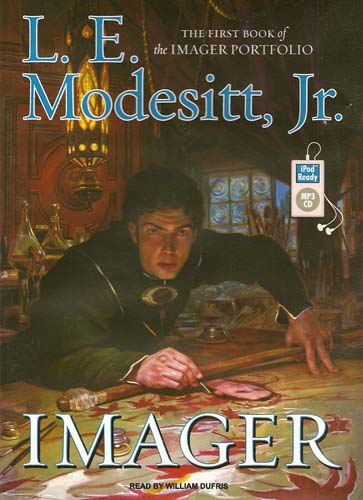
Fantasy Audiobook - Imager by L.E. Modesitt, Jr.Imager (The First Book of the Imager Portfolio)
By L.E. Modesitt, Jr.; Read by William Dufris
2 MP3-CDs – 18 hours – [UNABRIDGED]
Publisher: Tantor Media
Published: 2009
ISBN: 9781400161805
| MP3 Audio Sample |

Although Rhennthyl is the son of a leading wool merchant in L’Excelsis, the capital of Solidar, the most powerful nation on Terahnar, he has spent years becoming a journeyman artist and is skilled and diligent enough to be considered for the status of master artisan—in another two years. Then, in a single moment, his entire life is transformed when his master patron is killed in a flash fire, and Rhenn discovers he is an imager—one of the few in the entire world of Terahnar who can visualize things and make them real.

Rhenn is forced to leave his family and join the Collegium of Imagisle. Because of their abilities (they can do accidental magic even while asleep) and because they are both feared and vulnerable, imagers must live separately from the rest of society. In this new life, Rhenn discovers that all too many of the “truths” he knew were nothing of the sort. Every day brings a new threat to his life. He makes a powerful enemy while righting a wrong, and he begins to learn to do magic in secret. Imager is the innovative and enchanting opening of an involving new fantasy story.
 
 
Science Fiction Audiobook - Revelation Space by Alastair ReynoldsRevelation Space
By Alastair Reynolds; Read by John Lee
2 MP3-CDs – 22 hours – [UNABRIDGED]
Publisher: Tantor Media
Published: 2009
ISBN: 9781400159550
| MP3 Audio Sample |

Nine hundred thousand years ago, something annihilated the Amarantin civilization just as it was on the verge of discovering space flight. Now one scientist, Dan Sylveste, will stop at nothing to solve the Amarantin riddle before ancient history repeats itself. With no other resources at his disposal, Sylveste forges a dangerous alliance with the cyborg crew of the starship Nostalgia for Infinity. But as he closes in on the secret, a killer closes in on him because the Amarantin were destroyed for a reason. And if that reason is uncovered, the universe—and reality itself—could be irrevocably altered.

Posted by Scott D. Danielson

Review of Sword of the Lamb by M.K. Wren

SFFaudio Review

Sword of the Lamb by M.K. WrenSword of the Lamb
By M.K. Wren; Read by Scott Brick
MP3 Download – 21 hours, 27 minutes – [UNABRIDGED]
Publisher: Scott Brick Presents
Published: 2008
Themes: / Science Fiction / Epic / Secret Societies / History / Political Intrigue /

I was thrilled to hear that SFFaudio scored a copy of Sword of the Lamb from Brick by Brick, narrator Scott Brick’s audiobook production company. Hearing Scott wax eloquent on the audio entry for his blog, I was hooked and begged to review it. Among other things he says:

“I loved it right from the beginning – I loved its format, I loved its pathos, I loved its political intrigue, and more than anything else, I loved its characters. The relationship between the two central characters, Alexand DeKoven Woolf and his brother Richard, is one of the greatest I’ve ever read. It is amazingly well-executed, rich in detail and nuance, and unashamedly sentimental. …

As you might have guessed, I tore through the next two volumes just as quickly as the first, and found myself profoundly moved. THE PHOENIX LEGACY is a huge, sprawling epic of political intrigue in the 33rd Century, in which mankind has witnessed amazing technological advancements, yet its society has devolved into a new kind of feudalism. It’s a tale of class struggles across solar systems, it’s THE WINDS OF WAR set in outer space, it’s A TALE OF TWO CITIES meets DUNE, it’s… it’s its own unique creation, a gem that most people, even most science fiction fans, don’t know about.

I’ve asked myself why this is, why this gem exists in bookstores everywhere but has largely gone ignored, but it defies explanation. Maybe it’s because of those damn covers; they really were bad. …”

Or … maybe, it’s because the books, or at least the first book, is not as brilliant as A Tale of Two Cities or Dune. I never read The Winds of War but I have read Gone With the Wind many times. Sword of the Lamb is not as brilliant as Gone With the Wind either. Oh how I hate to be the only person that Scott Brick ever introduced to these books who did not fall in love with them, but there you go. I wanted to love The Sword of the Lamb, I really did. However, every time I felt myself falling for it, the author tripped me up.

First, a brief synopsis of The Sword of the Lamb. Set in the 33rd century, mankind has long since populated many planets. Their government, called The Concord, looks as if it is about to take that inevitable downward slide into a dark age, which would be the third in known history. This is a feudal system governed by the Lords of trading houses and supported by two servant castes, who are actually not much more than slaves. We see the story through two brothers of the DeKoven Woolf House, Alexand and Rich. Alexand is the eldest son and being groomed for the power and responsibility he will eventually inherit. Rich, fragile because of a childhood illness, takes the path of scholar and sociologist. Both boys have been greatly influenced by their tutor who was a passionate supporter of the downtrodden lowest “bond” class. The combination of logic and insistence that “bonds” are people who deserve more than they receive sends both young men down paths they could not possibly foresee, including involvement with the underground movement, The Society of the Phoenix.

This is a book where the relationships shine. The brothers are very different but have an unbreakable understanding and bond. Alexand and his love, Adrien, likewise have a meeting of minds and hearts that leaves them inseparable. Make no mistake about it, these are indeed epic characters and we want to see them succeed and achieve their heart’s desire no matter what the cost. Wren has a gift for dialogue and even seemingly unimportant situations are compelling and interesting when there are characters involved. She uses this to great advantage in painting characters in the book.

Likewise, her plot is interesting. It is true that one can foresee the major story lines before they come along. (Let’s face it, Alexand and Adrien had it much too easy in their match. It practically screamed “star-crossed lovers coming next scene!”). However, that is forgivable if the story is told well. Much of the time, Wren pops in surprising little twists and turns in the broader plot that make the story much more interesting and keep us thinking.

With all that going for it, what could go wrong?

Info-dumps.

Nothing can kill a story like too much exposition and this book has it in spades. Wren can’t resist from the very beginning when the tutor is going to bid the boys goodbye and decides to give them one last quiz. (Hey, what easier way to just throw a thousand years’ worth of history at the reader?) She can’t resist making us listen to old computer tapes of university lectures from leading sociologists about a woman’s diary during one of the terrible societal breakdowns long ago or recordings of insightful university lectures. She can’t resist even when we are being introduced to that long awaited encounter with the actual Society of the Phoenix. We’re excited! We’re seeing a secret society! But first, let’s have someone sit around and think at very great length about how they are organized and who hates who. Gee, who doesn’t love a sharp rap over the knuckles and a history lesson before beginning an adventure?

In short, the author doesn’t trust her characters to be able to carry the story without giving us a lot of background that doesn’t matter at all. Things are getting going, we are in a white-heat to see what will happen next, and she grinds it all to a halt with yet another long, boring description. By the time she’s done, we barely care about the story any more. At least, that’s how it hit me. Luckily, her genius with characters was such that I would reluctantly be pulled back into the story. Only to have her once again stick out her foot and trip me on the way to the finish line. Overall, I tend to blame the book’s editor. This is something they are supposed to catch. And didn’t.

To be fair this may be something that stands out in audio form much more than on the printed page. I would have been skipping, or at best skimming, those long expositions in a regular book. Scott Brick is an enormously talented narrator and he pours his heart and soul into the book as we would expect since he loves it so. I’m not sure he is capable of doing a bad job of narrating anything. But even he couldn’t lessen the abyss of those sections. In the end, I finally would just skip ahead as best I could to get to the spots where the story would pick up and move forward. It was always worth it. The story was good. The characters, of course, were great. The narration was fantastic. But those info-dumps … they were killers.

Perhaps I’m nitpicking. Maybe most people don’t loathe info-dumping the way that I do. Fair enough. However, let’s consider those other epics to which this book was compared. A Tale of Two Cities. Gone With the Wind (my own addition, I know). Dune. It didn’t matter if we knew much or, indeed, anything, about the French Revolution, the American Civil War, or Arakis and the Empire. The authors all managed to get in the information we needed, and even a little more, without having our eyes glaze over. In fact, we barely noticed that we were being fed background information at all. That is the difference between a truly classic epic novel and a pretty good book that’s kinda long.

Sadly, Sword of the Lamb is the latter.

Posted by Julie D.