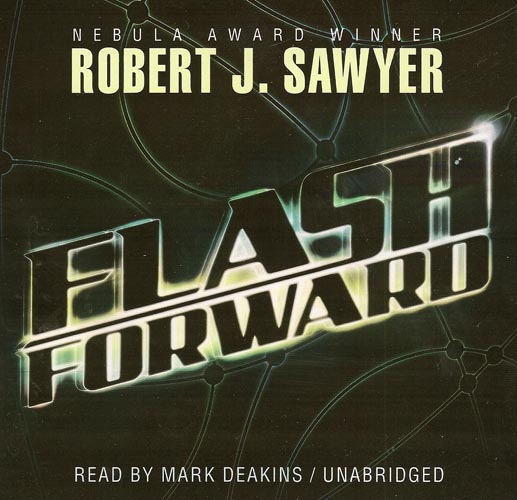
 FlashForward
By Robert J. Sawyer; Read by Mark Deakins
9 CDs – Approx. 10.5 Hours [UNABRIDGED]
Publisher: Blackstone Audio
Published: 2009
ISBN: 1433252945
Themes: / Science Fiction / Hard SF / Time Travel / Disaster / Physics / Toronto / CERN / Murder / Mystery / Switzerland /
A scientific experiment begins, and as the button is pressed, the unexpected occurs: everyone in the world goes to sleep for a few moments while everyone’s consciousness is catapulted more than twenty years into the future. At the end of those moments, when the world reawakens, all human life is transformed by foreknowledge. Was that shocking revelation a peek at the real, unalterable future, or was it only one of many possible futures? What happens when a man tries to change it, like the doctor who has twenty years to try to prevent his own murder? How will the foreknowledge of a part of “then” affect the experience of the “now”?
This is the sixth Robert J. Sawyer novel that I have enjoyed. But, I didn’t get into it via the usual route. I started watching the TV series without explicitly knowing that it was an audiobook, that it was by Robert J. Sawyer, or that the novel even existed. But after seeing the TV series go into a mid-season hiatus I discovered the novel, and decided this was the perfect chance to read the story upon which it was based. Having seen the first half of the first season, and having read the novel, I recommend that you don’t watch any of the FlashForward TV series until you have read the audiobook. Both are really good and worthy, but different. The TV show is not spoiled by the audiobook, but seeing how it was adapted should add some value. The novel veers towards Hard SF, whilst the TV show is more of a Hollywood drama with SF leanings.
I personally found a couple of blemishes in the novel’s story that may only bother a few others. George Bernard Shaw and I agree that your particular country is not that interesting just because you were born there. I can understand mentioning TRIUMF and the Sudbury Neutrino Observatory, they are useful to the plot and interesting. But the Toronto Transit Commission (TTC)? I ride it every day, and I don’t care. This and a few other Canada Canada Canada details are like being beaten with a Canadian hockey stick. Does the truly “True Great North” need to be bragged about? How un-Canadian. Another quibble, for me, was Sawyer use of John A. Wheeler’s Participatory Anthropic Principle, where things exist only when observed by a consciousness. I cannot fathom anybody believing this anthropocentric twaddle, the idea should be banished like the dark matter, astrology, and celestial spheres. Humans are neither that powerful nor that important.
Despite these quibbles FlashForward has an obliging rationalistic science slant. Consistency reigns. If you like to hear scientists with reasonable amounts of emotions talking, this book is for you. The conversations were what I expect from physicists. The visions of the future, caused by the flashforwards of the title, were very down to earth and believable. The audiobook also mixes in a modicum of mystery, via a future “who done it.” I predicted some of the events and was pleasantly surprised by others in this not-too-long a story. The ending, though plausible, did not unfurl as I had expected.
Narrator Mark Deakins gave a realistic delivery. His only error being when he twice mis-pronunced “Dyson” with the accent incorrectly on the last syllable, as in “Die-sown.” FlashForward is definitely worth a listen.
posted by Steen Hansen


 iCity
iCity