Review of The Sisters Grimm: The Everafter War by Michael Buckley

SFFaudio Review

Fantasy Audiobook - The Sisters Grimm: The Everafter War by Michael BuckleyThe Sisters Grimm: The Everafter War
By Michael Buckley; Read by L.J. Ganser
6 Hours 45 Minutes – [UNABRIDGED]
Publisher: Recorded Books
Published: 2009
Themes: / Fantasy / Magic / YA /

I listened to book seven in a day. This is something I used to do when I could read. With audiobooks, I can’t multitask as well so I tend to go through a book in smaller bites. Not this one. Fortunately, the books aren’t too long, so I can do one in a day. Once in a while.

As the title suggests, this is the book where the war the girls saw in book five comes to pass. The Everafter War is between the followers of the Crimson Hand and the Everafters who refuse to follow the Master. Basically, it’s a war between the followers of the Drimson Hand and everyone else. Their plan is to first take over Ferryport Landing and destroy the barrier keeping them prisoners in the small town, then taking over the rest of the world. Lovely Evil Villain stuff fit for a fairy tale.

This book, however, is darker. Although Buckley doesn’t go into detail and doesn’t dwell on the war, there are casualties. Including one of my favorite Everafters from the series. But this death is the linchpin that rallies the troops and makes them realize this really is a war.

Sabrina and other characters have their own moments of truth where they begin to see things more clearly. I won’t say more, because you need to experience these with the characters. So, no spoilers!

I love Buckley’s touch when it comes to humor and relieving tension. He kept the story fast-paced, but used humor, character development and the overarching story to break up moments of tension and sorrow.

As the teaser at the beginning of the book promises, you find out who the Master is. I figured this out in book 5, but was still interested in WHY that person became the Uber Villain, the Master. And there are a few other answers to clues put in previous books.

It’s a good read. It’s a good series. I think, though, I’d give this book an 8 out of 10. The violence is not too much for pre-teens or middle grade readers. The story is also worth reading for adults who like to share books with their kids.

I’m looking forward to next month when I can buy book eight and see what happens next!

Posted by Charlene Harmon
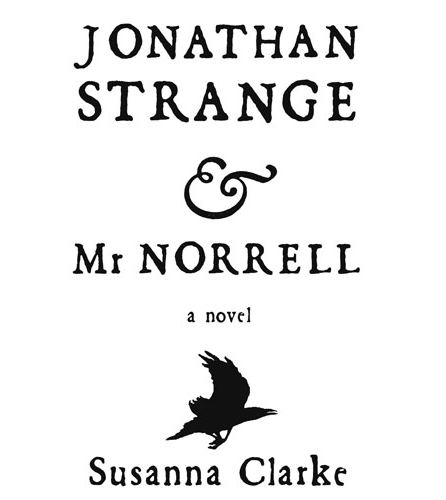
Review of Jonathan Strange & Mr. Norrell by Susanna Clarke

SFFaudio Review

Fantasy Audiobook - Jonathan Strange & Mor. Norrell by Susanna ClarkeJonathan Strange & Mr. Norrell
By Susanna Clarke; Read by Simon Prebble
32 Hours – [UNABRIDGED]
Publisher: Macmillan Audio
Published: 2004
Themes: / Fantasy / Magic / England /

Mr. Norrell is a fusty but ambitious scholar from the Yorkshire countryside. He is also the first practical magician in hundreds of years. What better way to demonstrate his revival of British magic than to change the course of the Napoleonic wars? Jonathan Strange discovers, to his dismay, that he is a natural magician. Because he “feels” his magic rather than depending on books as Mr. Norrell does, they wind up representing two distinctly different ways of doing British magic. Clarke deliberately used a style that calls to mind Jane Austen or Charles Dickens and thus transports the reader to a time gone by when spelling varied, footnotes could be long and involved, manners were paramount, and when it is possible to believe in such a thing as British magic.

I tried this book several times but either wasn’t in the right mood or was expecting something different. Hannah read it, loved it, shoved it on my nightstand, and nagged me about it (with that hopeful, wistful, little puppy look that a mom can’t say no to…). Once I began reading I couldn’t understand why I didn’t warm to it before … the writing is charmingly understated and amusing. Set in England during the Napoleonic war, it is about magic, English practitioners of magic, books about magic, and the Raven King.

However, once I was well into the book I got bogged down with the many wayside visits and long footnotes that added atmosphere but didn’t seem to advance the story. That is when I picked up the audio book from the library. Once I was listening, I began enjoying it immensely more than before. I think I do better with meandering books when on audio for some reason. Eventually I almost became addicted and couldn’t stop listening.

At the end the book suddenly picked up the pace with one thing happening after another. It ended in an unexpected way with some story lines being firmly concluded while others were left to drift off. Usually this would bother me but, in a sense, it was very true to real life, which makes me reflect upon the fact that the way the story was told was very like having someone tell it to you in person. They take little byways of explanation that may not have too much to do with the story and then come back to the point. In listening to the book this made for a delightful and somehow restful story.

This was wonderfully narrated by Simon Prebble whose dulcet tones and perfect pacing helped make the long sentences easily understood and who emphasized the humorous bits without overdoing it. There is no doubt that his narration is the key element that not only got me to the end of the book, but actually left me sad when it ended. Recommended but only for those who do not object to long, meandering stories with a lot of footnotes.

Posted by Julie D.

LibriVox: Pygmalion’s Spectacles by Stanley G. Weinbaum

SFFaudio Online Audio

Pygmalion’s Spectacles was first published in 1935 in the aptly named Wonder Stories magazine. Four years after it’s first publication it was reprinted in Startling Stories as a “classic” and it was placed in their “Scientifiction Hall Of Fame.” It was reprinted again in Fantastic Story magazine in the Spring 1955 issue. Three magazine publications is a rare occurrence for any SF story. So, what makes this story special?

Well, this tale of utopia, immortality, and romance, is also, most probably, the very first story to feature the concept of virtual reality.

Here’s the description from the Wikipedia entry:

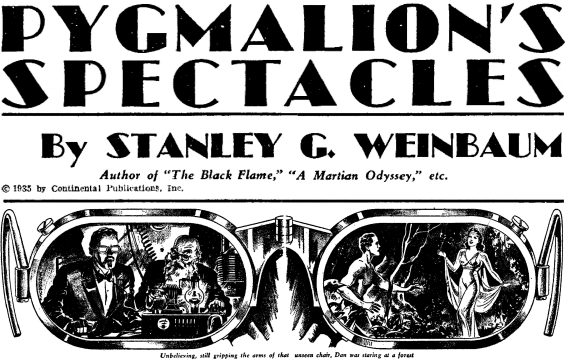
A comprehensive and specific fictional model for virtual reality was published in 1935 in the short story Pygmalion’s Spectacles by Stanley G. Weinbaum. In the story, the main character, Dan Burke, meets an elfin professor, Albert Ludwig, who has invented a pair of goggles which enable “a movie that gives one sight and sound […] taste, smell, and touch. […] You are in the story, you speak to the shadows (characters) and they reply, and instead of being on a screen, the story is all about you, and you are in it.”

And though the ideas may be pioneering, the plot of Pygmalion’s Spectacles is very similar to Fitz-James O’Brien’s The Diamond Lens, itself an excellent SF tale. The tone of their respective endings differs, but their plot, in which a man falls in love with an intangible woman, is straight out of the Greek mythology that Weinbaum alludes to. And they both use science, rather than magic to get to their respective endings.

There is, I should also point out, a LibriVox |MP3| recording of the Metamorphoses by Ovid, a 2,000 year old poem featuring the myth of Pygmalion.

Pygmalion's Spectacles by Stanley G. Weinbaum

Here is a |PDF| made from the Pygmalion’s Spectacles publication in Fantastic Story. And here are two LibriVox versions (my advice, go for the first one):

LibriVoxPygmalion’s Spectacles
By Stanley G. Weinbaum; Read by Gregg Margarite
1 |MP3| – Approx. 43 Minutes [UNABRIDGED]
Publisher: LibriVox.org
Published: January 13,2009
He put on the glasses and fell in love with a dream… First published in Wonder Stories, June 1935.

LibriVoxPygmalion’s Spectacles
By Stanley G. Weinbaum; Read by Chrystal Layton
1 |MP3| – Approx. 45 Minutes [UNABRIDGED]
Publisher: LibriVox.org
Published: November 17, 2007
He put on the glasses and fell in love with a dream… First published in Wonder Stories, June 1935.

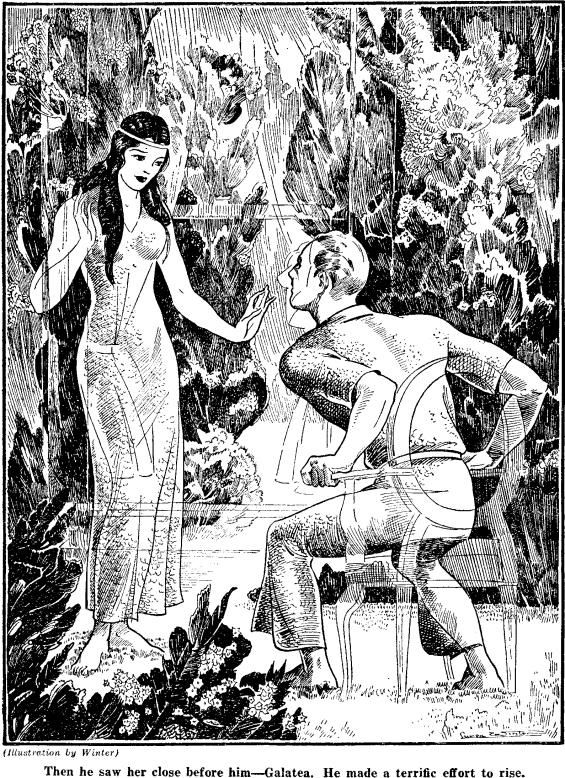
Pygmalion’s Spectacles illustration by Lumen Winter (from Wonder Stories, June 1935):
Pygmalion's Spectacles -  illustration by Lumen Winter

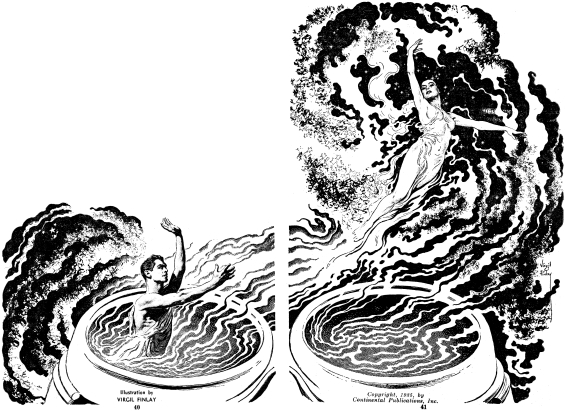
Pygmalion’s Spectacles illustration by Virgil Finlay (from Fantastic Story Magazine, Spring 1955):
Pygmalion's Spectacles - illustration by Virgil Finlay

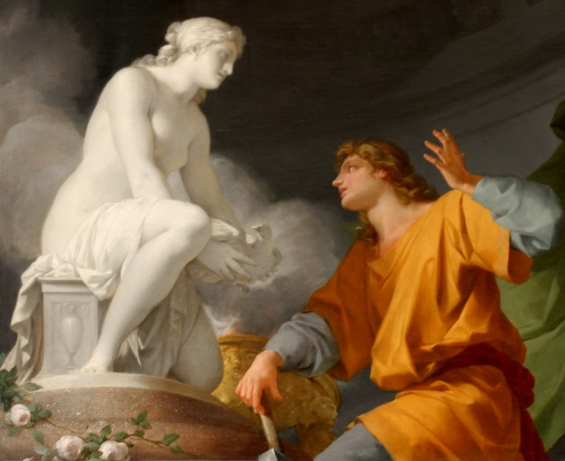
Painting of Pygmalion and the statue by Jean-Baptiste Regnault:
Jean-Baptiste Regnault - Pygmalion

[Thanks to Tim at The Drama Pod for the reminder]

Posted by Jesse Willis