
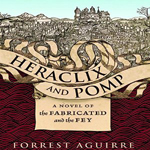
 Heraclix and Pomp: A Novel of the Fabricated and the Fey
By Forrest Aguirre; Narrated by Brandon Massey
Publisher: Audible Studios via Resurrection House
Publication Date: 14 October 2014
[UNABRIDGED] – 11 hours, 7 minutes
Themes: / reanimation / golem / necromancer / fantasy /
Publisher summary:
Heraclix was dead and Pomp was immortal. That was before Heraclix’s reanimation (along with the sewn-together pieces and parts of many other dead people) and Pomp’s near murder at the hands of an evil necromancer. As they travel from Vienna to Prague to Istanbul and back again (with a side-trip to Hell), they struggle to understand who and what they are: Heraclix seeks to know the life he had before his death and rebirth, and Pomp wrestles with the language and meaning of mortality. As they journey across a land rife with revolution and unrest, they discover that the evil necromancer they thought dead might not be so dead after all. In fact, he might be making a pact to ensure his own immortality….
Heraclix and Pomp: A Novel of the Fabricated and the Fey is a story about mortality, at the end of the day. It has horror and fantasy trappings, but at its core, it deals with finding oneself and dealing with mortal matters. The story is told through the guise of Heraclix, a golem, pieced together from many beings, and Pomp, a fairy faced with mortality. I think this book is probably a 2.5-star book…on the one hand, I liked the characters and the world and the idea. But on the other, I was bored a lot of the time when listening, and the book felt repetitive.
The book seems to do a lot of moral speaking, all from the frame of Heraclix or Pomp. Brought together when a sorcerer’s attempt at a spell goes haywire, Heraclix suffers a re-birth of sorts, while Pomp is nearly killed in the doing of the magic. Bound by their shared experience, they set off to first escape the sorcerer and then to learn more about Heraclix’s past. As he travels Europe and The Middle East, Heraclix learns whose parts literally make up his whole–he is a golem of patched together parts from people, most of whom he learns about in his travels. Pomp, meanwhile, is from the land of the Fey, used to being a prankster and not having to worry about a thing. However, the sorcerer almost killed her, brining her face to face with her on mortality, so she learns more of what it is to be human (or at least, human-like) while helping Heraclix learn about himself.
I enjoyed the world that Aguirre developed, and I enjoyed the characters. The book takes place in the time shortly after The Crusades, in parts of the world I don’t often see come up in books. Heraclix and Pomp run into vagabonds, sorcerers, gypsies, kings, nomads, and a host of other characters as they search between Vienna and Instanbul–and a variety of places in between, including a trip to Hell. The telling of the various stories of the lives that Heraclix was a part of was charming and not like most things I’ve read.
But…somehow, it wasn’t enough. I repeatedly found my mind wandering during the narration, found myself having to go back to the beginnings of chapters to see what I’d missed. The book seemed to work very well one chapter at a time…at first, but even then, I was finding other things to read. Some of the language used seemed purposefully obscure, and a lot of the scenes felt like repeats–Heraclix and Pomp enter a setting, they find some part of Heraclix’s past, they are chased out into another setting, rinse, repeat. I think if the book had been shorter, it might have helped. It’s not that it was bad (it certainly wasn’t), but I think more might have been left on the editor’s desk.
The narration, performed by Brandon Massey, was decent. His voice is strong, good for an audiobook, if a little droning at times. The biggest “problem” with the narration might be more due to the story itself. It was sometimes hard to keep track of characters, of who was who. This was especially problematic when characters from the early parts of the book would be re-introduced at the end of the book. Audiobooks are much harder to flip back through to refresh your memory, after all. Massey’s voice sounded familiar to me, though looking through my library, he hasn’t narrated anything else that I’ve read. His voice would be good in a mystery or other novel when there are only a few characters.
All in all, I liked this book, but wished that it had been a little less obscure and a little less repetitive. That doesn’t mean, though, that you shouldn’t give it a try if it sounds interesting. But maybe try it out in a print format.
Posted by terpkristin.


 Sigma2Foxtrot is a new SFF audio podcast by the guys behind the Arkham Insiders podcast. Inspired by, and partially modeled on, The SFFaudio Podcast. We heartily recommend it to all German speakers and listeners interested in “Science Fiction, Fantasy, Horror and Hard-boiled crime!”
 Martian Time-Slip