News, Reviews, and Commentary on all forms of science fiction, fantasy, and horror audio. Audiobooks, audio drama, podcasts; we discuss all of it here. Mystery, crime, and noir audio are also fair game.
The video below is a quick exploration of the MP3-CD audiobook format. It’s my favourite format for physical audiobooks. The packaging is small, the files are ready to be used, and they are cheaper audiobooks than their regular CD equivalent. The only disadvantage to the MP3-CD format is they don’t play on all CD players, and the ones they do play on may limit the volume output.
When you’ve got an old paperback book that’s coming apart at the spine, with pages falling out all over the place it’s time to consider making it immortal. In order to do that, in a reasonable period of time, you must kill the book. That’s the hardest part of the process. The actual transformation is pretty easy.
To do it I use a Fujitsu ScanSnap S1500 which came with Adobe Acrobat Standard 9. Here are three videos I put together that show the process of turning a paperback into an ebook:
I read your recent post about digitizing print books with interest. I wondered if you might be able to expand on your process a bit, as it seemed to me like a few steps were missing from your video.
Indeed, here are my answers to some specific questions:
How do you actually sever all the pages from the book?
Most of the time this can be done just with your hands, at least with paperbacks and old magazines. The only tools I’ve ever needed to use are flathead screwdriver, to pry up staples found in some mags from the 1960s and 1970s, and scissors which I’ve used to trim out glued edges. If you’re doing a hardcover with sewn binding you’d probably be able to do it with just an X-Acto knife.
When you run the pages through the scanner, does it scan both sides of the page simultaneously? Or do you have to scan them all twice?
The Fujitsu ScanSnap is not only superfast, it’s also supersmart, it scans both sides at the same time (technically the term is “duplex”).
If so, how do you collate them so the pages are all in the right order?
The bundled software, called ScanSnap Manager, allows you to customize the named output files. I usually have them just come out as 001, 002, 003, etc..
How long does it take you to digitize a single book?
Lets see I’ve just scanned the February 1976 issue of Fantasy & Science Fiction which has 128 pages (64 leaves). In the scanning itself I set a stopwatch. It took 1 minute 30 seconds to scan the entire mag. The software took another 45 seconds of processing. And I spent about 30 seconds correcting orientation on a few pages. So under three minutes for 128 pages
Have you tried this on hardcovers as well, or just paperbacks?
I don’t think I’ve done more than a couple of hardcovers, they were really easy though as they were essentially unbound already.
After six years of faithful service I’m closing the SFFaudio.com P.O. Box in Port Moody, British Columbia.
Anybody and everyone who sends physical stuff to it please make a note. Those who normally only send me psychic messages need make no change. My astral plane address will remain identical.
The new mailing address for physical stuff sent directly to me is:
SFFaudio.com (Jesse Willis)
#102-2978 Burlington Dr.
Coquitlam, BC
V3B 7S6
Canada
Paul Verhoeven (filmmaker), Ridley Scott (filmmaker), Roberto Orchi (filmmaker), Kim Stanley Robinson (writer), Matt Fraction (writer), Gregg Rickman (biographer), Michio Kaku (purveyor of futuorology), André Fenton (neuroscientist), David Brin (“Futurist”), and Brad Barker (surveillance corporate guy) are consulted for the Science Channel’s Prophets Of Science Fiction: Philip K. Dick episode. The narration tying all the interview snippets together is performed by Jonathan Adams.
I disliked this program very much. Now the 1994 BBC Arena documentary wasn’t spectacular either, but at least it focused on talking to the people who knew Dick and the man’s ideas. The Science Channel consults with some of the folks who knew Dick or wrote about him, but in trying to make the case that Dick was predicting (or prophesying) the future they’ve made crap. I don’t even know what to call it. Is this a docudrama? A biographical video? Some bit of video retro-futurology?
Philip K. Dick stories aren’t about virtual reality or surveillance, not any of the one’s I’ve read anyway. What they do seem to be is epistemological, ethical, and metaphysical explorations of our relationship to the world around us. Dick’s tales certainly have used fictional technologies to conduct their thought experiments, but the question of whether these technologies are plausible or not is of no importantance to their plots. The Man In The High Castle isn’t about string theory, it’s a look at history and the way human reality is formed by it. Do Androids Dream Of Electric Sheep? isn’t about prophesying human looking robots, it’s about what our responsibilities to the being around us that themselves can feel. At least that’s closer to Dick’s point.
One line of the narration goes:
“Dick’s work explores technology’s impact of on human consciousness.”
I haven’t read that Dick story. Have you?
The technologies Dick employs in his stories are for exploring what’s already going on in us, not what will go on when we develop such-and-such a technology.
I see that Prophets Of Science Fiction has also done a show on Arthur C. Clarke, I suspect that that one will fit the title better.
Oh, and the beard on the actor playing the adult Dick was shit.
Thomas M. Disch (author), Brian Aldiss (author), Kim Stanley Robinson (author), Tim Powers (author), Terry Gilliam (filmmaker), Lawrence Sutin (biographer), Paul Williams (biographer), Barry Spatz (analyst), Kleo Mini (second wife), Anne Dick (third wife), Tessa Dick (fifth wife), Jim Blaylock (friend), Russel Galen (agent) talk about Philip K. Dick and his writings in this 1994 TV documentary made for BBC TV’s Arena. The interstitial readings from Dick’s fiction are narrated by Greg Proops.
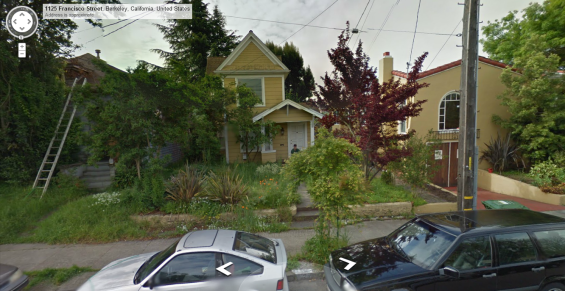
1126 Fransisco St, Berkley, CA – home of Philip K. Dick from 1950 to 1958:
ReCivilization is a new five part CBC radio show, by Don Tapscott one of the authors of Wikinomics and Macrowiknomics. The show is podcast and I’ve subscribed. I heard its first episode on the radio a few minutes ago starting about half-way through. It looks to be a pretty thoughtful show. There was an interview Sue Gardner (of the Wikimedia foundation) and Leo Laporte (of TWiT). Like CBC’s Spark the producers of ReCivilization are adding extended interviews to the website and blog.
Here’s the description:
In the first installment of ReCivilization, Don looks at the media and how the industrial-age model of mass production is giving way to new, collaborative and citizen journalism, enabled by the web. Under the old model, newspapers and broadcasters delivered the news to passive listeners and readers; in this new, digital age, anyone can be a publisher or a broadcaster – and traditional media is being forced to adapt. The episode also introduces Anthony D. Williams, Don’s longtime collaborator and a regular contributor to the series.


 After six years of faithful service I’m closing the SFFaudio.com P.O. Box in Port Moody, British Columbia.