New Releases: AudioGo: The History Of The World In 100 Objects

New Releases

AudioGo has collected the popular BBC Radio 4 programme The History Of The World In 100 Objects as I guess what we’d call a 25 hour radiobook.

In 2010, the BBC and the British Museum embarked on an ambitious project: to tell the story of two million years of human history using one hundred objects selected from the Museum’s vast and renowned collection.

Presented by the British Museum’s Director Neil MacGregor, each episode focuses on a single object – from a Stone Age tool to a solar-powered lamp – and explains its significance in human history.

Music, interviews with specialists and quotations from written texts enrich the listener’s experience. On each CD, objects from a similar period of history are grouped together to explore a common theme and make connections across the world. Seen in this way, history is a kaleidoscope: shifting, interlinked, constantly surprising and shaping our world in ways that most of us have never imagined.

This box set also includes an illustrated booklet with additional background information and photographs, and each CD includes PDF images of the featured objects.

The landmark series on BBC Radio 4 that tells the story of humanity through 100 man-made objects from the British Museum’s unique collection.

Posted by Jesse Willis

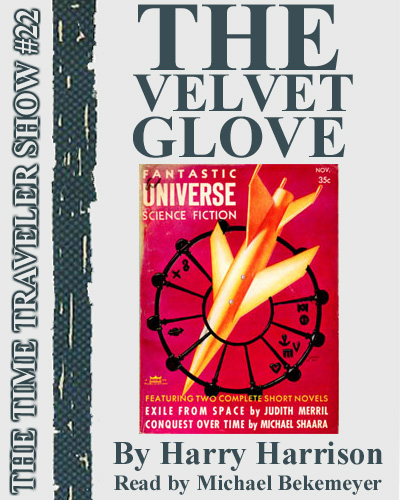
Michael Bekemeyer’s reading of Harry Harrison’s The Velvet Glove

SFFaudio Online Audio

You may recall that one Michael Bekemeyer recorded a Harry Harrison story, The Velvet Glove, for The Time Traveler Show podcast back in 2007. He’s got a new project in development:

And here’s the story:

The Time Traveler Show #22 - Harry Harrison’s The Velvet GloveThe Velvet Glove
By Harry Harrison; Read by Michael Bekemeyer
1 |MP3| – Approx. 1 Hour [UNABRIDGED]
Podcaster: The Time Traveler Show
Podcast: December 28, 2007
First published in Fantastic Universe, November 1956.

[via Rick Jackson aka The Time Traveler]

Posted by Jesse Willis

Commentary: West Of The Sun by Edward Pangborn should be an audiobook

SFFaudio Commentary

A recent email pointed me towards Project Gutenberg and a public domain novel I’d not previously heard of. After doing a little research I now think it would make a really terrific audiobook!

It’s a standalone SF novel by by Edward Pangborn, it was first published in 1953, and its called West Of The Sun.

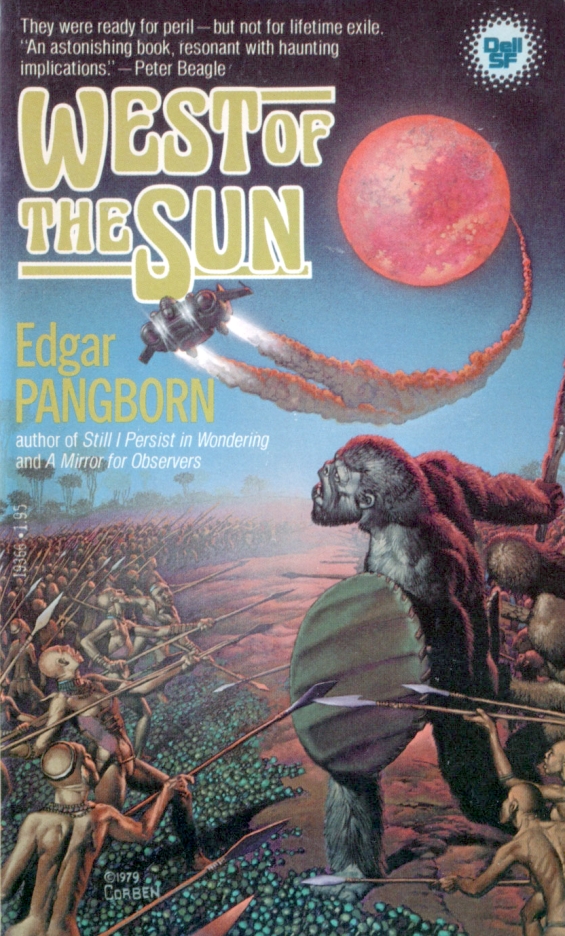
DELL - West Of The Sun by Edgar Pangborn

Here’s the premise:

On earth it was 2056 A.D. but on the red-green planet it was THE YEAR ONE

There were only six human beings—

DR. CHRISTOPHER WRIGHT, anthropologist— he believed in man’s basic goodness … but could he put his trust in an alien race?

PAUL MASON— he dutifully shared his wife with his best friend.

DOROTHY LEEDS— Paul was her husband, but she knew there were some things more important than love.

SEARS OLIPHANT— the gentle scientist who inspired love in an alien.

ANN BRYAN— the youngest of them all, she had to be taught violence and passion.

EDMUND SPEARMAN— the rebel who had to have his own tribe to rule … even though it meant war with his Earth companions.

Six humans alone against the deadly forces of a strange and distant planet.

Cool sounding right?

I’ve only heard one Pangborn short story, The Good Neighbors, but based on the quality of it, and the reviews I’ve been reading of West Of The Sun (detailed below) I think it’d make a terrific audiobook!

Potential narrators, I suggest you have a look at it HERE.

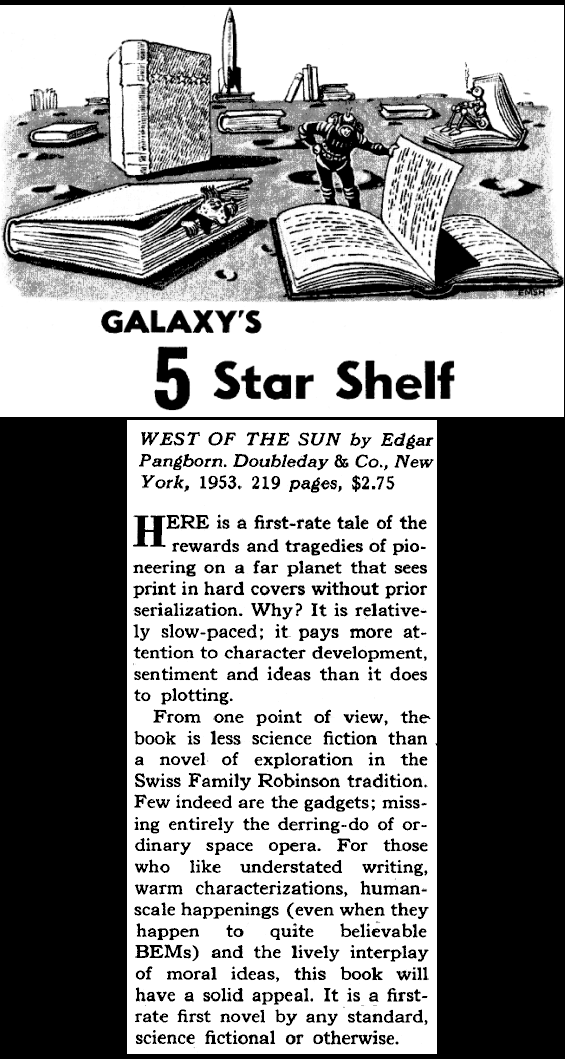
Galaxy's Five Star Shelf - review from Galaxy, July 1953

Recommended Reading column from Fantasy & Science Fiction, May 1953

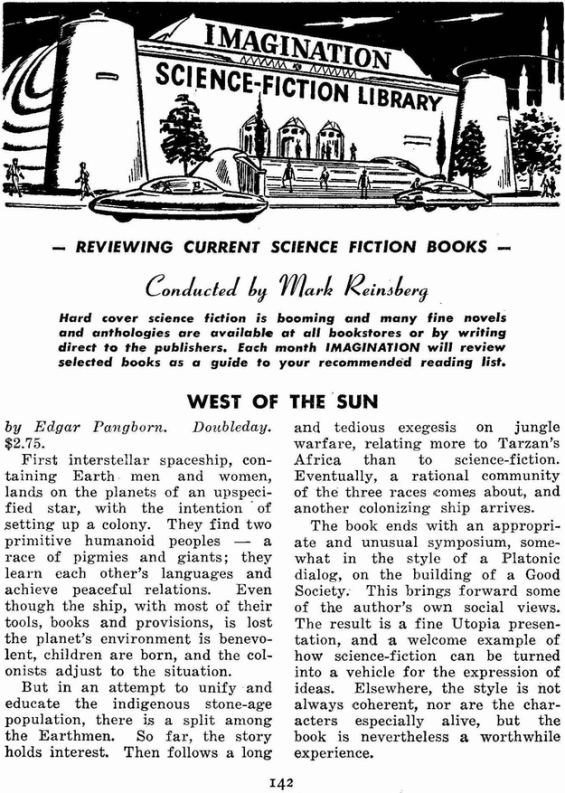
Review of West Of The Sun from Imagination, July 1953

Posted by Jesse Willis

LibriVox: The Good Neighbors by Edgar Pangborn

SFFaudio Online Audio

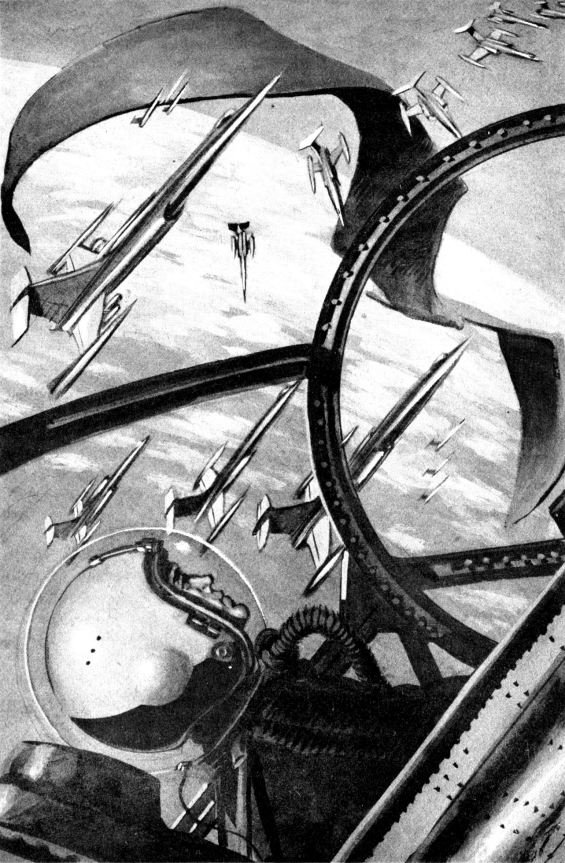
LibriVoxA first contact story and a mystery story! When a massive alien, the size of a city, enters Earth’s atmosphere fighter jets are scrambled to meet it. The alien seems to be in search of something – but what it is won’t turn out to be what we expect. Here’s part of the description of the alien:

She had a head, drawn back most of the time into the bloated mass of the body but thrusting forward now and then on a short neck not more than three hundred feet in length. When she did that the blunt turtle-like head could be observed, the gaping, toothless, suffering mouth from which the thunder came, and the soft-shining purple eyes that searched the ground but found nothing answering her need. The skin-color was mud-brown with some dull iridescence and many peculiar marks resembling weals or blisters. Along the belly some observers saw half a mile of paired protuberances that looked like teats.

The Good Neighbors by Edgar Pangborn - illustrated by Wood

LibriVox - The Good Neighbors by Edgar PangbornThe Good Neighbors
By Edgar Pangborn; Read by Gregg Margarite
1 |MP3| – Approx. 12 Minutes [UNABRIDGED]
Publisher: LibriVox.org
Published: February 21, 2009
|ETEXT|
You can’t blame an alien for a little inconvenience—as long as he makes up for it! First published in Galaxy Science Fiction, June 1960.

And here is a |PDF| made from the original publication in Galaxy.

Posted by Jesse Willis

Commentary: The art of book (and audiobook) arrangement

SFFaudio Commentary

I’ve never understood the appeal of the art of flower arrangement – flowers are pretty, and I guess they’re full of symbolism – but other than that I don’t really get the appeal.

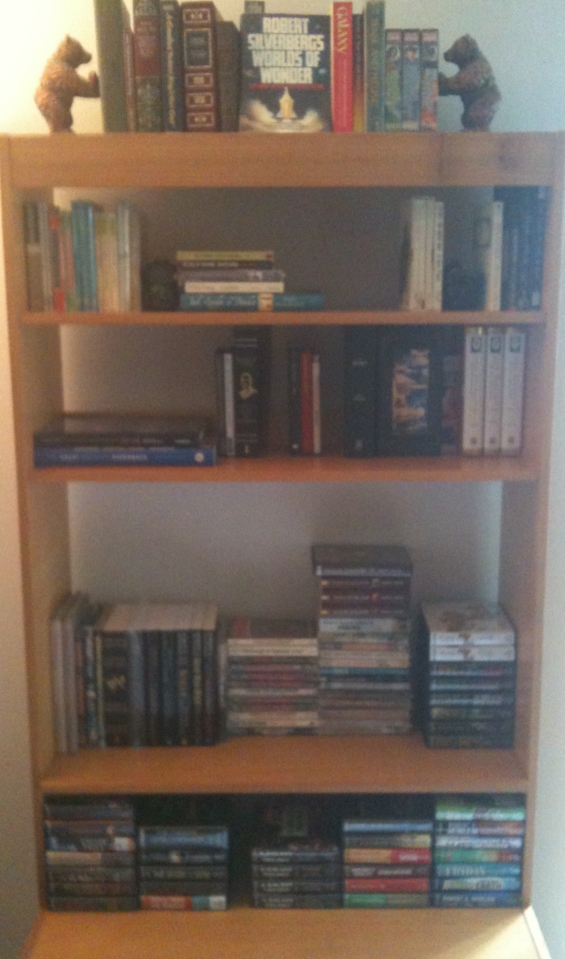
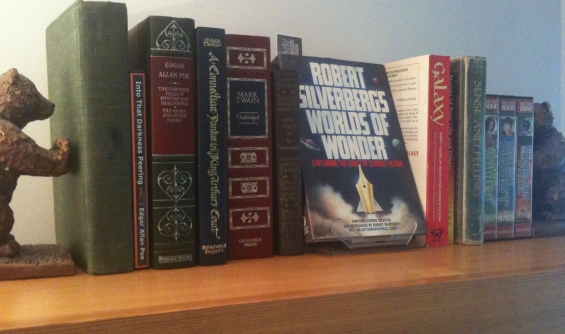
On the other hand, I find that whenever I visit someone’s home I’m immediately off and looking at their bookshelves. To me that’s where the real art of arrangement happens.

I happened to do a little of that myself today.

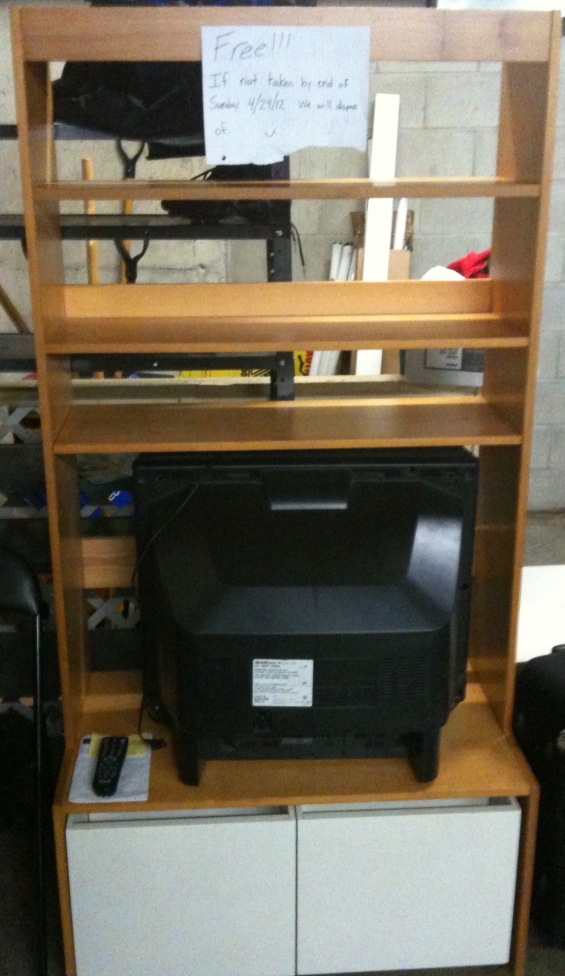
It started yesterday – when I spotted this perfectly good bookshelf being given away! FREE!

Free Bookshelf!

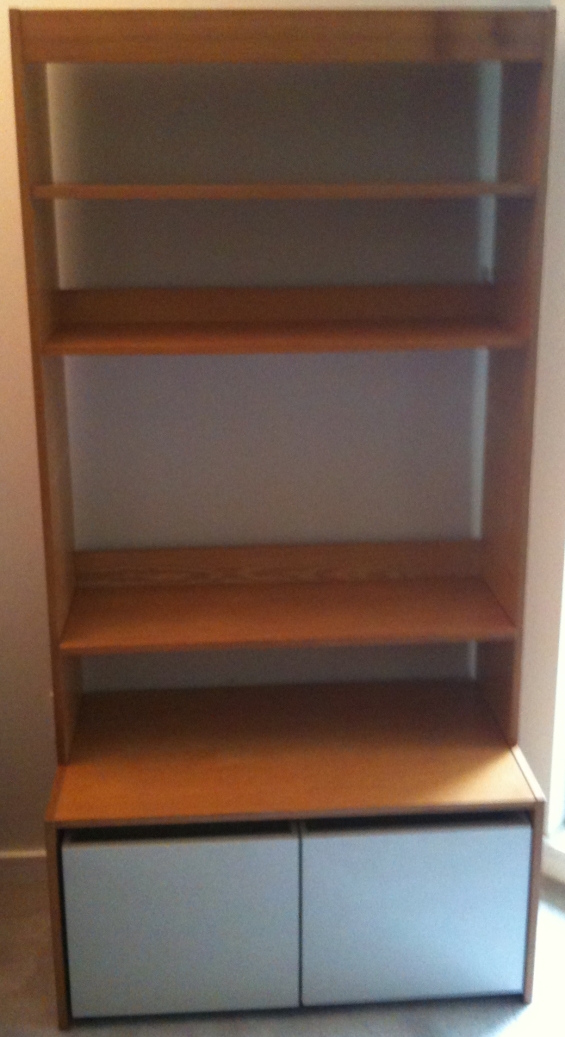
I snapped it right up, dusted it right off, and found a place for it in my apartment.

My New Bookshelf!

Then I policed up various books, and audiobooks, from various other overflowing shelves and arranged them in a handy and functional order.

Arrangement

They’re all basically grouped by author. Some of the books I’ve had for decades, others are quite new.

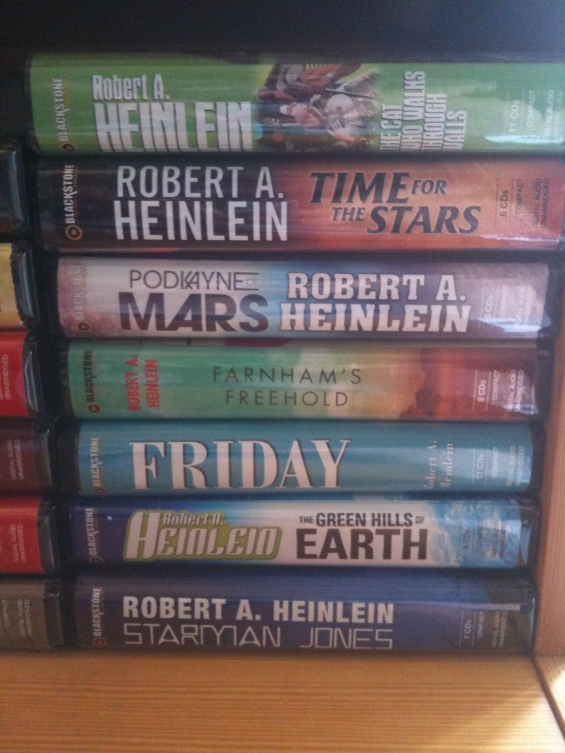
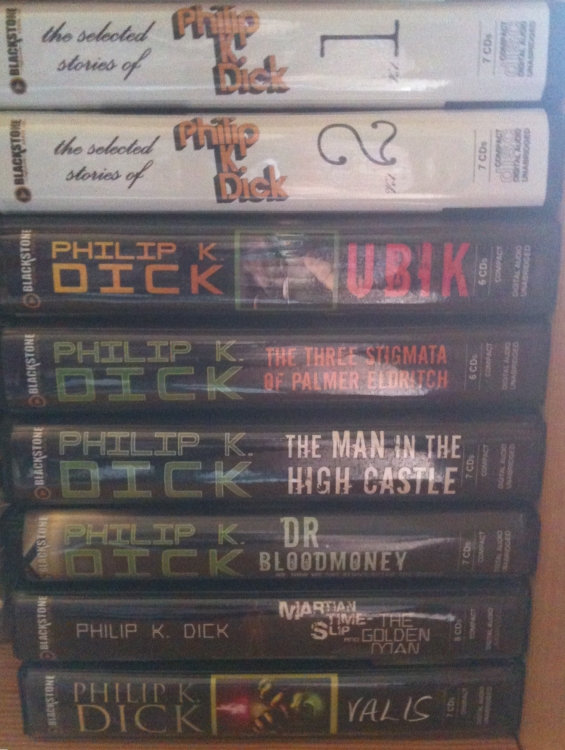
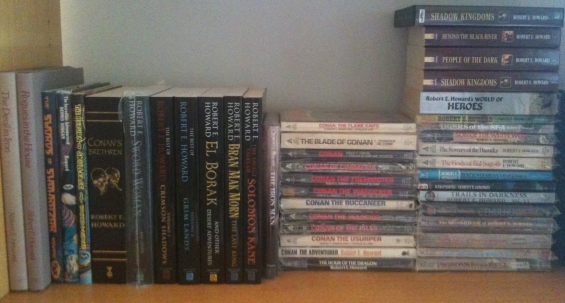
Here are a few details:

Blackstone Audio - Robert A. Heinlein Audiobooks

Blackstone Audio - Philip K. Dick Audiobooks

Robert E. Howard books and audiobooks

Top shelf - Robert Silverberg, Guy de Maupassant, Robert A. Heinlein, Mark Twain, Full Cast Audio, Edgar Allan Poe

Posted by Jesse Willis

LibriVox: We Are Seven by William Wordsworth

SFFaudio Online Audio

I’m a shy visitor to the world of poetry. I find myself unable to even consider an approach to any given poem without some sort of tour guide, as it were. The latest such guide was an episode of BBC Radio 4’s In Our Time in which Lyrical Ballads, a famous and influential collection of poems by Samuel Taylor Coleridge and William Wordsworth, was discussed.

Of the many poems mentioned, one was entirely new to me – and that was We Are Seven by William Wordsworth. The guests’ discussion of it somehow reminded me of something – of what I’m not exactly sure – was it Harlan Ellison’s Jeffty Is Five? I don’t know – but I was reminded of something nonetheless. I think you may be too.

Here’s a snippet from the Wikipedia description of it:

“[We Are Seven] describes a discussion between an adult poetic speaker and a ‘little cottage girl’ about the number of brothers and sisters who dwell with her. The poem turns on the question of whether to count two dead siblings.”

Have a listen for yourself, I found it rather haunting:

LibriVoxWe Are Seven
By William Wordsworth; Read by Verity Kendall
1 |MP3| – Approx. 3 Minutes [POEM]
Publisher: LibriVox.org
Published: April 27, 2012
First published in Lyrical Ballads, With A Few Other Poems.

Here’s the text itself:

We Are Seven by William Wordsworth

A simple child, dear brother Jim,
That lightly draws its breath,
And feels its life in every limb,
What should it know of death?

I met a little cottage girl,
She was eight years old, she said;
Her hair was thick with many a curl
That cluster’d round her head.

She had a rustic, woodland air,
And she was wildly clad;
Her eyes were fair, and very fair,
—Her beauty made me glad.

“Sisters and brothers, little maid,
“How many may you be?”
“How many? seven in all,” she said,
And wondering looked at me.

“And where are they, I pray you tell?”
She answered, “Seven are we,
“And two of us at Conway dwell,
“And two are gone to sea.

“Two of us in the church-yard lie,
“My sister and my brother,
“And in the church-yard cottage, I
“Dwell near them with my mother.”

“You say that two at Conway dwell,
“And two are gone to sea,
“Yet you are seven; I pray you tell
“Sweet Maid, how this may be?”

Then did the little Maid reply,
“Seven boys and girls are we;
“Two of us in the church-yard lie,
“Beneath the church-yard tree.”

“You run about, my little maid,
“Your limbs they are alive;
“If two are in the church-yard laid,
“Then ye are only five.”

“Their graves are green, they may be seen,”
The little Maid replied,
“Twelve steps or more from my mother’s door,
“And they are side by side.

“My stockings there I often knit,
“My ‘kerchief there I hem;
“And there upon the ground I sit—
“I sit and sing to them.

“And often after sunset, Sir,
“When it is light and fair,
“I take my little porringer,
“And eat my supper there.

“The first that died was little Jane;
“In bed she moaning lay,
“Till God released her of her pain,
“And then she went away.

“So in the church-yard she was laid,
“And all the summer dry,
“Together round her grave we played,
“My brother John and I.

“And when the ground was white with snow,
“And I could run and slide,
“My brother John was forced to go,
“And he lies by her side.”

“How many are you then,” said I,
“If they two are in Heaven?”
The little Maiden did reply,
“O Master! we are seven.”

“But they are dead; those two are dead!
“Their spirits are in heaven!”
‘Twas throwing words away; for still
The little Maid would have her will,
And said, “Nay, we are seven!”

[Thanks also to Carmen H and Ruth Golding]

Posted by Jesse Willis