LibriVox: Mr. Spaceship by Philip K. Dick

SFFaudio Online Audio

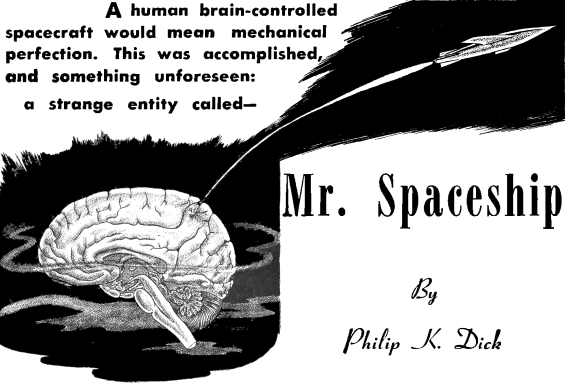
The short story, Mr. Spaceship by Philip K. Dick, is about Philip Kramen and Commander Gross, two characters that are trying to end a war. To do it these agents have to build a ship guided by something intelligent so they can defeat the “yuks” (enemy aliens that are trying to invade Earth). Kramen and Gross determine that the ship should be guided by a disembodied human brain!

To this end they recruit Professor Thomas, a very aged man confined to his bed. The brain removal is a success, and Thomas gains control of the ship.

The story’s premise is similar, remarkably similar, to the later published tale, The Ship Who Sang. The Ship Who Sang by Anne McCaffrey was published in the April 1961 issue of The Magazine of Fantasy and Science Fiction – eight years after Mr. Spaceship was published.

I think Mr. Spaceship is one of the most interesting Philip K. Dick works that I’ve read. Mr. Spaceship is a very well organized story that was planned out step by step. The writing was very clear, giving us the main problem, and how the characters were going to solve it. I definitely recommend Mr. Spaceship to readers who like science fiction stories.
Mr. Spaceship by Philip K. Dick

LibriVoxMr. Spaceship
By Philip K. Dick; Read by Gregg Margarite
1 |MP3| – Approx. 1 Hour 11 Minutes [UNABRIDGED]
Publisher: LibriVox.org
Published: June 27, 2010
|ETEXT|
A human brain-controlled spacecraft would mean mechanical perfection. This was accomplished, and something unforeseen: a strange entity called — Mr. Spaceship. First published in Imagination Stories of Science and Fantasy, January 1953.

Here is a |PDF| made from scans of the original publication in Imagination.

Posted by Andrew Kang

Kansas Historical Society: The Bender Knife (a podcast about the Bloody Benders of Kansas)

Aural Noir: Online Audio

KSHS Cool Things PodcastIn research for another story I came across a cool podcast along the lines of BBC Radio 4’s The History Of The World In 100 Objects. Except that instead of it being a history of the planet it’s just the history of Kansas. The first epsiode of the KSHS’ Cool Things podcast to strike me (out of my chair, through the floor, and then into a shallow grave in a nearby field) was an episode on “The Bender Knife”. Here’s the setup:

Two men settled a claim near the town of Cherryvale in southeastern Kansas in 1870. John Bender, Sr., and John Bender, Jr., built a one-room timber cabin with a trap door that led to a stone cellar. Once the lodging was complete, the Bender men sent for the rest of the family, a mother and a daughter, both named Kate. The family outfitted the house with furniture and supplies, and hung a canvas curtain to divide it into two rooms. The Benders turned the front half into an inn and grocery store where travelers on the nearby Osage Trail could find rest, supplies, and a warm meal. Ma and Kate planted a garden and small orchard near the house. By all appearances, the Benders were like most area settlers: a family of German descent who came west for a fresh start.

Business at the Bender inn would have been brisk. The southeast corner of Kansas had recently opened to white settlers, and men regularly arrived with money to purchase land and livestock. This available cash made the area a dangerous place to travel. Settlers were easy prey for robbers, and it was not uncommon for people to go missing. No one took note of people looking for their family members. This changed when locals started disappearing.

You can read the full story HERE.

Bender Knife

|MP3|

And here’s the Wikipedia entry on the Bloody Benders.

Also check out their “Space Age Stove” episode (featuring a very cool Frigidaire Custom Imperial Flair stove).

Posted by Jesse Willis

LibriVox: Mountain Man by Robert E. Howard

Aural Noir: Online Audio

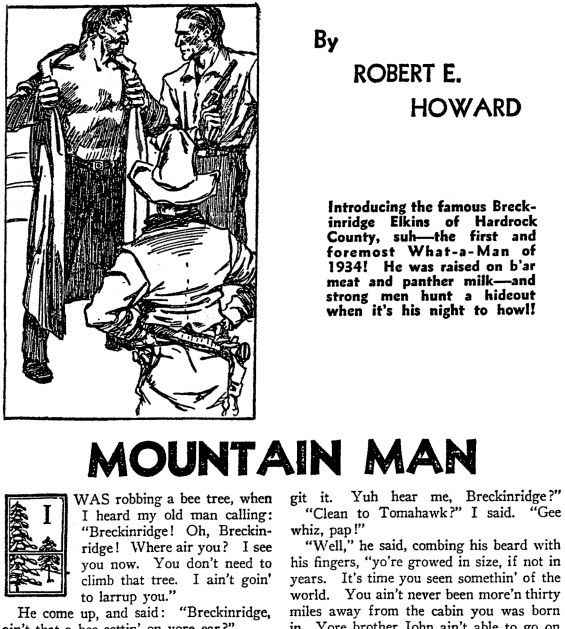
Robert E. Howard’s Breckinridge Elkins stories are humorous tall tales about a mighty naive but mighty muscled country boy. This one, the very first, starts off a little like Winnie The Pooh, but fear not, all Howard’s usual themes are in there. There’s a bit of a difference though, even though you’ve got a barbaric he-man battling civilized folk the story differs from a CONAN tale in that it’s set in the then contemporary world (1934) and also because it’s told in first person by an unreliable narrator.

The audiobook’s narrator, RK Wilcox, on the other hand, is a very reliable narrator, as you’ll hear in this solid reading of Mountain Man.

Mountain Man by Robert E. Howard

LibriVoxMountain Man
By Robert E. Howard; Read by RK Wilcox
1 |MP3| – Approx. 35 Minutes [UNABRIDGED]
Publisher: LibriVox.org
Published: May 25, 2008
|ETEXT|
Introducing the famous Breckinridge Elkins of Hardrock County, suh-the first and foremost What-a-Man of 1934! He was raised on b’ar meat and panther milk – and strong men hunt a hideout when it’s his night to howl! First published in Action Stories, March-April 1934.

Here’s a |PDF| from the original publication in Action Stories.

Posted by Jesse Willis

National Endowment for the Arts: Big Read: A Wizard Of Earthsea by Ursula K. Le Guin

SFFaudio Online Audio

National Endowment for the Arts: Big ReadThe National Endowment for the Arts presents a complied interview piece on Ursula K. Le Guin’s A Wizard Of Earthsea.

Contributors include Michael Chabon, Kelly Link, Orson Scott Card, Walter Mosley, R.L. Stine and Le Guin herself!

|MP3|

Subscribe via the podcast feed:

http://feeds2.feedburner.com/neabigread

Posted by Jesse Willis

Guardian Short Stories Podcast: My Dream Of Flying To Wake Island by J.G. Ballard

SFFaudio Online Audio

Willliam Boyd explains his love of J.G. Ballard’s short story My Dream Of Flying To Wake Island:

In the short history of the short story – not much longer than 150 years – very few writers have completely redefined the form. Chekhov, pre-eminently, but also Hemingway and Borges. JG Ballard has to be added to this exclusive list, in my opinion. Ballard’s models for his haunting stories are closer to art and music, it seems to me, than to literature. These are fictions inspired by the paintings of De Chirico and Max Ernst, which summon up the mesmerising ostinatos of Philip Glass and Steve Reich. Character and narrative are secondary – image and symbol dominate with a surreal and hypnotic intensity, and the language reflects this. Ballardian tropes – empty swimming pools, abandoned resorts, psychotic astronauts, damaged doctors, the alluring nihilism of consumer society and so forth – are unmistakably and uniquely his. “My Dream of Flying to Wake Island” is a true Ballardian classic.

This is a story you can listen to again and again.

Guardian Short Stories PodcastMy Dream Of Flying To Wake Island
By J.G. Ballard; Read by William Boyd
1 |MP3| – Approx. 30 Minutes [UNABRIDGED]
Podcaster: Guardian Short Stories Podcast
Podcast: December 11, 2010
First published in Ambit #60 (Autumn, 1974).

Posted by Jesse Willis

National Endowment for the Arts: Big Read: The Great Gatsby by F. Scott Fitzgerald

SFFaudio Online Audio

National Endowment for the Arts: Big ReadThe National Endowment for the Arts presents a complied interview piece on F. Scott Fitzgerald’s The Great Gatsby. It features Matthew J. Bruccoli, Maureen Corrigan, Dana Gioia, Andrew Sean Greer, Gish Jen, Robert Redford and Sam Waterston.

|MP3|

There’s a teacher’s guide HERE too.

Subscribe via the podcast feed:

http://feeds2.feedburner.com/neabigread

Posted by Jesse Willis