Review of Tales of the Red Panda: The Crime Cabal

SFFaudio Review

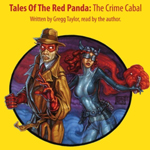
Tales of the Red Panda The Crime Cabal by Gregg Taylor

Tales of the Red Panda: The Crime Cabal
By Gregg Taylor; Read by Gregg Taylor
Publisher: Audible
Release Date: October 17, 2012
ISBN: 9780986856334
Playing time: 5 hours 53 minutes [UNABRIDGED]

Themes: pulp / heroes / depression era / gangs / zombies / bombs / hypnotism / secret identities / roof tops / grapnel guns

Depression-era Toronto is the setting for Gregg Taylor’s pulp hero The Red Panda and his sidekick The Flying Squirrel. The novel opens with the last of the big gangs in the city being brought to Justice; Police Chief O’Mally railing against the masked vigilantes at loose in his city. While the Press love the hero: defender of the weak, the poor and the downtrodden of society.

Out from the ashes of the many gangs that our hero’s have crushed rises a new gang, The Crime Cabal. This new gang knows that for them to flourish, they must deal with The Red Panda once and for all. But there is more behind the Cabal than a simple gang. When the hulking enforcers of the gang turn out to be zombies it’s clear that this is no ordinary gang.

The Tales of the Red Panda: The Crime Cabal is the first novel set within the same setting as the podcast audio dramas, also written and produced by Gregg Taylor under the Decoder Ring Theatre banner. There is continuity between the podcast and the novel, but the novel does stand on it’s own, even providing an origin story for one of the long running supporting characters. The setting and characters are all introduced with enough background and flare to be fully formed within the novel alone.

Gregg Taylor does a commendable job with the narration and the characters. Of note are the character voices especially as I’ve listened to the audio dramas for some years. Taylor captures the essence of the voices of the characters as they have been portrayed by other actors. For several years in some cases. So, even if you have listened to the podcasts you won’t be disappointed by the the portrayal of familiar characters, and if you haven’t then they come out fully formed characterizations.

My only niggle is that in the first few chapters the narration feels just a little rushed in places, but this passes.

Posted by Paul [W] Campbell

Review of The Fat Man; A Tale of North Pole Noir

SFFaudio Review

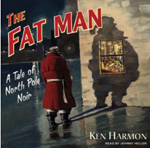
The Fat Man: A Tale of North Pole Noir

The Fat Man; A Tale of North Pole Noir
By Ken Harmon; Read by Johnny Heller
1 MP3 CD / 5 CDs – 5.5 hours – [UNABRIDGED]
Publisher: Tantor Audio
Published: 2010

Themes: / Fantasy / Christmas / Elves / Santa / Noir / Murder / Reindeer / It’s a Wonderful Life /

If you’re looking for a holiday story that’s not yet another retelling of The Christmas Carol, then pick up Ken Harmon’s The Fat Man. Gumdrop Coal is framed for murder after being ousted from the Coal Patrol and he’s out to clear his name.

Fired from his longtime job as captain of the Coal Patrol, two-foot-three inch 1,300-year-old elf Gumdrop Coal is angry. He’s one of Santa’s original elves, inspired by the fat man’s vision to bring joy to children on that one special day each year. But somewhere along the way things went sour for Gumdrop. Maybe it was delivering one too many lumps of coal for the Naughty List. Maybe it’s the conspiracy against Christmas that he’s starting to sense down every chimney.

Take all the Christmas references your sweet tooth can stand and keep going, add in an embittered and betrayed Elf from the Coal Patrol, Reindeer with the panache of top gun fighter pilots, and a spunky girl reporter, Buttercup Snitch, who either only has eyes for Gumdrop or is in on the frame job.

The story is told by Gumdrop Coal, leader and founder of the Coal Patrol, in a wonderful hard bitten noir style. Gumdrop is used to dealing with some nasty customers (children). The Coal Patrol are the guys who work from the Naughty List. After it’s been checked, twice.

Set in Kringle Town with Santa and the Elves. Filled with characters you will have heard from assorted Christmas Fairy. But they aren’t all as you might expect.

It isn’t all candy and Christmas trees; there is also a dark side to Kringle Town. The other side of the tracks: Potterville. If you’ve ever watched It’s a Wonderful Life you should recognise that name.

Gumdrop doesn’t believe Naughty Boys and Girls should be treated the same as their well behaved siblings. That smothering all children in gifts regardless of merit lessens both the gift and the child.

Johnny Heller tells it in a wonderful straight-up noir-style, even when doing the high pitched elves.

Posted by Paul [W] Campbell

Review of Mockingbird by Chuck Wendig

SFFaudio Review

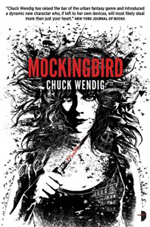
Mockingbird by Chuck WendigMockingbird (Miriam Black #2)
By Chuck Wendig; Read by Emily Beresford
Publisher: Angry Robot on Brilliance Audio
Published: 2012
Length: 9 hours [UNABRIDGED]
ISBN: 978-1-4692-0889-3

Themes: / fantasy / urban fantasy / psychic / powers / death /

Publisher Summary:

This whole “settling down thing” that Louis has going for her just isn’t working out. Still, she’s keeping her psychic ability – to see when and how someone is going to die just by touching them – in check. But even that feels wrong, somehow. Like she’s keeping a tornado stoppered up in a tiny bottle.

Chuck Wendig’s Blackbirds was my favorite read of 2012, introducing the character Miriam Black and promising of further adventures. The book trailer featuring narration by Dan O’Shea really intrigued my interest as to the powerful oratory nature of the book’s narrative and convinced me that I should continue the series via the audiobook route. The audiobooks are narrated by Emily Beresford and at first the very pleasant tone defied expectations, but given the book’s initial divergent nature from the first volume I ended up finding the narration to serve quite well. I am sure if I had started this series on audiobook, I would have enjoyed the first installment equally.

Just one touch and Miriam Black can see the specific details of one’s death including the date and all the potentially gory details. Blackbirds introduces Miriam as a transient wandering from one death scene to another and exploiting her abilities for financial gain. After all, any attempts to intervene with the fate yield disastrous outcomes so why not profit from her ability? Without spoiling the details, the end of that book leads Miriam desperately trying to circumvent another future that has been written in stone, or at least written in her journal she keeps of all her deadly visions.

The outcome of this first novel leads Miriam to settle down and try to make it without the use of her powers at the onset of Mockingbird. Needless to say, events quickly transpire and she is called to use her powers and once again finds herself going head to head with fate and even an apparent serial killer joins the mix as well. The novel builds and expands on concepts and characters introduced in the first novel and I highly recommend to anyone who enjoyed the first installment. I did miss having an author’s afterword as in the first novel which serves as a bridge between the two novels. I hope that the afterword’s promise of many more potential Miriam Black novels is fulfilled.

Book Trailer for Blackbird and Mockingird:

Review by Dan VK

Review of Brotherhood of the Wolf by David Farland

SFFaudio Review

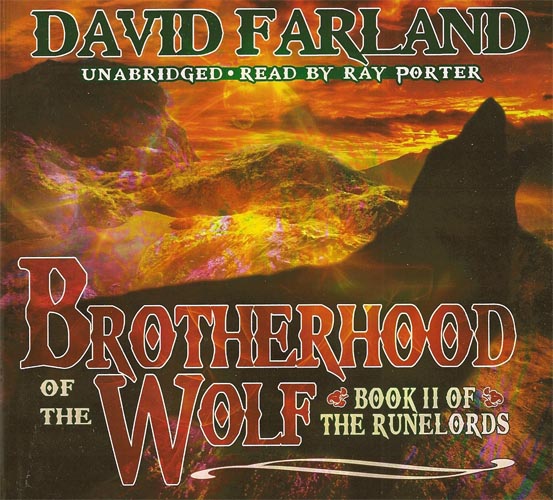
Fantasy Audiobook - Brotherhood of the Wolf by David FarlandBrotherhood of the Wolf (Runelords, Book 2)
By David Farland; Read by Ray Porter
18 CDs – 22.5 hours – [UNABRIDGED]
Publisher: Blackstone Audio
Published: 2009

Themes: / Fantasy / Epic Fantasy / Attributes / Magic / War /

In Hollywood there’s an old saying: The sequel is never as good as the original. Sadly, the same can be said for book 2 in “The Runelords” series.

It’s a dark book about war and destruction. Characters make choices, for good or ill, that change them. In my opinion, the changes are not always for the better.

I frequently found myself putting the iPod down because I didn’t like where the story was going, only to pick it up again later, hoping the ending would be satisfactory. It wasn’t. It left me feeling dissatisfied, depressed and in need of something that would get rid of the distasteful feeling.

The book reminded me a lot of “The Empire Strikes Back” where the movie ends with Han in Carbonite, Luke with an artificial hand and Vader on the loose. It’s a dark ending with some hope, but a lot of trouble for all the main characters. Or the second Back to the Future movie where I didn’t like the story went and I didn’t like what the characters did.

That’s how I feel about Brotherhood of the Wolf.

However, because I loved book 1 so much, and I know what a brilliant writer David Farland is, I’m going to give Book 3 a chance. And hope that, like many a third movie, it will be much better than the second.

This book is not without its virtues. It’s well written. The plot draws the listener from point to point as the story progresses. It is entertaining, in a dark, brooding sort of way. I just don’t happen to like dark stories. I also don’t like books and movies that make me cry. At many points I was afraid this was going to be one of those books. I was grateful it was not.

Posted by Charlene Harmon

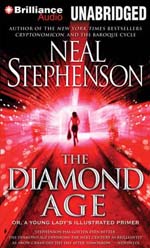
Review of The Diamond Age by Neal Stephenson

SFFaudio Review

The Diamond Age by Neal StephensonThe Diamond Age: Or, a Young Lady’s Illustrated Primer
By Neal Stephenson; read by Jennifer Wiltsie
16 compact discs; Approx. 19 hours [UNABRIDGED]
Publisher: Brilliance Audio
Published: 2001/2012
ISBN: 978-1-4558-8349-3
Themes: / Science Fiction / Nanotechnology / Computer Programming / Victorian Culture / Cyberpunk /

Editor’s Note: This edition is the same recording that was released in 2001, but it has been repackaged and re-released.  Back in 2003, Scott reviewed The Diamond Age after listening to it on cassette tape.

Publisher Summary: Set in twenty-first-century Shanghai, The Diamond Age is the story of what happens when a state-of-the-art interactive device falls into the hands of a street urchin named Nell. Her life — and the entire future of humanity — is about to be decoded and reprogrammed.…

Review: This was my second listen of the audio version narrated by Jennifer Wiltsie, which I enjoyed more thoroughly than the first time. Perhaps the main reason for this was that I happened to listen to Oliver Twist in between and discovered that Neal Stephenson had written a wonderful homage to Charles Dickens’ masterpiece, unbeknownst to me. That is not to say that reading Oliver Twist is a requirement for liking this book, but that it is a great way to fully appreciate the author’s style in this story, which was somewhat foreign to me at first. The Diamond Age is the sort of book that has the amusing ability to make me feel both more and less intelligent than I really am. Stephenson has a style of genre bending all his own that I like to think of as Neal-punk. At times he’ll mix it with some Dickensian dialogue that makes perfect sense to me. Other times his writing flies right over my head and convinces me that I’d need a significant amount of time and effort doing research in order to get his meaning, which is okay with me. It all lends itself to the sort of layered writing that bears up well to multiple readings, getting more and more understanding and appreciation each time. That is not so say that it requires a re-read in order to enjoy, it just helped me out quite a bit. I also happen to be an avid re-reader.

The characters in this book are diverse, interesting, often funny, and easy to sympathize with, especially Nell. I would mostly recommend this to people who enjoy an esoteric story that gives you a lot of food for thought. Neal Stephenson has a bit of a reputation for writing not-so-great endings. I don’t think The Diamond Age has a cut and dried conclusion, leaving room for the listener’s own imagination to wonder about and fill in some details. I can see how this may be dissatisfying to some, but I rather like a story that leaves me thinking about it afterwards. Jennifer Wiltsie did an excellent job with the narration, smoothly going from one character’s voice to another and delivering some lovely Victorian dialogue flawlessly to my American ears. All in all, I found it to be unique, imaginative, and quite fun.

Posted by Philip

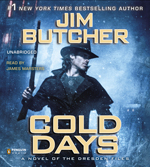
Review of Cold Days by Jim Butcher

SFFaudio Review

Cold Days by Jim ButcherCold Days: A Novel of the Dresden Files
By Jim Butcher; Read by James Marsters
Publisher: Penguin Audio
Release Date: November 27, 2012
ISBN: 9781611761603
Playing time: 19 hours [UNABRIDGED]

Themes: / fairy / wizard / urban fantasy / near-death /

Publisher summary:
After being murdered by a mystery assailant, navigating his way through the realm between life and death, and being brought back to the mortal world, Harry realizes that maybe death wasn’t all that bad. Because he is no longer Harry Dresden, Chicago’s only professional wizard. He is now Harry Dresden, Winter Knight to Mab, the Queen of Air and Darkness. After Harry had no choice but to swear his fealty, Mab wasn’t about to let something as petty as death steal away the prize she had sought for so long. And now, her word is his command, no matter what she wants him to do, no matter where she wants him to go, and no matter who she wants him to kill. Of course, it won’t be an ordinary, everyday assassination. Mab wants her newest minion to pull off the impossible: kill an immortal. Beset by enemies new and old, Harry must gather his friends and allies, prevent the annihilation of countless innocents, and find a way out of his eternal subservience before his newfound powers claim the only thing he has left to call his own…His soul.

After a slight departure from normal Dresden Files form in the preceding Ghost Story–owing to Harry’s (near) death and all–Dresden returns to corporeal form in Cold Days. But he can’t expect a warm welcome, even from his closest friends, because he’s now fulfilling his service as Winter Knight to Mab, the fairy Winter Queen. And this novel manages to raise the stakes again, for Harry, for Chicago, for the world. There have been so many Dresden Files novels now they actually fall into categories: there are vampire novels, fairy novels, wizard council novels, undead novels, and so forth. As the series grows there is more and more crossover, but Cold Days easily qualifies as a fairy novel.

I have two equal and opposite reviews in mind for Cold Days, and instead of choosing which to write, I’ll write both.

The first review argues that Cold Days, the fourteenth installment in the Dresden Files, suffers from serious series fatigue. With a few exceptions, it features largely the same cast of characters, the same locales, and the same themes that readers have grown accustomed to. Despite some glimpses of growth, development, and transformation, Harry Dresden is largely the same smart-mouthed, down-on-the-heel practicing wizard he was in Storm Front. His all-too-frequent pop culture references that once seemed amusing now strike a chord of annoyance. The frenetic action sequences that a few novels ago felt exhilarating now come off as trite and paint-by-numbers. In short, the novel makes me feel as if my once solid relationship with The Dresden Files has fallen a bit flat.

Some of the problems present in Cold Days are inherent in the stagnant conventions of urban fantasy as a whole. Except for a few quick jaunts to Edinburgh or Mexico, the entire series has largely taken place in Chicago. While Aristotle’s unity of place might be best practice for a play or even a novel, it certainly doesn’t work for a series of this length. This reader, at any rate, longs to see the heroes face other challenges in far-off lands. Worse, the single, small, isolated locale undermines the severity of the universal threats posed by the series’ villains. It’s difficult to take seriously a dangerous entity bent on world destruction when the only destruction in evidence takes place within a few city blocks.

With all the storylines introduced over the course of thirteen previous novels, it’s inevitable that not all of them can be picked up or carried along in a sequel, nor should they be. However, a pretty major development took place in book 12, Changes, prior to Harry’s apparent death, that is surprisingly absent from Cold Days, even in Harry’s continuous flow of internal monologue. He makes oblique references to it a few times, but I’d hoped that particular surprise would herald a shift in the series rather than merely the plot for a single novel. It is to be hoped that Jim Butcher will pick up this important thread in future novels.

The other review in my head praises Cold Days as a worthy installment to the Dresden Files series. This is largely on account of Jim Butcher’s vigorous writing style and strong characterization. Pop culture reference overload notwithstanding, Butcher’s writing, like a fine oak-aged whiskey, has only improved with age. Though the action sequences as a plot device are overused, there’s no denying they’re well-written. There’s a knock-down drag-out bar fight early in the novel, and you really can feel every shotgun blast and flying bar stool. The witty, flippant language that jaunts through the novel makes the few moments of gravity or pathos all the more powerful. There’s an exchange between Harry and his friend/love interest (to quote Facebook, “it’s complicated”) Karin Murphy that’s poignant and dramatic enough you’d expect to find it in a Scorsese flick.

And while Harry Dresden himself might wear thin at times, the host of supporting characters still haven’t lost their charm and complexity. Harry’s half-brother Thomas, his apprentice Molly, and polka-infused Medical Examiner Butters all make welcome and notable experiences. These characters crackle with life, personality, and possibility. For me, fantasy and science fiction novels, however wonderful their locales and however revolutionary their ideas, are only as strong as their characters. In a series of this length, the importance of characters increases exponentially. And even if some, including the protagonist, rub me the wrong way at times, they’re still characters I know and care about.

So, two equal and opposing reviews–how to break the tie? Simple: will I read the next Dresden Files novel? The answer is a definite yes. I don’t say this lightly. It takes a lot to keep me, and probably most readers, invested in a long-running series, especially in a sub-genre I don’t usually read. (Incidentally, the fact that I don’t often enjoy urban fantasy means you should take my first, negative review with a pinch of salt.) I bowed out of Robert Jordan’s Wheel of Time series after book seven, and I put down Charlaine Harris’s Sookie Stackhouse novels after the third installment. Blasphemous as it sounds, I’m even losing patience with George R. R. Martin’s A Song of Ice and Fire. Yet through thick and thin I’ve stuck with The Dresden Files for fourteen novels filled with great characters and complex supernatural elements. And I’m eager for a fifteenth.

The audio edition marks the return of James Marsters, best known as Spike from the Buffy the Vampire Series TV series, as narrator. Ghost Story, the previous novel, was narrated by John Glover. I feel sorry for narrators who have to pick up a series mid-stream, like John Lee who stood in for Roy Dotrice in narrating George R. R. Martin’s A Feast for Crows. John Glover performed admirably in his reading of Ghost Story, and if he had read the series from the beginning there would have probably been no cause for complaint. But for the previous twelve novels, James Marsters was Harry Dresden. His dry, sometimes deadpan style perfectly fits the Chicago detective noir tone of the novels. So his return to the series is a welcome breath of fresh air. Also, major props to Marsters for hitting the sustained high notes in the dialogue of the minuscule fairy underlings.

Posted by Seth