Free Listens Review of Firstborn by Brandon Sanderson

Review

“Firstborn” by Brandon Sanderson

Source: Tor.com (mp3)

Length: 1 hour, 13 minutes

ReaderBrandon Sanderson and Emily Sanderson

The story: If you keep up with fantasy literature, you probably know Brandon Sanderson from his own large fantasy novels, such as the excellent Mistborn, the juvenile fantasy Alcatraz series or as the writer called in from the bullpen to finish the late Robert Jordan’s sprawling Wheel of Time fantasy series. So for Sanderson to be writing space opera science fiction and a short story is two unusual situations at once. He’s so successful, at least in this story, that I wonder why he doesn’t write more short science fiction.

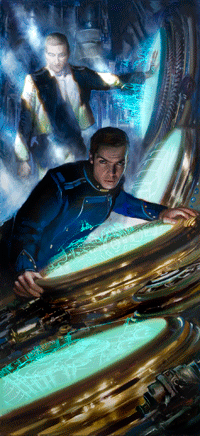
“Firstborn” is set in a galactic empire where space navies do battle with rebel forces, complete with space fighters dogfights. Dennison Crestmar, a young nobleman in the Imperial Navy, is struggling as an unsuccessful officer who is constantly compared to his older brother, the famed admiral Varion Crestmar, who has never lost a battle. The setting, plot, and characters seem ripe for a series of clichés, but somehow Sanderson crafts these parts into an engaging and inventive story.

Rating: 8/10

The reader: Sanderson, as he freely admits, is not a professional voice actor. He doesn’t have the richness of sound that the pros have and the recording quality has a bit of hiss. Yet, Sanderson is a very good amateur reader. He is expressive and seems to be enjoying reading his own work. When his wife checks in to read some of the middle portion of the story, she does an equally fine job. Although he does a good job here, I don’t think I’d like to see Sanderson narrate those fantasy novels he’s best known for; those things are long and I’d rather have him writing sequels than reading!

posted by Seth

FREE LISTENS REVIEW: Thousandth Night by Alastair Reynolds

Review

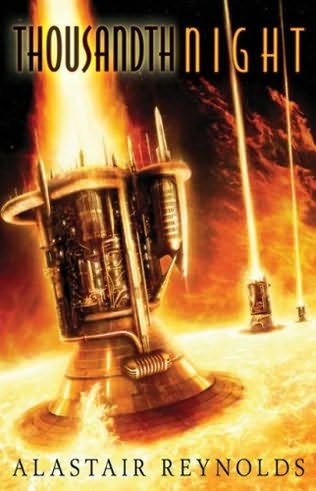
Thousandth Night by Alastair Reynolds

SourceSubterranean Press (part 123456789101112131415)
Length: Approx. 3 hours
ReaderSam A. Mowry

The story: In the far future when Thousandth Night is set in, humankind has advanced to the point where almost anything is possible: living for hundreds of thousands of years, travelling across the galaxy, and transforming the structure of the human body to almost any form. One thing that is not possible is breaking the laws of physics by travelling or communicating faster than the speed of light.
One group of humans, the Gentian line, meets every few thousand years. For 999 days each member shares his or her experiences from travelling through the galaxy. Then on the thousandth night, they elect the member with the most entertaining presentation to prepare the next reunion.

Reynolds introduces together a number of space opera technologies on the framework of a mystery during one Gentian reunion. He later reused these technologies in the setting for another novel, House of Suns.  Although the big science fiction ideas are the star, Reynolds never loses sight of the effects of science on humans. In fact, one of the major themes of the novella is our efforts change the physical world around us and the long-term consequences, good and bad, of those actions.

Note: This story contains sexual situations and may not be suitable for younger listeners.

Rating: 8 / 10

The reader: Mowry has a wonderfully smooth voice with a richness like a less gravelly Charlton Heston. His reading is clear and his pacing is rhythmic. He doesn’t try to charge the reading with emotion that isn’t there, but instead remains restrained. The only complaint I have is that his fairly straight reading sometimes makes it difficult to know what is narration and what is dialog. After a bit, I got into the story and had no trouble with knowing when characters were speaking and enjoyed his reading tremendously.

Posted by Seth

Review of Quicksilver by Neal Stephenson

SFFaudio Review

Cover of Quicksilver by Neal StephensonQuicksilver
By Neal Stephenson; Read by Simon Prebble and Kevin Pariseau
Audible Download – 14 Hours 48 Minutes [UNABRIDGED]
Publisher: Audible Frontiers
Published: 2010
Themes: / Natural Philosophy / History Of Science / Historical Fiction

Let me begin this review by saying that anyone with the cajones to write historical fiction on this scale deserves mad props. Quicksilver, being the introductory volume in Neal Stephenson’s epic Baroque Cycle, spins a dizzying tale of science and adventure on the colorful canvas of late seventeenth- and early eighteenth-century Christendom. Like Stephenson’s massive World War II yarn Cryptonomicon, Quicksilver blends erudite discourse on the nature of the world with high drama and hair-raising adventure. The story sometimes takes a back seat to the intellectual ideas under discussion, but readers not afraid to apply a little mental elbow grease will find a lot to enjoy.

Before diving into an actual review, a note on this audio edition is in order. Audible Frontiers has elected to split the three massive print volumes of the Baroque Cycle into eight audiobooks. They haven’t just taken a metaphorical paper knife to the series, though. They’ve worked closely with Neal Stephenson to ensure the audio volumes have their own cohesion and progression. Neal Stephenson also lends his voice to a brief audio introduction preceding each volume. Thus, this audio performance of Quicksilver comprises only part of the print volume of the same name. I’ve not read the print edition, so I can’t draw any further comparisons.

In typical non-linear Stephenson fashion, Quicksilver narrates the pivotal events in the life of Puritan-turned-scholar Daniel Waterhouse. The story jumps between his youth in the mid-1600s and his later life in the early 1700s. Readers of Cryptonomicon will be familiar with this technique. They’ll probably also recognize our protagonist’s surname, as the Waterhouse family plays a pivotal role in the aforementioned novel. The ageless enigmatic Enoch Root also makes an appearance early on in the novel. Stephenson, to some extent, seems to be following the example of James Clavell, whose Struan family formed the backbone of his Hong Kong novels through different time periods. Having said that, one certainly doesn’t need to have read Cryptonomicon to appreciate Quicksilver.

The similarities between Cryptonomicon and Quicksilver also extend to theme and writing style. Stephenson takes frequent detours to explain the dynamics of a sun dial, the optics of a telescope, or the physics of eighteenth-century seafaring vessels. The digressions feel appropriate to a tale that features the likes of Isaac Newton, Samuel Pepys, and Gottfried Leibniz. Indeed the title Quicksilver, the common name for mercury, serves as a metaphor for the transition in modes of thinking and reasoning that the novel is trying to highlight. Daniel Waterhouse witnesses the nascent days of experimental science as we know it. The erudite dialogues and monologues sometimes made my eyes glaze over, however, and I was yearning to return to the story.

What saves Quicksilver from sometimes devolving into a mere lecture on the history of science is Neal Stephenson’s vibrant prose. Stephenson writes with the exact precision of a philosopher, but with an eye for earthy metaphors and a sensitivity towards the modern reader. I might quibble with occasional use of language that wasn’t current in the seventeenth century, but must concede that these (usually very minor) transgressions make the work far easier to read and digest. As a lover of language for language’s sake, I found Quicksilver a philological joy to read.

The colorful prose is brought to life by Simon Prebble’s artful narration. Narrating historical fiction can be almost as monumental a task as writing it. How does one lend a voice to the intellectual magnificence of a Newton or a Leibniz? Simon Prebble does a magnificent job, aided by Stephenson’s written cues, of bringing real life and character to most of the novel’s characters. The cast of Quicksilver encompasses a vast ethnic background, from British to Dutch to German to the New World, and Simon Prebble juggles this diversity with ease. Kevin Pariseau narrates only the epigraphs beginning each chapter, which are usually apropos to the following content.

One last observation about Quicksilver: it isn’t really science fiction. Okay, if you want to get pedantic, it’s actually the purest form of science fiction–fiction about science and its development. But the novel certainly isn’t science fiction in the modern genre sense. The ageless (immortal?) Enoch Root figures into the tale, and there are certainly themes reminiscent of science fiction (what is real? how does the world work?), but listeners casually browsing the science fiction portion of Audible hoping for a straightforward science fiction story will be disappointed. Like so often happens in publishing, I assume that the categorization was a marketing decision, by analogy with Stephenson’s more strictly science fiction work like Snow Crash. Still, fans of science fiction with an open mind will find lots to appreciate in these stories.

I’ve begun listening to King Of The Vagabonds, the follow-up volume to Quicksilver. The story shifts gears abruptly in both focus and tone, turning its attention now to the homeless beggar and thief Jack Shaftoe (another familiar name to readers of Cryptonomicon). Clearly the Baroque Cycle has a wide array of stories to tell, and I’m looking forward to following its tangled webs.

Posted by Seth Wilson

Review of Blood Groove by Alex Bledsoe

SFFaudio Review

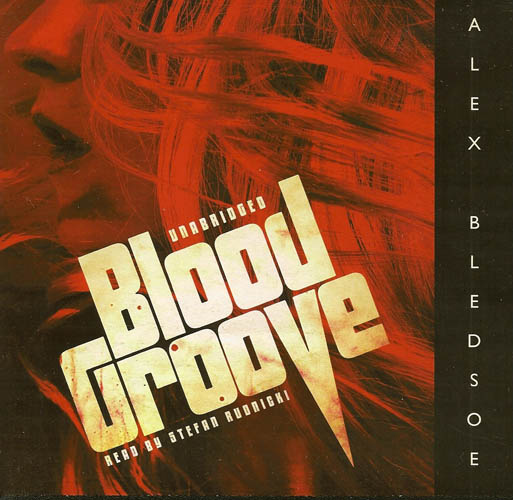
Blood Groove by Alex BledsoeBlood Groove
By Alex Bledsoe; Read by Stefan Rudnicki
7 CDs – Approx. 8.5 Hours [UNABRIDGED]
Publisher: Blackstone Audio
Published: 2009
ISBN: 9781433243880
Themes: / Fantasy / Urban Fantasy / Vampires / Revenge / Love / 1970s / 1910s / Memphis / Wales /

When centuries-old vampire Baron Rudolfo Zginski was staked in Wales in 1915, the last thing he expected was to reawaken in Memphis, Tennessee, sixty years later. Reborn into a new world of simmering racial tensions, he must adapt quickly if he is to survive. Hoping to learn how his kind copes with this bizarre new era, Zginski tracks down a nest of teenage vampires, who have little knowledge of their true nature, having learned most of what they know from movies like Blacula. Forming an uneasy alliance with the young vampires, Zginski begins to teach them the truth about their powers. They must learn quickly for there’s a new drug on the street created to specifically target and destroy vampires. As Zginski and his allies track the drug to its source, they may unwittingly be stepping into a trap that can destroy them all.

The vampire is the Mr. Potato Head of Fantasy fiction. It’s an old and worn out monster, fully mythologized with more than 100 interchangeable preternatural powers and weaknesses from which to assemble a fully customized vampire. For what might be a complete list of them check out the terrific website TVTropes.org. It cites a wonderfully cynical list of vampire tropes under the title: “Our Vampires Are Different.” So then the question is: If there is nothing really new under the sunless skies of vampire fiction why do we pick up them up? It’s a good question and one worth pondering. I picked up Blood Groove in large part because of the title. I liked the pun, figuring it referred to a blood groove (or fuller) on a sword and/or the idea of groovy 1970s vampires and/or the dado in a forensic pathologist’s slab. And before I picked up Blood Groove I noticed other Bledsoe books (probably a pun to be made there too) had cute titles like: The Sword-Edged Blonde and Burn Me Deadly.

Alex Bledsoe doesn’t give any new power to the vampire that he hasn’t had before, but he does add a new figurative kryptonite (like sunlight and garlic and crosses) to the mix. In fact, it’s creation and dissemination is central to the plot of Blood Groove. Along the way we also get an historical setting (1975), a virtual tour of parts of Memphis, Tennessee, some trivia about Elvis Presley and a relatively unpredictable story.

One of the elements that surprised me was not knowing who the protagonist of Blood Groove was. The vampires seemed the focus, and yet there was almost nothing that could make them sympathetic in a heroic or anti-heroic way. We’d meet one, he’d be killed, and then I thought “Okay…and?” but the story wouldn’t explain – which was a nice move actually. So for a good chunk of the novel the characters, all well fleshed out, appeared in scenes, died or were killed, only to be replaced by new characters with new agendas and new back-stories. The period shifted too. First we are in 1975 Memphis, then 1915 Wales. Eventually it settles down and we’re given fresh references, almost devotionals actually, to two early 1970s movies Blacula and Vanishing Point. As with many an urban fantasy novel these days there’s a mixing up of sex and love. Blood Groove doesn’t feel particularly paranormal romancy – but it’s probably not too far from the edges of curve.

Narrator Stefan Rudnicki gives voice to about a dozen characters of mixed gender, ethnicity and accent. Most obviously the East European vampire Baron Rudolfo Zginski has a suitably Bela Lugosi type accent. As with every Rudnicki read audiobook I’ve heard his rich voiced narration in Blood Groove is always in service to the text. One reviewer on Amazon.com put it well: “[Reading Blood Groove] was like eating a brownie with nuts when you don’t like the nuts.”

The trailer for Vanishing Point:

The trailer for Blacula:

Posted by Jesse Willis

Review of Hunt Through The Cradle Of Fear by Gabriel Hunt (aka Charles Ardai)

SFFaudio Review

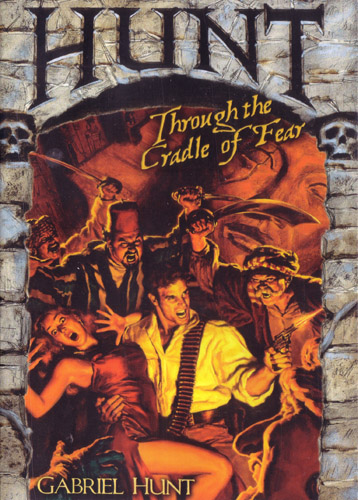
AUDIO REALMS - Hunt For Adventure: Through The Cradle Of Fear by Gabriel HuntSFFaudio EssentialHunt: Through The Cradle Of Fear (#2 in the Adventures Of Gabriel Hunt series)
By Gabriel Hunt (aka Charles Ardai); Read by Jim VanDusen
6 CDs – Approx. 8 Hours [UNABRIDGED]
Publisher: Audio Realms
Published: November 2009
ISBN: 9781897304761
Themes: / Adventure / History / Mythology / Fantasy / Hungary / New York / Egypt / Greece / Sri Lanka / Libya / Noir /

From the towers of Manhattan to the jungles of South America, from the sands of the Sahara to the frozen crags of Antarctica, one man finds adventure everywhere he goes: GABRIEL HUNT. Backed by the resources of the $100 million Hunt Foundation and armed with his trusty Colt revolver, Gabriel Hunt has always been ready for anything – but is he prepared to enter… The Cradle Of Fear? When a secret chamber is discovered inside the Great Sphinx of Egypt, the mystery of its contents will lead Gabriel to a remote Greek Island, to a stone fortress in Sri Lanka … and to a deadly confrontation that could decide the fate of the world!

Hunt Through The Cradle Of Fear is a fast paced, well researched, modern adventure tale in the vein of Indiana Jones or Jake Sampson: Monster Hunter. The adventure never flags or gets bogged down in the equipment porn many of the other adventure series I’ve read have. Instead, the story both figuratively and literally jets from scene to scene – with a narration that almost as velocitous. Adding to the fun is Sheba, a distressed damsel who is no mere mcguffin – she’s got skills that both Lajos DeGroe, the billionaire heavy, and Hunt both need. When Gabriel Hunt, the titular hero/author, isn’t stowed away on a private jet, chasing after Sheba to who-knows-where, he’s doing battle from the seat of New York taxi or jumping off ramparts into shadowy abysses. Spanning three-quarters of the circumference of the Earth, this story threads together a plot explaining the various archaeological connections between Greece, Egypt and Sri Lanka. I thoroughly enjoyed every moment of it.

In Chapter 19 there’s a delightful little scene that shows just how playful this book is. Gabriel Hunt, and his buxom companion, are set to meet a shadowy hacker in an Istanbul landmark when they bump into a pair of married writers – one is named Naomi, and she write historical fantasy, the other, her husband, writes adventure stories. If your a bit familiar with Charles Ardai, who wrote Hunt Through The Cradle Of Fear you’ll instantly recognize, as I did, that that was a cameo by both Charles Ardai and his wife Naomi Novik (author of His Majesty’s Dragon |READ OUR REVIEW|! Fun heh? Also promising is the serial but standalone nature of this book. Each book in the series stands alone, but offers callbacks to the earlier adventures as well as advancing the plot and/or revealing more about the Hunt family fortune. This is book 2 in a series, all attributed to Gabriel Hunt, but all ghost-written by various authors. One brief scene referring to events in book 1 Hunt At The Well Of Eternity, for example, made me want to pick up the first book in the series.

If you’re looking for painterly descriptive passages, or angsty characters, you’d do well to avoid this romp. Gabriel Hunt is an adventurer first and foremost. But, if you, like me, enjoy a little back-story – slowly revealed – between hard-fought gun battles and perilous plunges from high places – you’re in for a real treat. When I talked to Fred Godsmark, of Audio Realms, in SFFaudio Podcast #078 I asked him why he produced book 2 in the Gabriel Hunt series, rather than book one. He told me that its was what he was suggested he start with. If Hunt At The Well Of Eternity is half as good as Hunt Through The Cradle Of Fear it’ll definitely be worth picking up too!

Narrator Jim VanDusen is an absolute keeper. His voice perfectly suits the care-free Hunt. But he’s also able to voice the black-hearted villains, the variously accented henchmen, as well as the brainy but busty beauty Sheba (the female lead). It’s always a delightful surprise to find a new narrator, Jim VanDusen is one of these.

But that’s not all! Tacked on to the end of this novel is a bonus 83 minute novelette by Charles Ardai, also read by Jim VanDusen, called Nor Idolatry Blind the Eye (the etext for which is |HERE|). Nor Idolatry Blind the Eye is a terrific adventure tale set in post WWII Libya and starring a shattered mercenary named Malcolm Stewart who is looking for a reason to live. It reminded me of a cross between one of Robert E. Howard’s ghost stories and the 1943 movie Five Graves To Cairo. Like Hunt Through The Cradle Of Fear it is also well researched, fast paced and truly thrilling. Unlike Cradle it’s grim, a meaty noir tale, in the way that a series story never could be. Highly recommended!

Posted by Jesse Willis

Review of The Big Time by Fritz Leiber

SFFaudio Review

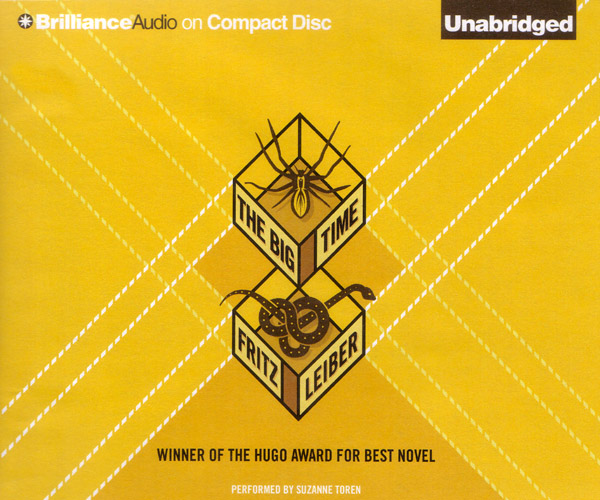
BRILLIANCE AUDIO - The Big Time by Fritz LeiberThe Big Time
By Fritz Leiber; Read by Suzanne Toren
4 CDs – Approx. 5 Hours [UNABRIDGED]
Publisher: Brilliance Audio
Published: August 2010
ISBN: 9781441875129
Sample: |MP3|
Themes: / Science Fiction / Mystery / Locked Room Mystery / Time Travel / Sex / Aliens / War / History /

Have you ever worried about your memory because it doesn’t seem to recall exactly the same past from one day to the next? Have you ever thought you might be changing because of forces beyond your control? Have you ever thought that the whole universe might be a crazy, mixed-up dream? If you have, then you’ve had hints of the Change War. It’s been going on for a billion years and it’ll last another billion or so. Up and down the timeline, the two sides – “Spiders” and “Snakes” – battle endlessly to change the future and the past. Our lives, our memories, are their battleground. And in the midst of the war is the Place, outside space and time, where Greta Forzane and the other Entertainers provide solace and R and R for tired time warriors. The Big Time was first published in two two issues of Galaxy Science Fiction magazine, March and April 1958.

When I finish reading an old Science Fiction novel like this one I pick-up my copy of The Dictionary Of Science Fiction Places (by Brian Stableford) and see if there’s an entry for it. There is one for The Big Time. It’s listed under “Place, The” on pages 238 and 239. Here are a couple of descriptive passages therefrom:

“[The Place is a] safe haven established outside the cosmos while infinity and eternity were undergoing the continual upheavals of the Change War, in order to serve as a Recuperation Station for soldiers fighting on the side of the Spiders against the Snakes. Its female staff were officially categorized as Entertainers and quite rightly thought of their work as nursing rather than whoredom.”

and

“The Place was midway in size and atmosphere between a fair-sized nightclub and a cramped Zeppelin hangar.”

As other reviewers have pointed out this is essentially a stage play, and as such, the stage for The Big Time is “The Place.” Now given that it won a Hugo Award, for the Best Novel of 1958, I’m kind of surprised how lightweight and compact The Big Time is. The entirety of the action takes place in just the one location and over a very short period of time. Adding to the oddness, it’s narrated in first person, by a resident/worker in what is essentially an quasi-bar-brothel (or bawdy house) for military personnel. That’s actually a very good thing in terms of storytelling as The Big Time is actually a locked room mystery tale, a mutiny and a variation on Edgar Allan Poe’s The Purloined Letter. The whole book is chock-full of allusions, historical details and notable quotations (one for each chapter in fact). The plot doesn’t really get rolling until about half-way through, at which point you’ve learned nearly enough to play along with the mystery aspect. I liked how it was resolved, and found that the process had me both suitably and appropriately buffaloed with it’s many Agatha Christie-style red-herrings.

There’s a nice description of this novel’s uniqueness on the Wikipedia entry: “The Big Time is a vast, cosmic back story, hidden behind a claustrophobic front story with only a few characters.” That’s it precisely. Now to the question I turned over and over in my mind after hearing it. “Is The Big Time a classic for the ages?” Upon long consideration I’m thinking that it is not. It is a good story, but it’s nowhere near that vaunted class of SF greatness. The idea of time travelers fighting a war across time and space isn’t a particularly original or interesting. And it isn’t an idea that is thoroughly exhausted in this story. But, for what this story is, and how it’s done, The Big Time is definitely worth reading if you’re in a mood for a locked room tale.

I’m sad to report a couple of minor blemishes mar this otherwise excellently produced audiobook version. First there’s the music. Each disc in the CD set ends and begins with music that absolutely does not fit the novel’s atmosphere. This problem may be entirely avoided by getting the original Audible Frontiers version, or perhaps mostly (or completely) eliminated with the MP3-CD edition.

Second, more serious, and entirely unavoidable, there is a lyrical song in the text, which I will reproduce to illustrate the problem. This comes at the end of Chapter 3:

Standing in the Doorway just outside of space,
Winds of Change blow ’round you but don’t touch your face;
You smile as you whisper tenderly,
“Please cross to me, Recuperee;
The operation’s over, come in and close the Door.”

Given the number of references I got, this one must be Fritz Leiber’s nod to the immortal Lili Marleen. But Suzanne Toren, who is otherwise absolutely fantastic, doesn’t use Lilli Marlene as the melody. And that is a small, but very real shame.

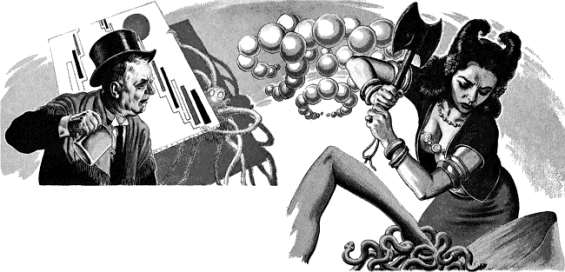
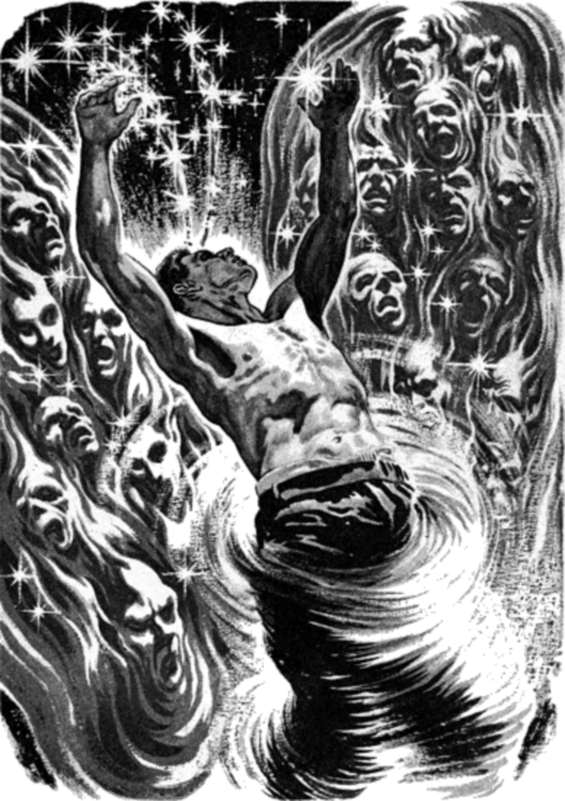
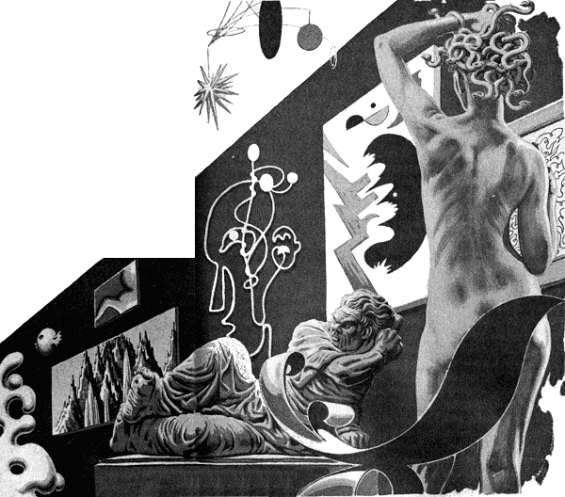
By the way, here are three of several cool Virgil Finlay illustrations from the original Galaxy publication:

The Big Time by Fritz Leiber - Illustrated by Virgil Finlay

The Big Time by Fritz Leiber - Illustrated by Virgil Finlay

The Big Time by Fritz Leiber - Illustrated by Virgil Finlay

Posted by Jesse Willis