Review of Star Trek: Vulcan’s Soul by Josepha Sherman and Susan Shwartz

Star Trek Audiobooks - Star Trek Vulcan's SoulStar Trek: Vulcan’s Soul Book I: Exodus
By Josepha Sherman and Susan Shwartz; Read by Boyd Gaines
3 Cassettes or 4 CD’s, 4 hours [ABRIDGED]
ISBN: 0743529995 (Cassette), 0743530004 (CD)
Publisher: Simon and Schuster Audio
Published: 2004
Themes: / Star Trek / Vulcans / Aliens /

A disheartening thing about being a fan of Star Trek is that one of its most beloved characters, Spock, has been left with an unfinished story. The last time we saw him on the screen was during the two-part Star Trek: The Next Generation episode entitled Unification. That the ratings for that episode are among the best Star Trek has ever gotten demonstrates the fan’s desire to see more of Spock. Alas, the business world encroaches, and for whatever reason, Spock was left on Romulus, his fate uncertain.

Enter Josepha Sherman and Susan Shwartz. Their previous two Star Trek novels, Vulcan’s Forge and Vulcan’s Heart (both available on audio) were excellent science fiction, focusing on Spock in particular and Vulcan culture in general. Vulcan’s Soul Book 1: Exodus continues that story in the same manner, focusing both on the character of Spock and the Vulcan world during the time of Surak, the great Vulcan philosopher who championed logic over emotion, and to whom we were first introduced during the Original Series.

The story takes place one year after the Dominion War. A hostile and powerful race called the Watarii, claiming to have an ancient score to settle with the Romulans, invade Romulan space. Spock and his wife, Captain Saavik, swoop in to help, enlisting the assistance of old friends Admiral Uhura and Admiral Chekov. They work to unravel the mystery of the Watarii while doing their best to assist in defending against them. Frequent flashbacks tell the interwoven story of Surak’s effect on the planet Vulcan.

The story is fast paced and extremely well-read by Boyd Gaines. The sound effects and music typical of previous Star Trek audiobooks is also present, effectively used to establish setting and tone.

My only quibble with this one is that I hadn’t heard from Uhura and Chekov in so long that I had to seriously question whether or not they would be alive one year after the Dominion War. The answer is: apparently so. They’d be over 150 years old, but possibly still kicking. Uhura is mentioned in a previous novel (Catalyst of Sorrows) as being the “centenarian head of Starfleet Intelligence.” I’m certainly finding this kind of thing old. I assume Sherman and Shwartz have a valid reason for using these two particular characters, but I’m currently not sure why they would bring yet another couple of TOS characters into the TNG/DS9/VOY era rather than using some contemporary characters from other series. Perhaps the Enterprise-A encountered some kind of strange nebula which had a hypnotic effect that prevents these folks from retiring… Another story, perhaps.

Other than that annoyance, this was a very good Star Trek novel with lots of Vulcan mythos, lots of eyebrow-raising conundrum, and a fantastic battle scene.

Find more on Star Trek audiobooks here!

(I’d like to acknowledge the kind assistance of Scott Armstrong, who did some research for me for this review. Any mistakes, of course, are my own.)

Posted by Scott D. Danielson
Review of Solution Unsatisfactory

Solution Unsatisfactory
Adapted by Daniel Taylor from the short story by Robert A. Heinlein; Full Cast Production
1 CD – 68 Minutes UNABRIDGED
Publisher: Atlanta Radio Theater Company
Published: 2003
ISBN: 0929483316
Themes: / Science Fiction / WWII / Nuclear Holocaust / Time Travel /

Solution Unsatisfactory describes an American supersecret project to develop an atomic superweapon that proves vital to the Allied triumph of World War II. ‘So what,’ you say. ‘That’s old news.’ And you’d be right, the atomic bombs dropped on Hiroshima and Nagasaki in 1945 were the final nails in the coffin of WWII. But what’s weird is, Solution Unsatisfactory was published in 1940, a full half decade before the atom bomb was even known to exists by the general public. What’s more, Heinlein’s story goes on to foresee the coming cold war with the Soviet Union and the concomitant race to arm with atomic weapons. Heinlein’s story doesn’t actually foretell the same events that happened, but the similarities are pretty eerie.

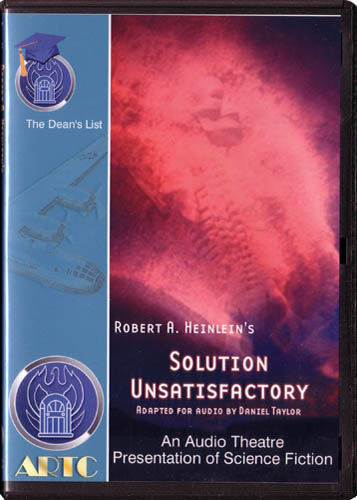
Daniel Taylor and the Atlanta Radio Theater Company have gone to great lengths to perform this difficult-to-adapt tale. Heinlein’s original short story is full of lots of exposition and less dialogue, and it takes place over a number of years, so Taylor has been forced to use propaganda radio transmissions and news bulletins to inform dramatically. The dramatization sounds crystal clear, performances are impactful and it follows the spirit of the text quite faithfully. The audiobook comes packaged in a DVD style amaray case with liner notes on the inside – a very cool idea. For the longest time the colourful cover art really baffled me, I figured it was like a Rorschach, but actually its not projective at all, I just was looking at it wrong. ARTC should be proud of themselves, Solution Unsatisfactory is a chilling reminder of how prescient science fiction can be, and more importantly, how it can serve as a warning.

Also included on the CD are two other shorter dramatizations. The Assassins by Gerald W. Page, a time-travel tale which is highly enjoyable, though predictable. It starts off at a convention of scientists where the topic of the day is to change the present by means of selective historical assassination. It ends in a familiar place. The final dramatization on the CD is the whimsical Grandma’s Diary by Daniel Taylor, which is neither SF or Fantasy, but entertaining.

As with other ARTC productions Solution Unsatisfactory needs a particular environment for maximum enjoyment. Cut out ambient background noise – use snug fitting headphones or a very quiet room (no white noise producers like ceiling fans for instance) with a solid pair of high fidelity speakers.

Posted by Jesse Willis

John Joseph Adams has started a new column on audi…

SFFaudio News

John Joseph Adams has started a new column on audiobooks for Locus Magazine. It appeared in the July issue, and has just been posted on the magazine’s website. Click here for the complete column. It’s great to see some audiobook coverage in Locus!

In my review of the unabridged version of Stephen King’s Salem’s Lot, I stated that this was the only audio version of Salem’s Lot of which I was aware. A reader from the UK informs me that Salem’s Lot was dramatized as a BBC Radio production in the mid 1990’s, but was unsure whether or not it was made available for sale anywhere. Anybody out there know? If so, drop me note! Better yet, send me your copy so I can hear it… :)

All my best, everybody, and thanks for visiting!

Posted by Scott D. Danielson

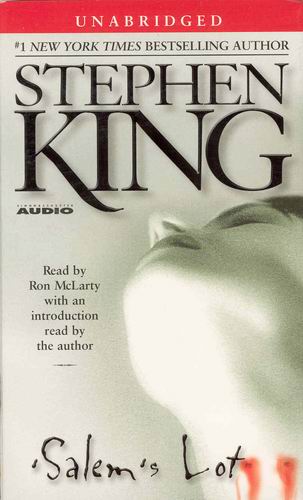
Review of Salem’s Lot by Stephen King

Salem’s Lot
By Stephen King; Read by Ron McLarty
11 Cassettes – 17.5 Hours [UNABRIDGED]
Publisher: Simon and Schuster Audio
Published: 2004
ISBN: 0743536959
Themes: / Horror / Vampires / Maine / Small town /

Simon and Schuster recently published this unabridged version of ‘Salem’s Lot, the only appearance of this 1975 Stephen King novel on audio of which I’m aware. This is the second novel published by King, and in my opinion is one of his finest.

Ben Mears, a successful author, returns to the small town of Jerusalem’s Lot to research a book he’s writing. Things get complicated quickly when a man named Barlow moves into town and folks start disappearing. Even more complicated – they start re-appearing. As vampires. As Ben Mears absorbs this fact, he meets the young Mark Petrie, and together they fight Barlow and his growing army.

The characters are the most striking attribute of any Stephen King novel, and this early novel is no exception. The numerous characters breathe with detail, and they all seem like people that I’ve met or could meet today. King lays the small town of Salem’s Lot out for all to see, warts and all, and then commences to destroying it while the reader watches. The actions and fates of the small town characters King has brought to life are where the story lies – not in Barlow himself.

Ron McLarty performs the novel, and does a fine job of it. He handles all the characters with great skill, reading in a clear and often tense manner. As you can probably tell, I really like Salem’s Lot. It’s one of the few novels that I revisit every so often. McLarty treated it well, and I thank him.

Now, I’d love to hear an unabridged audio version of the other two of what I’ve heard called King’s Trinity: one of The Shining, and one of the uncut version of The Stand. I’ll wait patiently…

NOTE: Did anyone catch that recent USA Network TV version of Salem’s Lot? Why the heck did they change so many small details? OK, OK, it’s a different medium, yadda yadda yadda, but wow. They had a perfectly good story to start with. ‘Nuff said. Back to the audio.

Posted by Scott D. Danielson

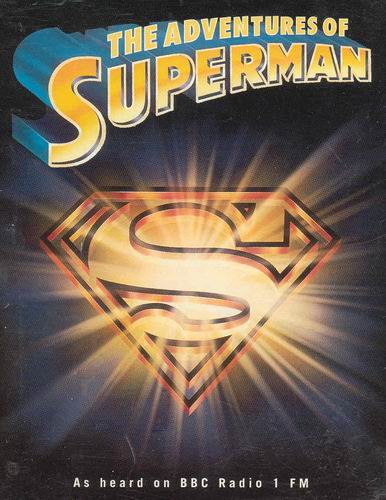
Review of The Adventures of Superman

The Adventures of Superman
Written and Directed by Dirk Maggs; Starring a Full Cast
2 Cassettes – 2.5 Hours [AUDIO DRAMA]
ISBN: 056339370X
Publisher: BBC
Published: 1994
Themes: / Fantasy / Superhero / Comics / Audio Drama /

This BBC radio drama (originally heard on BBC Radio 1 FM) tells the story of Superman from his first appearance in the skies to his battles with Lex Luthor, The Bizarro Superman, and Metallo. Dirk Maggs adapted and directed the script, from stories written by John Byrne, Dave Gibbons, and Jerry Ordway, published by DC Comics.

The production is strikingly effective. On the back cover of the package, it says, “A movie without pictures – you won’t believe your ears!” That’s not rhetoric – this audio drama plays exactly like a movie. Scene changes are made, setting is established, and special effects all executed with sound. With headphones on and eyes closed, you can practically see the screen in front you. And the acting is uniformly excellent. Remarkable!

I enjoyed the production much more than I expected to, because not only did it sound great, the story was great too. The tale begins with the first appearance of Superman as he saves a supersonic jet from destruction. From there, Clark Kent sets up his alter ego, dons his costume, then spends the rest of the story fighting Lex Luthor (and his creations) while discovering his own origins. The entire thing was executed brilliantly, and the result is a production that I enjoyed more than any Superman film I’ve seen.

Posted by Scott D. Danielson

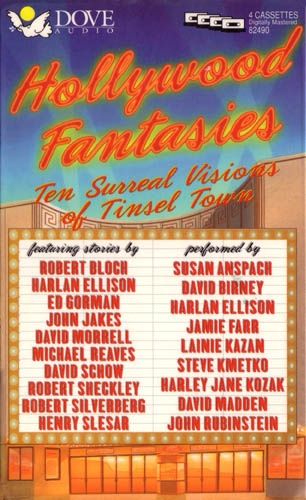
Review of Hollywood Fantasies: Ten Surreal Visions of Tinsel Town

Science Fiction Audiobooks - Hollywood FantasiesHollywood Fantasies – Ten Surreal Visions of Tinsel Town
By Robert Bloch, Harlan Ellison, Ed Gorman, John Jakes, David Morrell, Michael Reaves, David Schow, Robert Sheckley, Robert Silverberg and Henry Slesar; Read by Susan Anspach, David Birney, Harlan Ellison, Jamie Farr, Laini Kazan, Steve Kmetko, Harley Jane Kozak, Favid Madden and John Rubinstein
4 cassettes – Approx 6 Hours [UNABRIDGED]
Publisher: Dove Audio
Published: 1997 – hardcopy out of print (available for download at Audible)
ISBN: 0787109460
Themes: Fantasy / Hollywood / Movies / Television / Westerns / Witchcraft / Virtual Reality / Magic /

Learn the truth behind the mask of Hollywood in these ten bizarre tales of dreams and dream weavers, movies and movie-makers, by some of the most respected fantasy writers of our time.

This disappointing collection has a few redeeming tales, but few must-listen gems. The majority of the stories feel like filler – many feature tacked on twist endings that are less than stellar. Apparently Harlan Ellison’s reading of his own story, “Laugh Track,” has been modified in the performance – with the addition of a few lines here and there – if anybody’s gonna mess with a story it best be the author. The cover art is utilitarian but colorful, packaging for this audiobook is however very poor, most examples of these 4 cassette plastic cases with cardboard covers have become unbound as the glue holding the two together was not up to its task. Another minor annoyance, the mislabeling of cassette 4, Ed Gorman’s story “Gunslinger” is said to run through all of side 7 and onto 8, when it is the reverse. “Dead Image” starts on side 7 and runs through all of side 8.

Stories Included:

“The Never-Ending Western Movie” by Robert Sheckley
Jamie Farr’s gruff cowboy voice successfully narrates this 1976 short story, which posits an alternate world in which the old-fashioned movie serial westerns and reality television have merged. This is hard enough on the actors, who now have to do their own stunts, but when the prop guns fire real bullets acting scared isn’t too tough.

“One For The Horrors” by David Schow
A run-down movie theater shows prints of lost movie masterpieces like The Man Who Would Be King starring Humphrey Bogart and Clark Gable? The only thing that could top that is what’s playing tomorrow night! This one really is fantasy! Strictly for film connoisseurs – it held my interest but could have exited the stage a little more interestingly. Author David Schow must have done some fascinatingly fun research for this one. Reader Steve Kmetko works some magic of his own in the theater of the ear.

“The Man Who Wanted To Be In The Movies” by John Jakes
George wants to be in movies, so he visits his local licensed witch to cast a spell that’ll do the job. Harley Jane Kozak, the narrator, is fine – but the story itself is absolutely pointless and uninteresting.

“Laugh Track” by Harlan Ellison
Have you ever wondered where the laugh tracks from television sitcoms come from? Meet Wally Modisett, the Phantom Sweetener. Originally appearing in “Weird Tales” Magazine in 1984, this overly lengthy tale is almost made up for in part by Ellison’s enthusiastic performance, told in first person.

“Reality Unlimited’ by Robert Silverberg
Virtual Reality movies. Neat idea, but that’s all it is, the idea is there but the story is M.I.A.. When this tale was written in 1957 it might have had some point to it, today it’s barely a curiosity. A disappointing story by the usually reliable Silverberg. But on the other hand Susan Anspach reading of it was fine.

“The Movie People” by Robert Bloch
Movie extras have been in Hollywood films since the silent era, but just because they have no lines doesn’t mean we can’t read between them. Adequate and with a modicum of originality this tale would have benefited from a few more drafts before publication – it wanted to be a better story. John Rubenstein takes his time with the telling – a laconic voice that doesn’t detract from the story.

“Werewind” by Michael Reaves
A serial killer and a lonely howling wind may be connected. The only question is how. Marginally listenable, Michael Reaves’ story isn’t predictable, but neither is it comprehensible. It feels like a refugee from a Danielle Steele novelization of A Nightmare on Elm Street – and that doesn’t make any sense to me either! David Madden’s reading is far better than this short deserves.

“The Movie Makers” by Henry Slesar
Henry Slesar’s ode to 1950’s science fiction b-movies succeeds – in disappointing the same way those bad movies do – minus the cheesy special visual effect. The twist ending is also predictable. Lainie Kazan’s serviceable reading is adequate to the story’s requirements – though consider the predominant male characterization a female narrator is a questionable choice.

“Gunslinger” by Ed Gorman
In the early Twentieth century cowboys were heading away from the range and towards Hollywood, where they’d take on roles in the burgeoning western film frenzy. One man however is has a score to settle with one of these cowboys turned film actors, and its gonna be real bullets that’ll fly. “Gunslinger is illogically placed in this collection – it is not fantasy. It is set in Hollywood, but isn’t particularly fanciful. David Birney doesn’t have much to do here, but neither does he fail to achieve what’s required – to tell the story.

“Dead Image” by David Morrell
A thinly veiled tale about movie rebel James Dean, that asks the question: If Dean had a second chance at life would he do things any different? This very interesting tale depends upon a listener’s knowledge of James Dean’s life and death – also neat was the appearance of a Dennis Hopper type. Morrell’s tale isn’t likely to be turned into a film itself, but it’s full of neat ruminations on destiny and fame. Jamie Farr’s deep voice makes a second, and very welcome, appearance in this collection. He’s becoming one of my favorite celebrity narrators.

Posted by Jesse Willis