Review of Heraclix and Pomp by Forrest Aguirre

SFFaudio Review

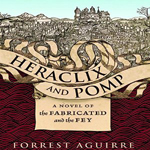
Hereclix and PompHeraclix and Pomp: A Novel of the Fabricated and the Fey
By Forrest Aguirre; Narrated by Brandon Massey
Publisher: Audible Studios via Resurrection House
Publication Date: 14 October 2014
[UNABRIDGED] – 11 hours, 7 minutes

Themes: / reanimation / golem / necromancer / fantasy /

Publisher summary:

Heraclix was dead and Pomp was immortal. That was before Heraclix’s reanimation (along with the sewn-together pieces and parts of many other dead people) and Pomp’s near murder at the hands of an evil necromancer. As they travel from Vienna to Prague to Istanbul and back again (with a side-trip to Hell), they struggle to understand who and what they are: Heraclix seeks to know the life he had before his death and rebirth, and Pomp wrestles with the language and meaning of mortality. As they journey across a land rife with revolution and unrest, they discover that the evil necromancer they thought dead might not be so dead after all. In fact, he might be making a pact to ensure his own immortality….

Heraclix and Pomp: A Novel of the Fabricated and the Fey is a story about mortality, at the end of the day. It has horror and fantasy trappings, but at its core, it deals with finding oneself and dealing with mortal matters. The story is told through the guise of Heraclix, a golem, pieced together from many beings, and Pomp, a fairy faced with mortality. I think this book is probably a 2.5-star book…on the one hand, I liked the characters and the world and the idea. But on the other, I was bored a lot of the time when listening, and the book felt repetitive.

The book seems to do a lot of moral speaking, all from the frame of Heraclix or Pomp. Brought together when a sorcerer’s attempt at a spell goes haywire, Heraclix suffers a re-birth of sorts, while Pomp is nearly killed in the doing of the magic. Bound by their shared experience, they set off to first escape the sorcerer and then to learn more about Heraclix’s past. As he travels Europe and The Middle East, Heraclix learns whose parts literally make up his whole–he is a golem of patched together parts from people, most of whom he learns about in his travels. Pomp, meanwhile, is from the land of the Fey, used to being a prankster and not having to worry about a thing. However, the sorcerer almost killed her, brining her face to face with her on mortality, so she learns more of what it is to be human (or at least, human-like) while helping Heraclix learn about himself.

I enjoyed the world that Aguirre developed, and I enjoyed the characters. The book takes place in the time shortly after The Crusades, in parts of the world I don’t often see come up in books. Heraclix and Pomp run into vagabonds, sorcerers, gypsies, kings, nomads, and a host of other characters as they search between Vienna and Instanbul–and a variety of places in between, including a trip to Hell. The telling of the various stories of the lives that Heraclix was a part of was charming and not like most things I’ve read.

But…somehow, it wasn’t enough. I repeatedly found my mind wandering during the narration, found myself having to go back to the beginnings of chapters to see what I’d missed. The book seemed to work very well one chapter at a time…at first, but even then, I was finding other things to read. Some of the language used seemed purposefully obscure, and a lot of the scenes felt like repeats–Heraclix and Pomp enter a setting, they find some part of Heraclix’s past, they are chased out into another setting, rinse, repeat. I think if the book had been shorter, it might have helped. It’s not that it was bad (it certainly wasn’t), but I think more might have been left on the editor’s desk.

The narration, performed by Brandon Massey, was decent. His voice is strong, good for an audiobook, if a little droning at times. The biggest “problem” with the narration might be more due to the story itself. It was sometimes hard to keep track of characters, of who was who. This was especially problematic when characters from the early parts of the book would be re-introduced at the end of the book. Audiobooks are much harder to flip back through to refresh your memory, after all. Massey’s voice sounded familiar to me, though looking through my library, he hasn’t narrated anything else that I’ve read. His voice would be good in a mystery or other novel when there are only a few characters.

All in all, I liked this book, but wished that it had been a little less obscure and a little less repetitive. That doesn’t mean, though, that you shouldn’t give it a try if it sounds interesting. But maybe try it out in a print format.

Posted by terpkristin.


Review of Martian Time-Slip by Philip K. Dick

SFFaudio Review

Martian Time SlipMartian Time-Slip
By Philip K. Dick; Performed by Jeff Cummings
Publisher: Brilliance AudioPreview
[UNABRIDGED] – 9 hours
Themes: / science fiction / outer space / Mars / Martians / time travel /

Publisher summary:

‘The writing is humorous, painful, awesome in its effect on both mind and heart…There are few modern novels to match it.’ —Rolling Stone

On an arid Mars, local bigwigs compete with Earth-bound interlopers to buy up land before the Un develops it and its value skyrockets. Martian Union leader Arnie Kott has an ace up his sleeve, though: an autistic boy named Manfred who seems to have the ability to see the future. In the hopes of gaining an advantage on a Martian real estate deal, powerful people force Manfred to send them into the future, where they can learn about development plans. But is Manfred sending them to the real future or one colored by his own dark and paranoid filter? As the time travelers are drawn into Manfred’s dark worldview in both the future and present, the cost of doing business may drive them all insane.

Martian Time Slip has everything I love about Philip K Dick’s writing: artificial life, unsettling visions, chaos and decay, hilarious satire, and story horizons that stretch into eternity.

PKD’s Mars is a strange and slightly alien version of 1960s California: a desert suburbia where the powerful waste water to show off their status, neglectful housewives pop pills and complain about their “whiny and dreadful” neighbors, and dodgy door-to-door salesmen offer illegal Earth foods like turtle soup and smoked frogs legs.

Since machines degrade quickly in the dry climate and resources for constructing new things are scarce, repair is a big business on Mars. The story starts when Jack Bohlen, a working-class repairman and latent schizophrenic, is diverted from a remote repair job to help some Bleekmen out in the desert.

Bleekmen are the subjugated natives of Mars, apparently related to ancient humans and the sole residents of the planet for thousands of years until the colonists arrived. Now’s they’re left to work menial jobs, and even their mystic practices are being “corrected” by the newcomers. For example, after they give Jack a lovely but creepy gift called a water witch, they explain how it works…

More carefully examining the water witch, Jack saw that it had a face and vague limbs. It was mummified, once a living creature of some sort; he made out its drawn-up legs, its ears . . . he shivered. The face was oddly human, a wizened, suffering face, as if it had been killed while crying out.

“How does it work?” he asked the young Bleekman.

“Formerly, when one wanted water, one pissed on the water witch, and she came to life. Now we do not do that, Mister; we have learned from you Misters that to piss is wrong. So we spit on her instead, and she hears that, too, almost as well. It wakes her, and she opens and looks around, and then she opens her mouth and calls the water to her.”

While on this mission, Jack runs into Supreme Goodmember Arnie Cott, the leader of the Water Works Union (one of the most powerful positions on Mars). Arnie is an obnoxious, manipulative, and racist schemer. He decides he can use Jack and so brings him in on one of his schemes to harness the precog abilities of an autistic boy, thus giving Arnie an advantage in real estate investment.

However, once he brings the autistic boy Manfred Steiner and Jack together, things start to gets very, very weird (in the best kind of way).

Originally, I was almost going to give this book a low rating, thinking it might be the first PKD book I’ve read that I didn’t really like. I kept going back to the audiobook and thinking I’d re-started in the wrong place, or that I’d zoned out and missed something the last time. It wasn’t until I decided to try a print version that I realized the reason I was losing my way was a side-effect of the novel’s beautiful and crazy structure, which spirals around and folds back in on itself.

Once I had a handle on this, I fell in love with it. This novel doesn’t reward broken up or distracted reading, but if you can give it dedicated attention, it’s brilliant.

I thought the audiobook I listened to, narrated by Jeff Cummings for Brilliance Audio, was well performed and the characters were easily differentiated, even though personally the narrative style wasn’t for me. In my mind, I tend to hear PKD’s characters as sort of dry and indifferent, so some of the characters in this version seemed too enthusiastic for my taste. But this is a very subjective thing and I imagine this reading would work well for lots of listeners. Just check out the sample audio before you buy.

This is a funny, eerie, and unforgettable story and definitely recommended, especially for PKD fans!

Posted by Marissa van Uden

The British Library Podcast – A Gothic Story

SFFaudio Online Audio

The British Library Podcast - A Gothic Story

The British Library Podcast has a very good primer for gothic fiction in a new podcast episode entitled A Gothic Story. Presented by Charlie Higson, here’s the official description:

To accompany the British Library’s exhibition Terror & Wonder: the Gothic Imagination, British horror writer Charlie Higson tells the true story of how the vampire and the zombie were born. From the first gothic novel to 19th century Romantics Lord Byron and Mary Shelley and from Hammer horror to the Night of the Living Dead, Charlie reveals how our favourite monsters evolved and triumphed. Along the way, Reece Shearsmith (The League of Gentlemen) reads extracts to chill the spine and thrill the senses.

Get the 1/2 hour |MP3| or listen to the sample below:

More information is HERE.

Posted by Jesse Willis

The SFFaudio Podcast #292 – TALK TO: John Betancourt

Podcast

The SFFaudio PodcastThe SFFaudio Podcast #292 –Jesse talks with John Betancourt, the publisher of Wildside Press, about copyright, the public domain, pulp magazines, author estates, comics, audiobooks, and ebooks.

Talked about on today’s show:
the Pulpscans Yahoo! Group, how to do copyright renewal searches properly, the tools, The Cold Equations by Tom Godwin, Astounding Science Fiction, two ways stories can be protected by copyright, before 1963, publisher renewals, author renewals, renewals after 1950 are on copyright.gov, 1923-1950, a text file for magazine renewals, and a text file for author renewals, Weird Tales, 1920s to the 1950s, OCR failures, looking for something to not be there, a very heavy burden, pseudonyms, false renewals, erroneous renewals, the pre-internet days, the Philip K. Dick estate’s copyright “pattern of abuse”, revisions, the 36 public domain Philip K. Dick stories, “they never got it wrong the other way”, a statistician could do something very interesting there, The Adjustment Bureau / Adjustment Team, the H.P. Lovecraft estate (if there is such a thing), the S.T. Joshi corrected texts, Home Brew (magazine) with Clark Ashton Smith, ebooks, paperbooks, and audiobooks, the Science Fiction Megapack, trademarking, licensing stories, horror, fantasy, golden age of science fiction, Lester del Rey, Westerns, length is not an issue in, Eando Binder, short stories in comics, Jack Binder, Captain Marvel, Whiz Comics, Captain Video, Tom Corbett, the Adam Link stories, Otto Binder, banned from Amazing Stories, “E” and “O”, unattributed short stories in comics, Fawcett Comics, Westbrook Wilson, Richard Lupoff, the space patrol stories, Joseph J. Mallard, a Nazi saboteur lost in the north woods, a dodge for a cheaper rate, silver age comics drop text stories, early DC Comics, Night Of The Living Dead, Zulu, fanzines in the public domain, Ray Bradbury in the public domain, copyright notification is no longer required, USA copyright lifetime + 70 years, 1984 by George Orwell is public domain in Canada but not yet in the USA, Donald A. Wollheim, a quasi-legal loophole, The Lord Of The Rings by J.R.R. Tolkien was briefly public domain in the USA, the scarcity of the Ace paperbacks of The Lord Of The Rings, the state of Ace doubles etc., unless it’s work made for hire, children’s books, Nancy Drew, Tom Swift, copyright compilation renewals, Analog renews a magazine…, how would we know if an author asks for his or her rights back?, the Guy de Maupassant Megapack, a victim of availability, Jules Verne, translations, a recent obsession, a gold mine [metaphor], an estimated 85% of books and stories published before 1964 are in the public domain, reading the letters pages of Weird Tales, Robert Bloch, spotty renewals, Ray Bradbury changed the name of stories a lot, pulp magazine editors, editorial meddling, respecting the text but keeping your job, annotated text links, nothing new can enter the public domain in the USA, corporate copyright to 95 years, the puppet Sonny Bono, life +70 years for authors is, 1922 and before is without question in the public domain in the USA, Mack Reynolds, buying author estates, Lester del Rey, H.B. Fyfe, unpublished manuscripts, John W. Campbell, Ellery Queen’s Mystery Magazine, archaeology for writers, 37 unpublished Mack Reynolds novels were thrown away, what is an author’s estate worth?, thousands of $$, R.A. Lafferty estate sold for $70,000.00, a major SF author’s estate was worth 1/4 million $$, the trend in ebooks, 14,000 different paperbooks and 1,100 ebooks and the ebooks earn 4 times as much as the paperbooks, the audiobook trend, Audible.com, Lois McMaster Bujold audiobooks, 200 audiobooks, a value added for authors, because Amazon owns everything…, a benign dictator forever?, when all competition is gone…, Amazon vs. Hachette, Amazon is demanding a higher and higher cut of ebook sales, 85% of ebook sales are through Amazon, a giant anti-trust situation, it’s like Highlander … there can be only one, when everything goes seamlessly into the Kindle…

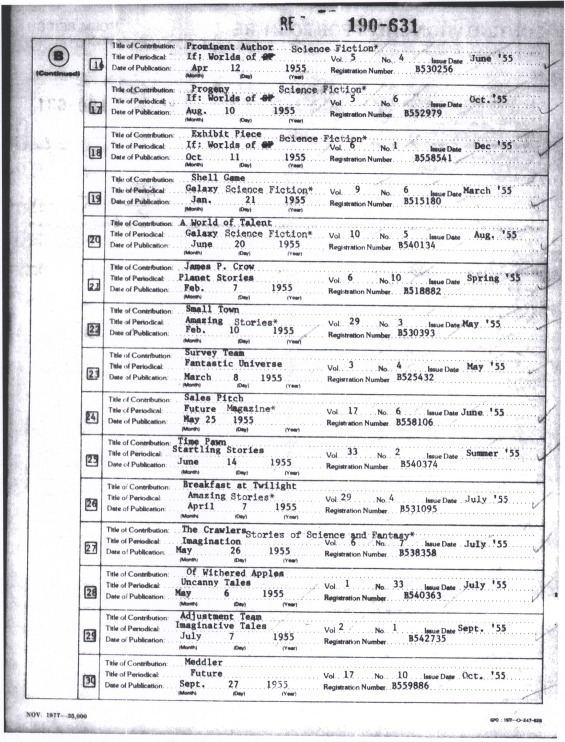
RE190631 Page 2 (back) Prominent Author, Progeny, Exhibit Piece, Shell Game, A World Of Talent, James P. Crow, Small Town, Survey Team, Sales Pitch, Time Pawn, Breakfast At Twilight, The Crawlers, Of Withered Apples, Adjustment Team, Meddler

Posted by Jesse Willis

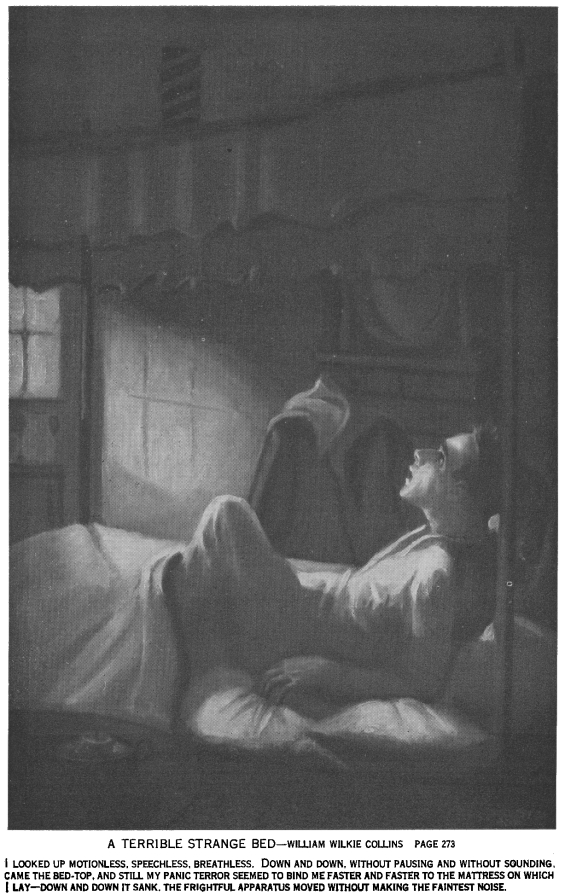
A Terribly Strange Bed by Wilkie Collins

SFFaudio Online Audio

A Terribly Strange Bed by Wilkie Collins was first published in the magazine Household Words, April 24, 1852.

A Terribly Strange Bed by Wilkie Collins

The Weird CircleThe Weird Circle – A Terribly Strange Bed
Adapted from the story by Wilkie Collins; Performed by a full cast
1 |MP3| – Approx. 30 Minutes [RADIO DRAMA]
Broadcaster: MBS, NBC, ABC
Broadcast: October 3, 1943
Provider: Archive.org

SuspenseSuspense – A Terribly Strange Bed
Adapted from the story by Wilkie Collins; Performed by a full cast
1 |MP3| Approx. 30 Minutes [RADIO DRAMA]
Broadcaster: CBS Radio
Broadcast: June 7, 1954
Provider: Archive.org

Audiobook:

Weird Circle adaptation:

Suspense adaptation:

Posted by Jesse Willis

The SFFaudio Podcast #291 – READALONG: Martian Time-Slip by Philip K. Dick

Podcast

The SFFaudio PodcastThe SFFaudio Podcast #291 – Jesse, Paul Weimer, and Marissa van Uden talk about Martian Time-Slip by Philip K. Dick.

Talked about on today’s show:
1964, first serialized as All We Marsmen, a pair of boxing insects, threads that lead nowhere, “a wonderful train-wreck of a novel”, the two audiobook versions, repeating scenes are disconcerting in the audiobook, repeating moments, at Arnie’s apartment, is this a byproduct of the writing process?, problems with marriage and plumbers, The Search For Philip K. Dick by Anne R. Dick, “Goodmember Arnie Kott Of Mars”, Chinatown, The Two Jakes, developers, Heliogabalus, time travel, the broken Friendly Dad robot, the school is monitoring, when you’re reading your Kindle Amazon is watching you, school is to make you conservative, preserving Earth culture, the time gate anthology, Robert Silverberg, autonomous robots, door to door salesmen, teaching machines, the different robot teachers, Immanuel Kant robot, with certainty he pointed down the hall, a western bias (the interests of Philip K. Dick), Aristotle, Abraham Lincoln, Julius, Winston Churchill, Tiberius, Thomas Edison, warfare, history, a million neat ideas, Philip II of Macedon, Alexander the Great, schizophrenia and autism, experiencing time at a different rate, derangement in a sense of time, A.D.D. and A.D.H.D., Camp BG, setting your watch by the stars and by the seasons, schizophrenia as a tendency but not a disability, daylight savings time, recipe for going to jail: act as if daylight savings isn’t real, its what the novel is about, the Soviets, an American Mars, a Bradburyian Mars, Martians as elves, the Bleekmen, water witch, hunter/gatherers nomadic culture, the “tame” Bleekman, the dream-quest is payback, a “pilg” (pilgrimage), Deus Irae by Philip K. Dick and Roger Zelazny, the trek through the desert, Tibor, Psychology Today, “oh, boy!”, thiotimoline, reconciling realities, “gubble gubble”, sharped tongued secretary, bicycles in outer space, she’s the predator, he’s the predator, Arnie and Manfred, sniffing around Doreen, they’re from the “TOMB WORLD”, Silvia is the most common female character name PKD uses, an analogy (or metaphor) for marriage, uppers and downers, drugs and coffee, back to the keyboard, Dr. Glaub is desperate to make some money, Dick’s own financial concerns, Anne, webbed fingers, inside the minds of horrible people, the dialogue driven sex scene is kinda creepy, why is she with this guy?, access to all the booze, why does Jack go back to his wife?, the perfunctory affairs are unbelievable, unredeemable, somehow it seems to all work, the Swiss rocket, Bleekmen are homo-sapiens, the S.M. Stirling Lords Of Creation novels, Mars as California, Australian aborigines, “dreamlines dreamsongs and dreamtime“, Ludwig Binswanger, psychiatry, psychology, Ellen had split her life, the “tomb world”,” degenerate and degenerating”, being trapped in your own body, “a narrowing a contracting”, gubble as a marker, Being John Malkovich, “Malkovich Malkovich Malkovich!”, our bodies with their low needs distract them from our purposes (if we have any), oblivious to suffering, depression, it’s all brain chemistry, anorexia, obsession with death, Mafred’s “sick” drawing, Amweb as the “tomb world”, the Manfred illustration, the nightmare woman, “her tongue wants to cut”, seeing into the future is seeing death, awesome imagery, a recurring image, The Minority Report, armless and legless (limbless characters), the movie adaptation of A Scanner Darkly, dialogue driven storytelling, what are they reacting to?, mental processes, “it was there to be found”, Virgil Finlay, reading it harder, a post apocalyptic zombie novel, building up a picture, open to being expanded, PKD is concise, most books aren’t dialogue driven, creative writing classes, showing off descriptive skills, novels vs. poetry, is J.R.R. Tolkien responsible for this?, a reverence for the landscape, what color is the dust?, visuals are everything has colonized Science Fiction and Fantasy in the last 30 years, eating meals and walking the landscape, this book isn’t a distraction from life, a meta-description of life, what makes this a SF story?, “the chamber”, the technology is your mind and your brain, even Mars isn’t very different, mars rats, what do the bleekmen hunt?, water witches!, does the water witch protect Jack?, the pistol, the real SF idea behind this is PKD is trying top figure out what déjà vu is, the “I know what is going to happen next” feeling, we are very poor at capitalizing on our future knowledge, the slipped gear, “Oh, little Jackie.”, Philip K. Dick’s science fiction is Psychology Today, an ansible, this problem in science and the social situation between these characters, lying in bed in a hypnagogic state, doing dream style processing of mental white noise in a semi-conscious state, “all different all equally true”, different angles, the broken mosaic, the fact that these books are dated doesn’t age the books, the Brilliance Audio audiobook narrated by Jeff Cummings, Grover Gardner (Tom Parker) narration of Martian Time-Slip, the bicycles floating into space, a horrible human being (he wastes water), Heliogabalus -> Helio (sun -> son) will Gabalus (gubble) less, Elagabalus, the religion of the Roman Empire, a scene, W.A. Mozart, “I love Mozart!”, Bruno Walter conducting, that hideous racket, encoding messages, Manfred Steiner, is this the sign?, they emerged from her pores, whoever’s perspective we see the scene from they all enter the “tomb world”, “teeming with gubbish”, “he wanted to bite her lip”, the pivot point, screeches, the screech of the bus, music, what do dogs think of music?, what do autistic people think of music?, trance music, a Dickian idea, music and sound, the bus brakes screech, “fire!”, bears at the zoo cavorting for peanuts, the suicide, “more evidence that Arnie is a horrible human being”, we just need a little bit of hope, Do Androids Dream Of Electric Sheep?, Galactic Pot-Healer, Fair Game by Philip K. Dick, The World Jones Made, there are 36 public domain Philip K. Dick stories, Time Out Of Joint (is Paul’s favourite Dick novel), a constructed town,

Martian Time-Slip WORD CLOUD

All We Marsmen illustrated by Virgil Finlay

All We Marsmen illustrated by Virgil Finlay

All We Marsmen illustrated by Virgil Finlay

All We Marsmen illustrated by Virgil Finlay

All We Marsmen illustrated by Virgil Finlay

All We Marsmen illustrated by Virgil Finlay

All We Marsmen illustrated by Virgil Finlay

All We Marsmen illustrated by Virgil Finlay

All We Marsmen illustrated by Virgil Finlay

All We Marsmen illustrated by Virgil Finlay

All We Marsmen illustrated by Virgil Finlay

Blackstone Audio - Martian Time-Slip by Philip K. Dick

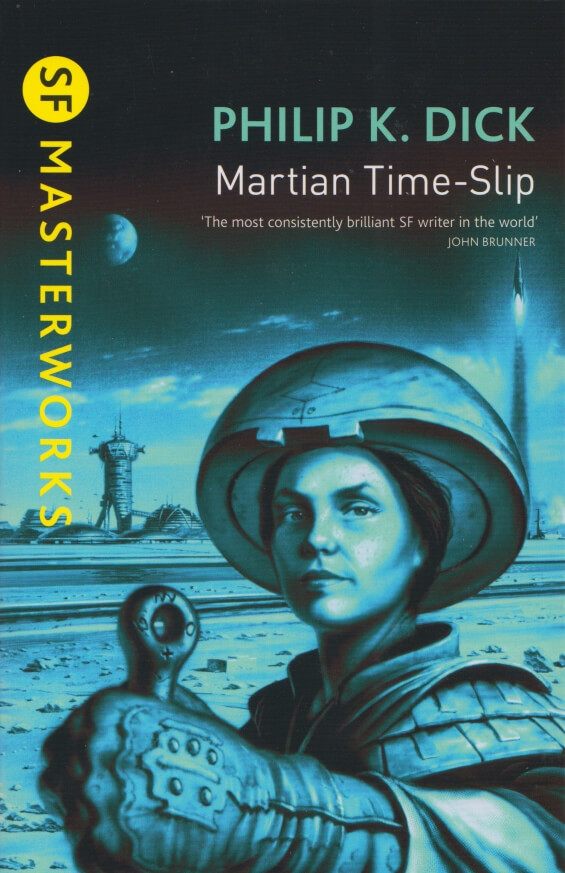
SF MASTERWORKS - Martian Time-Slip by Philip K. Dick

All We Marsmen by Philip K. Dick - illustrated by Virgil Finlay

Posted by Jesse Willis