Review of Chimpanzee by Darin Bradley

SFFaudio Review

ChimpanzeeChimpanzee
Written and narrated by Darin Bradley
Publisher: Resurrection House via Audible
Publication Date: 9 October 2014
[UNABRIDGED] – 5 hours, 46 minutes

Themes: / dystopia / unrest / cognitive theory / virtual reality / revolution /

Publisher summary:

Unemployment has ravaged the U.S. economy. Foreclosures are rampant. People struggle everywhere, exhausted by the collapse that destroyed their lives . . .

Benjamin Cade is an expert in cognition and abstract literature, and before the flatlined economy caught up to him, he earned his living as a university instructor. Now, without income, he joins the millions defaulting on their loans—in his case, the money he borrowed to finance his degrees. But there are consequences.

Using advances in cognitive science and chemical therapy, Ben’s debtors can reclaim their property—his education. The government calls the process “Repossession Therapy,” and it is administered by the Homeland Renewal Project, the desperate program designed to salvage what remains of the ravaged U.S. economy. The data Ben’s repossession will yield is invaluable to those improving the “indexing” technology—a remarkable medical advance that has enabled the effective cure of all mental disorders. By disassembling his mind, doctors will gain the expertise to assist untold millions.

But Ben has no intention of losing his mind without a fight, so he begins teaching in the central park, distributing his knowledge before it’s gone in a race against ignorance. And somewhere in Ben’s confusing takedown, Chimpanzee arrives. Its iconography appears spray-painted and wheat-pasted around town. Young people in rubber chimpanzee masks start massive protests. A new use of the indexing technology shows up in bars across the country. It’s called “chimping” . . . named after the mysterious protest movement, and it uses goggles and electrodes to reverse the curative indexing process, temporarily (recreationally) offering those inclined a mental illness of their own choosing.

As Ben slowly loses himself, the Chimpanzee movement seems to grow. And all fingers point to Ben . . . or maybe the voice that speaks to him every time he uses the chimping rig. As civil unrest grows, and Homeland Security takes an interest, Ben finds himself at the center of a storm that may not even be real. What is Chimpanzee? Who created it? What does it want?

And is there even enough of Ben left to find out?

What I prefer in my dystopia is realism and possibility, that it could happen here, in my lifetime. I read dystopia for the horror, for the thrill. That is the brilliance Darin Bradley brings to his novels, both in Noise and in Chimpanzee. It helps that Chimpanzee takes place in a town an hour from where I live, a place I visit often, particularly the arts district, where quite a bit of the action takes place. The events are very vivid to me, described in that place. They will be vivid to others for different reasons, but basically anyone watching the news in the last few years will feel they know the world of this novel.

The premise of Chimpanzee (see description above) may be even more chilling to those of us working in academia, who have seen the impact of the various economic downturns on expensive liberal arts educations. Now that there are no job guarantees, and no guarantee on the investment made (often by the students through hefty loans), people are starting to question the benefit of the system we have maintained for so long. I hate this conversation, because I work at one of those schools, and depend on it for my livelihood. So did the author, for a while. And that’s where reality and the terror of this possible future start to blur within the novel.

There is a lot in this novel that might feel over the reader’s head.  I would encourage people who don’t understand every word from the rhetoric of cognitive theory to press on –  treat it like a classic science fiction info dump.  Let it wash over you, grasp what you can. You will be in the same place as the students in the story, who also are put into a position of creating their own meaning, applied to their real situations.

There is a concept of virtual reality in this novel that I liked, called chimping, something you can do at a bar with your friends.  It becomes an important part of the story in ways I will not give away here.

The audiobook has a story to its making. In the insert, it talks about the initial difficulty Resurrection House had in distributing the audio version.  It includes a warning:

“Because some books aren’t meant for sedans on highways. They may have too many voices, or they may have jagged corners that snag plots, or they may have things with no business being in stories… like symbols or formulae or languages we don’t understand. You can listen to them, if you’re ready to pay attention.”

I did not heed the warning and listened to some of this audio production while driving around. The first time I encountered a repossessed memory, the sound used to represent the hole, the deletion, it almost sent me off the road.  When I played it at home, my husband jumped out of his skin. It would be remiss not to warn you.

Otherwise, the audio moves back and forth between a radio-play style performance from multiple readers with sound effects and music, and the author’s own narration.  I liked the music choices and the sound effects were generally effective.  Having sound effects in some parts magnifies the silence of the others. Benjamin Cade spends a lot of time inside his head, and losing what is in his head, so I think that silence is well warranted.  It takes some getting used to, but I ended up appreciating it.  The author also does a good job delivering his narration in a noirish tone, where short sentences shine.

Posted by Jenny Colvin

The SFFaudio Podcast #293 – AUDIOBOOK/READALONG: Carmilla by J. Sheridan Le Fanu

Podcast

J. Sheridan Le Fanu's CARMILLA
The SFFaudio PodcastThe SFFaudio Podcast #293 – Carmilla by J. Sheridan Le Fanu; read by Elizabeth Klett (for LibriVox). This is an unabridged reading of the novelette (3 hours 7 minutes) followed by a discussion of it. Participants in the discussion include Jesse, Mr Jim Moon, and Elizabeth Klett.

Talked about on today’s show:
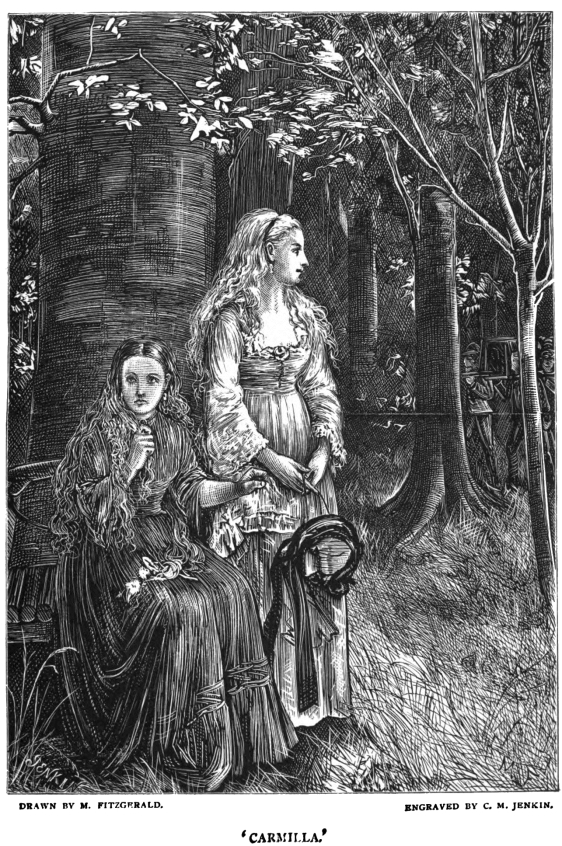
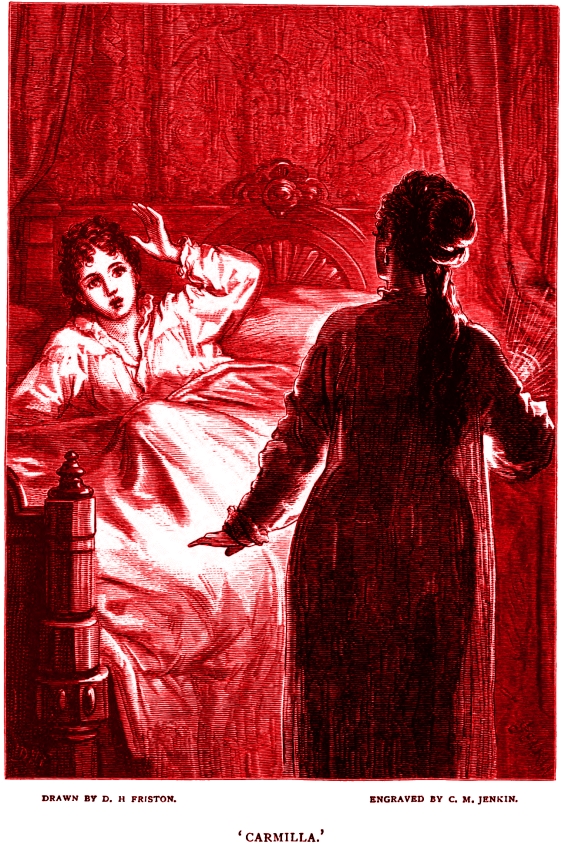
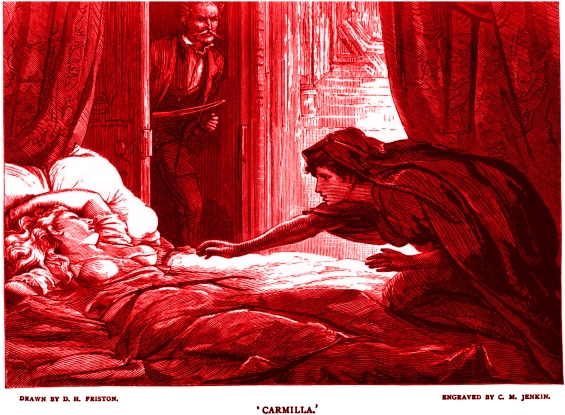
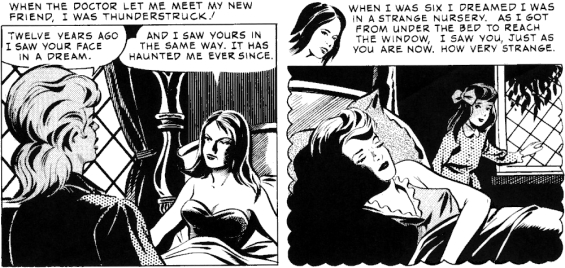
1871, 1872, Elizabeth’s first solo for LibriVox, a per-adolescent kid, Dracula, a novella and not a novel, Dracula is obsessed with its own structure, dictaphone, the manner of the telling, The Dark Blue magazine, the framing device, the Dr. Martin Hesselius framing device, wee have the papers to prove it, not with that ending, so chilling, eight years after the major events, three hundred, Duke Charles, CBS Radio Mystery Theater adaptation, the setting, the nearest inhabited village is twenty leagues away, the ruins of Karnstein, white lilies, swans, perch, in the moat, the story within the story, Spielsdorf’s letter, Millarca and her “mother”, fete, a masked ball, a vampire scam, a glamour on the father, pulling Laura’s father aside, is she glamouring him?, so lonely, giving in to her whim, why don’t the vampires not immediately suck some folk dry?, preying on the village girls, Varney The Vampire, the name as an anagram, the blue mark, the lonely vampire, “you’re going to die into me”, “I live into your warm life and you’ll die sweetly into mine”, Laura has been stalked since she was six, enchanted by the pretty lady, needles, “just a blue spot”, the father and the doctor are shielding Laura, shielding Mina from the truth ends up hurting her, the female characters in both stories are more capable than the male characters give them credit for, religion, the crucifix doesn’t figure into Carmilla, the complicated layering of imagery, Carmilla’s escape from the castle, enclosure, Carmilla can transcend enclosures, transcendent confinement, an extra-transmissive female, the Mountebank peddlar, the little dog, amulets for protection against the oumpire, a very sharp tooth like a fish, a transaction through a window, a liminal space, invading the domestic space, well educated in trickery and juggling, the mountebank half-recognizes Carmillas as a vampire, a clever recipe, Harker’s shaving mirror, Markheim by Robert Louis Stevenson, Carmilla thinks of herself as a product of nature, “all things proceed from nature”, girls as caterpillars while they live in the world, relying on God to take care of us is naive, a post Darwinian perspective, Dracula’s Guest by Bram Stoker, Horror Europa with Mark Gatiss, Nosferatu was nearly destroyed by copyright claims, the invasion of the home, Eric Rabkin, vampires are for aristocrats whereas werewolves are for peasants, The Odyssey as a series of stories about the host-guest relationship, Carmilla’s only virtue is that she’s pretty, Bertha, the striking image of Carmilla crawling onto Bertha’s bed, a phallic sword, there’s no hiding the fact that this is all sex sex sex, The Vampire Lovers, Hammer Horror with nudity, the British Board of Film Censors, “this is literature”, The Killing Of Sister George, Richard LeStrange from Cork, adaptations of Carmilla, the servants, a quick snack on the peasants, bathing in seven inches of blood, Elizabeth Bartolde, floating of coffins in blood, entirely shielded from ghost stories and fairy tales, languorous and dream-like, languorous and languid, a code word for sensual, sated, façade, interest in beauty, metamorphosis, your chrysalis is your coffin, how vampires leave their graves, revenants, Karnstein = fleshstone, out of folklore and into proto-science fiction, turning Laura into a vampire, one of the great questions in Carmilla – who is her mother? who is the man in black, the cuckoo nest scenario, who are these people?, the “broken” carriage charade, the cuckoo in the nest, pushing the other chicks out of the nest, a wonderful horrible story, Laura Palmer in Twin Peaks, a lot of Laura victims, lesbianism and incest, corruption beneath the veil of respectability, why the mother is missing, the doom to come, Morella by Edgar Allan Poe, Ligeia, Berenice, all up in the creepy, all possessing consumption, waiting for the fruit to be ripe, Blood And Roses, the petals of the rose, is it like a venereal disease?, M.R. James, the lens of distance,

“Magia Posthuma,” “Phlegon de Mirabilibus,” “Augustinus de cura pro Mortuis,” “Philosophicae et Christianae Cogitationes de Vampiris,” by John Christofer Herenberg; and a thousand others

the rules for vampires, Count Alucard, the writing itself, vic-fic, the clarity and economy of Le Fanu’s prose, clear but evocative, he doesn’t over-egg the pudding.

Aricel Comics - Carmilla, issue 1

Carmilla by J. Sheridan Le Fanu

Carmilla by J. Sheridan Le Fanu

Carmilla by J. Sheridan Le Fanu

Carmilla adaptation from Creepy Magazine 19

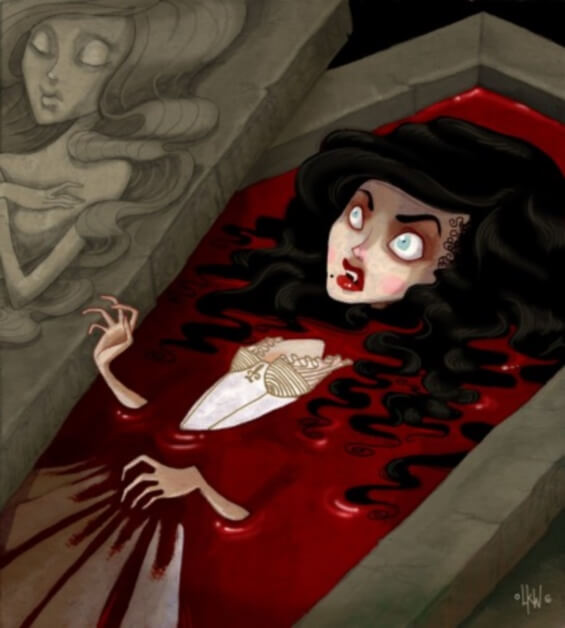
Carmilla - illustration by Lisa K. Weber

Posted by Jesse Willis

Review of Fool’s Fate by Robin Hobb

SFFaudio Review

Fools FateFool’s Fate (Tawny Man Trilogy #3)
By Robin Hobb; Performed by James Langton
Publisher: Brilliance Audio
[UNABRIDGED] – 35 hours
Themes:  / fantasy / Farseer / assassin / dragon /
Publisher summary:

FitzChivalry Farseer has become firmly ensconced in the queen’s court. Along with his mentor, Chade, and the simpleminded yet strongly Skilled Thick, Fitz strives to aid Prince Dutiful on a quest that could secure peace with the Outislands—and win Dutiful the hand of the Narcheska Elliania.The Narcheska has set the prince an unfathomable task: to behead a dragon trapped in ice on the isle of Aslevjal. Yet not all the clans of the Outislands support their effort. Are there darker forces at work behind Elliana’s demand? Knowing that the Fool has foretold he will die on the island of ice, Fitz plots to leave his dearest friend behind. But fate cannot so easily be defied.

Disclaimer: This is a review of the third book in a trilogy and the review will likely include spoilers from preceding books. I’d strongly recommend starting with the first book in the trilogy (Fool’s Errand) or better yet, Assassin’s Apprentice since the Farseer trilogy is very good and all these books are related.

Fool’s Fate is the last book of the Tawny Man trilogy. The story picks up immediately where Golden Fool left off as the Farseers are preparing to travel to the island Aslevjal to kill the dragon Icefire. The Fool has also told FitzChivalry that they must save Icefire to put the world on a better path. Which will Fitz decide: his oath of loyalty and allegiance to the Farseer throne or his role as the Catalyst of the White Prophet? I’ve really enjoyed all of the books in this trilogy leading but this book stands out as something special.

The whole premise of the book is based on a challenge Prince Dutiful was goaded into and that the adults don’t particularly want to do. It’s pretty obvious that something else is at play with the Outislanders in making this challenge and the result is a fantastic conclusion to the Farseer and Tawny Man trilogies. As already stated, FitzChivalry’s struggle with his role as the Catalyst while also serving his realm have you wondering what will happen all the way up to the climax.

As I listened to this story, I really felt like a full story was being told in which I couldn’t see the seams. I normally can’t help my mind picking a story apart into its elements to determine what’s going to be important later in the story but things weren’t so obvious here. There are so many things going on that it just feels like an active world as opposed to having just a few conveniently introduced devices to be used later (for instance, you know when Harry Potter learns a new spell that it will almost certainly be the sole thing that gets him out of trouble later. Expecto Patronum!). What will be important here? New understandings of the Wit from Webb? The newly forming Skill coterie? Chade’s blasting powder? Something old Elderling tools? Hobb does a great job working everything together into a good ride.

If there is one weakness in this book, it’s that it wraps things up too well. When I say too well, I mean that the falling action and conclusion of the book feel like the resolution to both the Farseer and Tawny Man trilogy as so much of what happens even concludes questions you may not even realize you had. The falling action and conclusion also take up about 1/3 of the book which kind of threw me. I was avidly consuming the story through the climax but then felt like things dragged out a bit afterward. Don’t get me wrong – I loved all of it, I just thought it was worth mentioning.

As with the previous installments of this trilogy, James Langton does a fantastic job with his narration of this book. There were times I forgot I was even listening to an audio book because I was just so into it. If I had one gripe it would be that some voices sound quite similar but those that do rarely have scenes together (Hap, Dutiful, Swift). I would definitely look for Langton reading other books.

Posted by Tom Schreck

Review of Tales of Terror

SFFaudio Review

Tales of TerrorTales of Terror Collection
A Night in Whitechapel, Was It a Dream?, Caterpillars, John Mortonson’s Funeral
By: Ambrose Bierce, Guy de Maupassant, E.F. Benson; Performed by Victor Garber
Publisher: Brilliance Audio
[UNABRIDGED] – 1 disc, 1 hour!
Themes: / short stories / horror / classic / supernatural /
Publisher summary:

‘Night in Whitechapel’ French short-story master Guy de Maupassant offers this chilling look into one of the world’s best known cities. When two young men make a trek to London on a cold December evening, they expect to take in the city and maybe a pub or two along the way. But a chance encounter with a mysterious woman soon has them questioning not only the proceedings of their evening but their sanity as well. ‘Was It a Dream?’ Guy de Maupassant once again delivers a spine-tingling narrative. A young man recounts the tragic death of his love, claimed by an unknown illness. In his grief, he wanders the cemetery where she is buried to find a dark secret that she, and many other corpses, share. ‘Caterpillars’ Stories of the supernatural from E.F. Benson have been terrifying audiences for decades—even making the transition to television adaptation. In “Caterpillars,” a man recalls his terrifying stay at a haunted Italian villa. You will never look at caterpillars in the same way. ‘John Mortonson’s Funeral’ Perhaps best known for The Devil’s Dictionary, Ambrose Bierce is a mainstay of nineteenth-century American literature. In “John Mortonson’s Funeral,” Bierce adds horror to his satirical lens. The mourners at this funeral will be forever changed.

“Night in Whitechapel” – Guy de Maupassant
When two young men make a trek to London on a cold December evening, they expect to take in the city and maybe a pub or two along the way. But a chance encounter with a mysterious woman soon has them questioning not only the proceedings of their evening but their sanity as well.

“Was It a Dream?” – Guy de Maupassant
A young man recounts the tragic death of his love, claimed by an unknown illness. In his grief, he wanders the cemetery where she is buried to find a dark secret that she, and many other corpses, share.

“Caterpillars” – E.F. Benson
A man recalls his terrifying stay at a haunted Italian villa. You will never look at caterpillars in the same way.

“John Mortonson’s Funeral” – Ambrose Bierce
The mourners at this funeral will be forever changed.This collection is well named. All of these tales have a certain creepiness factor that will leave your skin crawling if you think about them too much. They also have the virtue of not being the usual “classic” horror tales included in most anthologies, although they are by authors acknowledged as master storytellers.

What enhances the subtlety and creeping horror is Victor Garber’s soft spoken narration. As any good actor would, he reads each tale differently to reflect its own character, but never with obvious technique that draws the listener away from the story itself. My favorite was “Was It a Dream?” in which the protagonist’s lovelorn state gradually gives way to shuddering fear in the graveyard. The transition was so seamless that I couldn’t tell you when it happened and by the end of the tale I myself was horror stricken.

The collection is short, clocking in at slightly more than an hour, but it is choice. Definitely recommended.

Posted by Julie D.

Sigma2Foxtrot – a German language SFF audio podcast

SFFaudio Online Audio

Sigma2FoxtrotSigma2Foxtrot is a new SFF audio podcast by the guys behind the Arkham Insiders podcast. Inspired by, and partially modeled on, The SFFaudio Podcast. We heartily recommend it to all German speakers and listeners interested in “Science Fiction, Fantasy, Horror and Hard-boiled crime!”

Here’s the podcast feed:

http://feeds.feedburner.com/Sigma2foxtrot

Posted by Jesse Willis

Review of Heraclix and Pomp by Forrest Aguirre

SFFaudio Review

Hereclix and PompHeraclix and Pomp: A Novel of the Fabricated and the Fey
By Forrest Aguirre; Narrated by Brandon Massey
Publisher: Audible Studios via Resurrection House
Publication Date: 14 October 2014
[UNABRIDGED] – 11 hours, 7 minutes

Themes: / reanimation / golem / necromancer / fantasy /

Publisher summary:

Heraclix was dead and Pomp was immortal. That was before Heraclix’s reanimation (along with the sewn-together pieces and parts of many other dead people) and Pomp’s near murder at the hands of an evil necromancer. As they travel from Vienna to Prague to Istanbul and back again (with a side-trip to Hell), they struggle to understand who and what they are: Heraclix seeks to know the life he had before his death and rebirth, and Pomp wrestles with the language and meaning of mortality. As they journey across a land rife with revolution and unrest, they discover that the evil necromancer they thought dead might not be so dead after all. In fact, he might be making a pact to ensure his own immortality….

Heraclix and Pomp: A Novel of the Fabricated and the Fey is a story about mortality, at the end of the day. It has horror and fantasy trappings, but at its core, it deals with finding oneself and dealing with mortal matters. The story is told through the guise of Heraclix, a golem, pieced together from many beings, and Pomp, a fairy faced with mortality. I think this book is probably a 2.5-star book…on the one hand, I liked the characters and the world and the idea. But on the other, I was bored a lot of the time when listening, and the book felt repetitive.

The book seems to do a lot of moral speaking, all from the frame of Heraclix or Pomp. Brought together when a sorcerer’s attempt at a spell goes haywire, Heraclix suffers a re-birth of sorts, while Pomp is nearly killed in the doing of the magic. Bound by their shared experience, they set off to first escape the sorcerer and then to learn more about Heraclix’s past. As he travels Europe and The Middle East, Heraclix learns whose parts literally make up his whole–he is a golem of patched together parts from people, most of whom he learns about in his travels. Pomp, meanwhile, is from the land of the Fey, used to being a prankster and not having to worry about a thing. However, the sorcerer almost killed her, brining her face to face with her on mortality, so she learns more of what it is to be human (or at least, human-like) while helping Heraclix learn about himself.

I enjoyed the world that Aguirre developed, and I enjoyed the characters. The book takes place in the time shortly after The Crusades, in parts of the world I don’t often see come up in books. Heraclix and Pomp run into vagabonds, sorcerers, gypsies, kings, nomads, and a host of other characters as they search between Vienna and Instanbul–and a variety of places in between, including a trip to Hell. The telling of the various stories of the lives that Heraclix was a part of was charming and not like most things I’ve read.

But…somehow, it wasn’t enough. I repeatedly found my mind wandering during the narration, found myself having to go back to the beginnings of chapters to see what I’d missed. The book seemed to work very well one chapter at a time…at first, but even then, I was finding other things to read. Some of the language used seemed purposefully obscure, and a lot of the scenes felt like repeats–Heraclix and Pomp enter a setting, they find some part of Heraclix’s past, they are chased out into another setting, rinse, repeat. I think if the book had been shorter, it might have helped. It’s not that it was bad (it certainly wasn’t), but I think more might have been left on the editor’s desk.

The narration, performed by Brandon Massey, was decent. His voice is strong, good for an audiobook, if a little droning at times. The biggest “problem” with the narration might be more due to the story itself. It was sometimes hard to keep track of characters, of who was who. This was especially problematic when characters from the early parts of the book would be re-introduced at the end of the book. Audiobooks are much harder to flip back through to refresh your memory, after all. Massey’s voice sounded familiar to me, though looking through my library, he hasn’t narrated anything else that I’ve read. His voice would be good in a mystery or other novel when there are only a few characters.

All in all, I liked this book, but wished that it had been a little less obscure and a little less repetitive. That doesn’t mean, though, that you shouldn’t give it a try if it sounds interesting. But maybe try it out in a print format.

Posted by terpkristin.