The Last Of The Masters by Philip K. Dick is PUBLIC DOMAIN

SFFaudio News

The Last Of The Masters by Philip K. Dick is PUBLIC DOMAIN.

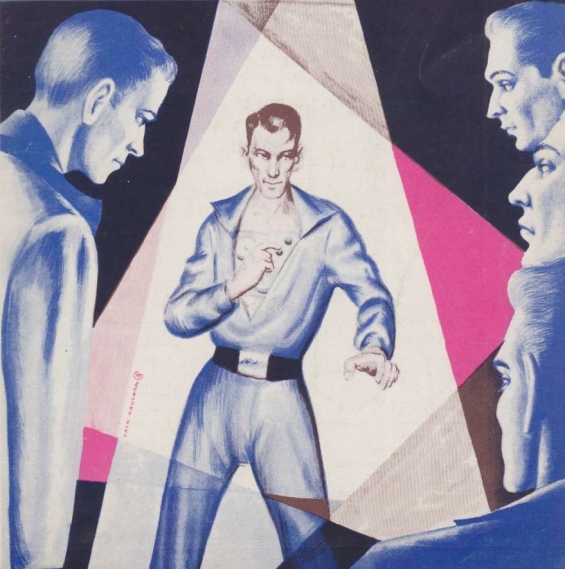
Orbit Science Fiction No. 5 - Includes The Last Of The Masters by Philip K. Dick

Here is the relevant passage from the Wikipedia entry:

After the author’s death, a nonexistent story with the same title was included under the new renewal registration number RE0000190631. This created the appearance that “The Last Of The Masters” was still under copyright protection.

I have a scan of that false renewal. It is HERE.

The Last Of The Masters was not published in Imaginative Tales, November 1955 (see for yourself HERE).

The Last Of The Masters was first published in Orbit Science Fiction No. 5. And that issue of that magazine was published and copyrighted in 1954:

ORBIT Science Fiction No. 5 - Table of contents (includes The Last Of The Masters by Philip K. Dick)

As the copyright for The Last Of The Masters was not properly renewed in its 28th year The Last Of The Masters by Philip K. Dick is PUBLIC DOMAIN.

Here is a |PDF| of The Last Of The Masters.

Posted by Jesse Willis

Review of Boy by Roald Dahl

SFFaudio Review

BoyBoy: Tales of Childhood
By Roald Dahl; Read by Dan Stevens
Penguin Audio
[UNABRIDGED] – 3 hours, 11 minutes

Publisher summary:

Where did Roald Dahl get all of his wonderful ideas for stories?

From his own life, of course! As full of excitement and the unexpected as his world-famous, best-selling books, Roald Dahl’s tales of his own childhood are completely fascinating and fiendishly funny. Did you know that Roald Dahl nearly lost his nose in a car accident? Or that he was once a chocolate candy tester for Cadbury’s? Have you heard about his involvement in the Great Mouse Plot of 1924? If not, you don’t yet know all there is to know about Roald Dahl. Sure to captivate and delight you, the boyhood antics of this master storyteller are not to be missed!

At the start of his book, Roald Dahl says, “An autobiography is a book a person writes about his own life, and it usually filled with all sorts of boring details. This is not an autobiography.”

Rather than a straight autobiography, it’s a short collection of some of his most powerful memories of childhood – the good, the scary, the hilarious and mischievous — all revealed with his amazing ability to paint a scene with the most evocative details and to find humor in even the worst situations.

Roald Dahl knows just the right details to capture your imagination and take you back to that feeling of being a kid, when the world is magical and mysterious and kinda gross, and Dan Stevens does a great job of narrating these tales with an engaging, slightly amused tone. Even readers who don’t know Roald Dahl’s books (they do exist: I know one!) would probably enjoy this book just for the trip back to a child’s perspective.

For fans, though, the collection is even more special, because it’s like taking a tour through Roald Dahl’s mind. Although Dahl rarely mentions it, if you know his work you’ll see the inspirations for his later stories and characters all through these anecdotes.

The most obvious one is in his near-religious awe of the candy shop. It promises so much and is so filled with delights, but the woman who works there is frightening and Roald Dahl in his friends come up with all kinds of conspiracy theories about the seeming-magic of some of the candy: for example, they are convinced the licorice shoelaces are made of rat’s blood, and the ‘tonsil ticklers’ candies are saturated with anesthetic to subdue children.

Then there is Mr. Cadbury, who regularly sent Roald Dahl’s family boxes of unidentified new flavors chocolates to taste-test. It’s not hard to see the seeds for Charlie and the Chocolate Factory when you hear Roald Dahl’s childhood revelation that, somewhere, there are people working away in inventing rooms to come up with new and amazing flavors of chocolate.

Along with all the more colorful and whimsical stuff are the darker stories of his boyhood, like having doctors turn up with their surgical bags and chloroform to operate right there in the living room, and many awful dealings with bullies of all sizes – but even the most horrid character becomes someone to delight in because of Roald Dahl’s cheerful wit and playful descriptive detail. You’re right there with him when the sheer force of the “foul and beastly” matron’s voice causes that “massive bosom of hers to quiver like a blancmange.”

Posted by Marissa van Uden

Review of The Poison Belt by Arthur Conan Doyle

SFFaudio Review

The Poison BeltThe Poison Belt
By Arthur Conan Doyle; Read by Gildart Jackson
Publisher: Dreamscape Audiobooks
[UNABRIDGED] – 3 hours, 24 minutes

Themes: / apocalypse / poison / science fiction /

Publisher summary:

What would you do if you had discovered that the planet was about to be engulfed in a belt of poisonous “ether” from outer space? Professor Challenger invites a hand-picked crew of adventurers and scientists to his home outside London, which has been fortified with several hours’ worth of oxygen. Challenger & Co. assemble in front of a picture window to witness the end of all life on the planet. As birds plummet from the sky, trains crash, and men and women topple over before their horrified gaze, they debate everything from the possibilities of the universe to the “abysses that lie upon either side of our material existence.”

I like Sherlock Holmes but I am much fonder of Arthur Conan Doyle’s other fiction. He was a skilled teller of “weird tales” and I have heard he was proudest of his historical fiction which I really enjoy. The Poison Belt is the second in a series of fantasy and science fiction novels featuring the brilliant and overpowering Professor Challenger.  It functions very well as a stand alone novel.

Having assembled a newsman, big game huntsman, and another scientist to explore South America in their first adventure, The Lost World, it is only logical that Challenger would call upon the same group for this scientific emergency. Professor Challenger puzzles them when he asks each to bring along a cylinder of oxygen. They are well acquainted with Challenger’s eccentricities but little do they suspect that he anticipates an apocalyptic event.

I’d say more but I think reading the whole description would have ruined my astonishment and interest in the story as it unfolded in this superb audiobook. In fact, having grabbed this review book solely based on my enjoyment of The Lost World, I hadn’t read the description at all. I was stunned to find this was such an apocalyptic novel. It is really well written and thought through. I was frequently surprised as various events occurred because I simply hadn’t thought through the consequences of an apocalypse in 1913 England.

Part of the enjoyment of The Poison Belt comes from the adventurers’ interactions. Doyle is very good at inserting humor, often through the two scientists’ bickering over conclusions, and at other times in hunter Lord John’s casual comments as in this instance when Challenger has asked the group to look at an amoeba through a microscope.

Lord John was prepared to take him on trust.

“I’m not troublin’ my head whether he’s alive or dead,” said he. “We don’t so much as know each other by sight, so why should I take it to heart? I don’t suppose he’s worryin’ himself over the state of OUR health.”

I laughed at this, and Challenger looked in my direction with his coldest and most supercilious stare. It was a most petrifying experience.

“The flippancy of the half-educated is more obstructive to science than the obtuseness of the ignorant,” said he. “If Lord John Roxton would condescend—-”

“My dear George, don’t be so peppery,” said his wife, with her hand on the black mane that drooped over the microscope. “What can it matter whether the amoeba is alive or not?”

“It matters a great deal,” said Challenger gruffly.

“Well, let’s hear about it,” said Lord John with a good-humoured smile. “We may as well talk about that as anything else. If you think I’ve been too off-hand with the thing, or hurt its feelin’s in any way, I’ll apologize.”

Part of the humor comes across thanks to the excellent narration by actor Gildart Jackson. As is often the case with actors, his reading is rife with expressive accents, subtle nuances, and changes of pace. This isn’t a very long book and goes along at a rattling pace. I was hooked from the beginning.

I don’t know when I’ve enjoyed an audiobook more and I hope that Dreamscape is considering more of Arthur Conan Doyle’s fiction for the future.

Posted by Julie D.

The Seismograph Adventure by Arthur B. Reeve

Aural Noir: Online Audio

The Seismograph Adventure - illustrated by Winter

Professor Craig Kennedy, a scientific detective similar to Sherlock Holmes, uses his knowledge of chemistry, psychoanalysis, and the scientific method to solve mysteries. In this adventure he foresees “potentialities and possibilities unrecognized by ordinary minds, and with his profound knowledge of applied sciences, is able to approach the enormous tasks confronting him from a new and scientific angle.”

And according to Hugo Gernsback The Seismograph Adventure is “one of the finest, as well as scientific, of Arthur B. Reeve’s stories.”

LibriVoxThe Seismograph Adventure
By Arthur B. Reeve; Read by Elliott Miller
1 |MP3| – Approx. 50 Minutes [UNABRIDGED]
Publisher: LibriVox.org
Published: 2010
“Can ghosts walk? And if they do, can their footsteps be recorded on a machine? And are the spirits of the phantom world subject to the same physical phenomena as our human bodies? These are tantalizing questions which arise during the thrilling and complex mystery into which Craig Kennedy and Jameson are plunged without warning.” First published in Cosmopolitan, April 1911.

And here’s a 10 page |PDF| made from its republication in Scientific Detective Monthly, March 1930.

Posted by Jesse Willis

The Dead Valley by Ralph Adams Cram

SFFaudio Online Audio

“In The Dead Valley the eminent architect and mediævalist Ralph Adams Cram achieves a memorably potent degree of vague regional horror through subtleties of atmosphere and description.”

-H.P. Lovecraft, Supernatural Horror In Literature

The story is chilling, and as performed with passion by my friend John Feaster, you’ll feel the eerie events surrounding The Dead Valley all the more.

The Dead Valley by Ralph Adams Cram

LibriVoxThe Dead Valley
By Ralph Adams Cram; Read by John Feaster
1 |MP3| – Approx. 21 Minutes [UNABRIDGED]
Publisher: LibriVox.org
Published: 2010
Two boys walk overland through the Swedish mountains at night. There they encounter something inexplicably evil. First published in 1895.

And here’s an 18 page |PDF| version.

NECRONOMICON PRESS - The Dead Valley

Posted by Jesse Willis

The SFFaudio Podcast #243 – READALONG: Herland by Charlotte Perkins Gilman

Podcast

The SFFaudio PodcastThe SFFaudio Podcast #243 – Jesse, Jenny, Bryan Alexander, Terpkristin, and Maissa Bessada discuss the 1915 novel Herland by Charlotte Perkins Gilman.

Talked about on today’s show: [Note: references to the novel are in bold, while references to the eponymous country are not.] “Lost utopian novel”; first appeared in book form in 1979 as part of an effort to rediscover works by female authors; was it suppressed by patriarchy?; the novel launches with action; features Heinlein-esque; the story feels very alien despite transpiring on Earth, takes place in an unnamed jungle region presumed to be either South America or Africa; Herland grouped as part of a trilogy along with an unrelated novel Moving the Mountain and the direct sequel With Her in Ourland; the book originally appeared in serialized form in Charlotte Perkins Gilman’s own magazine; grounded in “utopian” and “lost race” tradition of the period which pick apart aspects of society; Heinlein’s and Gilman’s sexism compared and contrasted; “virgin impregnation” compared with conception of Christ; foundation of Herland as a Roman-style slave revolt; “what a world of slaves it was” Goslings quote echoed in Herland; utopian ecology (plants, animals); Jesse calls it “Mother Knows Best totalitarianism”; “intentional Darwinism”; eugenics foreshadowing World War II; Bryan brings up The King in Yellow again; protagonists give threefold approach to women; punishment in Herland more akin to child-rearing foregoing execution; Leviticus does advocate execution; both the male protagonists and the Herland women are archetypical; The Yellow Wallpaper; utopia or dystopia; unreliable narrator and narrative; Jesse argues that there’s “no drama in a perfect society” and the book has a terrible plot; eighteenth-century feminist utopia Millennium Hall; Jenny says the sequel’s plot is even worse; immortality and living in Heaven; no dogs in Herland, only cats; subservience of aesthetics to productivity; “their country was as neat as a Dutch kitchen”; childhood Jesse conflated cats and dogs; cats and dogs emblematic of gender relations in Herland; Herland is a baby-proof world; more about narrator bias in the novel; Gilman projecting her own views on mental disorder into the book; 1984 parallels; The Mysterious Doctor Fu Manchu; comparison to Goslings; why does Herland want to integrate men?; sexual dynamics in marriage; Castle Waiting by Linda Medley, a medieval utopia about bearded women; Y: The Last Man series by Brian K. Vaughan; female politicians behaving like men e.g. Margaret Thatcher; Barbara W. Tuchman and the “fallen tower” of World War I era society; utopian societies lack practical advice for the here-and-now; Origin of Species debated as source of eugenics; education in Finland; education as driving force in Herland; “only our best become teachers”; Montesori; No Child Left Behind; the perils of individualism in a utopia; “fashion and women go together” says Jesse; Jenny shares insights on potential contributions from women in the sequel; a debate on why Herland never took off; patriotism and its linguistic roots; more on the novel’s World War I context; Willa Cather’s WWI novel One of Ours; “trilogy” of novels packaged as e-book.

The ForeRunner by Charlotte Perkins Gilman

Posted by Jesse Willis