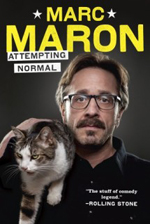
Review of Attempting Normal by Marc Maron

SFFaudio Review

Attempting NormalAttempting Normal
By Marc Maron; Read by Marc Maron
Publisher: Random House Audio
5 hours, 34 minutes [UNABRIDGED]

Themes: / memoir / comedy / humanity /

Publisher summary:

People make a mess.
 
Marc Maron was a parent-scarred, angst-filled, drug-dabbling, love-starved comedian who dreamed of a simple life: a wife, a home, a sitcom to call his own. But instead he woke up one day to find himself fired from his radio job, surrounded by feral cats, and emotionally and financially annihilated by a divorce from a woman he thought he loved. He tried to heal his broken heart through whatever means he could find—minor-league hoarding, Viagra addiction, accidental racial profiling, cat fancying, flying airplanes with his mind—but nothing seemed to work. It was only when he was stripped down to nothing that he found his way back.
 
Attempting Normal is Marc Maron’s journey through the wilderness of his own mind, a collection of explosively, painfully, addictively funny stories that add up to a moving tale of hope and hopelessness, of failing, flailing, and finding a way. From standup to television to his outrageously popular podcast, WTF with Marc Maron, Marc has always been a genuine original, a disarmingly honest, intensely smart, brutally open comic who finds wisdom in the strangest places. This is his story of the winding, potholed road from madness and obsession and failure to something like normal, the thrillingly comic journey of a sympathetic f***up who’s trying really hard to do better without making a bigger mess. Most of us will relate.

It seems like most people spend all their time cultivating various masks to hide behind, but Marc Maron has made a business out of taking his off, and getting professionals in artistic fields from comedy to film and music to do the same. His trick is to reveal his own flaws and past mistakes and make people feel OK about being human so they can relax and open up too. This is why his WTF podcast is so popular, and why he has such a loyal fan-base, and why his interviews are some of the most interesting out there.

In Attempting Normal, he says that one of the beliefs that shaped his life is that “People want to share but they usually don’t” – because they are afraid they will be judged, or seem weak, or out of fear that others won’t have the capacity to carry the burden of what they have to say. In his book, Maron says, “But all that stuff is what makes us human; more than that, it’s what makes being human interesting and funny. … We’re built to deal with shit. We’re built to deal with death, disease, failure, struggle, heartbreak, problems. … The way we each handle being human is where all the good stories, jokes, art, wisdom, revelations and bullshit come from.”

His book is a collection of autobiographical stories about how he has personally handled being a fallible human. He talks about his mistakes, drug problems, neurotic episodes and failed marriages, and he describes odd encounters with creatures such as hookers, stray cats, comedy road pirates, and Conan O’ Brian. What links all his stories together is that universal story plot: humans, who are really weird, get themselves into shit, deal with it, and climb back out. It’s a book about accepting the darkness and pain, struggling through, and keeping hope. It also has some profound wisdoms: “Bedtime is the worst time to start an argument because all the drama unfolds while you are wearing your underwear. Being angry in your underwear is a hard thing to pull off.”

It’s always awesome to hear people telling their own stories, but Maron’s narration is particularly good as he has beautiful timing and an open, free-flowing style thanks to years of working as a stand-up comic. He also has that hard-edged vulnerability that pro-comedians learn to do so well.

One of the things I appreciate about him, and which comes across heavily in this book, is that he loves the art of comedy not just as a form of entertainment but for its role in society: a way for people and for the culture to release tension. He says comedians are “like all artists, masters of the mathematics of relief.”

I also really dig his empathy for the human condition. He’s a dark character, but he has built up this amazing understanding of humanity that he uses to draw people out in interviews and to reflect on his own experiences. I learned from this book where it comes from: he has an insatiable curiosity for information about human psychology and philosophy, and even though he claims his obsessive collecting of books (from Plato and Spinoza to Hunter S.) is mostly pointless, I think it’s what gives him that ability to see the deeper truths in any situation.

“I can’t read anything with any distance. Every book is a self-help book to me. Just having them makes me feel better. I underline profusely, but I don’t retain much. Reading is like a drug. When I’m reading from these books it feels like I’m thinking what is being read, and that gives me a rush. That is enough. I glean what I can. I finish some of the unfinished thoughts lingering around in my head by adding the thoughts of geniuses, and I build from there.” (Mark Maron)

This isn’t a book about a huge celebrity or particular topic – it’s just an honest and humble conversation about how we’re kinda weird, kinda funny, and in the end only human.

Posted by Marissa van Uden

La Chasse-Galerie by Honoré Beaugrand (Read by Mark Turetsky)

SFFaudio Online Audio

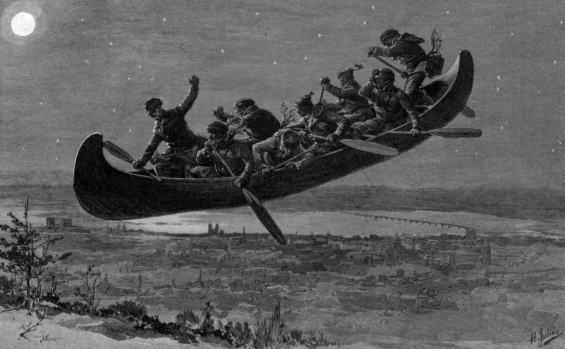
La Chasse-Galerie (aka “The Bewitched Canoe” aka “The Flying Canoe“)

I mentioned this story on a recent podcast, then I tracked down a very early English translation |PDF|, and now narrator Mark Turetsky has recorded it for us all! Thanks Mark!

Honoré Beaugrand’s La Chasse-Galerie is the story of some Quebecois voyageurs, actually Gatineau loggers, who make a pact with the devil in order visit their women. Satan grants them the power to paddle though the sky. But they are warned that if the blashpheme, by touching any church steeples along they way, or if they do not return before six o’clock the next morning, they will lose their souls!

This version of the story was first published in The Century Magazine, August 1892.

La Chasse-Galerie - illustrated by Henri Julien

Posted by Jesse Willis

BBC Learning: Tales From Ancient Greece

SFFaudio Online Audio

BBC Learning -Tales From Ancient GreeceI probably should have told you about this podcast earlier, the thing is, I forgot just how stupid BBC policy can be. So, hurry up and subscribe to this great podcast before what remains of the earlier files drop out of the feed!

Tales from Ancient Greece, a production of BBC Learning, is a dramatized retelling of the Greek mythology. Officially the show is “particularly suitable for children aged 9 to 11,” but I like it quite a bit too. The premise is that Hermes, the winged messenger god, was a witness to practicality every famous Greek myth and in each 15 minute show he’ll take us on one such adventure. Here’s a snippet of the official description:

“[Hermes’] stories are full of laughter and sorrow and unusual people, places and creatures. The series includes such favourites as the story of Persephone, King Midas, the Minotaur and Medusa.”

Unfortunately you’ve already missed Orpheus and Eurydice (episode 2) and Persephone (episode 1)!

The show is weekly and began with Episode 0, beginning on May 1, 2013 (it was just an introductory 9 second podcast announcing that the show would be weekly).

Podcast feed: http://downloads.bbc.co.uk/podcasts/radio/greekmyths/rss.xml

iTunes 1-Click |SUBSCRIBE|

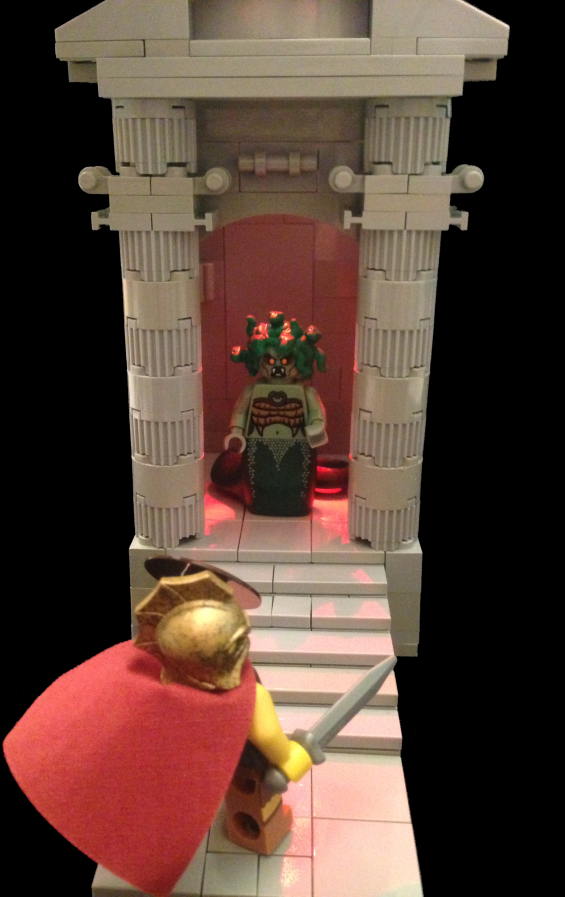
My favourite episode so far was that of Perseus And The Gorgon (episode 4) |MP3|. I’ve even LEGOized it!

Perseus and the Gorgon (Medusa)

Posted by Jesse Willis

The Mark Time and Ogle Award winners for 2013

SFFaudio News

The Mark Time AwardJerry Stearns, the coordinator for the The Mark Time Awards and Ogle Awards, writes in with this list of the winners for 2013 (the presentations will take place on July 4, 213 at CONvergence in Bloomington, MN):

Mark Time Award:

GOLD:
The Truth: The Modern Prometheus
The Truth
Written by Greg Kotis
Producer, Jonathan Mitchell
New York, NY
thetruthapm.com

SILVER:
Titanium Rain, Episode One
Audiocomics
Written by Josh Finney
Pacific Grove, CA
Audiocomicscompany.com

&

Our Fair City, Season 3
HartLife NFP
Clayton Faits, Head Writer
Jeffrey Gardner, Executive Producer
Chicago IL
OurFairCity.com

Ogle Award:

GOLD:
The Will of the Woods
Audio Epics
Written & Produced by Domien De Groot
Deurne, Belgium
audio-epics.com

SILVER:
The Truth: In Good Hands
Written by Louis Kornfeld & Jonathan Mitchell
Producer, Jonathan Mitchell
New York, NY
thetruthapm.com

&

The Truth: That’s Democracy
Written by Louis Kornfeld & The Truth
Producer, Jonathan Mitchell
New York, NY
thetruthapm.com

And, 15 year retrospective of the Mark Time and Ogle Awards at NATF’s HEAR Now Festival in Kansas City on June 21-23, 213.

About the HEAR Now Festival:

HEAR Now: The Audio Fiction and Arts Festival is the audio equivalent of a film festival for contemporary audio storytelling in all its forms: live and scripted solo performances, multi-voiced, classic radio drama, experimental narrative, and much more. This four-day Festival, running June 20th – 23rd, 2013, in Kansas City, MO, will offer programs, showcasing the many forms of audio fiction and sound art storytelling, in theaters and other “listening” venues.

The 2013 HEAR Now Festival will be a gathering place where the work of master storytellers is celebrated and shared, presenting programs that exemplify traditions of craftsmanship, as well as aesthetic and technological innovation.

Audio drama, audiobooks, recorded, and live performances will be heard in local theaters and other venues all conveniently located in the “Country Club Plaza District” of Kansas City. HEAR Now will offer moderated discussions and panels along with a performance workshop culminating in a live showcase performance event.

For more information about CONvergence: www.convergence-con.org
For more about the Mark Time Awards: greatnorthernaudio.com/MarkTime/MarkTime.html

[via Jerry Stearns]

Posted by Jesse Willis

BBC Radio 4: Dangerous Visions

SFFaudio Online Audio

BBC Radio 4Dangerous Visions “A season of dramas that explore contemporary takes on future dystopias” is the title for new BBC Radio 4 programming that airs from Saturday June 15 to Friday June 21, 2013.

Here’s the official description:

Alternative worlds dominate radio drama this week. To complement productions of The Drowned World and Concrete Island (next week) by the master of the near future J.G. Ballard, writers imagine their own dystopias in our season Dangerous Visions. As well as the maternal death syndrome threatening the survival of the human race in The Testament Of Jessie Lamb, dramatised from her own novel by Jane Rogers, the original plays ask what happens if sleep is outlawed? If cloning becomes a matter of course, and your loved ones are indistinguishable from their cloned replicants? If North London declares UDI against the wasteland of South London? If human sacrifice becomes an accepted necessity? If one man becomes immortal? Along with other related programmes on Radio 4, 4 Extra completes the season with a chilling new four-part serialisation of William Golding’s classic fable, Lord of the Flies, exploring the very essence of good and evil.

Here are the programs, and related goodness:

Saturday 15th June:

Dangerous Visions: The Sleeper
Radio 4, 1430: A fable for our times. In The Sleeper by Michael Symmons Roberts we see our own society as it is today but with one familiar element removed. This is a Britain in which, decades ago, human beings gradually lost the gift of sleep. With Maxine Peake and Jason Done.

Archive on 4: Very British Dystopias
Radio 4, 2000: Beneath the calm surface of British politics, lurking in the imaginations of some of our leading writers, terrible things have happened. Professor Steven Fielding examines these dystopian visions which have gripped creative and public imaginations.

Lord of the Flies: Fire on the Mountain (part 1 of 4)
Radio 4 Extra, 2300: William Golding’s classic story about a group of boys plane-wrecked on a deserted island. New dramatisation by Judith Adams, with Ruth Wilson narrating.

Sunday 16th June:

Dangerous Visionaries
Radio 4, 1445: As Radio 4 begins its new season of Dystopic Dramas, Dangerous Visions, the playwright and poet Michael Symmons Roberts wonders how close the gap between imagining and living in dystopia actually is.

Dangerous Visions: The Drowned World
Radio 4, 1500: JG Ballard’s story of a scientific mission surveying drowned cities. This is a future where the earth’s atmosphere, and human consciousness, has eroded. Adapted by Graham White.

Dangerous Visions: Face to Face with JG Ballard
Radio 4 Extra, 1800: The late author of Empire of the Sun and many works of speculative fiction reveals his perspective on the world and the media.

Monday 17th June:

Dangerous Visions: The Testament Of Jessie Lamb
Radio 4, 1045/1945, Monday to Friday: Jane Rogers dramatises her award winning dystopian novel about a teenage girl who decides to save humanity. Starring Holliday Grainger as Jessie Lamb.

Dangerous Visions: Billions
Radio 4, 1415: Blake Ritson and Raquel Cassidy star in Ed Harris’s wicked tale of love and deception, in which Mark comes home to find a replacement wife provided by her insurance company.

Tuesday 18th June:

Dangerous Visions: Invasion
Radio 4, 1415: On his return from Mars, Astronaut Kadian Giametti wakes up in quarantine. Slowly he discovers that the world outside his cell has changed beyond recognition.

Wednesday 19th June:

Dangerous Visions: London Bridge
Radio 4, 1415: In Nick Perry’s dark vision of the future, the River Thames has become a border separating the crime-free police state of North London from the lawless slumland of the South.

Thursday 20th June:

Dangerous Visions: Death Duty
Radio 4, 1415: In Michael Butt’s dark vision of the future, a city-state plagued by drought has instituted a system of sacrifice in a desperate measure to bring about rain. With Nicholas Jones.

[Thanks to David and Roy!]

Posted by Jesse Willis

Review of Deathworld 2 by Harry Harrison

SFFaudio Review

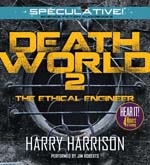
Deathworld2 by Harry HarrisonDeathworld 2: The Ethical Engineer
By Harry Harrison; Performed by Jim Roberts
Publisher: Brilliance Audio4 hours [UNABRIDGED]

Themes: / gambler / psionic abilities / planetary worlds / planetary colonists / slavery /

Publisher summary:

In the first Deathworld, wily interstellar gambler Jason dinAlt managed to survive on Pyrrus, a planet that seemed to be at war with its own people. He also stopped a deadly feud between two groups of those people. In the second volume of this trilogy, Jason finds that keeping the peace is even more difficult than ending the war. He is also becoming increasingly annoyed with the superior attitude of the natives, including his girlfriend, and this leads to his taking a very big chance. He allows himself to be arrested and taken away from the planet to show that he can take care of himself. He soon regrets that decision after crashing on a planet where the people are quite primitive and he is made a slave. Now he just wants to escape and get back to Pyrrus, but finds that it takes all his cunning and physical prowess just to stay alive. Harry Harrison gives us another fast-paced yet surprisingly thought-provoking story in Deathword 2: The Ethical Engineer.

Deathworld 2: The Ethical Engineer is the second in Harry Harrison’s Deathworld trilogy, which follows the interplanetary adventures of professional gambler Jason din’Alt. Although the plot picks up pretty soon after the first book left off, it doesn’t feel like a sequel as much as an interlude from the Pyrran saga. There is very little to link the two books other than the presence of the protagonist who is immediately taken off world away from the characters of the first book. However, the story itself is full of pulp fiction-y goodness and centers on a brand new, slightly less deadly world. A primitive world that seems to have regressed since it’s initial colonization, a majority of the people are slaves to brutal tribal chiefs who lead a never ending search for food in a barren wasteland. The more powerful chiefs, as uneducated and greedy as their people, each own one aspect of the technology that remains from more advanced times. But their refusal to work together has left the world with limited resources and a stagnated intelligence. A possible commentary on the dangers of rigid corporatism, the world structure explores a backward approach to invention that deconstructs advanced ideas into their most rudimentary parts, much to their detriment.

This sort of simplistic, one-dimensional thinking also plays into Jason’s new antagonist Mikah who is a member of some sort of universal police force that imposes a very strict moral code on everyone around them. He sees life in perfectly defined right and wrongs with no room for the moral relativism Jason is so fond of indulging in. Initially arresting Jason because of his gambling, he spends most of the book in mortal danger due to his refusal to bend his moral code and frequently hampers Jason’s attempts to rescue him for the same reason. His frustrating behavior quickly makes Mikah into one of the most annoying characters ever conceived and I spent most of the book wishing Jason would just leave him behind. In most respects, Mikah acts like a robot with no capacity to learn, change, develop, or understand anything not in his original programming, so that even though he is ideologically opposed to Jason, he’s not a very interesting adversary.

Jason, on the other hand, actually manages to both develop and regress in this book. In addition to a knowledge of gambling and weapons and his psionic powers (none of which he uses in this story), we find out he is rather conveniently a skilled mechanic and electrician. Unlike this last book, he actually has a good reason to be entangled in this plot since it was a consequence of his lifestyle choices but by ignoring his psionic powers which were so vastly important before, he was become a more generic character. This isn’t helped by the fact that exposure to the morally upright Mikah has no more effect of him than he does on Mikah. In the end, nothing has really changed except for the bloody wars he probably will have left behind him.

As far as the audio goes, it is the same wooden narrator as the first book and so not one I would recommend. But overall, it’s the kind of enjoyable light reading meant for a rainy afternoon and is short enough that it won’t take you much longer.

Posted by Rose D.