Review of Oz Reimagined

SFFaudio Review

ozOz Reimagined
Edited by John Joseph Adams and Douglas Cohen; Performed by Tanya Eby and Nick Podehl
Publisher: Brilliance Audio
11 hours [UNABRIDGED]

Themes: / fantasy / wizards / dorothy / oz /

Publisher summary (paraphrased):

The ultimate anthology for Oz fans – and, really, any reader with an appetite for richly imagined worlds… Some stories are dystopian…Some are dreamlike…All are undeniably Oz.

TABLE OF CONTENTS

“The Great Zeppelin Heist of Oz” – Rae Carson & C.C. Finlay
“Emeralds to Emeralds, Dust to Dust” – Seanan McGuire
“Lost Girls of Oz” – Theodora Goss
“The Boy Detective of Oz: An Otherland Story” – Tad Williams
“Dorothy Dreams” – Simon R. Green
“Dead Blue” – David Farland
“One Flew Over the Rainbow” – Robin Wasserman
“The Veiled Shanghai” – Ken Liu
“Beyond the Naked Eye” – Rachel Swirsky
“A Tornado of Dorothys” – Kat Howard
“Blown Away” – Jane Yolen
“City So Bright” – Dale Bailey
“Off to See the Emperor” – Orson Scott Card
“A Meeting in Oz” – Jeffrey Ford
“The Cobbler of Oz” – Jonathan Maberry

I didn’t pick this book to review out of Oz-Nostalgia, since I only have very vague childhood memories of reading the original L. Frank Baum stories, and these memories were nearly bleached out of my brain completely when I was in my twenties, because I worked in an electronics store that played The Wizard of Oz movie on a seemingly infinite loop. Despite that traumatic experience, I wanted to read this collection because I love seeing how different authors’ voices, experiences and imaginations can flavor a similar story concept; and because I remembered the best parts about Oz were the scary parts – the Winged Monkeys, the Wheelers, the mean witches – and so the idea of darker, more adult perceptions of Oz really appealed to me.

The collection was even better than I expected. The tales were so eclectic and interesting I never got tired with being in Oz and even ended up downloading the original stories once I’d finished so I could revisit the world. The Oz Reimagined stories include everything from murder mystery and psychological drama to dystopia, urban fantasy, and cyberpunk. The tones of the stories are also varied, with some taking a darker view and dealing with themes like aging or death, and others leaning more to the whimsical, colorful and cute.

The narrators, Tanya Eby and Nick Podehl, did an amazing job with all the different voices and styles of storytelling in this collection. When I clicked back through the audio to remind myself of the stories, I could tell which story was which right away just by the narrator’s cadence and tone. They managed a huge range of voices. I especially adored the voices of the pathetic lion and bitchy Dorothy in “Off to See the Emperor”: I listened to that one twice, both for the good writing and entertaining narration.

The authors in this collection range from rising stars to old pros. The stand-out stories for me were Seanan McGuire’s “Emeralds to Emeralds, Dust to Dust,” which was a beautiful tale with equally beautiful use of profanity (I love artfully used curse words); Tad William’s “The Boy Detective of Oz,” which is set in his Otherland computer-simulated world and which stars the fascinating glass cat; Dale Bailey’s “City So Bright,” about a working-class munchkin who polishes the wall for a system he realizes is completely corrupt; and Orson Scott Card’s “Off to See the Emperor,” with two of the intelligent and yet naïve child characters that Card does so incredibly well.

As Gregory Maguire says in the introduction, these are “postcards from the beyond,” and every writer has different experiences and points of view to share. I thought it was an awesome collection that took me on a little trip and reminded me why I enjoyed the scary, weird and colorful world of Oz when I was kid.

Posted by Marissa van Uden

Dishonored: The Drunken Whaler

SFFaudio Online Audio

Having sampled a fair amount of steampunk fiction I’d pretty much concluded it was a genre best relegated to photography or film, not text. But there may be another place steampunkery may be successful – computer games. The BioShock series looks promising, but perhaps even more promising is the 2012 game Dishonored. Here is the trailer:

And here is the soundtrack to it, based upon an early 19th century sea chanty:

|MP3| (right click to download (it doesn’t HuffDuff properly)

[via Bethesda’s Blog]

Posted by Jesse Willis

Review of Sailing Alone Around The World by Joshua Slocum

SFFaudio Review

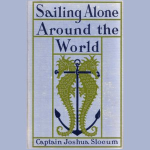
Sailing Alone Around The World by Joshua SlocumSailing Alone Around The World
By Joshua Slocum; Read by Alan Chant
1 |M4B|, 22 Zipped MP3 Files, or Podcast – Approx. 7 Hours 52 Minutes [UNABRIDGED]
Publisher: LibriVox.org
Published: May 9, 2007
|ETEXT|
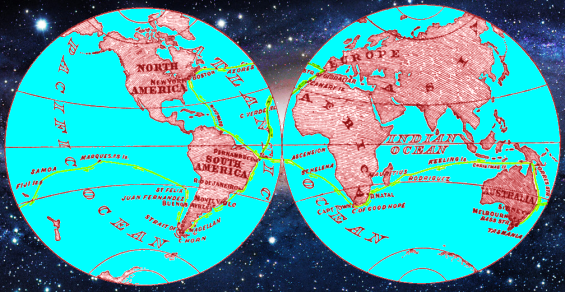
Joshua Slocum was the first man to sail around the world alone in a small boat. He personally rebuilt an 11.2 metre sloop-rigged fishing boat that he named the Spray. On April 24, 1895, he set sail from Boston, Massachusetts. More than three years later, he returned to Newport, Rhode Island, on June 27, 1898 having circumnavigated the world, a distance of 46,000 miles (74,000 km). In 1899 he described the voyage in Sailing Alone Around the World now considered a classic of travel literature. It is a wonderful adventure story from the Age of Sail and a book of which Arthur Ransome declared, “boys who do not like this book ought to be drowned at once.”

Podcast feed: http://librivox.org/bookfeeds/sailing-alone-around-the-world-by-joshua-slocum.xml

iTunes 1-Click |SUBSCRIBE|

I was listening to an episode of the CBC Radio One Ideas podcast, entitled Sailing Alone Around The World |MP3|, and was struck by the story of the first man to do that very thing. The program uses excerpts from Slocum’s book of the same name, and interviews those modern solitary sailors who’ve followed in Slocum’s wake. The fact that, in some sections of the sea, the next nearest human being to a lone sailor might be someone on the International Space Station, was an astounding revelation to me. The fact that there have been fewer solitary circumnavigators than there have been people in space, also astounding. So, not even half-way through the show I set my sights on LibriVox, where I searched for, found, and downloaded an M4B of the audiobook.

Slocum was an Canadian by birth and a naturalized American. In the late 19th century, upon finding himself out of work (the age of coal powered ships had begun in earnest), Slocum found there was no more call for a tall ship captain. One day Slocum finds himself having been gifted with an aged sloop. And so he sets about refitting it, hires himself out to himself plans to write a book (serialized in the Century magazine), loads up his cabin with food, supplies and lots of books, and sets sail on a solitary circumnavigation of the planet earth.

What he finds in the adventure is, simply put, real adventure! Slocum is alone for the entire trip except for The Spray itself, Slocum’s sloop, which is full of emotions (it feels happy when the sailing is good, and becomes anxious when in port too long). Similarwise he has a few passengers, there’s a hungry goat, a sneaky bilge rat, and a long suffering spider (it meets another just like it half a planet away from where it was born).

In his more than three years at sea Slocum meets with ship thieves, admirals, colonial governors, the widow (and adopted son) of Robert Louis Stevenson, friendly natives, hostile natives, officious bureaucrats, friendly bureaucrats, storms, reefs, sickness, and even a ghost!

Along the way he salute’s the sea god Neptune, ports at many memorable anchorages, including the island of the real life inspiration for Daniel Defoe’s Robinson Crusoe (Alexander Selkirk), and becomes an international celebrity.

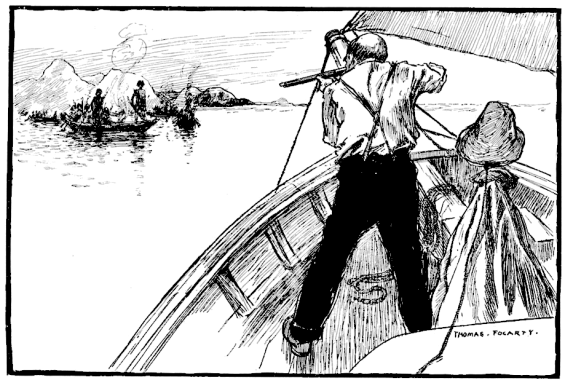
Slocum’s narrative is helped by his enjoyable sense of humor and hindered by his prejudices. And while the various characters that he meets in the book may sometimes benefit from Slocum’s breezy writing style I got no real sense of the other side of the story. Incidents with thieves, one man steals his pistol, and one South American boy tries to steal his ship, come across as far less frightening than they might really have been. Indeed, there’s something of a deliberate storyteller to this travel narrative, something which reminds me of Sławomir Rawicz’s extraordinary adventure memoir The Long Walk (it may have been entirely made up). That said, the documentation seems far more present, and the journey here does seem to have actually occurred.

Narrator Alan Chant has an English accent and a relaxed reading style. There’s a bit of background noise in the recording, but the audio is very serviceable. Each chapter begins and ends with a bit of seabird song. Recommended.

A Brush With Fuegians

The Voyage Of The Spray

Posted by Jesse Willis

The SFFaudio Podcast #216 – AUDIOBOOK: The Pit And The Pendulum by Edgar Allan Poe

Podcast

Edgar Allan Poe's The Pit And The Pendulum
The SFFaudio PodcastSpoken Freely Presents: Going Public ... In ShortsThe SFFaudio Podcast #216 – The Pit And The Pendulum by Edgar Allan Poe, recorded by Paul Michael Garcia for Spoken Freely: Going Public In Shorts.

Experience Edgar Allan Poe’s chilling short tale of the torments endured by a prisoner of the Spanish Inquisition.

The story is also available on Downpour.com right now.

Previously, Gabrielle de Cuir’s narration of Prince Bull by Charles Dickens is HERE. And next up, will be Dick Hill’s narration of Two Illuminating Stories: The Story Of The Bad Little Boy, and The Story Of The Good Little Boy by Mark Twain, that’s HERE.

Then, check out the full Spoken Freely Presents: Going Public … In Shorts compilation which will be available on June 30, 2013 over on Downpour.com – all proceeds for which go to Reach Out And Read.

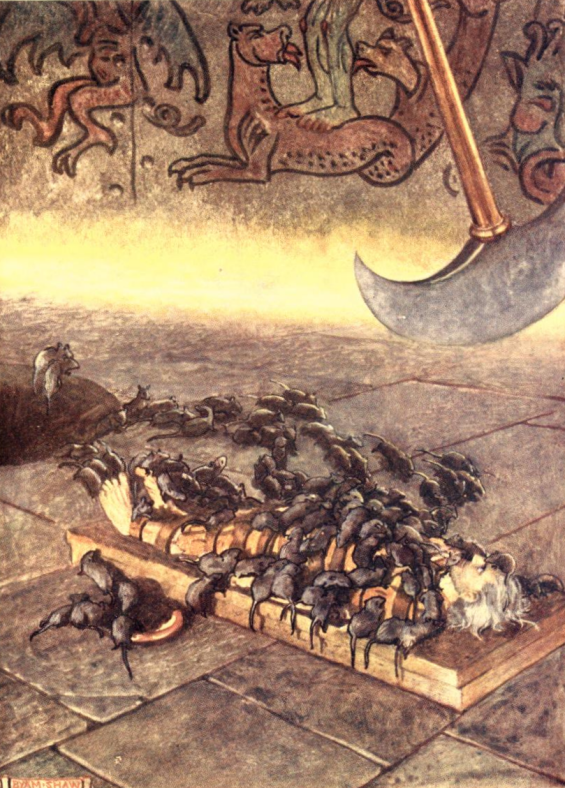
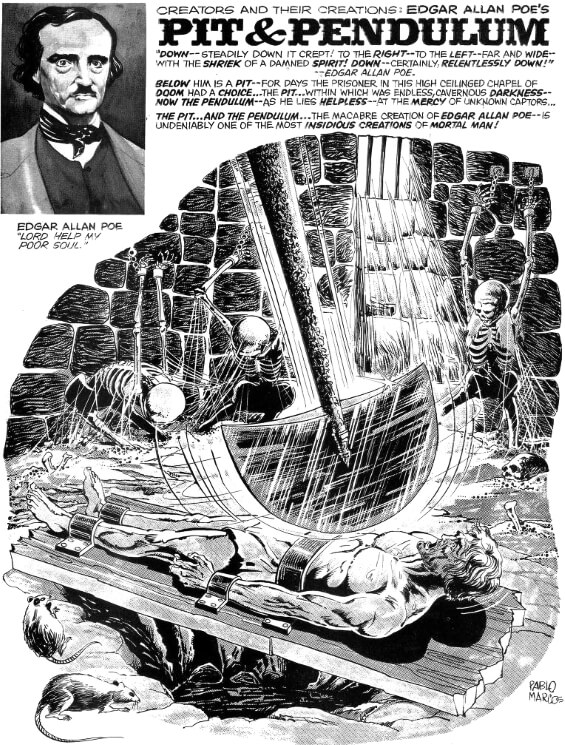
The Pit And The Pendulum - illustrated by Byam Shaw

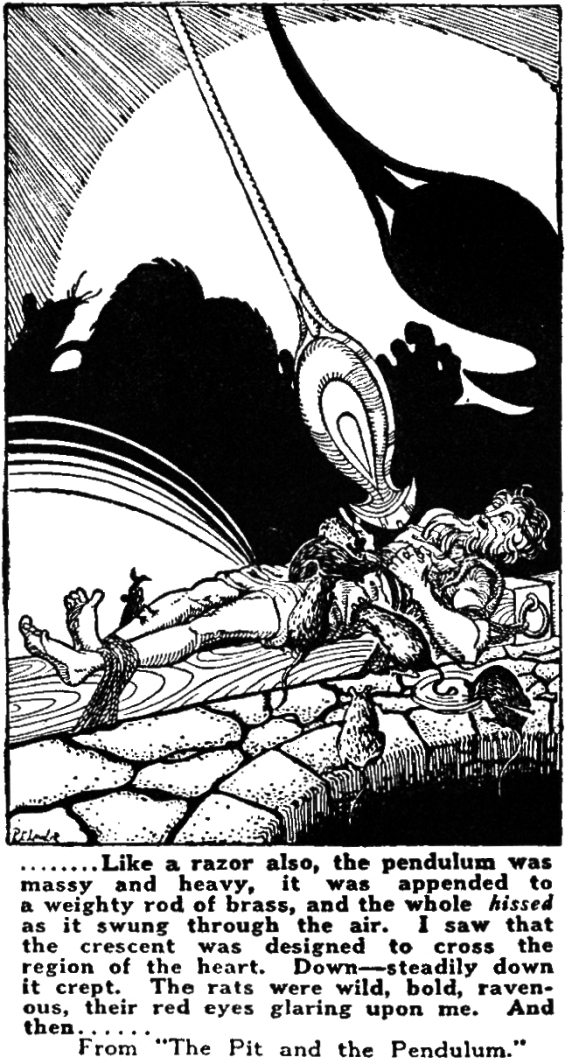
The Pit And The Pendulum - illustration from an ad in Amazing Stories, August 1928

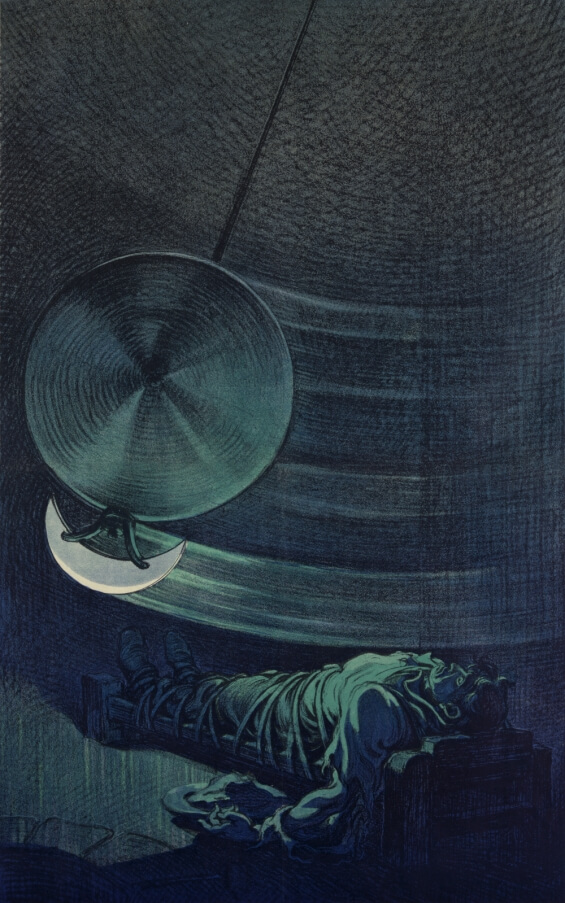
Mark Summers illustration of The Pit And The Pendulum by Edgar Allan Poe

The Pit And The Pendulum - from Puck, May 26, 1909

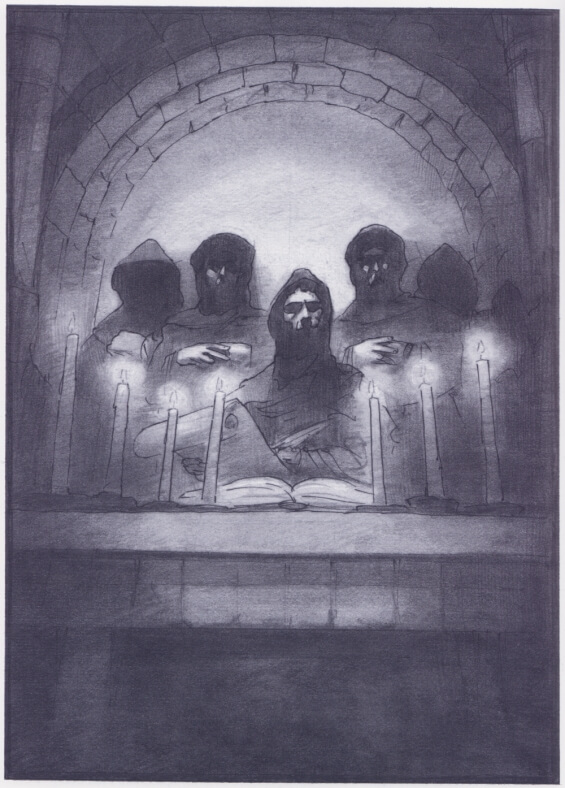
The Pit And The Pendulum by Edgar Allan Poe from Psycho, Issue 7

[Thanks Xe!]

Posted by Jesse Willis

Alethia Phrikodes by H.P. Lovecraft

SFFaudio Online Audio

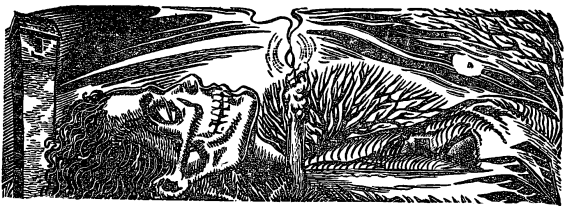
Alethia Phrikodes by H.P. Lovecraft

Alethia Phrikodes is a long poem by H.P. Lovecraft. The title, by the way, is from Greek, and means “Frightful Truth.”

Following the title there is a short line, in Latin, reading:

“Omnia risus et omnis pulvis et omna nihil.”

Omni = all
risus = laughter
pulvis = dust
nihil = nothing

That could be translated to:

“Everything is a laugh and everything is nothing.” or maybe “All is a laugh and all is dust.” or “All laughter is all dust is all nothing.” or “All the laughter and all the dust and all the nothing.”

I found Alethia Phrikodes in the pages of the July 1952 issue of Weird Tales. But, subsequent research shows that it’s actually a segment extracted from an even longer, and much earlier, poem, entitled The Poe-et’s Nightmare (first published in The Vagrant, No. 8, July 1918).

Beyond being really cool Alethia Phrikodes is also, apparently, Lovecraft’s “first enunciation of cosmicism.”*

And so here’s Mr. Jim Moon’s beautiful narration of it |MP3| (12 minutes). To go with it check out this |PDF| which includes the text and the gorgeous art by Jon Arfstrom (from it’s publication in Weird Tales).

Posted by Jesse Willis

*Notes on a manuscript version are available HERE.

Review of The Mongoliad: Book One

SFFaudio Review

Mongoliad: Book 1The Mongoliad: Book One (Foreworld Saga #1)
By Greg Bear, Neal Stephenson, Erik Bear, Mark Teppo, Joseph Brassey, Cooper Moo, Nicole Galland; Narrated by Luke Daniels
Publisher: Brilliance Audio
Length: 13.25 hours [UNABRIDGED]
Note: I received this audiobook as a complete package with a prequel, Sinner, included. This review only covers The Mongoliad: Book One, as I reviewed Sinner: A Prequel to the Mongoliad separately.

Themes: / mongoliad / martial arts / fantasy /

Publisher summary:

Fusing historical events with a gripping fictional narrative, this first book in the Mongoliad trilogy reveals a secret history of Europe in the thirteenth century. As the Mongols swept across Asia and were poised to invade Europe in 1241, a small band of warriors, inheritors of an ancient secret tradition, conceived a desperate plan to stop the attack. They must kill the Khan of Khans; if they fail, all of Christendom will be destroyed. In the late nineteenth century a mysterious group of English martial arts aficionados provided Sir Richard F. Burton, well-known expert on exotic languages and historical swordsmanship, a collection of long-lost manuscripts to translate — the lost chronicles of this desperate fight to save Europe. Burton’s translations were lost, until a team of amateur archaeologists discovered them in the ruins of a mansion in Trieste. From the translations and from the original source material, the epic tale of The Mongoliad was recreated.

The Mongoliad: Book One is a different sort of book. It pretty much violated all of my typical “rules” for a book, and I still find myself wanting to read on, to find out what happens in The Mongoliad: Book Two. I’m not sure the book is really a 3-star book, but I think it’s unfair to rate a book 2 stars but say that I want to know what happens next.

For those who don’t know, “The Mongoliad” was a bit of a “multimedia experiment” started by Neal Stephenson and some of his science fiction, fantasy, and historical fiction friends. The end product, the volumes in the main story as well as the side stories, was a collaborative effort by Neal Stephenson, Greg Bear, Mark Teppo, and others. Originally published on the web (though the site seems to be more or less inactive now, with the authors stating that the published works are the preferred versions), it was originally intended to be a joining of authors and various media types for different forms of story-telling. Though it seems to often be sold/pitched as a fantasy novel, the story is much more historical fiction with some fantastical elements than pure fantasy. While that may frustrate some, it was just fine for me; I loved The Baroque Cycle, after all. The story weaves fictional tales using actual events from the Mongol invasion of Europe.

The Mongoliad: Book One is comprised with a few parallel story lines. Set in the Middle Ages, the two primary story lines are that of a group of knights on a quest (including Raphael, who we met in Sinner: A Prequel to the Mongoliad) and that of an adviser/guard to a Mongol Kahn. Through these “main” story lines, there are some side-stories in the novel, including some flashbacks as well as a plotline surrounding some of the brother-knights who are not on the quest but are left to keep the Mongol invaders “occupied” (including Andreas, who we also met in Sinner: A Prequel to the Mongoliad. The fact that I’m describing this so poorly is a testament to the first major issue I had with the book, an issue that is probably only an issue with the audio version: there are a lot of names, and a lot of names that sound the same…so it can be extremely confusing to keep them all straight when listening. The second major issue I have with the book is related, that because the stories go back and forth, it can be easy to get confused as to who is who when switching between stories, especially if it’s been a day (or more) since last listening. Luke Daniels, the narrator, did a good job with using different voices for each of the characters. But if you couldn’t remember which one was the adviser and which was the slave, then the voices didn’t help much. One other note on the narration: Luke Daniels is a good narrator, one who adds to the story without adding so much that it’s distracting. That said, in addition to the confusing names, there are also flashbacks and stuff in the story, and it was hard to figure out when the story was a flashback and when it was just moving on. I suspect a print edition may have been more obvious.

While I’m on the topic of “confusing characters,” another major issue I had with the book was that it felt like it was in desperate need of an editor. This may be a factor of “too many cooks in the kitchen” or maybe it was just the contribution from each author wanting to ensure the setup for the other authors was clear…or maybe it just needed more editing. It’s not the first of Neal Stephenson’s books I’ve said this about (*cough* Anathem *cough* Reamde *cough*). Interesting plot-relevant sections would be bogged down with–or worse, broken up by–seemingly interminable character- and world-building sections. I don’t mind world- and character-building, but I felt like it could have been done much more organically than it was done in this book. Here, it was either story or it was non-story world/character setup. It would have been much more fulfilling to learn about a feature in a town by seeing a character interact with it instead of a half chapter describing the looks of the buildings. Also, this was a book heavy on battle descriptions…descriptions that didn’t really matter to the overall plot/story arc except to say “the good guys won” or “the bad guys were defeated, but not without good guy casualties.”

This leads me to the final major issue I had with the book: it didn’t end so much as stop. Not only does it end in the middle of a fairly interesting scene, but none of the story lines are wrapped up; they are all left hanging. I hope that before I go onto The Mongoliad: Book Two, I can find a good synopsis online or a cheat-sheet to remind me of who was who and what happened, since I’m going to be listening to a (very different) book before I move onto the next book…and that’s the funny thing. I’m definitely going to listen to the next book (and probably the third book). I like the characters. I want to see if the knights will be able to complete their quest (if true history is any guide, I suspect they will), and how some of the side-quests turn out. I care about the adviser to the Kahn; he doesn’t seem like a bad guy, even if the guy he’s serving isn’t a great leader. I would like to see how some of the mystical/spiritual elements play out in the actual story. So, despite my significant frustrations, possibly because I do really like historical fiction, I’m going to continue with the series. I’m not sure this book is for everyone. I’m not sure that audiobook is the best way to consume the books. But despite its flaws, I actually want to know what happens next, so onward I go…

Posted by terpkristin.