News, Reviews, and Commentary on all forms of science fiction, fantasy, and horror audio. Audiobooks, audio drama, podcasts; we discuss all of it here. Mystery, crime, and noir audio are also fair game.
A grave insult. A mater of honor! A duel to the death.
A Coward (aka The Duel)
By Guy de Maupassant; Read by E (aka Eileen)
1 |MP3| – Approx. 18 Minutes [UNABRIDGED]
Podcaster: Public Domain Podcast
Podcast: December 04, 2005 On the nature of free will and cowardice.
Sci-Fi Radio Theater has a new show. Part fine popsicle, part bad yogurt it’s called Hyper Nocturnal and it’s “an 8 part hybrid sci-fi/horror radio play.”
I’d describe it as horror meets humor in a Science Fiction setting.
Here’s the first episode in its entirety:
In deep space the crew of a cargo vessel known as the Macedonia must confront an unspeakable evil birthed from the frayed fabric of reality.
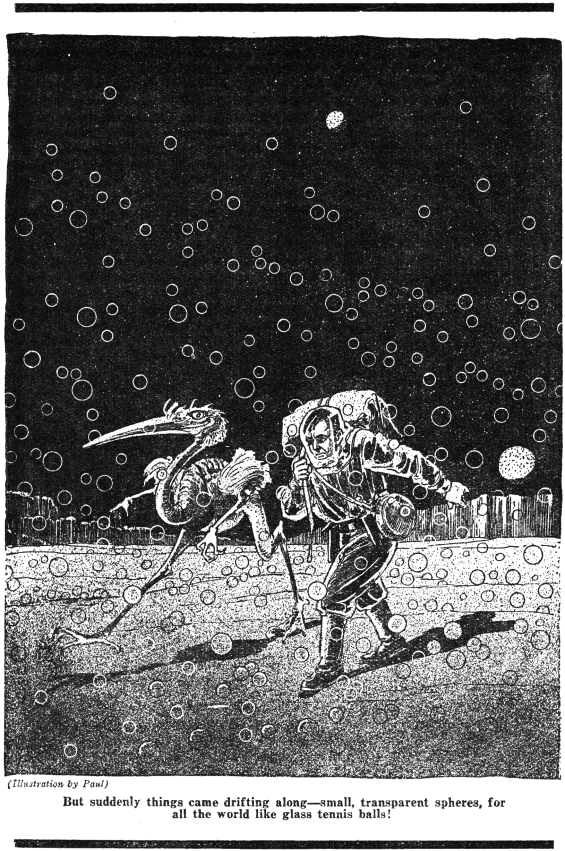
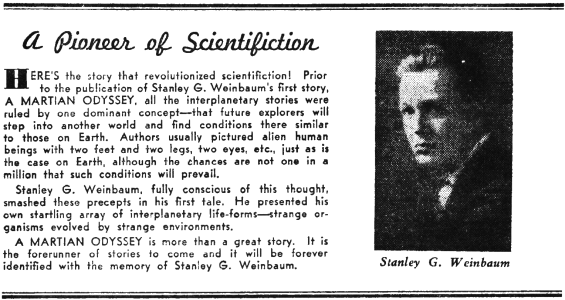
A Martian Odyssey is a classic of alien human interaction. Isaac Asimov said of it and of Weinbaum:
“With this single story [A Martian Odyssey], Weinbaum was instantly recognized as the world’s best living science fiction writer, and at once almost every writer in the field tried to imitate him.”
It is also argued that this is the first story to satisfy Astounding editor John W. Campbell’s famous challenge:
“Write me a creature who thinks as well as a man, or better than a man, but not like a man.”
When it was republished, just 4 years later, in Startling Stories, A Martian Odyssey was added to the “Scientifiction Hall Of Fame”:
And with that that same printing was this extolling editorial explanation:
A Martian Odyssey
By Stanley G. Weinbaum; Read by Gregg Margarite
1 |MP3| – Approx. 58 Minutes [UNABRIDGED]
Publisher: LibriVox.org
Published: January 13, 2009 Early in the twenty-first century, nearly twenty years after the invention of atomic power and ten years after the first lunar landing, the four-man crew of the Ares has landed on Mars in the Mare Cimmerium. A week after the landing, Dick Jarvis, the ship’s American chemist, sets out south in an auxiliary rocket to photograph the landscape. Eight hundred miles out, the engine on Jarvis’ rocket gives out, and he crash-lands into one of the Thyle regions. Rather than sit and wait for rescue, Jarvis decides to walk back north to the Ares. First published in Wonder Stories, July 1934.
Here’s an illustrated |PDF| made from the original publication in Wonder Stories.
The Gaiman content begins shortly after the 32 minute mark. There’s also a nice bit of Gilbert & Sullivan near the end. Here’s the official description:
Prophecies, solutions to pressing problems, windows to the soul… Dreams are wellsprings of creativity, a place where our life and the shadowlands meet. Join Ellen Kushner for a conversation with the Sandman graphic novel author Neil Gaiman; and hear music written about or even received in dreams by Alan Hovhaness, David Maslanka (based on work of Carl Jung) and world artists from Hawaii to Australia.
Talked about on today’s show:
reality shows, Duck Dynasty, about words, puns, rhyming, nothing, negative, was Lem a robot?, modern or timeless?, H.G. Wells, full of great ideas, fables, fairy tales, The Brothers Grimm, royalty,
“Have it compose a poem- a poem about a haircut! But lofty, tragic, timeless, full of love, treachery, retribution, quiet heroism in the face of certain doom! Six lines, cleverly rhymed, and every word beginning with the letter S!!” …
shooting an arrow at a barn, The Hitchhiker’s Guide To The Galaxy by Douglas Adams, Robert Sheckley, robots, the Google Doodle tribute to Stanisław Lem, a metaphor for our reality, the Wikipedia entry on Fables, Aesop’s Fables, Eric S. Rabkin, Scott is interested in Lem, Karol Wojtyła (aka Pope John Paul II), Poland, a small interesting country, Memoirs Found In A Bathtub, Audible’s audiobook, why did Jenny “Lem” this Lem?, Fox is not necessarily always the same fox, distant past? distant future?, “mostly harmless” palefaces, Princess Crystal, everybody’s a robot, a suitable suitor,
“Your Highness, my name is Myamlak and I crave nought else but to couple with you
in a manner that is liquid, pulpy, doughy and spongy, in accordance with the customs of
my people. I purposely permitted myself to be captured by the pirate, and requested him
to sell me to this portly trader, as I knew the latter was headed for your kingdom. And I
am exceeding grateful to his laminated person for conveying me hither, for I am as full of
love for you as a swamp is full of scum.”
The princess was amazed, for truly, he spoke in paleface fashion, and she said:
“Tell me, you who call yourself Myamlak the paleface, what do your brothers do
during the day?”
“O Princess,” said Ferrix, “in the morning they wet themselves in clear water, pouring
it upon their limbs as well as into their interiors, for this affords them pleasure.
Afterwards,
they walk to and fro in a fluid and undulating way, and they slush, and they
slurp, and when anything grieves them, they palpitate, and salty water streams from
their eyes, and when anything cheers them, they palpitate and hiccup, but their eyes
remain relatively dry. And we call the wet palpitating weeping, and the dry—laughter.”
“If it is as you say,” said the princess, “and you share your brothers’ enthusiasm for
water, I will have you thrown into my lake, that you may enjoy it to your fill, and also I
will have them weigh your legs with lead, to keep you from bobbing up …”
“Your Majesty,” replied Ferrix as the sage had taught him, “if you do this, I must
perish, for though there is water within us, it cannot be immediately outside us for longer
than a minute or two, otherwise we recite the words ‘blub, blub, blub,’ which signifies our
last farewell to life.”
“But tell me, Myamlak,” asked the princess, “how do you furnish yourself with the
energy to walk to and fro, to squish and to slurp, to shake and to sway?”
“Princess,” replied Ferrix, “there, where I dwell, are other palefaces besides the
hairless variety, palefaces that travel predominantly on all fours. These we perforate until
they expire, and we steam and bake their remains, and chop and slice, after which we
incorporate their corporeality into our own. We know three hundred and seventy-six
distinct methods
of murdering, twenty-eight thousand five hundred and ninety-seven
distinct methods of preparing the corpses, and the stuffing of those bodies into our bodies
(through an aperture, called the mouth) provides us with no end of enjoyment.
Indeed,
the art of the preparation of corpses is more esteemed among us than astronautics and is
termed gastronautics, or gastronomy—which, however, has nothing to do with
astronomy.”
“Does this then mean that you play at being cemeteries, making of yourselves the
very coffins that hold your four-legged brethren?”
the poet robot,
Trurl adjusted, modulated, expostulated,
disconnected, ran checks, reconnected, reset, did everything he could think of, and the
machine presented him with a poem that made him thank heaven Klapaucius wasn’t
there to laugh—imagine, simulating the whole Universe
from scratch, not to mention
Civilization in every particular, and to end up with such dreadful doggerel! Trurl put in six
cliche filters, but they snapped like matches; he had to make them out of pure corundum
steel. This seemed to work, so he jacked the semanticity up all the way, plugged in an
alternating rhyme generator—which nearly ruined everything, since the machine
resolved to become a missionary among destitute tribes on far-flung planets. But at the
very last minute, just as he was ready to give up and take a hammer to it, Trurl was
struck by an inspiration; tossing out all the logic circuits, he replaced them with
self-regulating egocentripetal narcissistors. The machine simpered a little, whimpered a
little, laughed bitterly, complained of an awful pain on its third floor, said that in general it
was fed up, though, life was beautiful but men were such beasts and how sorry they’d all
be when it was dead and gone. Then it asked for pen and paper. Trurl sighed with relief,
switched it off and went to bed.
Men are such beasts but we’ll be sad when they’re gone, the paperbook, kudos to narrator Scott Aiello, satire of something, Mandrillion the Greatest, ruler of the Multitudians, the perfect advisor, fantasy with Science Fiction language, lawyer soup, Escape Pod, Peter Swirski, A Stanislaw Lem Reader, reviews, people who review Lem, Lem = genius, sitting in awe, “Imagine a mixture of Borges, Calvino, Saint-Exupéry, Pynchon, Douglas Adams, Samuel Beckett, L. Frank Baum, Dr. Seuss, Lewis Caroll, and perhaps a little Philip K. Dick. That’s what this is like, sort of.”, complete impatience with reading “another one of these or another one of those”, A Perfect Vacuum, a big show-off, the ideas per story quotient, Gene Wolfe, Jorge Luis Borges, meta, overwhelming wordplay, digressions aplenty, format and rules, classic Hard SF, the hyperdrive handwaviumed away, all of language is handwavium, Sodium stars with an N, we think when we’ve named something we’ve understood it, make sense out of nonsense, stardust into toilet seats:
Feeling dismay rather
than disappointment at this neglect, I immediately sat down and wrote The Scourge of
Reason, two volumes, in which I showed that each civilization may choose one of two
roads to travel, that is, either fret itself to death, or pet itself to death. And in the course
of doing one or the other, it eats its way into the Universe, turning cinders and flinders of
stars into toilet seats, pegs, gears, cigarette holders and pillowcases, and it does this
because, unable to fathom the Universe, it seeks to change that Fathomlessness into
Something Fathomable, and will not stop until the nebulae and planets have been
processed to cradles, chamber pots and bombs, all in the name of Sublime
Order, for only a Universe with pavement, plumbing, labels and catalogues is, in its sight, acceptable
and wholly respectable.
the are no rules in The Cyberiad, owookiee’s 1 star review of The Cyberiad, a Droopy cartoon as directed by Tex Avery, The Perfect Imitation adapted, saggy biologicals, Daniel Mróz’ illustrations, Tobias Buckell’s blog post about The Fate Of Today’s Book Bloggers, the way Luke Burrage reviews books, a constructed object vs. a piece of art, conversations between writers, how books should be talked about, the SFSignal new releases posts, zombie novels, you’re reading the books wrong, you should read by author, Donald E. Westlake, Lawrence Block, Telling Lies For Fun And Profit, Philip K. Dick, George R.R. Martin, Fred Himebaugh (@Fredosphere), Twitter fight!, looking for reasons not to read books, Your Movie Sucks by Roger Ebert, if a book sucks you usually stop reading that author entirely, Neal Stephenson, positive that tell you nothing about why it’s good, wandering through the woods eating rocks and bark, moods, Star Wars fans, get meta, reviewing novels vs. short stories, in the context, negative reviews tell you a lot more about a book than positive reviews, this book has too much science, Star Trek: Deep Space Nine, Star Trek, Battlestar Galactica, panspermia and ancient astronauts, the finite and the infinite, iTunes U, characters on Battlestar Galactica are always confronted the question “what is human?”, synthesis, the enemy is the ally, the enemy is indistinguishable from one’s self, a space fable, Caprica, SumerianAramaic Sanskrit and Battlestar Galactica, Babylon 5, Firefly, a gift of kindness, Porco Rosso, Hayao Miyazaki, what is IT Tam?
The Invisible Hook: The Hidden Economics of Pirates
By Peter T. Leeson; Read by Jeremy Gage Audible Download – Approx. 7 Hours 41 Minutes [UNABRIDGED]
Publisher: Audible, Inc.
Published: September 4, 2009
Themes: / Economics / Piracy / History / Slavery / Democracy / Anarchy /
Pack your cutlass and blunderbuss–it’s time to go a-pirating! The Invisible Hook takes readers inside the wily world of late seventeenth- and early eighteenth-century pirates. With swashbuckling irreverence and devilish wit, Peter Leeson uncovers the hidden economics behind pirates’ notorious, entertaining, and sometimes downright shocking behavior. Why did pirates fly flags of Skull & Bones? Why did they create a “pirate code”? Were pirates really ferocious madmen? And what made them so successful? The Invisible Hook uses economics to examine these and other infamous aspects of piracy. Leeson argues that the pirate customs we know and love resulted from pirates responding rationally to prevailing economic conditions in the pursuit of profits.
I love non-fiction, and I love books that look at history, books that look at history through one lens or another are even better! And so there is much to love in The Invisible Hook. The title is a play on Adam Smith’s elegant metaphor for how markets work, the invisible hand. Most of the examples cited deal with the Atlantic and Caribbean pirates, rather than earlier Roman era or modern day pirates. But we get a sense of how it likely worked in other regions and times. Chapters on the paradoxical attitudes towards pirate slavery, the wildly contradictory stories about piratical impressment, and the chapter on the Jolly Roger, the pirate flag, are absolutely fascinating. And, as something of a piratical hobbyist myself, I’m pleased to report they deliver clear insights only hinted at in other non-fiction books about piracy. You know you’ve got a good book in hand when you find yourself relating the premises, arguments, and conclusions of whole chapters to friends.
How good is the analysis really? That’s kind of hard to tell. Democracy and equality as a function of economics? Wonderful! Seems logical, seems plausible. And that’s the sort of thing you don’t hear often enough. Indeed, economist Steven Levitt, of Freakonomics fame, gets a shout out early on in The Invisible Hook. This is a book in that vein, a kind of entertaining pop-economics, well written, and very thoughtful. But it also boasts the same kind of inarguable psychohistory-style post-analysis of such books. It reminds me of books like William Rosen’s The Most Powerful Idea in the World, and Jared Diamond’s Collapse. Well written history looked at through the lens of a soft science makes the seemingly inexplicable events of history seem almost inevitable. That is to say, this book should be just one of many such on such topics. In the end though how can you not wanto to read a book that makes piracy, as depicted in The Princess Bride, actually very plausible?
But this is not as merry a ship as it might be. As with many book published these days, there’s some bit of puffery. Concepts well illustrated in a paragraph or two are revisited, whole passages nearly reworded, and I’m betting that this for reasons of market driven economics. It might be that each chapter can be looked at on it’s own, textbook style, but listened to as I did, back to back the chapters have a tendency to revisit the same ports too often. This is one of my major complaints about books these days. Too many books are being published with too many words that don’t say different things. At under eight hours even this relatively slim volume, by today’s market standards, but it’s still puffier than any pirate’s shirt really ought be. It is like a pirate cutter on the stalk, slowed down by a sea-anchor of unneeded repetition. Saying the same thing over and over and over. Get my point? Okay, its the market, and to be fair Adam Smith’s own The Wealth Of Nations is a bloody long book, 36 hours! I’d be willing to bet my strong right arm that the original article, as published by Levitt (mentioned in the book), would be an even better audiobook than this very fine one, and no doubt it’d measure at least a peg leg shorter.
Narrator Jeremy Gage is from the old school of audiobook narration, the kind I like. He doesn’t so much as perform a book as read it. His conspiratorial tone typically him a great choice for first-person POV novels, like Lawrence Block’s Burglars Can’t Be Choosers. This is the first non-fiction book I’ve heard him narrate. So now I can say he’s great for non-fiction too.

 A Coward (aka The Duel)

 A Martian Odyssey