
Review of Technomancer by B.V. Larson

SFFaudio Review

TechnomancerTechnomancer (Unspeakable Things, Book One)
By B.V. Larson; Read by Christopher Lane
Publisher: Brilliance Audio
[UNABRIDGED] – 9 discs – 11 hours

Themes: / mystery / thriller / magic /

Publisher summary:

When Quentin Draith wakes up in a private sanatorium, he has no memory of who he is or how he received the injuries riddling his body. All he knows is that he has to get out, away from the drugs being pumped into him and back to the real world to search for answers. His first question: How did his friend Tony’s internal organs fill with sand, killing him in a Las Vegas car crash? After a narrow escape, he tracks down the basic facts: he is an investigator and blogger specializing in the supernatural — which is a good thing, because Quentin’s life is getting stranger by the minute. It seems he is one of a special breed, a person with unusual powers. He’s also the prime suspect in a string of murders linked by a series of seemingly mundane objects. The deeper he digs and the harder he works to clear his name, the more Quentin realizes that some truths are better off staying buried….

This one had a lot of potential, but in the end didn’t live up to it.  Technomancer starts off strong with the main character, Quentin Draith, waking up in a hospital, not remembering any details about his life…not even his name. From there, the reader (listener, in my case) is taken on a bit of a “mystery-thriller” type book with science fiction/supernatural elements thrown in. The reader learns about Quentin as he learns about himself. That part of the story is actually kind of fun, the act of discovery. Unfortunately, the book breaks one of my cardinal rules for books in a series: it doesn’t stand very well on its own and didn’t wrap up the story line in any satisfying way. At the end of the book, I was left bored and annoyed that I’d read the entire thing, let down by what it was compared with what it could have been.

Quentin discovers that there have been a variety of bizarre deaths in Las Vegas, odd happenings. Through one of the people he meets, he finds that he’s a blogger who writes about these strange things. As the story goes on, he meets a somewhat shady police officer who is the lead investigator for these events and comes to piece more of the story together. There are some people in the community who have special objects. These objects give them powers, or can be used against others. For example, one of the objects Quentin learns about early-on is a ring that makes the person wearing it lucky in games of chance (such as blackjack). Another power is used for a sort of mind control. Some of these powers have a limited range over which they can work; others can work anywhere. Some objects even allow the owner to create “rips” to other worlds or other places in this world, portals that can be used to travel around the Vegas area. These “rips” can lead to worlds, though, where other beings live, beings who can come through similar rips to our world. Quentin suspects that these beings (called “grey men”) are responsible for all the odd events in Vegas. Through his travels, he also learns that there are two groups of users of these special objects: the “community,” and the “rogues” or the “cultists.” The “community” are people who, to some extent, have banded together to collect objects. The “cultists” have objects of their own, but seem generally more interested in using them for new study. They compare the objects to witchcraft in the 1600’s: if you don’t understand the science behind something, then it is seen as magical, no? Eventually, Quentin forms a plan to destroy the grey men, and the story ends more or less after his attempt to do so…

All of that sounds like it has the potential to be an interesting story. Sadly, the book, taken on its own, didn’t form much of a complete story. Over 9 CD’s (10.5 hours), the book spent the first 8 with Quentin wandering around, finding objects and meeting people. Only three of the people he met (out of many) ended up being truly relevant by the end of the book. The final “battle” as it were didn’t start until the end of the 8th CD and was wrapped up 2/3 through the final CD; that is, the climax was only about 30 minutes long in total, and came right at the end. Instead of describing more of the how’s and why’s, Larson spent most of this book world- and character-building. Even the “battle” was rushed. It wasn’t clear, at the end of the story, if the battle made any difference. Or why Quentin survived. Or what happened to the others who went to battle with him. Or why some of them mattered. A quick look on Amazon indicates that this is the first in the “Unspeakable Things” series. This book was unsatisfying enough to me that I won’t go on to read the others. I kept holding out hope that the climax would come and the story would be resolved, but in the end, it wasn’t. It just felt like a very long introduction to a short book.

As this was an audiobook, I should probably mention something about the narration. In short, it was a pretty average narration, nothing to write home about, but nothing particularly bad or unpleasant, either. Lane did a fine job with the voices; there was never a question of which character was speaking, and his female voices weren’t as over-the-top as some male narrators do. In the end, when a narrator doesn’t distract from the book, they’re doing an alright job in my book, and that was the case here. I think it was probably better to listen to this book instead of reading the print version, so that I could do other things while reading.

Review by terpkristin.

On the Road with Harlan Ellison

SFFaudio Recent Arrivals

On The Road With Ellison Volume Six is the latest report from Harlan Ellison and a life lived on the road. This 2CD set includes an exclusive new essay and features Harlan’s historic 2005 Grand Master Award acceptance speech. Volume Six finds the author impersonating a rabbi, getting kicked out of Brazil, offering his thoughts on Star Wars and saying goodbye to his dear friend Octavia Butler. Follow Harlan on the road and get inside the head of America’s most outspoken wordsmith. This is Ellison live on stage and anything goes.

Harlan Ellison is one of a kind. Of course, Volumes 1-5 are also available. For more details, including audio samples, click over to Deep Shag Records!

Posted by Scott D. Danielson

Listen To Genius: The Tell-Tale Heart by Edgar Allan Poe

SFFaudio Online Audio

Reprinted 150 times, according to ISFDB.org entry on it, I’m thinking Edgar Allan Poe’s The Tell-Tale Heart may very well be the most reprinted story ever.

It’s a pretty great story, so you can see why it would be, but with its popularity comes a flood of different free readings, most not so great. Which is why I was so pleased to find this free version by the great Grover Gardner. Goodness!

The Tell-Tale Heart - illustrated by Virgil Finlay

Listen To Genius!The Tell-Tale Heart
By Edgar Allan Poe; Read by Grover Gardner
1 |MP3| – Approx. 14 Minutes [UNABRIDGED]
Publisher: Redwood Audiobooks (Listen To Genius)
Published: 2008?
Source: ListenToGenius.com
First published in The Pioneer, January 1843.

And here’s a handy |PDF| version.

Posted by Jesse Willis

Listen To Genius: The Story-Teller by Saki (H.H. Munro)

SFFaudio Online Audio

A horribly good story, narrated by a proper old school narrator, the great Alan Sklar.

“‘It’s the stupidest story I’ve ever heard,’ said the bigger of the small girls, with immense conviction.”

Listen To Genius!The Story-Teller
By Saki; Read by Alan Sklar
1 |MP3| – Approx. 14 Minutes [UNABRIDGED]
Publisher: Redwood Audiobooks (Listen To Genius)
Published: 2008?
Source: ListenToGenius.com

And here’s a |PDF| made from the publication in Beasts And Super-Beasts (1914).

Posted by Jesse Willis

The SFFaudio Podcast #206 – READALONG: Seven Nebula Nominated Short Stories

Podcast

The SFFaudio PodcastThe SFFaudio Podcast #206 – Scott and Jenny talk about the seven short stories nominated for the Nebula Award.
Talked about on today’s show:
Seven nominated stories for the Nebula Award. Why so many? Some of the stories have themes in common.  Scott wasn’t enamored by any of the seven (but it gets better with the discussion).  All of them are free online, and all except “Nanny’s Day” are also available in audio (see links below). 

Robot by Helena Bell (Clarkesworld 9/12) |audio version read by Cat Rambo| Scott’s favorite part is the very beginning: “You may wash your aluminum chassis on Monday and leave it on the back porch opposite the recyclables…don’t eat the dead flesh of my right foot until after I have fallen asleep and cannot hear the whir of your incisors working against the bone.” 

Immersion by Aliette de Bodard (Clarkesworld 6/12) |audio version read by Kate Baker| The story takes place in a restaurant, and the author likes to cook. Scott said this isn’t her first nomination. (Shipbirth was nominated last year , but we excluded it from our short story discussion at the time since it was not available in audio; “The Jaguar House, in Shadow” in the novella category for the Nebula and the Hugo in 2010.) Reminds Scott of The Story of Your Life by Ted Chiang.  Enjoying Kate Baker’s reading.

Fragmentation, or Ten Thousand Goodbyes by Tom Crosshill (Clarkesworld 4/12) |audio version read by Kate Baker| Author of “Mama, We are Zhenya, YourSon” |OUR READALONG| First line: “Every day, Mom says goodbye to me for the last time.” Stories grow in talking about them.

Nanny’s Day by Leah Cypess (Asimov’s 3/12)
Scott’s first would be Jenny’s last, and Scott is surprised to like it so much when it isn’t even really science fiction!

Give Her Honey When You Hear Her Scream by Maria Dahvana Headley (Lightspeed 7/12) |audio version read by Gabrielle de Cuir| “Everyone knows that forever is, and has always been, a magic word. Forever isn’t always something one would choose, given all the information.”  Scott says It’s a both-and. Jenny says this is why love is hard.

The Bookmaking Habits of Select Species by Ken Liu (Lightspeed 8/12). |audio version read by Stefan Rudnicki| We agree this story is missing its story, but are intrigued by the people and world created.

Five Ways to Fall in Love on Planet Porcelain by Cat Rambo |audio version|
Five things Jenny loves about this story:

  1. The creatures – chimmerees and limentia, like jellyfish floating on the wind.
  2. “She’d lain awake in the darkness, checking her mind with the same care. Were there any sorrows, any passions that might lead her thoughts along the same groove till it gave, eroded into madness?”
  3. Sound garden, but can it dissolve your insides to dust?
  4. Frozen orgasms
  5. “There were more interesting worlds in the multi-verse, she knew. Paper dolls, and talking purple griffons. Intelligent rainbows and everyone’s favorite, the Chocolate Universe. She shrugged.” Jenny wants to visit ALL these worlds.

Other discussion:

Hugo Award nominees will be announced before this episode posts and we both vote! – Embassytown by China Miéville The Best of All Possible Worlds by Karen Lord – what is “hard” science fiction?  Scott is tired of “stories in space” that aren’t really science fiction. Nominations can be quite a mystery.

Posted by Jenny Colvin

Review of The World Until Yesterday by Jared Diamond

SFFaudio Review

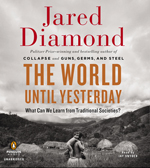
The World Until YesterdayThe World Until Yesterday: What Can We Learn from Traditional Societies?
By Jared Diamond; Read by Jay Snyder
Publisher: Penguin Audio
Published: 31 December 2012
ISBN: 9781611761474
[UNABRIDGED] 16 CDs – 19 hours

Themes: / humanity / community / society / history /

Publisher summary:

Most of us take for granted the features of our modern society, from air travel and telecommunications to literacy and obesity. Yet for nearly all of its six million years of existence, human society had none of these things. While the gulf that divides us from our primitive ancestors may seem unbridgeably wide, we can glimpse much of our former lifestyle in those largely traditional societies still or recently in existence. Societies like those of the New Guinea Highlanders remind us that it was only yesterday—in evolutionary time—when everything changed and that we moderns still possess bodies and social practices often better adapted to traditional than to modern conditions.

The World Until Yesterday provides a mesmerizing firsthand picture of the human past as it had been for millions of years—a past that has mostly vanished—and considers what the differences between that past and our present mean for our lives today.

This is Jared Diamond’s most personal book to date, as he draws extensively from his decades of field work in the Pacific islands, as well as evidence from Inuit, Amazonian Indians, Kalahari San people, and others. Diamond doesn’t romanticize traditional societies—after all, we are shocked by some of their practices—but he finds that their solutions to universal human problems such as child rearing, elder care, dispute resolution, risk, and physical fitness have much to teach us. A characteristically provocative, enlightening, and entertaining book, The World Until Yesterday will be essential and delightful reading.

The World Until Yesterday by Jared Diamond is at its heart a consciousness-raising book. It opens our eyes to the way we live, the ways we used to live, and what we now take for granted. The book covers many broad subjects, and although Jared Diamond had to condense each of them to fit them all into one book, there is enough detail to give readers a clearer perspective about what it means to be a human in a community, and there are plenty of great anecdotes too.

The audiobook narration is great. Jay Snyder comes across as personable and interested in what he’s talking about, so it’s easy to stay engaged all the way through. He helped to make the huge spectrum of ideas and information easy to absorb.

Each subject in the book is explored from the context of different societies, ranging from traditional small-scale societies to modern nation-state societies. The subjects covered include the sharing of territory and resources; managing disputes; the benefits and inherent harms of certain justice systems; how we maintain friendships; how we deal with strangers or enemies; how we treat our children and the elderly; what cultural blind-spots we have when it comes to dangers, diseases; varying ideas about nutrition; and how religion has evolved for different purposes in different cultures and eras.

The anecdotes from Jared Diamond’s many experiences living with traditional, small-scale societies range from scary to comical (although of course, we who live in the West are usually the comical ones). The story about the deranged, murdering “sorcerer” who roamed the New Guinea jungle at night gave me the chills. And I cracked up laughing at the story about the New Guinea tribe who could not believe the first white Europeans they ever saw were people and not spirits. The European explorers stayed with them and kept insisting they were just regular humans, but the tribe didn’t believe them until later, when they checked the explorers’ toilet. It had never occurred to me to wonder whether ghosts shit.

Jared Diamond does not romanticize traditional life: he explores what works and what doesn’t in all the different societies. While he is passionate about certain ideas (e.g. the hidden harms in certain child-rearing practices in the West, or the benefits of constructive paranoia), he also tries to remain objective and offers critics’ viewpoints too.

The World Until Yesterday is also a call to action because it not only shows what people in large modern cultures can learn from small traditional societies, it also explains how we might integrate the more beneficial practices into our personal lives (and simultaneously phase out some of the weirder ones).

Overall, this was a fascinating book with loads of insights into what it means to be human as viewed through the lens of other cultures. I think a lot of ideas from this book will stay with me for a long time, and I’m sure I’ll listen to this again at different times of my life when I want a clearer perspective on my community, culture, or even my own behavior as an individual.

Review by Marissa van Uden.