
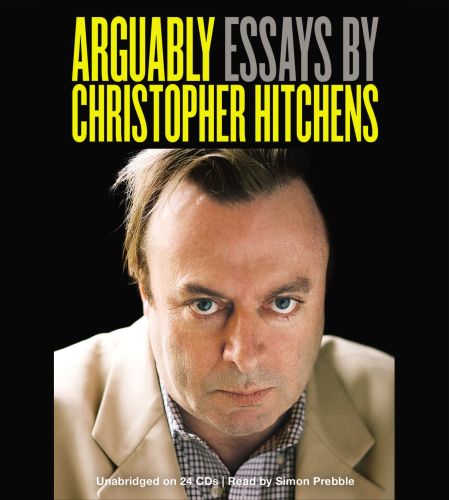
 Arguably: Essays
By Christopher Hitchens; Read by Simon Prebble
24 CDs – Approx. 28.5 Hours [UNABRIDGED]
Publisher: Hachette Audio
Published: September 1, 2011
ISBN: 9781611139068
Themes: / Non-fiction / History / War / Biography / Science Fiction / Fantasy / Iran / Afghanistan / Germany / North Korea / France / Dystopia / Utopia / Religion / Tunisia / Piracy / Terrorism / Feminism / Pakistan /
The first new collection of essays by Christopher Hitchens since 2004, Arguably offers an indispensable key to understanding the passionate and skeptical spirit of one of our most dazzling writers, widely admired for the clarity of his style, a result of his disciplined and candid thinking. Topics range from ruminations on why Charles Dickens was among the best of writers and the worst of men to the haunting science fiction of J.G. Ballard; from the enduring legacies of Thomas Jefferson and George Orwell to the persistent agonies of anti-Semitism and jihad. Hitchens even looks at the recent financial crisis and argues for arthe enduring relevance of Karl Marx. The audio book forms a bridge between the two parallel enterprises of culture and politics. It reveals how politics justifies itself by culture, and how the latter prompts the former. In this fashion, Arguably burnishes Christopher Hitchens’ credentials as-to quote Christopher Buckley-our “greatest living essayist in the English language.”
Here’s a question I was thinking about while listening to Arguably.
What is fiction for?
One answer, the bad one, is that it’s for entertainment. That’s certainly where many readers are willing go, and the fiction writers who write it too. Maybe that’s precisely why so much fiction is just so very shitty.
To me, if you aren’t exploring ideas in your fiction, then you really aren’t serving a greater purpose. Idea fiction, fiction with ideas rather than just action and plot, is to my mind a kind of supplement to the wisdom found in writings on history, biography and science.
Of the many lessons learned I in listening to the 107 essays in Arguably I was particularly struck by the wisdom Christopher Hitchens gleaned from his reading of fiction. Hitchens reviews many books in this collection, nearly half of the essays are book reviews. Books like 1984, Animal Farm, Flashman, The Complete Stories Of J.G. Ballard, Our Man In Havana, and even, surprisingly, Harry Potter And The Deathly Hallows all get fascinating, critical, and reverent reviews.
Yet Hitchens also takes the lessons with him into his writing about his travels. Hitchens writes about visits to such places as North Korea, Cyprus, Afghanistan, and Kurdish Iraq. When talking about his visit to Beirut we see what comes when Hitchens, a man of ideas, acts upon them. The essay, The Swastika and the Cedar sees the convictions of the commited anti-fascist Hitchens beaten and nearly kidnapped for an act of vandalism on a prominently displayed swastika. Writes Hitchens:
“Well, call me old-fashioned if you will, but I have always taken the view that swastika symbols exist for one purpose only—to be defaced.”
In a review of two books, Lolita and The Annotated Lolita, Hitchens applies the controversial subject in a real life look at the modern, and very non-fictional oppression and objectification of women. Indeed, the ideas he appreciated in fiction helped Hitchens to come to grips with the real world.
I think the worst essay in this collection is the one on the serving of wine and restaurants, Wine Drinkers Of The World, Unite. It was simply a waste of the talent, too light, too easy a target. And yet, even that essay, the worst essay in all 107 has a memorable anecdote: “Why,” asks Hitchens’ five year old son, “are they called waiters? It’s we who are doing all the waiting.”
As to the narration of the audiobook. I’m ashamed to admit that I was initially dismayed when I saw that Christopher Hitchens had not narrated this audiobook himself. I was wrong to worry. Incredibly, Simon Prebble seems to have have become Hitchens for this narration. Prebble perfectly captures the erudite words, so eloquently performs them, and with an accent so like that of Hitchens’ own so as to make me think that it was Hitchens who had actually read it.
I think the worst essay in this collection is the one on the serving of wine and restaurants, Wine Drinkers Of The World, Unite. It was simply a waste of the talent, too light, too easy a target. And yet, even that essay, the worst essay in all 107 has a memorable anecdote: “Why,” asks Hitchens’ five year old son, “are they called waiters? It’s we who are doing all the waiting.”
Here’s a list of the book’s contents, with links to the original etexts when available, along with my own notes on each:
ALL AMERICAN
Gods Of Our Fathers: The United States Of Enlightenment – a review of Moral Minority: Our Skeptical Founding Fathers by Brooke Allen
The Private Jefferson – a review of Jefferson’s Secrets: Death And Desire At Monticello by Andrew Burstein
Jefferson Vs. The Muslim Pirates – a review of Power, Faith, And Fantasy: America In The Middle East: 1776 To The Present by Michael B. Oren
Benjamin Franklin: Free And Easy – a review of Benjamin Franklin Unmasked: On the Unity of His Moral, Religious, And Political Thought by Jerry Weinberger
John Brown: The Man Who Ended Slavery – a review of John Brown, Abolitionist: The Man Who Killed Slavery, Sparked The Civil War, And Seeded Civil Rights by David S. Reynolds
Abraham Lincoln: Misery’s Child (aka Lincoln’s Emancipation) – a review of Abraham Lincoln: A Life by Michael Burlingame
Mark Twain: American Radical – a scathing review of The Singular Mark Twain: A Biography by Fred Kaplan
Upton Sinclair: A Capitalist Primer – a review of The Jungle by Upton Sinclair
JFK: In Sickness And By Stealth – a review of An Unfinished Life: John F. Kennedy, 1917–1963 by Robert Dallek
Saul Bellow: The Great Assimilator – review of six novels by Saul Bellow (The Dangling Man, The Victim, The Adventures Of Augie March, Seize The Day, Henderson The Rain King, and Herzog)
Vladimir Nabokov: Hurricane Lolita – reviews of Lolita by Vladimir Nabokov and The Annotated Lolita edited and annotated by Alfred Appel, Jr.
John Updike: No Way – a review of The Terrorist by John Updike (with reference to The Coup too)
John Updike: Mr. Geniality – a critical review of the affable Due Considerations: Essays And Considerations by John Updike
Vidal Loco – Gore Vidal went crazier, more elitist and perhaps more racist as he got older (with attention and quips for Quentin Crisp and Oscar Wilde and Joyce Carol Oates)
America The Banana Republic – Hitchens on the “socialistic” bank bailout of 2008 (“socialism for the rich and free enterprise for the rest”)
An Anglosphere Future – a review of The History Of The English Speaking Peoples by Andrew Roberts (with reference to both Sherlock Holmes and The White Company by Sir Arthur Conan Doyle as well as to Cecil Rhodes and Rudyard Kipling)
Political Animals – a review of Dominion: The Power Of Man, The Suffering Of Animals, And The Call To Mercy by Matthew Scully
Old Enough To Die – on capital punishment as applied to children
In Defense Of Foxhole Atheists – a visit to the United States Air Force Academy and the tax funded proselytizing
In Search Of The Washington Novel – a search for some good fiction about Washington, D.C.
ECLECTIC AFFINITIES
Isaac Newton: Flaws Of Gravity – a stroll through the medieval streets of Cambridge with the scientists, mathematicians, and philosophers who worked there
The Men Who Made England: Hilary Mantel’s “Wolf Hall” – a review of Wolf Hall by Hilary Mantel
Edmund Burke: Reactionary Prophet – a review of Reflections On The Revolution In France by Edmund Burke
Samuel Johnson: Demons And Dictionaries – a review of Samuel Johnson: A Biography by Peter Martin
Gustave Flaubert: I’m With Stupide – a review of Bouvard et Pécuchet by Gustave Flaubert translated by Mark Polizzotti
The Dark Side Of Dickens – a review of Charles Dickens by Michael Slater a biography (Hitchens was a not uncritical admirer of the subject)
Marx’s Journalism: The Grub Street Years – a glowing review of Dispatches for the New York Tribune: Selected Journalism Of Karl Marx edited by James Ledbetter, foreword by Francis Wheen (Marx admired the United States, and other fascinating facts about the father of communism)
Rebecca West: Things Worth Fighting For – an introduction to Black Lamb and Grey Falcon: A Journey Through Yugoslavia by Rebecca West
Ezra Pound: A Revolutionary Simpleton – a review of Ezra Pound, Poet: A Portrait Of The Man And His Work: Volume I: The Young Genius, 1885-1920 by A. David Moody (a biography of the fascist poet)
On “Animal Farm” – an introduction to Animal Farm
Jessica Mitford’s Poison Pen – a review of Decca: The Letters Of Jessica Mitford edited by Peter Y. Sussman
W. Somerset Maugham: Poor Old Willie – a review of W. Somerset Maugham: A Life by Jeffery Meyers
Evelyn Waugh: The Permanent Adolescent – a look at the enigmatic life, writing, religion, and sexuality of Evelyn Waugh
P.G. Wodehouse: The Honorable Schoolboy – a review of Wodehouse: A Life by Robert McCrum
Anthony Powell: An Omnivorous Curiosity – a review of To Keep The Ball Rolling: The Memoirs Of Anthony Powell
John Buchan: Spy Thriller’s Father – a review of John Buchan The Presbyterian Cavalier by David R. Godine (with discussion of The 39 Steps and a fantasy novelette The Grove Of Ashtaroth)
Graham Greene: I’ll Be Damned – a review of The Life Of Graham Green: Volume II: 1939-1955 by Norman Sherry
Death From A Salesman: Graham Greene’s Bottle Ontology – an introduction to Our Man In Havana by Graham Greene
Loving Philip Larkin (aka Philip Larkin, the Impossible Man) – a review of Philip Larkin: Letters To Monica edited by Anthony Thwaite
Stephen Spender: A Nice Bloody Fool – a review of Stephen Spender: The Authorized Biography by John Sutherland
Edward Upward: The Captive Mind – a look at the British novelist and short story Edward Upward
C.L.R. James: Mid Off, Not Right On – a review of Cricket, The Caribbean, And World Revolution by Farrukh Dhondy
J.G. Ballard: The Catastrophist – a review of The Complete Stories Of J.G. Ballard
Fraser’s Flashman: Scoundrel Time – a look at the George MacDonald Fraser series of Flashman books and the connection with The Adventure Of The Empty House
Fleet Street’s Finest: From Waugh To Frayn – an essay on the dubious romance of journalism
Saki: Where The Wild Things Are – a review of The Unbearable Saki: The Work of H.H. Munro by Sandie Byrne
Harry Potter: The Boy Who Lived – a review of Harry Potter And The Deathly Hallows by J.K. Rowling
AMUSEMENTS, ANNOYANCES, AND DISAPPOINTMENTS
Why Women Aren’t Funny – a controversial essay on why more comedians are male and why women laugh at them the way they do
Stieg Larsson: The Author Who Played With Fire – a look at the phenomenon of the bestselling author of The Girl With A Dragon Tattoo
As American As Apple Pie – a literary and chronological history of the blowjob, with reference to Valdamir Nobokov’s Lolita
So Many Men’s Rooms, So Little Time – a fascinatingly insightful argument on what’s was going on with the Larry Craig bathroom airport scandal and related phenomena
The New Commandments – deconstructing the Ten Commandments
In Your Face – are bans on burqas and veils actually bans, or are they liberation?
Wine Drinkers Of The World, Unite – ill mannered waiters are ruining the business of wine drinking
Charles, Prince Of Piffle – a damning look at the prince who shouldn’t be king
OFFSHORE ACCOUNTS
Afghanistan’s Dangerous Bet – a visit to Afghanistan, it’s all about the women
First, Silence The Whistle-Blower – is there any hope for democracy in Afghanistan?
Believe Me, It’s Torture – a report on what it’s like to be water-boarded
Iran’s Waiting Game – a visit to Iran and a meeting with Hussein Khomeini the grandson of Ayatollah Khomeini
Long Live Democratic Seismology – on democracy, Chile, Iran, and earthquakes
Benazir Bhutto: Daughter Of Destiny – a personal remembrance of the brave liar, Benazir Bhutto
From Abbottabad To Worse – an explanation for the existence of Pakistan as the U.S.A.’s worst best friend
The Perils Of Partition – on what dividing a country does to it (it’s like a man with a broken leg – he can think of nothing else)
Algeria: A French Quarrel – a review of A Savage War of Peace: Algeria 1954-1962 by Alistair Horne
The Case Of Orientalism (aka East Is East) – a review of Dangerous Knowledge: Orientalism and Its Discontents by Robert Irwin
Edward Said: Where The Twain Should Have Met – a review of Orientalism by Edward Said
The Swastika And The Cedar – a visit to “the Arab street”
Holiday In Iraq – Hitchens on holiday in Kurdish Iraq: it’s lovely
Tunisia: At The desert’s Edge – a lavish and lengthy visit to Africa’s gentlest country
What Happened To The Suicide Bombers Of Jerusalem? – why is no one writing about the dog that didn’t bark?
Childhood’s End: An African Nightmare – on Joseph Kony and the Lord’s Resistance Army
The Vietnam Syndrome – on the horrific effects of Agent Orange and the legacies of dioxin
Once Upon A Time In Germany – a review of the movie The Baader Meinhof Complex, it explores the origins of The Red Army Faction
Worse Than “Nineteen Eighty-Four” – North Korea is a slave state seemingly modeled on 1984
North Korea: A Nation of Racist Dwarfs – a visit to North Korea
The Eighteenth Brumaire Of The Castro Dynasty – a look at the Castro regime’s familial coup
Hugo Boss – a visit to Venezuela with Sean Penn and a meeting with Hugo Chávez – he’s nuts
Is The Euro Doomed? – what will be the fate of Europe’s common currency?
Overstating Jewish Power – In the Israeli American relationship who’s pulling who’s strings?
The Case For Humanitarian Intervention – a review of Freedom’s Battle: The Origins Of Humanitarian Intervention by Gary J. Bass
LEGACIES OF TOTALITARIANISM
Victor Serge: Pictures From An Inquisition – reviews of The Case Of Comrade Tulayev and Memoirs Of A Revolutionary by Victor Serge
André Malraux: One Man’s Fate – a review of Malraux: A Life by Olivier Todd, translated by Joseph West
Arthur Koestler: The Zealot – a review of Koestler: The Literary And Political Odyssey Of A Twentieth-Century Skeptic by Michael Scammell
Isabel Allende: Chile Redux – an introduction to The House Of The Spirits by Isabel Allende
The Persian Version – a review of Strange Times, My Dear: The PEN Anthology Of Contemporary Iranian Literature edited by Nahid Mozaffari
Martin Amis: Lightness At Midnight – a review of Koba The Dread: Laughter And The Twenty Million by Martin Amis
Imagining Hitler – the problem of evil, and Hitler, with reference to Explaining Hitler by Ron Rosenbaum and Hitler 1889-1936: Hubris by Ian Kershaw
A War Worth Fighting – a persuasively systematic review of Churchill, Hitler And The Unnecessary War: How Britain Lost Its Empire And The West Lost The World by Pat Buchanan
Just Give Peace A Chance? – a critical review of Human Smoke by Nicholson Baker
W.G. Sebald: Requiem For Germany – a review of On The Natural History Of Destruction by W.G. Sebald
WORDS’ WORTH
When The King Saved God – for the love of the King James version
Let Them Eat Pork Rinds – Berthold Brecht, Charles Dickens and various other sources inform Hitch’s view of the Hurricane Katrina relief disaster
Stand Up For Denmark! – a still timely plea for preferring free speech to religious tolerance
Eschew The Taboo – on the banning of words, particularly the word “nigger”
She’s No Fundamentalist – a spirited defense of Ayaan Hirsi Ali
Burned Out – the verb “fuel” is fueled by journalistic sloppiness
Easter Charade – on life and death and Terri Schiavo
Don’t Mince Words – the disenfranchisement of south Asians in Britain isn’t the cause of bombings, hatred of women is.
History And Mystery – al-Qaeda in Iraq, jihadists, or “insurgents”? Do words matter? Of course they bloody well do.
Words Matter – political slogans make of “every adult in the country” an “illiterate jerk who would rather feel than think”
This Was Not Looting – how can a government “loot” it’s own weapons manufacturing facility? The government of Iraq managed it according to The New York Times.
The “Other” L-Word – a lighthearted piece on the prominence of the word “like” and it’s use
The You Decade – what’s wrong with you (marketing to the selfish)
Suck It Up – the Virginia Tech shootings prompted the wrong response from the world (namely that it prompted one)
A Very, Very Dirty Word – the English empire, in centuries to come, may only be remembered for soccer and the phrase “fuck off”
Prisoner Of Shelves – on the indispensability of books
Posted by Jesse Willis

 Fear
Fear
 Mindwebs – The Gun Without A Bang