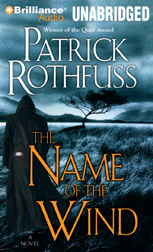
 The Name of the Wind
By Patrick Rothfuss; Read by Nick Podehl
28 hours – [UNABRIDGED]
Publisher: Brilliance Audio
Published: 2011
Themes: / Fantasy / Magic / Magicians / University /
The emperor may have clothes, but they didn’t fit me
A review by Brian Murphy
What do you want out of your fantasy? Exotic places? People different than the ones you know? High language? The clangor of battle? Wonders cold and distant and magnificent? The calling of silver trumpets? You don’t get any of this in Patrick Rothfuss’ The Name of the Wind. It feels very … pedestrian, and common. Rothfuss’ created world is very much like our own, and is altogether too much with us. Worst of all, its protagonist is annoying as hell. In my opinion.
I was fully prepared to love The Name of the Wind. I knew about the overwhelmingly positive reviews on Amazon, and the rave reviews from bloggers whose tastes and opinions frequently mirror my own. I was excited to see fantasy/SF luminaries like Robin Hobb, Ursula LeGuin, and Orson Scott Card (“He’s the great new fantasy writer we’ve been waiting for,” the latter wrote) singing its praises, and was fully prepared to do the same.
But the long and short of it is this: I didn’t love this book, and for long stretches, I didn’t even like it. Which makes me a bit sad, as I too was anticipating the arrival of a new great hope to emerge (or rescue, depending on your point of view) from the current crop of fantasy writers. As it turns out, I’m still waiting.
All that said, I recognize The Name of the Wind as a pretty solid artistic endeavor. In no way would I describe it as objectively bad, and the more I thought about it, I realized that it’s just not to my tastes. So I thought I would detail in this review why I didn’t like it, and then speculate on a few of the reasons why so many others have found it appealing. Of course, since I didn’t like The Name of the Wind very much, this review will spend much more time on the former, so be prepared.
The Name of the Wind is the first in a planned trilogy called The Kingkiller Chronicles. It details the life and times of a young man named Kvothe, a brilliant and talented magician doing his best to stay out of the limelight by posing as a simple innkeeper. When we meet Kvothe he’s in his early to mid 20s and is already a legend, though the events of his life have been exaggerated and mythologized. The Name of the Wind is essentially about a single day in which Kvothe sets the record straight for the loremaster Chronicler by giving the latter the full and true account of his youth and his subsequent rise to fame. We learn about Kvothe’s upbringing with a traveling group of minstrels and performers, to his days as a homeless street urchin, up through his first year at a University for wizards.
The Name of the Wind is epic fantasy length-wise (approximately 700 pages, and 23 discs in the audio version), but has nothing to do with J.R.R. Tolkien. It has everything to do with Harry Potter—Potter with a harder edge, yes, but Potter, unmistakably. When I read the description of the book and some of the reviews on Amazon I was expecting something closer to Ursula LeGuin’s Earthsea series—mythic, serious, a book with lessons to teach us about human nature and our place in the world. Instead I got a harmless, overlong soap opera.
I think we need a new name for this type of fantasy. This “positive” review (“Lovely and Undemanding” by Jo Walton or Tor.com) expresses one of my problems with the novel: its lightweight nature. Writes Walton, “It’s not very demanding—and I wonder if that’s precisely part of its wide appeal and success… I wonder if “undemanding” is something we actually seek in fantasy, if it’s part of the star quality that DAW instantly recognised in Rothfuss? … The Name of the Wind is a lovely read, but at the end there isn’t much to say about it.”
There is something to say about The Name of the Wind, of course, but the word that comes to mind is ordinary. I don’t mind applicability to the real world in my fantasy fiction, but what I don’t want is 1:1 equivalency. Aside from some sprinkled anachronisms (calling a week “a span,” or invoking the name of “Tehlu” instead of God) Rothfuss’ world is too much like our own. Half or more of the book is about Kvothe’s struggles with … student loans. Most of the problems Kvothe encounters are pedestrian: Young love, separation from his parents, completion of school projects on time, teachers who just don’t understand him. His college days also suffer from what I would call 90210 syndrome—despite the heavy workload we’re assured he’s suffering under, Kvothe seems to have endless time for hanging out with friends and sipping wine at the bar, or saving the town from marauding dragons. Which is much cooler than schoolwork, of course, but not entirely realistic. This is a problem, given that one of the conceits Rothfuss employs in The Name of The Wind is that he’s telling us a “real” story as opposed to a cliché fantasy. He uses the construction, “Now if this were a book, then X would have happened, but this is not a fantasy, and so here’s the real truth,” time and time again. But the problem is we never once feel like we’re in something other than a well planned, well coordinated, safe fantasy. Rothfuss does not have the maturity as a writer to pull off this conceit, in my opinion. Despite its claims to the contrary The Name of the Wind is a genre novel in every sense of the word. Again, that’s not a bad thing, and many readers have enjoyed it and will continue to do so. But let’s not pretend it’s anything more than another Belgariad.
This brings me to my first major problem with The Name of The Wind: I don’t like Kvothe. I don’t need to identify with the main character to enjoy a story, but I have to at least enjoy residing in their head space. I come up just short of actively despising the dude (Rothfuss does deserve praise for evoking that reaction in me, but I would bet it wasn’t his intent). The only way to explain Kvothe is that he is some avatar of the Gods. It’s utterly impossible for a boy his age to know what he knows. A precocious human child does not even come close to explaining his impossible adroitness and encyclopedic knowledge. Even after spending three years as a homeless street urchin, during which he did little but beg for coins and bread, Kvothe can rattle off every historical and anatomic question thrown at him by a brilliant panel of instructors to gain admission to the university. At one point he finds a dead man with a crossbow and knows how long the man has been dead, the type of crossbow he’s using, its cost, its usage, the fact that it’s illegal, etc. This is supposedly a medieval setting and yet what we have in Kvothe is a medieval McGyver, a walking Wikipedia page, applying scientific rigor and clear-headed rationality to every situation he encounters (another thing that irks me: The medieval tech level of Rothfuss’ world makes no sense. We have a college of brilliant teachers who have mastered anatomy and physics and every natural science known to man, yet are stuck reading rare books over candlelight and riding on horses).
One Amazon reviewer said that “Kvothe’s cockiness, arrogance, and impatience are constantly and quite believably landing him in trouble.” Except that they really don’t. Kvothe is not cocky and arrogant, save on a very superficial level. Impatient, yes. But his impatience lands him in minor scrapes from which he emerges undamaged or perhaps lightly scathed. He is, basically, perfect in every way, able to overcome every challenge with ease. For example, Kvothe takes the stage at a prestigious tavern to “earn his pipes,” a challenge which requires him to play before a tough, knowledgeable crowd to earn the distinction of master musician (yes, he’s an incredibly gifted lute player too. I didn’t mention that yet?). A jealous student sabotages Kvothe’s lute string so that it breaks at the height of his performance. But Kvothe is unflappable. It’s not even a real crisis, just a chance for Kvothe to again prove that he is that much better than we could have even thought. He finishes the most difficult song in the land with five strings and doesn’t miss a beat. Afterwards the audience weeps uncontrollably. There always seems to be a crowd around to applaud his every word. Hordes of faceless onlookers cheer his every act, applaud his every song, laugh at his every joke.
Kvothe’s only reported “fault” is his awkwardness with women and his inability to understand them, yet during one scene he compares his love Denna to a half dozen flowers with practiced, poetic ease, wooing her as no suitor before ever could. Denna returns the favor, spending paragraphs describing how Kvothe’s eyes change color when his emotions are aroused and how beautiful his red hair is. Kvothe flatters her back, telling her that only one other person has ever noticed that his eyes change color… this is bad romance novel stuff.
As for its originality? Sorry, I’m not seeing that either. The magic system seems very much cribbed from Ursula LeGuin, the conceit that knowing the true name of something grants you power over it.
So after all that grousing what is there to recommend about The Name of the Wind? At the sentence level Rothfuss is a pretty good writer. I think he’s better than Terry Brooks, and better than Stephen Donaldson. The Name of the Wind is compulsively readable, which is no mean feat. Stephen King has been labeled by a number of critics as pedestrian or lightweight, yet most of these guys can cite chapter and verse of his books and have apparently read all of them straight through. That’s because he’s so darned readable. So is Rothfuss. The story is easy to follow and carries you along to the end.
Second: Rothfuss gives you a lot of cool stuff to gawk at. Teachers engaged in a decades long war over the proper way to shelve books. A room where papers are cast to the wind and land on tiles labeled with “yes,” “no” and “maybe,” answering your questions unerringly like a medieval magic eight ball. And so on. Again, very Harry Potter-esque with its fine imaginative touches. Rothfuss also embeds lots of “Easter Eggs” and bits that prove significant later on, or lead the reader to speculate about their importance in the story. There’s lots of chatter by fans about why the evil Chandrian are so secretive, what the Underthing (mysterious passages and rooms beneath the school) are all about, and so on.
Yet a third reason: The Name of the Wind is a nice change of pace from the “GrimDark” fantasies of Joe Abercrombie, George R.R. Martin, and Richard Morgan, where everyone is a bastard and ends up raped, or dead, or both. We can cheer for Kvothe, and enjoy his scrapes, and perhaps remember what it was like to love our first girl with an unrequited love, or when we could barely scrape together six bucks on a Thursday night for a pizza.
In summary, The Name of the Wind is the product of a good writer with a lot of potential but did not deliver what I was looking for. Your mileage will vary, of course.
Posted by Brian Murphy


 The SFFaudio Podcast #143 – Scott, Jesse, Tamahome, and Kristin (A.K.A Terpkristin) talk about recently arrived audiobooks, new releases and more.