The SFFaudio Podcast #131 – TALK TO: Julie Hoverson of 19 Nocturne Boulevard

Podcast

The SFFaudio PodcastThe SFFaudio Podcast #131 – Jesse, Scott, and Tamahome talk to Julie Hoverson of 19 Nocturne Boulevard

Talked about on today’s show:
how do you say “hiatus”?, “one woman butt kicking army”, third year anniversary, 74 episodes, The Dunwich Horror by H.P. Lovecraft audio drama, Bill Hollweg is in The Deadeye Kid, Maine accents, The Leech by Robert Sheckley (secretly), comedy, A Date With Dana was funny, classic storylines, The Rookie won the Mark Time Award, “line up to get killed by their favorites”, “I love creepy old ladies”, Crumping The Devil, The Imp Of The Perverse, Lovecraft’s The Thing On The Doorstep, Within The Walls Of Eryx is “straightforward sci-fi”, Dis Belief is from a Jorge Luis Borges story, puns, finding the copyright owner, finding quality audio drama, Julie’s audio blog about oversight, we need curation, Voice Hollywood does their own ratings, Julie will be at the next Balticon, Balticon Podcast, there’s never enough people to help, Geek Girl Con, editing the parts together, simultaneous recording?, Julie is in The Radio Drama Handbook by Richard J. Hand and Mary Traynor, The Grand Guignol is violent theater, The Thrice Tolled Bell is like a Hammer film, “cuz I’m crazy”, what dramas does Julie like?, We’re Alive (The Zombie Podcast, also from Blackstone Audio), why do it?, Julie tried to develop a “dead serial killer buddy movie”, Wormwood, comics, Five Fingers Of Doom, short stories, timing your podcast releases, “the mentality of slackness”, for the nasty creepiness: One Eighteen: Migration, Julie’s The Gift Of The Zombi an Xmas show, zombies in love, “zombies are the new cowboys”, a half-hour is a good length, fan dogs on Facebook, “what’s the best science fiction audio drama around?”, Kim’s Warp’d Space involves milk runs, Children Of The Gods, The Leviathan Chronicles, Julie is in Edict Zero (created by Jack Kincaid who did The Geek’s Guide To The Galaxy intro), a cop show on a future colony, how complicated can a show be?, “there’s always engaging things”, Big Finish are pros, “fanfic”, Darker Projects Star Trek tie-ins (Tamahome listened to Lost Frontier), Jesse wants A Princess Of Mars drama, who’s got the rights?, adapting a novel, William Shakespeare, Cymbeline Revisited, Edwardian Entertainments, The Yellow Wallpaper

Posted by Tamahome

The Sci-Fi Christian Podcast

SFFaudio Online Audio

Sci-Fi ChristianThe Sci-Fi Christian is a podcast (and site) about books, comics, movies and TV shows (with a heavier emphasis on the latter two). As you might surmise the hosts, Matt Anderson and Ben De Bono, are both Christians. As such they talk about the intersection between their beliefs and the media they consume. The premise, as laid out in the first episode |MP3|, is that they’ll be asking questions like ‘Was Jesus a Zombie?’ and ‘What does God think about teleportation? (Is it suicide?).’

Here’s the official description:

“We see The Sci-Fi Christian, in all its iterations, as being about the collision between faith and nerdom. We believe that good genre fiction is about more than just entertainment. We seek to engage with the themes and philosophies behind our favorite stories, wrestling with the big ideas within speculative fiction. We’re unabashedly nerdy and unabashedly Christian. Even if your faith background differs from ours, we look forward to interacting with you at The Sci-Fi Christian!

If you’re a theist you may like this. But even from an outsider’s perspective there is a lot to like in this show. The hosts don’t have identical tastes in the properties that they enjoy (which makes for a sparkier conversation). Also good is that they’re genuinely and equally enthusiastic about the subjects they discuss.

I myself am less enthused. This is not because I am not a Christian. As with every show that I’ve heard that uses the “Sci-Fi” shibboleth in its title there is a certain lightness to The Sci-Fi Christian Podcast that turns me off. Perhaps the best identifier of such a podcasts is a pervasive usage of the words “spoiler” and “spoiler alert.”

I will happily go to the grave never having to hear the phrase “spoiler alert” or listen to someone discuss whether something was (or wasn’t) “a spoiler.” To my mind the whole “spoiler” meme is one that, if it has value at all, should be only acted upon and never discussed.

Podcast feed: http://thescifichristian.com/podcast/

Posted by Jesse Willis

CBC Q: Interview with Margaret Atwood

SFFaudio Online Audio

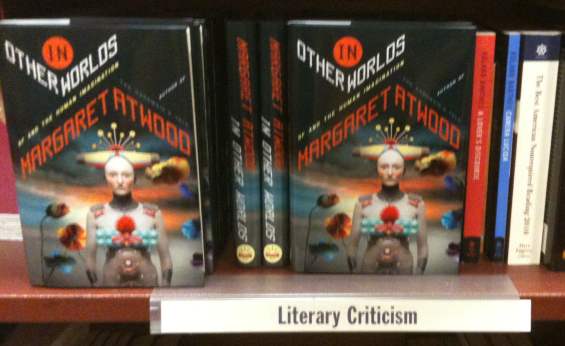
CBC Radio One - Q: The PodcastHost Jian Ghomeshi of CBC Radio One’s Q has an astounding new interview with Margaret Atwood. Atwood’s latest book, In Other Worlds: SF And The Human Imagination, can be found in the “Literary Criticism” section of your local paperbook store.

Gomeshi talked to Atwood about the realistic novel, comics, Weird Tales and the “sluttish” reputation of SF.

In Other Worlds by Margaret Atwood

One point in the interview left me confused and asking questions. Atwood claimed that “Conan the Barbarian is the literary descendant of Walt Whitman … and Henry James”.

I am floored.

What the fuck is she talking about?

Seriously, did she misspeak?

Did she mean to say that Robert E. Howard himself was their literary descendant?

Surely she didn’t mean the the character. Either way I don’t get it.

Or maybe she meant the stories themselves were somehow in the tradition of Walt Whitman and Henry James??? How could that be?

No matter how I look at it I don’t see how either Walt Whitman or Henry James ties into Howard. It just doesn’t make any kind of sense to me.

Does anybody know what the hell Atwood meant by that?

Seriously, I do not get it.

Will I have to buy her book to understand this thesis?

Have a listen |MP3|.

Podcast feed: http://www.cbc.ca/podcasting/includes/qpodcast.xml

Posted by Jesse Willis

P.S. CBC, please release Apocalypse Al. You can call it “scientific romance” or something else, just release it.

Recent Arrivals – Brilliance Audio + COMICS

SFFaudio Recent Arrivals

The Rise Of Endymion by Dan Simmons
Day By Day Armageddon by J.L. Bourne
The Unincorporated War by Dani Kollin and Eytan Kollin
Swords And Deviltry by Fritz Leiber
Fafhrd And The Gray Mouser adapted by Howard Chaykin
The Outfit adapted by Darwyn Cooke
Sense And Sensibility adapted by Nancy Butler

Posted by Jesse Willis

Scientific American – 60-Second Science – Moon Not Made of Cheese

SFFaudio Online Audio

Scientific American  - 60-Second ScienceEvery once in a while I have an surreal conversation. The conversation usually begins when a person says something I misunderstand. They claim something and then proceed to tell me about it. I assume that the person in question’s claim is a claim about the universe (I assume that because that’s the place I’m trying to understand). When the surreality begins is when it turns out that they are actually talking about is a part of the world – I guess that’s their perception of it.

The other day I had one when a friend of mine suggested I read a book called Fringe-ology. He described it as “a good book.”

Was he right? Is Fringe-ology a good book? The title sounded frighteningly unfruitful to me.

The question I then asked myself was: “Must I read it to form my own judgement?”

It was highly rated on Amazon.com (five stars and twenty five reviews). Did that fact make it “a good book?”

The book’s subtitle, How I Tried to Explain Away the Unexplainable-And Couldn’t, didn’t make me want to read it either. Science, as I understand it, isn’t about “explaining away” anything (unless you are speaking metaphorically, which the practice of science certainly doesn’t embrace). And the “unexplainable” is a term that shows some seriously misguided thinking about reality (based on my reading of science history). Perhaps that was just marketing though.

Upon closer examination there is something else that makes me question Fringe-ology being a “good book” – there is a bent spoon on the book’s cover.

That is not a good sign.

To try to convince me to read Fringe-ology: How I Tried to Explain Away the Unexplainable-And Couldn’t my friend said this:

“[the author Steven Volk is a] Hard-nosed news reporter who looks honestly at this stuff. And find he can’t disprove much of it.”

I suggested that no matter how hard one’s proboscis, the act of setting out to disprove something wasn’t science.

My friend then went on to talk about the reams of sworn eyewitness testimony to the existence of UFOs. And that they would be admissible as evidence in a court of law.

I then suggested that “reality is not determined by a judicial process.”

It was at about this point that I twigged to some sort of incommensurability in our communications. I was talking about the world, as discovered by the practice of science, and my friend was talking about some other way of seeing the world (that I think is demonstrably false – but perhaps enjoyable or something).

In the end I may have to accept my friend’s judgement about my character. He said I was a “closed” person. He may be right. I will not read horoscopes, I will not accept sworn eyewitness testimony for paranormal claims, and I don’t expect to be reading Fringe-ology: How I Tried to Explain Away the Unexplainable-And Couldn’t any time soon – at least not without some more compelling reasons than I’ve been given.

There’s another way to put all of the above.

My friend was talking about institutional facts and I was talking about brute facts. He thinks the inexplicable exists, whereas I suggest that a book about the inexplicable is going to be zero pages long.

Which brings me to this extraordinarily boring (but presumably useful to my friend) story from Scientific American’s 60-Second Science podcast: “Moon Not Made of Cheese” – which takes a very pragmatic approach to debunking shitty ideas.

|MP3|

Podcast feed:

http://rss.sciam.com/sciam/60secsciencepodcast

Posted by Jesse Willis