StarShipSofa No 194 Eric James Stone

SFFaudio Online Audio

StarShipSofaThe 194th StarShipSofa contains Eric James Stone’s Nebula Award winning (and Hugo nominated) novelette “That Leviathan, Whom Thou Hast Made”. Great story, well worth a listen!

|CLICK HERE|

You can find another of his great stories at Escape Pod: EP277: Rejiggering the Thingamajig by Eric James Stone

Posted by Scott D. Danielson

Recent Arrival: Doc Savage – Python Isle

SFFaudio Recent Arrivals

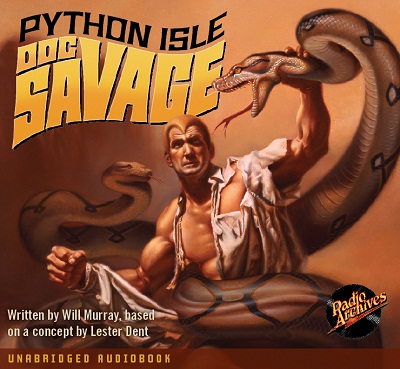
Science Fiction Audiobook - Doc Savage - Python Isle by Will Murray

Just in from RadioArchives.com:

For over eighty years, the name Doc Savage has meant thrills and excitement to millions of readers worldwide. Now, for the very first time, the Man of Bronze comes to vivid life in “Python Isle”, the first audiobook adventure from RadioArchives.com.

In “Python Isle”, a long-lost pioneer flyer returns to civilization accompanied by an exotic woman who speaks in a lost tongue. From his towering skyscraper headquarters in New York, through a dangerous Zeppelin journey to Cape Town, climaxing on a serpent-haunted island in the forbidden reaches of the Indian Ocean, Doc Savage and his iron comrades race to untangle a weird puzzle so deep that the only clues can be found in the Bible!

Written by Will Murray and produced and directed by Roger Rittner – the same team that brought you “The Adventures of Doc Savage” radio series – “Python Isle” features dramatic narration by Michael McConnohie, cover art by Joe DeVito, and two exclusive interviews with Will Murray on the history of Doc Savage and the discovery of author Lester Dent’s long lost manuscripts.

|CLICK HERE| for more info, including an audio sample!

Posted by Scott D. Danielson

Review of The Broken Sword by Poul Anderson

SFFaudio Review

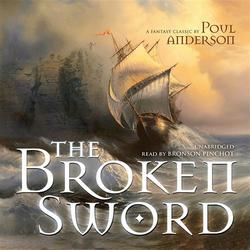
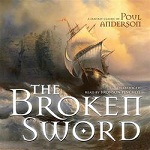
Fantasy Audiobook - The Broken Sword by Poul AndersonThe Broken Sword
By Poul Anderson; Read by Bronson Pinchot
7 CDs – 8 Hours – [UNABRIDGED]
Publisher: Blackstone Audio
Published: 2011
ISBN: 9781441786876
Themes: / Fantasy / Vikings / Myth / Battle /

The Viking Age of England offers fertile ground for storytelling. It was a time of strong men, beautiful fair-haired women, and bloody raids for plunder. Christianity was the new religion on the block, striving to make inroads on the old pagan beliefs—and often at the point of a sword. Gods were said to mingle with men and the world lay poised on the edge of Ragnarok, a final battle and fiery conflagration that would end the world.

Poul Anderson drew on the best of this wild and poetic age, stirred it up with myth and fantasy, and the result was his 1954 novel The Broken Sword. Its like has rarely been matched in the annals of fantasy literature.

I’ve read The Broken Sword previously and knew what a wonderful book it was, but TV and film actor Bronson Pinchot’s narration in this new Blackstone Audio, Inc. production added a new dimension to the novel. I had first heard Pinchot in a reading of Stephen King’s Eyes of the Dragon. While he was wonderful there he ups his game in The Broken Sword, reading with a spite and fury in his voice that perfectly matches the book’s unrelenting grimness and battle fury. Pinchot breathes life into beautiful maidens and proud warriors, deep-throated trolls, and ancient elven warrior-kings whose voices are like winds sighing through treeless leaves.

Oddly enough there is exactly one sound effect in the entire recording—an echo effect used to convey the cold, cruel laughter of Odin—and it’s on the final disc. It was cool but rather jarring, considering it’s on the last disc and there’s no precursor. But on to the tale.

In The Broken Sword the land of Faerie exists alongside the lands of men, invisible save to those with the witch sight. Faerie is a land of bright castles and achingly lovely elves, of the gods of Odin and Tyr, the giants of Jotunheim, black-eyed trolls, and other, fouler monsters.

Pride and ambition touches off the events of The Broken Sword. Orm the Strong is the fifth son of Ketil Asmundsson and thus low in the totem pole of inheritance. Rather than accept a smaller share of wealth Orm seeks his own fortune by going a–viking. On one of his raids he kills a husband and his sons, burning their hall to the ground. The man’s mother, a witch, escapes and swears revenge: She bestows a curse that Orm’s eldest son will be fostered beyond the world of men, while he in turn will foster a wolf that will one day rend him.

The elf-earl Imric travels to the lands of men and sets the witch’s curse in motion. Imric takes Orm’s unbaptized infant son Skafloc and replaces him with Valgard, a changeling, whom Imric himself has fathered by raping a captive troll woman. Valgard’s dark ancestry is evident when he bites his unknowing mother’s breast and grows restless and violent in Orm’s care. Skafloc, raised among the elves, is fair haired and fair of spirit, though equally mighty and otherwise a mirror image of his dark changeling “brother.”

After he discovers his true half troll, half-elf heritage, Valgard embarks on a mission of revenge, killing several members of his foster family. Aided with an army of trolls he then launches a war of annihilation on the elven lands of Alfheim. Skafloc and the elves are beaten back by the initial assaults and all seems lost. Only by going on a quest to reforge a powerful ancient weapon—the eponymous broken sword, a weapon of terrible demonic power that demands blood each time it is drawn and ultimately turns on its wielder—can Skafloc save Alfheim and avenge his family.

Though The Broken Sword seems largely forgotten these days it remains influential. The elf Imric for example reveals the clear stylistic (and thematic) influence The Broken Sword had on subsequent authors like Michael Moorcock. Moorcock (a big fan of the book, who once wrote thatThe Broken Sword “knocked The Lord of the Rings into a cocked hat”) based his Melniboneans heavily on Anderson’s elves. Imric is (largely) Elric of Melnibone, not only in similarity of name, but in appearance and even character. Anderson’s Elves are darker than those in The Lord of the Rings (though I would point out that Tolkien’s elves closely resembled Anderson’s in his source material; see the prideful warrior Feanor from The Silmarillion). They are haughty, prideful, shun the sunlight, and if not malicious are certainly mischievous. These traits have their roots in Norse myth, which both Tolkien and Anderson drew upon.

Everything about the book is wonderfully northern. Characters mingle soaring verse with common speech in conversation. Anderson weaves old northern vocabulary into the tale, evocative words like “Fetch,” “Fey,” and “Weird” (the latter is a fate from which no man escapes), which lend The Broken Sword a hard northern ethos to match its flavor. In this pagan hierarchy the Norns are higher than the towering Jotuns or even the Aesir. Even the gods will die in the fires of Ragnarok at their appointed time. That grimness bleeds through into The Broken Sword as its protagonists are slowly crushed beneath the merciless wheel of fate.

“Throw not your life away for a lost love,” pleaded Mananaan. “You are young yet.”

“All men are born fey,” said Skafloc, and there the matter stood.

This is hard stuff and an unforgiving outlook on life, though not incompatible with that other somewhat famous work that debuted in 1954—Tolkien’s Fellowship of the Ring. No matter what Moorcock—he of the tin ear when it comes to Tolkien analysis—may tell you.

The writing in The Broken Sword is top-notch, really and truly great stuff. A small sample of dialogue uttered by the troll-woman Gora:

“The world is flesh dissolving off a dead skull,” mumbled the troll-woman. She clanked her chain and lay back, shuddering. “Birth is but the breeding of maggots in the crumbling flesh. Already the skull’s teeth leer forth and black crows have left its eye sockets empty. Soon a barren window will blow through its bare white bones.”

One final, important note about the Blackstone recording: The text is Anderson’s original from the 1954 version of the book, which Anderson updated in 1971 for republication in the Ballantine Adult Fantasy line. This is not immediately apparent from the description on the Blackstone website. I’ve only read the 1971 version, so for those who haven’t had the chance to experience The Broken Sword in its earliest and rawest incarnation you now have another chance.

Posted by Brian Murphy
Geekscape: interview with Simon Pegg

SFFaudio Online Audio

GeekscapeSimon Pegg is the latest guest on the Geekscape podcast (#215). Pegg talks about his memoir Nerd Do Well as well as Green Lantern, Star Trek, Shawn of the Dead, Hot Fuzz, Paul, Super 8, Mission Impossible: Ghost Protocol, Star Trek 2, The World’s End, Community and Spaced.

|MP3| (video available too |M4V|)

Podcast feed: http://pod.geekscape.tv/Geekscape-Audio.xml

iTunes 1-Click |SUBSCRIBE|

Posted by Jesse Willis

2010 Mark Time and Ogle Award winners and honorable mentions

SFFaudio News

The Mark Time AwardThe 14th annual Mark Time Awards and Ogle Awards, presented at Convergence 2011, June 30th, in Bloomington, MN, are from “a wider range of countries than ever before.” Both awards are juried. The Mark Time Award is for distinguished achievement in Science Fiction audio theater production. The Ogle Award is presented for Fantasy and Horror audio theater production. The awards presentation will take place at Convergence 2011, June 30th, 2011 in Bloomington, MN. Six of the eight producers are scheduled to be in attendance as well as three of the five judges.

Mark Time Award:

GOLD
The Truth: Moon Graffiti
Written & Produced by Jonathan Mitchell
New York, NY

SILVER
The Cleansed, Pilot Episode
FinalRune Productions
Written & Produced by Fred Greenhalgh
Alfred, ME

HONORABLE MENTIONS
1918
Aural Stage
Written by Richard Lovejoy
Producers, Matthew Boudreau, Samantha Mason
Buffalo, NY

Brad Lansky And The Anti-Starc
Protophonic
Written by J.D. Venne
Producer, Dieter Zimmermann
Cape Town, South Africa

Ogle Award:

GOLD
Whoever Wishes
Tekdiff
Written & Produced by Cayenne Chris Conroy
Minneapolis, MN

SILVER
We’re Alive, Chapter 17, “There Might Be Others”
Zombiepodcast
Written by Kc Wayland
Producers, Kc Wayland, Shane Salk
Orange, CA

HONORABLE MENTIONS
Soul Survivor
Sonic Society
Written & Produced by Jack. J. Ward
Bedford, Nova Scotia, Canada

The Witch Hunter Chronicles
Audio-epics
Written and Produced by Domien de Groot
Deurne, Belgium

Posted by Jesse Willis

The SFFaudio Podcast #113 – TOPIC: Stupidity and Intelligence in Science Fiction and Fantasy

Podcast

The SFFaudio PodcastThe SFFaudio Podcast #113 – Jesse and Eric S. Rabkin talk about Stupidity and Intelligence in Science Fiction (and Fantasy).

Talked about on today’s show:
Johann Wolfgang von Goethe’s The Sorcerer’s Apprentice, Mickey Mouse, Fantasia, Christopher Marlowe‘s The Tragicall History of the Life and Death of Doctor Faustus, Brothers Grimm Clever Hans (the fairy tale), Clever Hans (the horse), War With The Newts by Karel Čapek, Excerpt from (Book Two – Up the Ladder of Civilisation), trephination, “there are some things man was not meant to know”, evil science and evil scientists, R.U.R., Mary Shelley’s Frankenstein, Frankenstein is an egotist whereas the creature wants community, Chapter 11 of Frankenstein, intellect vs. empathy, “One man’s life or death were but a small price to pay for the acquirement of knowledge which I sought.”, the ideology of intelligence is suspect, Gulliver’s Travels, Laputa, philosophers, The Clouds by Aristophanes, “head in the clouds”, BBC Radio dramatization of Lysistrata, The Black Cloud by Fred Hoyle, “the big bang”, telepathy, Gregg Margarite, “Genius in not a biological phenomenon.”, “stupid people can have smart babies and smart people can have stupid babies”, eugenics, sterilization programs, “we know so little about what we mean by intelligence”, “we breed against the outliers”, “If I see further than others it is because I stand on the shoulders of giants”, Sir Isaac Newton, Newton vs. Leibniz, Darwin vs. Wallace vs. Darwin’s grandfather, Robert A. Heinlein, “steam engine time”, Columbus and the egg, humans (persons) can compound our intelligence, Flowers For Algernon by Daniel Keyes, Charly, “we shouldn’t define humanity by our intelligence”, The Time Machine by H.G. Wells, flowers from Weena, “fundamental humanity has to do with emotion and not intelligence”, He, She and It by Marge Piercy, programming a robot with stories, Yod is a robot-like golem, “it was immoral to create a conscious weapon”, The Doomsday Book by Connie Willis, Eric is the world’s least reliable critic of The Doomsday Book, The Invisible Man by H.G. Wells, philosophy of science, the meaning of weapon, We by Yevgeny Zamyatin, tool vs. weapon, “we have one mad scientist after another”, Gojira!, Ozymandias, Watchmen, Understand by Ted Chiang, “talking to babies”, “if everyone in the world around you is an idiot…what kind of relationship can you have with the world”, His Masters Voice by Stanisław Lem, Hogarth is an incredibly intelligence person, Edgar Allan Poe, Audible Frontier’s Solaris: The Definite Edition, The Futurological Congress, Isaac Asimov, Eric puts on his professorial hat, nous, the etymology of the word “intelligence”, Asimov reads between the lines for you, the etymology of the word “stupid”, what’s with the word “sentient” in Science Fiction?, Beyond Lies The Wub by Philip K. Dick, ansible, “sentience is the bag that we put all our coding for equally human”, was Larry Niven the prime promulgator of the SF version of “sentience”?, The Island Of Doctor Moreau by H.G. Wells, “words are a map on the world”, The Time Machine, evolution and the clash of the classes, Wells respects the intelligence of his readers, Morlocks vs. Eloi, the King James version of the Bible, “Eloi Eloi Lama Sabachthani“, Hugo Gernsback, Amazing Stories, “whizz bang sensofwunda”, The New Accelerator by H.G. Wells, “the warp drive is not important”, “the ansible is not important”, “we are all time travelers”, “in Wells’ greatest works he leaves some part of the story open”, “but whether this was a reprieve for us or them only time will tell”, Experiment In Autobiography by H.G. Wells, The Gods Themselves by Isaac Asimov, “Against stupidity the gods themselves contend in vain”, Friedrich Schiller, reporters became cynical now they just go see what’s happening on Facebook, The Marching Morons by C.M. Kornbluth is public domain, much of Kornbluth is PD because he died so young, The Space Merchants by Frederik Pohl and C.M. Kornbluth, Little Black Bag by C.M. Kornbluth, Idiocracy, stupid people have lots of (stupid) babies (?), what’s wrong with The Marching Morons?, PLENTY!, “The Marching Chinese”, Thomas Robert Malthus, eugenics and dysgenics, what ties do genetics and intelligence have?, a very high fraction of American presidents have been left handed, immigrant groups produce terrific comedians, Microcosmic God by Theodore Sturgeon, storing up ideas for my “word hoard”.

The Marching Chinese

Posted by Jesse Willis