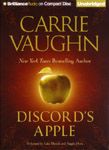
 Discord’s Apple
By Carrie Vaughn; Read by Angela Dawe and Luke Daniels
8 CDs – Approx. 9 Hours 12 Minutes [UNABRIDGED]
Publisher: Brilliance Audio
Published: July 6, 2010
ISBN: 9781441876003
Sample |MP3|
Themes: / Fantasy / Magic / Gods / Family / Romance / Greek Mythology / Colorado / Terrorism / Arthurian Legend / Russia / Los Angeles / Immortality /
When Evie Walker goes home to spend time with her dying father, she discovers that his creaky old house in Hope’s Fort, Colorado, is not the only legacy she will inherit. Hidden behind the basement door is a secret and magical storeroom, a place where wondrous treasures from myth and legend are kept safe until they are needed again. Of course, this legacy is not without its costs: There are those who will give anything to find a way in. With the help of her father, a mysterious stranger named Alex, and some unexpected heroes, Evie must guard the storeroom against ancient and malicious forces, and protect both the past and the future even as the present unravels. Old heroes and notorious villains alike rise to fight on her side or to do their best to bring about her defeat. At stake is the fate of the world and the prevention of nothing less than the apocalypse.
Novels with alternating storylines, like Discord’s Apple, are probably easier to write than regular single plot novels. I’ve never come across one that defeated the main problem of such novels. It’s the problem of comparison. The present (alternate present) storyline in Discord’s Apple is far less compelling than those parts which are set during, and in the immediate years following, the Trojan War. By disc three it had become abundantly clear that the two storylines would meet up – and that the more interesting part of the book would be subsumed by the lesser. But, as the novel progressed MORE storylines were added and none of them were very promising. First there was The Eagle Eye Commandos story, the story of a set of G.I. Joe knock-offs that are, we are told, ‘the most popular comic book series in the USA.’ That storyline is told in a third person ominscient POV, as if were’ reading over Evie’s shoulder while she writes it on her laptop. That’s a big problem. I’ve seen scripts for comic books. They look nothing like what Evie writes for her artist collaborator – she’s writing standard prose, not a comics script, the artist would have to adapt what Evie wrote and dumping most of it. Then, just to confuse things just a little more, we get an out of nowhere historical Walker family storyline. It goes nowhere. Then, another short lived storyline will pop up for a chapter, then disappear, never to be heard from again. By disc five, these trends, along with many other warning signs, had cast a dread pall over my hopes for the novel’s conclusion.
It is never good when an author shows contempt for her story or for her readers. Carrie Vaughn is guilty of both of these authorial sins. As was pointed out in detail on Charlie Stross’ blog even the opening scene of Discord’s Apple is a mess. It is, of course, described (not shown) and features the destruction of “The Kremlin” by an Cessna full of kerosene:
He made a noise like a deflating balloon. “The Kremlin’s been bombed. Obliterated. A Cessna filled with drums of kerosene rammed it. They’re thinking it’s Mongolian rebels.”
She took a moment to register that he was talking about current events and not a plot point in their comic book. “Then our May storyline is out the window.”
The Eagle Eye Commandos couldn’t raid the building complex if it wasn’t there. She should have seen this one coming.
“Yeah. Unless we can put some kind of ‘how things might have been’ spin on it.”
Uh …. no. How could she have seen this coming? That whole passage should stop you in your tracks. Let me lay it out for you:
1. The biggest Cessna ever built carries no more than a dozen passengers and crew, the Cessna brand, moreover, is widely known to be a small aircraft manufacturer, with pretty much every single model ever built measuring far less than the 16 meters of their very largest passenger jet.
2. The Kremlin, meanwhile, is a massive fortress without one central structure. It measures a vast 68 acres and yet this plane full of drums of kerosene “obliterated” it. I would be very much surprised to learn that even the worlds biggest aircraft could completely destroy the Kremlin with any number of drums of Kerosene stuffed into it. Consider this, even with a maximum capacity of 27,276 liters the largest water bomber in the world, the Martin Mars, world only be able to drench four acres in a single pass. At that rate it would require no less than sixteen passes to completely cover the Kremlin with Kerosene – and that would assume that every pass had no overlaps.
3. Worse, why would “Mongolian rebels”, of all rebels, attack the Kremlin? That makes absolutely no sense at all. Russia and Mongolia have essentially been staunch allies for the last five hundred years. Russia never annexed Mongloia, doesn’t claim any part of it as a part of Russia, and didn’t even incorporate it into the Soviet Union. This is an absolutely monumental gaff – as backward as expecting the Palacio Nacional in Mexico City to be attacked by Quebec separatists.
And she should have ‘seen it coming’?
Other signs of contempt for the reader litter the novel. At one point the main character, a comic book writer, notes that the events that have just happened to her seemed unbelievably “overwrought” – after which she makes a point of filing them away for future use as a plot twist in her comic book series. She wants to add an unbelievable and overworked event to her own writing … what is a reader supposed to takeaway from that other than Vaughn is pissing on our shoes? Is she thumbing her nose at comics?
More stumbling blocks – as the “terrorism” in Russia continues we’re told that trainyards and shipyards are the targets. Yeah …. no …. that doesn’t sound like terrorism – it sounds like war. Terrorism is violence intended to foster terror. Blowing up a shipyard, attacking a citadel, derailing a train – that all is far more targeted than than strategic bombing of Europe in WWII. Carrie Vaughn seems blissfully ignorant of the meaning and import of the word “terrorism.”
But it doesn’t stop there! Vaughn has her central character, a rough analogue for herself, say that the Trojan Horse was the “car bomb” of its day. After hearing that I was figuratively shaking my head for about an hour.
That character, Evie Walker, then does some stunt driving while being chased by a herd of coyotes. In so doing she executes something she calls a “Hollywood turn.” … What I assume that Vaughn was actually referring to is, in fact, called either a Rockford or Moonshiner’s or J-Turn (and never a “Hollywood turn”).
Evie Walker also casually mentions that a drive through Los Angeles requires multiple stops and searches – adding hours to a commute. But it doesn’t end there, even the small town in Colorado, as depicted in Discord’s Apple, exist under a draconian police state. A drive through the city center means a warrant-less search of your vehicle and a questioning by police. There’s also food rationing. It isn’t explained, none of it. That’s shocking and interesting stuff and yet it has absolutely no follow up in the book whatsoever. Evie Walker doesn’t seem alarmed by it, finds it mildly annoying (and maybe even comforting), but she doesn’t mention it as being particularly shocking or even attempt to explain why it isn’t. What the fuck?
At first I thought maybe that my problems with Discord’s Apple were the same kinds of problems I had with Catherine Asaro’s Sunrise Alley |READ OUR REVIEW|. I thought that maybe Carrie Vaughn’s focus and interest just wasn’t on the stuff I care about: ideas, attention to detail, and the surprising (but logical) consequences to those ideas and details. But upon further consideration I don’t think that’s true. Vaughn’s writing technique for Discord’s Apple consisted of remixing her Sinon fan-fiction with events in her own life, filtered through a magical grab bag of other mythology and politics that she is only very dimly interested in. A few aspects of this novel could have worked had they been more focused and perhaps less slap-dashed together. Was she writing on a tight deadline? Couldn’t she do some revision? I don’t know.
The return of King Arthur (and Merlin) – ok why not? Sadly, this epic pair seem to be merely active mannequins in Discord’s Apple – their presence may have initially been to offer a possible rival love interest for the protagonist, but that doesn’t even come close to ripening. What about that artist penciler/inker partner on the comic book Evie Walker is writing? Oh him? Apparently he’s there solely to give Walker someone to talk to, setup the novel’s unpaid off premise. He just dries up and blows away.
What about that mysterious new dog, Queen Mab, that Evie’s father has? You know, the one with more emotion, knowledge and expression than all the rest of the characters in the novel? Oh that? It’s just what Vaughn would call her “Wash” techniques – something designed to manipulate the audience’s expectations. Consider me manipulated.
It is terrible.
The best part of the novel, the part that is actually alright – good even – the part that Vaughn wrote with passion and attention: That’s Sinon’s story. The rest, set in Evie’s time (or whenever else Vaughn went with the roving POV) is full of characters that are only minimally purposeful. Their goals are only strong enough to push them onto the stage, not strong enough to explain what they’re doing there or explain why they skulk-offstage when someone else is talking.
Or to put it another way – if this novel was a piece of clothing it would be a sweater. But unfortunately it’d be the kind of sweater that started out as a smart-looking and comfortable scarf and has now has been inexplicably knit-into an unwieldy sweater/dress/hat garment with a dozen fist sized holes in it. This sweater may be somewhat fashionable in some parts of the book store sweater store. Maybe it’ll be popular with the talented readers who don’t have time to think about what they’re reading. But for a Science Fiction reader, like me, who tries on a book sweater thinking it will be a garment with a particular purpose in mind, well he may find that every string of that sweater’s yarn wants to unravel. Or to put it in Carrie Vaughn style terms:
It’d be like the arrival of the president of the radical monarchist league (driving an Austin-Healey Bug Eyed Sprite with 17 liters of re-fried beans in the glove compartment) to an Outer Limits cast reunion party in Ruritania. Yep. It’s going to mess-up President Al Franken’s America in many magically unproductive ways! I should have seen it coming.
The shame of it is that Vaughn’s probably could write a lot better than Discord’s Apple. What works in the novel works well. Over on John Scalzi’s blog Vaughn wrote:
I have more ideas than I will ever be able to write in my lifetime. One of my solutions to this dilemma is to put as many ideas in a book as I can manage. The more disparate the better, because finding connections between seemingly unrelated ideas can make for great stories.
In a grad school Latin course, I translated bits of the Aeneid and fell in love with Sinon. He’s the Greek spy left behind to talk the Trojans into bringing the horse into the city. He’s brash, clever, and really awesome. So I committed a very long piece of fanfic telling what happened to Sinon after the war — he was kidnapped by a very pissed-off Apollo, made a slave, granted immortality so he’d be a slave forever, and. . .well. You’ll just have to read about it, because his story is the second part of Discord’s Apple, in which we learn that the Trojan War never really ended. (It all fits together, honest.)
At first, I didn’t know quite what to do with this very long piece of fanfic. I got to thinking about the nature of epic literature in general, and I decided that Sinon’s story needed to be part of Evie’s story. You see, “Evie returns home to discover an amazing heritage” is just an idea. But Evie and Sinon meeting each other, the chaotic events surrounding that meeting, and the fact that the goddess Hera still wants to get her hands on that apple – that’s a story.
Throw in King Arthur and my deep and irrational fondness for 1980′s GI Joe comics and what I ended up with was a novel about family, storytelling, history, and war and how they get tangled together.
This right here is the whole problem. Ideas are what stories should be about. But what Vaughn doesn’t realize is that not all ideas are gold. Not all ideas should include everything you think to include, not all of them fit together. A book about a comic book writer living in a Alternate Present USA police state? That sounds really cool. A book about King Arthur returning? That could be cool. A book about a woman who returns home to take care of her dying father only to discover that every magical artifact from history is in the basement? COOL! All together it is a mess.
Vaughn’s not short of ideas, not even short of good ideas. She’s short of a filter, an editor. Vaughn needs to have someone really critiquing the shit out of her ideas, really making the novel focused. Vaughn is a huge Sinon of Ithaca fan, and with the parts of this book set during and after the Trojan War she has made me one too. The market may not be clamoring for fiction rooted wholly in Greek Mythology, or for a book about a comic book writer living in an alternate USA, but I am. What I’m not clamoring for is a novel about all of those things in one.
The audio production itself is faultless. Discord’s Apple is a two narrator production with the vast majority of the reading is by Angela Dawe. Dawe performs everything except for the Bronze Age storyline which is delivered by Luke Daniels. Both Dawe’s and Daniels pronunciation and delivery are flawless.
Posted by Jesse Willis

 Guns, Germs And Steel: The Fates Of Human Societies
 Robopocalypse
 Richard Dreyfuss reads from the incredibly long iTunes EULA (End User License Agreement) at the CNET Reporter’s Roundtable. I found it quite stirring.