The SFFaudio Podcast #104 – READALONG: Untouched By Human Hands and Seventh Victim by Robert Sheckley

Podcast

The SFFaudio PodcastThe SFFaudio Podcast #104 – Scott, Jesse, and Gregg Margarite talk about two Robert Sheckley short stories, Untouched By Human Hands (aka One Man’s Poison) and Seventh Victim.

Talked about on today’s show:
extravaganza vs. jamboree vs. hootenanny, the absent article, The Tenth Victim, Is That What People Do? The Selected Stories Of Robert Sheckley, “one man’s poison is another man’s meat”, writing with your mind, On The Road by Jack Kerouac, Gregg has been on many bloody campaigns with his typewriter, Scott loves the pen and notebook, Jesse uses a camera, whiteboard technologies, our podcast about FOOD, Douglas Adams, “Sheckley is not as vaudevillian as Adams”, Tom Baker’s Doctor Who, The Pirate Planet, a building shaped like a doughnut, “food-worthy”, c-rations vs. sea rations, “fill all your stomachs and fill them right”, Hellman and Casker, how do you determine food from non-food, chemists have horribly burnt tongues, Geology exams require the use of tongues, giggling food, drinking vs. being drunk, short stories should throw off sparks, Alfred Hitchcock Presents, Untouched By Human Hands was sixty years ahead of its time, Laurel And Hardy vs. Gilligan’s Island, the SyFy channel is sixty years behind the times, Melancholy Elephants by Spider Robinson |READ OUR REVIEW|, Robert A. Heinlein, copyright, Mickey Mouse vs. Mighty Mouse, keeping murder alive, Sheckley’s late career, Stanton Frelaine = Stand In the Free Lane?, The Most Dangerous Game, Richard Connell, The Lottery by Shirley Jackson, The Lifeboat Mutiny by Robert Sheckley, The Leech, Warrior Race, Watchbird, La Decima Vittima, Marcello Mastroianni, New York, World War IV, World War VI, feminism, Mindswap, the economy in Seventh Victim, wordlbuilding in a short story, Spotters, Morger, the Tens Club, a game where people kill people, “there is no such thing as human rights”, are these rights not self-evident?, thou shalt not kill/murder, “the age of the half-believer”, Catholicism vs. protestantism, cherry-picking the beliefs from the old and new testament, the three legs of the scientific method (rational, empirical, scholastic), fads, should we require a degree in science to wear a lab-coat?, cargo cults, philosophy, the Emotional Catharsis Bureau, “damn women”, “gladiatorial events complete with blood and thunder”, does a desire to murder start wars?, Gregg thinks we are vehicles for genes, Professor Eric. S. Rabkin, Genesis, 2001: A Space Odyssey, is aggressiveness (or competition) a requirement to move on, the Space Race, the architects of tech during WWII, Michael Faraday isn’t getting any royalties, copyright vs. copyfight, seek technology got a patent!, For Us The Living: A Comedy Of Customs by Robert A. Heinlein, guaranteed minimum income, William Shakespeare, West Side Story, “there are only seven stories [basic plots]”, “we stray”, Frelaine’s reaction to the suicidal Victim, the purpose of catharsis, the deep unsatisfaction of an unfinished play, an unrequited kill, how many [TV] series are canceled before their plots unfold? (too many), Dexter vs. Babylon 5 vs. Lost, Game Of Thrones, Drive, The Wire is deeply unsatisfying every episode, ambivalent storytelling, “you can’t fix this neighborhood, move.”, The Corner, Firefly and Serenity, “he had a plan”, how to watch Babylon 5, what is the message of Seventh Victim, X-Minus One, Battlefield 2, do violent video games (and computer games) reduce violence?, Penn & Teller’s Bullshit, Killer: The Game Of Assassination, Gregg wants it with collateral damage.

Posted by Jesse Willis

Robert Sheckley’s Seventh Victim

SFFaudio Online Audio

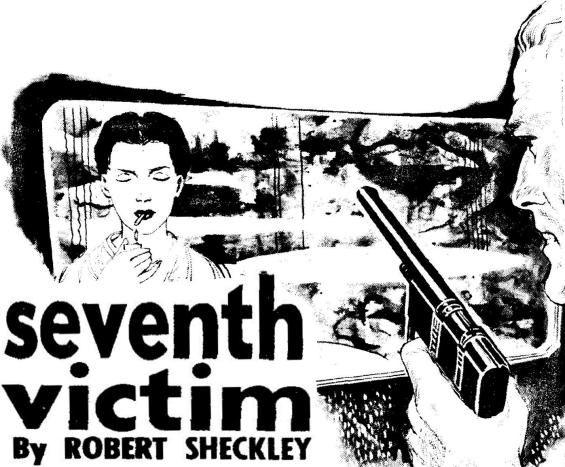
Seventh Victim by Robert SheckleyGoing in, and liking Robert Sheckley, I was surprised how much I didn’t respond to his most famous short story Seventh Victim. Upon first reading it I didn’t think of it as terrific story. Nor did I think of it as having much in the way of intellectual heft. But, upon reflection, particularly after watching the film adaptation I am coming around a bit. Indeed, plenty of folks, it seems, think of Seventh Victim as an academic story. It’s been used in both introductory psychology and philosophy textbooks. It has been reprinted more than a dozen times in different anthologies or collections. The 1965 film adaptation, called The Tenth Victim (La Decima Vittima), prompted Sheckley to expand the short story into a novel under the same name (which spawned more novel sequels Victim Prime and Hunter / Victim.

Robert Sheckley’s short story Seventh Victim is the tale of a future earth in which men and women engage in a voluntary game of assassination. Upon its first publication Galaxy magazine’s editor, H.L. Gold, abstrusely compared it to Richard Connell’s The Most Dangerous Game. I see that. But I was more struck by its closer resemblance to the game played in the opening scenes of the 1985 film Gotcha!. That film was likely inspired by a 1982 movie, Tag: The Assassination Game – which itself certainly nodded towards The Most Dangerous Game (the name of the first victim in the film is Connally). And that movie, in turn, was likely inspired by a real game of fake murder played on university campuses at the time (it looks like it is still played today too). While the story itself isn’t available as an audiobook there are a couple of audio dramatizations (both use the same script):

Future TenseFuture Tense – The Seventh Victim
Adapted from a short story by Robert Sheckley; Adapted by Ernest Kinoy; Performed by a full cast
1 |MP3| – Approx. 27 Minutes [RADIO DRAMA]
Broadcaster: WMUK Special Projects
Broadcast: May 20th, 1974
Provider: Rimworlds.com
“The most dangerous game, said one writer, is Man. But there is another still more deadly!” First published in the April 1953 issue of Galaxy Science Fiction.

X-Minus OneX-Minus One – The Seventh Victim
Adapted from a short story by Robert Sheckley; Adapted by Ernest Kinoy; Performed by a full cast
1 |MP3| – Approx. 22 Minutes [RADIO DRAMA]
Broadcaster: NBC
Broadcast: March 6, 1957
Provider: Archive.org
“Tonight we go forward in time to the days when war has been outlawed – and in its place there is a system of carefully controlled legalized murder.” First published in the April 1953 issue of Galaxy Science Fiction.

Cast:
Lawson Zerbe …. Freeline
Terri Keane …. Janet
Frank Maxwell … Emanuel Gale
Ian Martin ….
Arthur Hughes …. Jerry
Fred Collins …. Announcer

[via Archive.org and Rimworlds]

Posted by Jesse Willis

CBS Radio Workshop: Aldous Huxley’s Brave New World

SFFaudio Online Audio

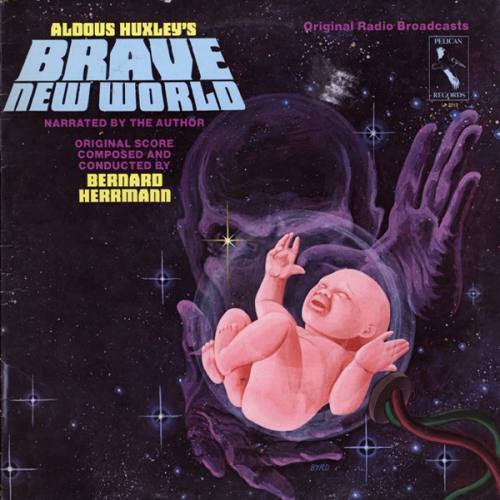
CBS Radio WorkshopThe CBS Radio Workshop was an experimental dramatic radio anthology series that aired on CBS radio from January 1956, until September 1957. Subtitled “radio’s distinguished series to man’s imagination,” it was a revival of the earlier Columbia Workshop, broadcast by CBS from 1936 to 1943, and it used some of the same writers and directors employed on the earlier series. Its first two episodes were a two-part adaptation of Aldous Huxley’s dystopian stunner Brave New World. It has some strong claims to being the definite adaptation as it is both introduced and narrated by Aldous Huxley himself. Here’s how Time magazine’s February 6, 1956 issue described it in their review:


“It took three radio sound men, a control-room engineer and five hours of hard work to create the sound that was heard for less than 30 seconds on the air. The sound consisted of a ticking metronome, tom-tom beats, bubbling water, air hose, cow moo, boing! (two types), oscillator, dripping water (two types) and three kinds of wine glasses clicking against each other. Judiciously blended and recorded on tape, the effect was still not quite right. Then the tape was played backward with a little echo added. That did it. The sound depicted the manufacturing of babies in the radio version of Aldous Huxley’s Brave New World.”

Music for the series was composed by Bernard Herrmann, Jerry Goldsmith, Amerigo Moreno, Ray Noble and Leith Stevens. Other writers adapted to the series included Robert A. Heinlein, Sinclair Lewis, H.L. Mencken, Edgar Allan Poe, Frederik Pohl, James Thurber, Mark Twain and Thomas Wolfe. According to Bill Hollweg the two MP3 files have been “cleaned and the volume normalized” – and they do sound great!

PELICAN - Brave New World - based on the novel by Aldous HuxleyBrave New World
Based on the novel by Aldous Huxley; Performed by a full cast
2 MP3 Files – Approx. 1 Hour [RADIO DRAMA]
Broadcaster: CBS
Broadcast: January 27 and February 3, 1956
Source: Archive.org

Part 1 |MP3| Part 2 |MP3|

Most interesting to me, however, is some of the commentary about this adaptation. On the back of the Pelican Records LP (LP-2013) edition there is critical essay on Huxley, Brave New World and this adaptation, by none other than Ray Bradbury! It is truly wonderful and I have reproduced it below:

There is science fiction and science fiction. There is science fiction still looked down upon by many intellectuals in our society, because it is written by the wrong people. And there is science fiction minus the label, written over in the main stream by acceptable A-1 main-line writers which is OK. And at the head of the list for some 40 years or more you would have to put Aldous Huxley and Brave New World. Whenever lists are drawn up for schools containing the acceptable authors who dare to be imaginative, it is Huxley and Orwell, ten to one.

Forget about Asimov, Clarke, Sturgeon, Heinlein, get lost.

There are a number of reasons beyond snobbishness of course. Huxley was in mid-career when he veered over into Future Country. Behind him lay half a dozen novels, most of which had good or fine reviews, and most of which are still selling moderately well and being read today. But mention Huxley and most people will name the one they know him by, Brave New World.

At the time it was published, much of the novel was fresh and innovative, properly cynical about human behavior and, at times, verging on territory laid out by Evelyn Waugh. Later on, Huxley and Waugh would indeed meet in the middle of the same cemetery. Huxley to dig graves and plant Hollywood types with his After Many A Summer Dies The Swan and Waugh with his The Loved One another shake of similar bones.

Since its publication, Brave New World has been skinned and boned and borrowed from by dozens of less competent writers who saw the serious fun Huxley had with his story and couldn’t resist imitating it.

As a satire today, reread when some of the things it talked about have moved straight on into our lives, the novel suffers as indeed it did back in 1932, from being a half-job. All the good stuff is up front in the book. Toward the end the fun and the imagination of Huxley diminish. Having the Indian hang himself seemed to me, even when I was younger, a bad solution to a good novel. Even Huxley, in 1952 when I first met him, expressed some doubt about his original ending.

But on his way to the finale, let’s face it, Huxley was the only referee we had for our impeding technological game. With foresight and precision he saw the Pill coming and ducked. He circled round cloning long before it became a tv Tale show mini-debate by mini-minds pretending to offer, as a result to most of us, mini-news. The drug culture of today noon occupied Huxley’s mind at breakfast 45 years back, long before he sprinkled mescaline on his Wheaties. While he was at it, old Aldous invented and reinvented the machined pornographies that have infiltrated our cinemas to slumber us better than Nembutal and bore us more than family picnics, well beyond 1984. And if we have not as yet birthed his ‘feelies’ into our world, we are on the thin dumb rim of doing so.

If there is a zero for failure to imagine at the center of the novel, and this radio play, it is the inability of Huxley (and Orwell, too later on) to in any way recognize or prophesy Space Travel. This may well be because of the time we lived in, then, when the Space Age seemed so remote, so impossible, that it could not be entered on any imaginary ledger to tip the scales toward an equally improbable better if not happy ending.

This was revealed in a lecture which I shared with Huxley onstage at UCLA some time in the early Sixties. Speaking first, he wondered again and again, what the next great development in literature might be.

I was stunned. In sat in my chair hardly daring to rise and deliver my speech, for suddenly my evening had changed. I had intended to make a few remarks about why I wrote what I wrote, but suddenly here was Huxley asking and not answering what was, to me, anyway, an obvious question with an obvious answer. What would the next great literature be?

Science Fiction! I wanted to shout. Good Grief and Jumping Jehoshaphat! Science Fiction!

Since every problem you can name in our time has to do with science and technology (name one that doesn’t) what else us there to write about except Pills, technological drugs, automobiles, smog, nuclear power, solar energy, space travel, tv, radio, transistors, free-ways, all, all of them scientific extensions of scientific dreams.

I rose and did not shout it. But I rose and said it, quietly, out of deference to my author hero.

Huxley shook my hand after the lecture and smiled at me with that dry quiet smile of his, and we spoke of Space Travel and how it might have changed Brave New World if he had thought to consider it in the full.

I still wish today that I might take his ghost to Cape Canaveral and whisk him to the top of the Vehicle Assembly Building where I have gone to stare down, with a wildly beating heart at the topmost part of the Apollo rockets lying ready below to give us alternative futures. We are not doomed to stay on Earth and share Huxley’s Indian suicide or Orwell’s Big Brother. When the time is ripe, we will just up and ‘go’.

All this said, when we return to the radio show, here captured to remind us once more that CBS, of all the radio networks, was the most open, the most adventurous, the most creative. Considering the year it was broadcast, 1956, long before Playboy made its real impact on our country, it is a fascinating work, of much imagination and good taste.

Let me step aside now, I have shouted my quiet shout. The next voice you’ll hear, a lovely gentleman’s voice, is that of Aldous Huxley. Would that he were alive today, for anther teatime chat and another long look into a sometimes dubious, sometimes exhilarating Future.

Ray Bradbury
Los Angeles
May 16, 1979

[Many thanks to Bill Hollweg and Rick]

Posted by Jesse Willis

Tantor Media: FREE AUDIOBOOK: Walden by Henry David Thoreau

SFFaudio Online Audio

Tantor MediaTantor Media has another limited time FREE MP3 download! This time it is Walden by Henry David Thoreau. This classic is a weirdly philosophical autobiography with fun words like: “cosmopolite” and “hokum”. Sez Tantor:

For your free download of Walden, please log in to your account
(consumer or library)—or create one.

After you’ve got an account (no credit card required), and you’ve signed in, do a search for “walden” or CLICK HERE, the link to the zipped folder full of 20 DRM free MP3s should be at the top. Here’s a screenshot:

Tantor FREE Walden OfferIn the email I got, it said the offer was in celebration of Earth Day (April 22), perhaps that is when the offer expires. It also had this funny (and almost mystifying) quote:
“A truly good book teaches me better than to [listen to] it. I must soon lay it down, and commence living on its hint. What I began by [listening], I must finish by acting.”
—Henry David Thoreau

TANTOR MEDIA - Walden by Henry David ThoreauWalden
By Henry David Thoreau; Read by Mel Foster
20 Zipped MP3 Files – Approx. 11.5 Hours [UNABRIDGED]
Publisher: Tantor Media
Published: 05/05/2008
Sample: |MP3|
Walden is the classic account of two years spent by Henry David Thoreau living at Walden Pond near Concord, Massachusetts. The story is detailed in its accounts of Thoreau’s day-to-day activities, observations, and undertakings to survive out in the wilderness for two years. Thoreau’s journal is an exquisite account of a man seeking a more simple life by living in harmony with nature. In today’s fast-paced consumer-driven society, the austere lifestyle endorsed by Thoreau is as relevant and refreshing as ever.

Posted by Jesse Willis

LibriVox: Adjustment Team by Philip K. Dick

SFFaudio Online Audio

LibriVoxMeanwhile … over on the Wikipedia talk page for the entry for Philip K. Dick’s Adjustment Team there is a wonderful argument going on. Part of it is over an issue called “copyfraud” (false claims of copyright designed to control works not under copyright). I suspect that it just such awesomeness that is behind so much of the awesomeness that is Wikipedia. Check this response out from a Wikipedia editor named “Refrigerator Heaven”:

Oh, to answer the section’s question. As a long-time fan of Philip K. Dick who is familiar with his main themes and not very interested in the movies based on his writings, I do think the copyright stuff is more interesting and more Dickian than the movie [The Adjustment Bureau]. Perhaps I’ll add a quote or two from him after dinner. For a parting thought I’ll leave this with a quote he used in his Hugo Award winning novel, The Man In The Hight Castle [sic]. “Things are seldom as they seem, skim milk masquerades as cream.”

Now don’t get me wrong, I don’t think Wikipedia is wonderful for its quotes alone. It was there, on the Wikipedia entry, for instance – that I learned that Adjustment Team was public domain. That’s what prompted me to tell my favourite LibriVox narrator that it was PD and that is, in part, why he recorded it for LibriVox. Thank you Gregg Margarite and thank you Wikipedia!

Soon to be collected in LibriVox’s Short Science Fiction Stories Collection #044:

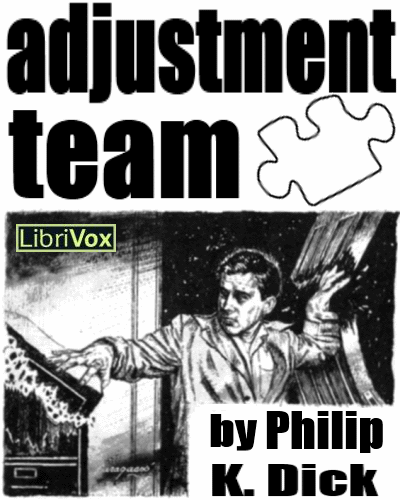
LIBRIVOX - Adjustment Team by Philip K. DickAdjustment Team
By Philip K. Dick; Read by Gregg Margarite
1 |MP3| – Approx. 1 Hour [UNABRIDGED]
Publisher: LibriVox.org
Published: NOT YET COLLECTED!
“Something went wrong and Ed Fletcher got mixed up in the biggest thing in his life.” First published in Orbit Science Fiction, Sept-Oct 1954, No.4.

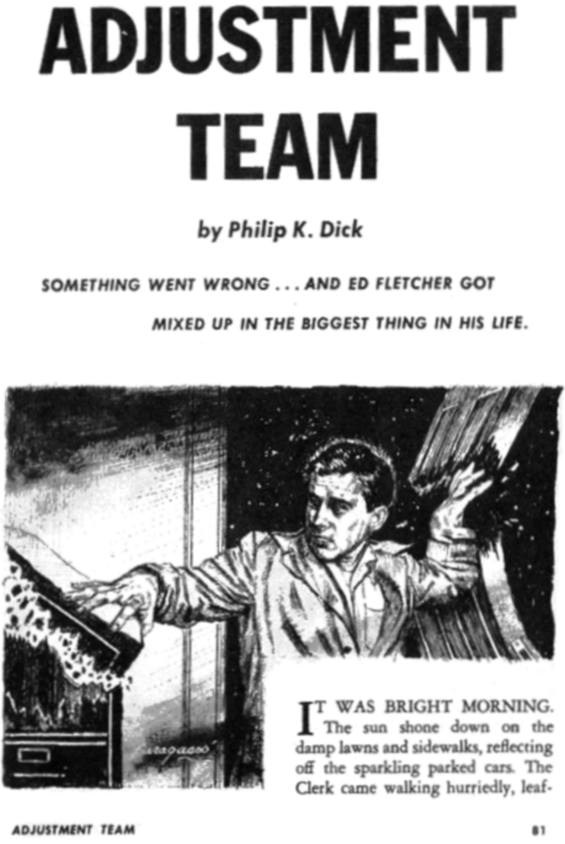
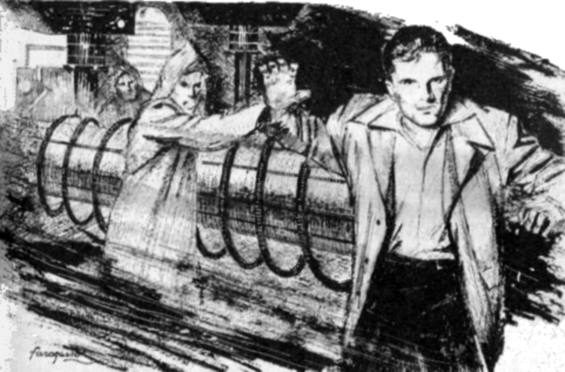
Illustrations by Faragasso:

Adjustment Team by Philip K. Dick

Adjustment Team by Philip K. Dick

Posted by Jesse Willis

Recent Arrivals: The Adjustment Bureau by Philip K. Dick

SFFaudio Recent Arrivals

I don’t think Philip K. Dick and Hollywood are writing for the same audience:

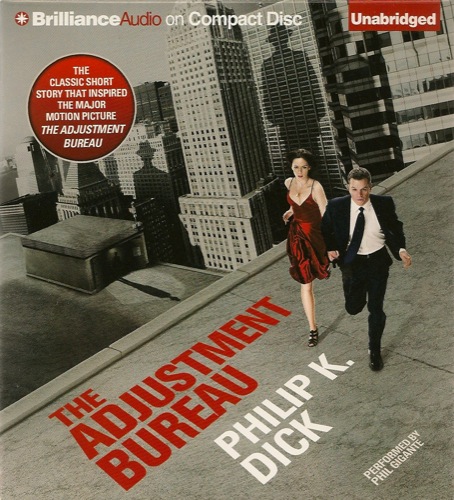
The Adjustment Bureau movie trailer: Powerful, handsome bachelor boy meets cute girl -> handsome boy loses beautiful girl -> handsome boy is chased by powerfully fedoraed men -> handsome gets beautiful back again.

The Adjustment Bureau (aka Adjustment Team) audiobook: middle class schnook has quietly comfortable conversation with wife -> gets pushed around by insurance salesman -> weird shit happens -> freaks out -> runs home to his wife. PLUS: talking dog!

BRILLIANCE AUDIO - The Adjustment Bureau by Philip K. DickThe Adjustment Bureau (aka Adjustment Team)
By Philip K. Dick; Read by Phil Gigante
Publisher: Brilliance Audio
Published: March 4, 2011
ISBN: 9781441894694
Sample |MP3|
The Adjustment Bureau is a major motion picture based on Philip K. Dick’s classic paranoid story, The Adjustment Team. This is the short story, The Adjustment Team, which asks the question – Do we control our destiny, or do unseen forces manipulate us? Ed Fletcher is a real estate agent with a normal life, until one day he leaves the house for work a few minutes later than he should have. He arrives at a terrifying, grey, ash world. Ed rushes home and tells his wife, Ruth, who goes back to the office with him. When they return, everything is normal. But he soon realizes people and objects have subtly changed. Panic-stricken, he runs to a public phone to warn the police, only to have the phone booth ascend heavenward with Fletcher inside…

Posted by Jesse Willis