News, Reviews, and Commentary on all forms of science fiction, fantasy, and horror audio. Audiobooks, audio drama, podcasts; we discuss all of it here. Mystery, crime, and noir audio are also fair game.
I use an RSS feed aggregator to check most websites these days but RadioArchive.cc is one I still have to check manually. One recent visit turned up a torrent that figuratively screamed for a download. Keep Your Pantheon was broadcast in 2007 on BBC Radio 4 and was written by David Mamet.
Keep Your Pantheon (or On The Whole I’d Rather Be In Mesopotamia)
By David Mamet; Performed by a full cast
1 Broadcast – Approx. 45 Minutes [RADIO DRAMA]
Broadcaster: BBC Radio 4 / Afternoon Play
Broadcast: May 28, 2007
Provider: RadioArchive.cc An impoverished acting company on the edge of eviction is offered a lucrative engagement. But through a series of riotous mishaps, the troupe finds its problems have actually multiplied, and that they are about to learn a new meaning for the term “dying on stage.”
Cast:
Strabo … Martin Jarvis
Lupus Albus … Lloyd Owen
Philius … Darren Richardson
Pelargon … Simon Templeman
Ramus … Morgan Sheppard
Quintus Magnus … Christopher Neame
Titus … Kenneth Danziger
Servant / 1st Centurion / Armourer / Priest … Alan Shearman
Messenger / 2nd Centurion / Guard … Matthew Wolf
Talked about on today’s show: Decoder Ring Theatre, Gregg is not as famous as Cher yet, something the same and something different, Girl’s Night Out, telling the mystery man’s story, World War II, Vancouver, secret identities, The Grey Fox (Vancouver’s own superhero), were there Japanese spy rings in Vancouver circa 1940?, Margo Lane, espionage, Nazi masterminds fomenting fifth-columns, Nazi Eyes On Canada |READ OUR REVIEW|, buying war bonds, Toronto, She’s secretly Japanese and secretly a superhero, Japanese-Canadian internment, Attack on Pearl Harbour, details from upcoming Red Panda Adventures episodes, the Dieppe raid, single-handedly defeating Hitler seems un-Canadian, augmented-dinosaurs, Professor von Schlitz, Captain America, Indiana Jones, how Gregg Taylor handicapped himself, “the man with an identity so secret even the audience doesn’t know it”, weaving a tangled web of lies, Superman was 4F, The Spirit, would static-shoes actually work?, Garth Ennis’ The Boys, what superhero you like tells us about you, the Martian Manhunter‘s kryptonite, Justice League: The New Frontier, Batman‘s superpower is a strength of will, Kit Baxter’s superpower is moxie, Trixie Dixon, creating dynamic female leads, CBC TV, the gender bending episode of Black Jack Justice (Justice In Love And War), Steven J. Cannell‘s Scene Of The Crime, gender switching, Black Jack Justice Hush Money, Cyrano de Bergerac, Roxanne, the formation of Black Jack Justice in opposition to The Red Panda Adventures, writing detective fiction vs. writing superhero fiction, Richard Diamond: Private Detective, the self-narrating hard-boiled post-war detective, The Adventures Of Sam Spade, paying your actors in corn, Philip Marlowe, writing drama in the half-hour format, Red Panda and retroactive continuity, an alternative universe that isn’t much different just a lot sillier, Baboon McSmoothie, the prime minister’s talking dog, the Moonlighting moment, flashback episodes, the Red Panda novels, Thomas Perkins, beautiful cover art helps, that repeated line: “It’s an interesting point.”, Aaron Sorkin, J. Michael Straczynski’s Babylon 5, Aaron Sorkin’s The West Wing, Gregg Taylor’s Decoder Ring Theatre, The Maltese Falcon, Sherlock Holmes, The Shadow, Orson Welles, a good TV show is like a play, The Green Hornet, “the MP3 revolution saved old time radio”, Gregg’s most frequently ignored piece of advice (write and record several shows before you release), might Decoder Ring one day adapt Cyrano or a Shakespeare play?, theater people are wonderful, Gregg would love to do cartoons (call him!), the Black Jack Justice comic, Gregg loves comics too!, the Comic Book Legal Defense Fund, the continuity of stories makes them more real, the nearly static Black Jack universe, Robert B. Parker, Spenser, the Jesse Stone tragedy, if Gregg gets crushed by a cement mixer…, The Old Testament God vs. New Testament God.
Goblin Feet
By J.R.R. Tolkien; Read by Kim Stich
1 |MP3| – Approx. 2 Minutes [POETRY]
Publisher: LibriVox.org
Published: Written in April of 1915. First published in Oxford Poetry 1915.
Goblin Feet
by J.R.R. Tolkien
I AM off down the road
Where the fairy lanterns glowed
And the little pretty flittermice are flying :
A slender band of grey
It runs creepily away
And the hedges and the grasses are a-sighing.
The air is full of wings,
And of blundering beetle-things
That warn you with their whirring and their humming.
O ! I hear the tiny horns
Of enchanted leprechauns
And the padding feet of many gnomes a-coming !
O ! the lights : O ! the gleams : O ! the little tinkly sounds :
O ! the rustle of their noiseless little robes :
O ! the echo of their feet — of their little happy feet :
O ! their swinging lamps in little starlit globes.
I must follow in their train
Down the crooked fairy lane
Where the coney-rabbits long ago have gone,
And where silverly they sing
In a moving moonlit ring
All a-twinkle with the jewels they have on.
They are fading round the turn
Where the glow-worms palely burn
And the echo of their padding feet is dying !
O ! it’s knocking at my heart —
Let me go ! O ! let me start !
For the little magic hours are all a-flying.
O ! the warmth ! O ! the hum ! O ! the colours in the dark !
O ! the gauzy wings of golden honey-flies !
O ! the music of their feet — of their dancing goblin feet !
O ! the magic ! O ! the sorrow when it dies.
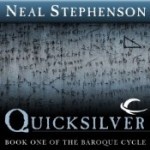
Quicksilver
By Neal Stephenson; Read by Simon Prebble and Kevin Pariseau Audible Download – 14 Hours 48 Minutes [UNABRIDGED]
Publisher: Audible Frontiers
Published: 2010
Themes: / Natural Philosophy / History Of Science / Historical Fiction
Let me begin this review by saying that anyone with the cajones to write historical fiction on this scale deserves mad props. Quicksilver, being the introductory volume in Neal Stephenson’s epic Baroque Cycle, spins a dizzying tale of science and adventure on the colorful canvas of late seventeenth- and early eighteenth-century Christendom. Like Stephenson’s massive World War II yarn Cryptonomicon, Quicksilver blends erudite discourse on the nature of the world with high drama and hair-raising adventure. The story sometimes takes a back seat to the intellectual ideas under discussion, but readers not afraid to apply a little mental elbow grease will find a lot to enjoy.
Before diving into an actual review, a note on this audio edition is in order. Audible Frontiers has elected to split the three massive print volumes of the Baroque Cycle into eight audiobooks. They haven’t just taken a metaphorical paper knife to the series, though. They’ve worked closely with Neal Stephenson to ensure the audio volumes have their own cohesion and progression. Neal Stephenson also lends his voice to a brief audio introduction preceding each volume. Thus, this audio performance of Quicksilver comprises only part of the print volume of the same name. I’ve not read the print edition, so I can’t draw any further comparisons.
In typical non-linear Stephenson fashion, Quicksilver narrates the pivotal events in the life of Puritan-turned-scholar Daniel Waterhouse. The story jumps between his youth in the mid-1600s and his later life in the early 1700s. Readers of Cryptonomicon will be familiar with this technique. They’ll probably also recognize our protagonist’s surname, as the Waterhouse family plays a pivotal role in the aforementioned novel. The ageless enigmatic Enoch Root also makes an appearance early on in the novel. Stephenson, to some extent, seems to be following the example of James Clavell, whose Struan family formed the backbone of his Hong Kong novels through different time periods. Having said that, one certainly doesn’t need to have read Cryptonomicon to appreciate Quicksilver.
The similarities between Cryptonomicon and Quicksilver also extend to theme and writing style. Stephenson takes frequent detours to explain the dynamics of a sun dial, the optics of a telescope, or the physics of eighteenth-century seafaring vessels. The digressions feel appropriate to a tale that features the likes of Isaac Newton, Samuel Pepys, and Gottfried Leibniz. Indeed the title Quicksilver, the common name for mercury, serves as a metaphor for the transition in modes of thinking and reasoning that the novel is trying to highlight. Daniel Waterhouse witnesses the nascent days of experimental science as we know it. The erudite dialogues and monologues sometimes made my eyes glaze over, however, and I was yearning to return to the story.
What saves Quicksilver from sometimes devolving into a mere lecture on the history of science is Neal Stephenson’s vibrant prose. Stephenson writes with the exact precision of a philosopher, but with an eye for earthy metaphors and a sensitivity towards the modern reader. I might quibble with occasional use of language that wasn’t current in the seventeenth century, but must concede that these (usually very minor) transgressions make the work far easier to read and digest. As a lover of language for language’s sake, I found Quicksilver a philological joy to read.
The colorful prose is brought to life by Simon Prebble’s artful narration. Narrating historical fiction can be almost as monumental a task as writing it. How does one lend a voice to the intellectual magnificence of a Newton or a Leibniz? Simon Prebble does a magnificent job, aided by Stephenson’s written cues, of bringing real life and character to most of the novel’s characters. The cast of Quicksilver encompasses a vast ethnic background, from British to Dutch to German to the New World, and Simon Prebble juggles this diversity with ease. Kevin Pariseau narrates only the epigraphs beginning each chapter, which are usually apropos to the following content.
One last observation about Quicksilver: it isn’t really science fiction. Okay, if you want to get pedantic, it’s actually the purest form of science fiction–fiction about science and its development. But the novel certainly isn’t science fiction in the modern genre sense. The ageless (immortal?) Enoch Root figures into the tale, and there are certainly themes reminiscent of science fiction (what is real? how does the world work?), but listeners casually browsing the science fiction portion of Audible hoping for a straightforward science fiction story will be disappointed. Like so often happens in publishing, I assume that the categorization was a marketing decision, by analogy with Stephenson’s more strictly science fiction work like Snow Crash. Still, fans of science fiction with an open mind will find lots to appreciate in these stories.
I’ve begun listening to King Of The Vagabonds, the follow-up volume to Quicksilver. The story shifts gears abruptly in both focus and tone, turning its attention now to the homeless beggar and thief Jack Shaftoe (another familiar name to readers of Cryptonomicon). Clearly the Baroque Cycle has a wide array of stories to tell, and I’m looking forward to following its tangled webs.
Audio-Drama.com is a wiki of audio drama websites, with category tags, and a search function, so you can focus on the type of audio drama that you’re looking for. There are also links to resources for creating audio drama, as well. Some of the articles have only basic information at the moment, but like any wiki, the content will only expand and improve with time.
Right now, Audio-Drama.com has over 1200 entries, and anyone can add or edit the articles. The more people that know about it, the greater a resource it will be.
And here’s the wiki-description from its “about” page:
Audio-Drama.com is a wiki project to compile a list of all things related to audio drama. It began as a list of audio drama-related news items and links in 2003. It was relaunched as a wiki in September of 2008. It was open to the public on July 15, 2010.
And, as you can see, by the entry someone put up for SFFaudio, the site is in its infancy. Someone should go beef that baby-up!
WATCH OUT FOR THE FALSE ENDINGS (mostly attributable to Luke)
Talked about on today’s show:
Role playing game names, “Tom And His Friends” Dungeons And Dragons comedy (aka Farador), SFFaudio Challenge #2, Rebels Of The Red Planet by Charles L. Fontenay, Mars, martian rebels, Podiobooks.com, Cossmass Productions, Mark Douglas Nelson, Dan Simmons’ Hyperion, the least interesting vs. the least fitting, I’m Dreaming Of A Black Christmas by Lewis Black, Christmas = Fantasy?, The Daily Show with Jon Stewart, Suck It, Wonder Woman |READ OUR REVIEW|, Star Wars, what makes Star Wars Science Fiction is a sense-of-wonder?, Star Trek, METAtropolis: Cascadia, Star Trek The Next Generation narrators vs. Battlestar Galactica narrators, Wil Wheaton as a narrator, Dove Audio, Levar Burton as a narrator, liking Star Trek for all the wrong reasons, Theodore Sturgeon, Harlan Ellison, assimilation is a neat idea, “who the hell are the Borg?”, The Unincorporated Man by Dani Kollin and Eytan Kollin |READ OUR REVIEW|, The Unincorporated War, “is there true Science Fiction to be found in sequels?”, The Hunger Games by Suzanne Collins, Peter F. Hamilton’s The Void Trilogy, Blackout by Connie Willis, The Doomsday Book by Connie Willis |READ OUR REVIEW|, Firewatch, dragging the story out, Whiteout by Connie Willis, World War II, Katherine Kellgren as a narrator, Jenny Sterlin as a narrator, Recorded Books, Brilliance Audio, Audible.com, Amazon.com, Earth Abides by George R. Stewart, Deep Six by Jack McDevitt, introductions to audiobooks, the introduction as an apology for the book, Slaughterhouse Five by Kurt Vonnegut Jr. |READ OUR REVIEW|, The Stainless Steel Rat by Harry Harrison, The Time Traders by Andre Norton, H.G. Wells, The First Men In The Moon, Around The Moon, Jules Verne, continuing characters rather than continuing series, Sherlock Holmes, Khyber Pass vs. Reichenbach Falls, Sir Arthur Conan Doyle, The Valley Of Fear, The Hound Of The Baskervilles, Lois McMaster Bujold’s Miles Vorkosigan series, does reading a series defeat the hope of being surprised? Priest Kings Of Gor by John Norman, A Game Of Thrones by George R.R. Martin |READ OUR REVIEW|, fun vs. funny, crime and adventure vs. ideas, A Princess Of Mars by Edgar Rice Burroughs, Bill The Galactic Hero, Slippery Jim DiGriz, The Stainless Steel Rat’s Revenge, This Immortal by Roger Zelazny, The Speed Of Dark by Elizabeth Moon, Books On Tape, Grover Gardner, Gregg has a grumbly voice, The Space Dog Podcast, The Science Fiction Oral History Association, Gordon Dickson, Isaac Asimov, Arthur C. Clarke, Cordwainer Smith, Scott Westerfeld, Ben Bova, Luke’s next podcast project, NaNoWriMo, what podcast schedule should you have?, Robert Silverberg AUDIOBOOKS are coming from Wonder Audio, the old stuff vs. the new stuff, Jay Snyder as a narrator, a Science Fiction story that has little SF content, autism, Charly, Understand by Ted Chiang, Flowers For Algernon, interacting with the world, I Am Not A Serial Killer by Dan Wells, psychopathy, an unreliable first person narrator, young Dexter, Asperger syndrome, The Curious Incident Of The Dog In The Night-Time by Mark Haddon, a detached (but reliable) narrator, the two audiobook versions of The Curious Incident Of The Dog In The Night-Time, Quicksilver by Neal Stephenson, the Baroque Cycle, Anathem, John Allen Nelson as a narrator, Phat Fiction, The Way Of Kings by Brandon Sanderson, The Towers Of Midnight by Robert Jordan and Brandon Sanderson, walking around central park as a retired person as my new career, who listens to audiobooks?, working the unworked niche, they really like Gregg’s voice!, no RSS-feed = soooo sad, Sam This Is You by Murray Leinster, Black Amazon Of Mars by Leigh Brackett, The World That Couldn’t Be Clifford D. Simak, The Idiot by John Kendrick Bangs, The Hate Disease, Asteroid Of Fear, Industrial Revolution by Poul Anderson, A Horse’s Tale by Mark Twain, anthropomorphic fiction, A Dog’s Tale by Mark Twain, Gregg has bugles lying around, Jonathan Swift, Gulliver’s Travels, Thought You Were Dead by Terry Griggs, Iambik Audio‘s upcoming Science Fiction audiobooks, LibriVox, working with small press publishers, Extract From Captain Stormfield’s Visit To Heaven, Blackstone Audio, The Many Colored Land by Julian May, Bernadette Dunne as a narrator, time travel, The Pliocene Epoch, sequel and prequel fatigue, flooding the Mediterranean, Blake’s 7: Zen : Escape Veloctiy is a Science Fictiony audio drama series, Firesign Theatre? (he means Seeing Ear Theatre), The Moon Moth based on the story by Jack Vance, Don’t Crush That Dwarf, Hand Me The Pliers, Mistborn, Terminal World by Alastair Reynolds, Lord Of Light by Roger Zelazny, Finch by Jeff Vandermere, Flood by Stephen Baxter, thematic exploration vs. bad writing, GoodReads.com, Eifelheim by Michael Flynn |READ OUR REVIEW|, Luke’s books should be audiobooks, The Fifth Annual SFFaudio Challenge, all the cool Science Fiction ideas in Luke’s books, Gregg Margarite is a secret author with a secret pseudonym, Eric Arthur Blair, the publishing industry headache is intolerable to many, good writers + savvy marketers = sales success?, Redbelt, David Mamet, drowning in an ocean full of crap, the Jesse Willis bump?, catering to the listeners (or readers) desires vs. publishers desires, Pogoplug, Out Of The Dark by David Weber, artificial robots vs. natural robots, What Technology Wants by Kevin Kelly, art and techne, does evolution have goals?, the Cool Tools blog, eyes vs. I, natural selection, zero-point energy, the Cat in Red Dwarf was pulled to the fish dispensing vending machine, if you won’t give me eyes at least give me bilateral symmetry, goals vs. patterns or positions, starfish vs. Inuit, technology is a function of evolution, Luke re-writes The War Of The Worlds in under 20 minutes, red weed and green mist, stomach-less martians, “the final final part” and the musical version, flipping over the narrative is fun, Ender’s Game vs. Ender’s Shadow, what do the martians have against doors?, keeping the martian cannon canon, The Dragon With The Girl Tattoo by Adam Roberts.



 I use an RSS feed aggregator to check most websites these days but RadioArchive.cc is one I still have to check manually. One recent visit turned up a torrent that figuratively screamed for a download. Keep Your Pantheon was broadcast in 2007 on BBC Radio 4 and was written by David Mamet.
  Keep Your Pantheon (or On The Whole I’d Rather Be In Mesopotamia)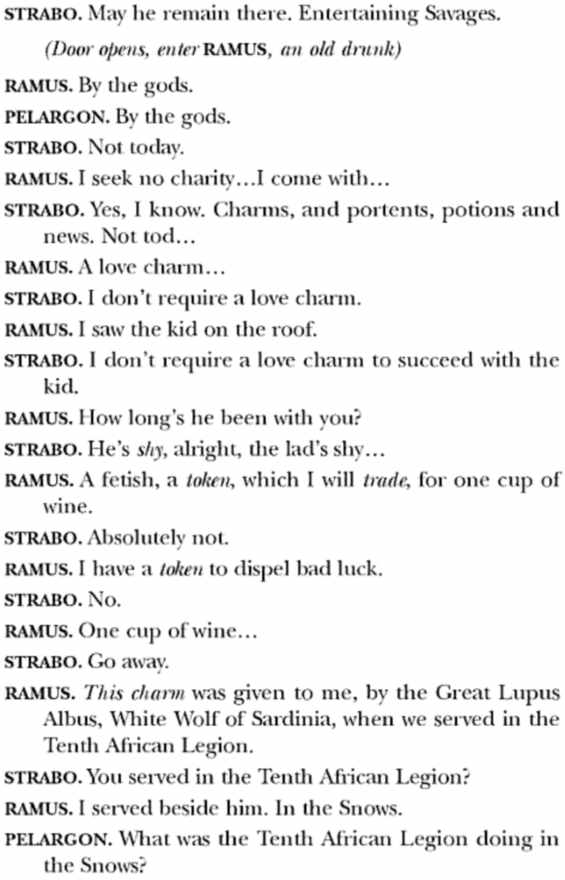

 Goblin Feet