Review of Hyperion by Dan Simmons

SFFaudio Review

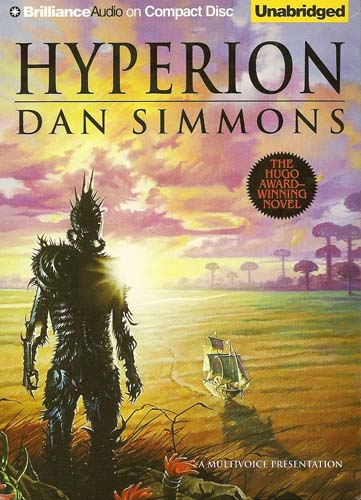
Hyperion by Dan SimmonsSFFaudio EssentialHyperion
By Dan Simmons; Read by Various
19 CDs – 21 hours – [UNABRIDGED]
Publisher: Brilliance Audio
Published: 2009
ISBN: 9781423381402
Themes: / Science Fiction / Artificial Intelligence / Aliens / Religion / Starships / Simulations / Transportation /

Seven people, all headed to the planet Hyperion to visit the Shrike, find themselves on the same ship. Regular pilgrimages are made to the Shrike, but these seven have been granted a visit to the Shrike together. To find out why this is, they all agree to tell each other their personal stories of what brought them. The result is a Canterbury Tales in space. A priest, a soldier, a poet, a scholar, a detective, and a consul each tell their story; all separate, all intensely personal, all very different, yet all involving the Shrike in some way.

The book is set in the distant future, and the ideas are plenty. There’s farcasting, where doorways are created to other worlds. One character has a house where every room is on a different world. Costs a fortune, but it can be done. There are artificial intelligences, starships, and sims. Against this backdrop is the Shrike, an alien creature that lives in the Time Tombs, and the seven on a pilgrimage who land in a city on the planet Hyperion, then make their way to see the Shrike over land. “Pilgrimage” is definitely the right word here, because the whole book has a mythic-religious quality. Each person is dealing with very difficult stuff, and what each person hopes to gain from the Shrike when they finally get to see it is nothing short of intervention of a higher power.

Audible Frontiers did a wonderful job with this audiobook. It used to be available only through Audible, but now Brilliance Audio is offering a hardcopy version on CD, which is how I listened. Each story is told by a different character, and each one uses a different narrator. The narrators were all excellent, so this is a perfect presentation of this book.

All seven of the stories are fascinating, well-written stories. There isn’t a weak one on the bunch. This is a top-shelf science fiction novel, up there with the greatest books of the genre.

Highly recommended, without question an SFFaudio Essential! The single caveat is that you must plan to read the next book in the Hyperion Cantos, (called The Fall of Hyperion), because the story doesn’t end with the end of this book. The Fall of Hyperion is also available from Audible (digital) and Brilliance Audio (CD), as are the two books that complete the series, Endymion and The Rise of Endymion. This is the only one I’ve read, but I expect I’ll be reading them all.

Posted by Scott D. Danielson

Aural Noir Review of Paranoia by Joseph Finder

Aural Noir: Review

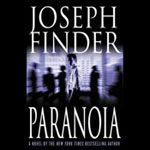
Macmillan Audio - Paranoia by Joseph FinderParanoia
By Joseph Finder; Read by Scott Brick
Audible Download – 13 Hours 8 Minutes [UNABRIDGED]
Publisher: Macmillan Audio
Published: July 2009
Provider: Audible.com
Themes: / Thriller / Espionage / Business / Crime / Corporate Culture /

Adam Cassidy is 26 and a low-level employee at a high-tech corporation who hates his job. When he manipulates the system to do something nice for a friend, he finds himself charged with a crime. Corporate Security gives him a choice: prison – or become a spy in the headquarters of their chief competitor, Trion Systems. They train him and feed him inside information. Now at Trion, he’s a star, skyrocketing to the top. He finds he has talents he never knew he possessed. He’s rich, drives a Porsche, lives in a fabulous apartment, and works directly for the CEO. He’s dating the girl of his dreams. His life is perfect. All he has to do to keep it that way is betray everyone he cares about and everything he believes in. But when he tries to break off from his controllers, he finds himself in way over his head, where nothing is what it seems and no one can really be trusted. And then the REAL nightmare begins…

I quite enjoyed this audiobook. That surprised me quite a bit. I was fairly skeptical going in. Books about business are often too much like self-help books. At worst they can be all full of untestable advice, formulaic reformulations of Sun Tzu’s The Art Of War, dogmatic variations on Machiavelli’s The Prince or even, horror of horrors, creating their own Baconian-style methodology (writing lists of commonalities). But, I told myself, this is a business thriller and not a business book, so I gave it a try. Now,after reading this thriller I think I’d be up for reading a good book on real world corporate espionage. It might be more interesting than any other kind of non-fiction business book I’ve read. A few other things struck me about Paranoia. First, Joseph Finder can write. This isn’t Oprah fiction, this literature that fits in somewhere in between John Grisham and Nelson DeMille. Second, there are a few twists and turns along the fairly predictable path. Some of these came rather unexpectedly. Those being generally in a good way. Third, Adam Cassidy, our flawed hero, is a fairly likable protagonist. This is helped by having the story told first person (and narrated the ever lovable Scott Brick). As to the novel’s formula, there were a couple of rough patches. At several points throughout the novel Finder seems to make a special effort to distance Cassidy from the techie world he works in. This felt a bit odd for the story, but it seems like a ploy to make a thriller set in the iPhone world more mainstream than it really is. At certain points Finder has Cassidy far less familiar with his tech business than he should be. In my experience techies usually don’t think of their toys as mere tools. I’ve never worked for Palm or Apple or Research In Motion (they make the BlackBerry), but I’m betting that the folks who work there are a lot more techie than Adam Cassidy. Another issue, the family and friends felt constructed into the plot – put there to provide a break from the main thrust of the story. Despite this I found myself not too upset with the author’s manipulation. Scott Brick again probably helped here. I’m not convinced he’s the best narrator for a lot of novels I hear him reading, but for those told first person, I must admit he’s got to be one of the best. Lastly, as with the character being blatantly aimed at the mass market, rather than more realistic for his position, there is comparable problem with the novel’s title. Sure there is a bit of paranoia in Paranoia – but that title has more to do with crappy generic book titling culture than the book itself. Corporate suits get there way on this all the time, and we consumers aren’t calling them on it. I would much rather read We Can Remember It For You Wholesale than Total Recall. The first tells me something about the story.

I picked up Paranoia during Audible.com’s free giveaway of the audiobook a few weeks back. After getting my first taste for free I think I’d be willing to pony up an Audible credit for the next Joseph Finder novel to come out. One Audible reviewer gave the novel a low star review because it has “more F-Bomb’s in it than any other book that I’ve read.” Thinking back, I can’t say I remember that many. The odd “Fuck!” now and then was present, but given the circumstances Cassidy is dealing with from chapter to chapter leaving them out would have been far more noticeable than having them there. Real drama tends to have swearing. I don’t usually like to talk about adaptations of audiobooks into other mediums. My ususal thinking is that fiction is best in the audiobook form, but I realized about two thirds of the way through that Paranoia might be improved further. There is a chapterized serial cliff-hanger feel to it that is similar to that of some of the best of modern television programs (the likes of Dexter, Breaking Bad and Weeds). Thematically, of course, this theoretical television adaptation would be far more similar to the short lived Fox TV series Profit. If there is going to be an adaptation of this novel, I suggest it be to cable TV, if only to keep the all the swearing.

Posted by Jesse Willis

Recent Arrivals – Blake’s 7 – Cally: Blood & Earth / Flag & Flame

SFFaudio Recent Arrivals

Hey, look what showed up in the Canadian PO Box today…

Blake's 7 - Blood And Earth and Flag And FlameBlake’s 7 – Cally: Blood & Earth / Flag & Flame
By Ben Aaronovitch and Marc Platt; Performed by a full cast
1 CD – Approx. 60 Minutes [AUDIO DRAMA]
Publisher: B7 Productions
Published: August 24, 2009
ISBN: 9781906577070
“It’s a source of utter bewilderment that Cally is still part of my life, but delighted to embrace her return. It’s astonishing to be playing the character thirty years on and to know that Blake’s 7 still has such an ardent following. Who would have known that back in 1978 we were making television history.”

This is going to the top of my “to be listened to stack”!

Posted by Jesse Willis

BBC Radio 7 and Radio 4: Fatherland and You’re Entering The Twilight Zone

SFFaudio Online Audio

SFFaudio’s covert agent in the U.K., codenamed “Roy”, has dug up some very interesting intel and delivered it to our email dead drop:

“As you said on SFFAudio that you liked Anton Lesser in the Falco series, you may want to note that he stars in the five part serialisation of Robert Harris’s Fatherland running on BBC7 this week (this serialisation from 1998 is actually an extended version of the 2 hour play first broadcast on R4 in 1997). You may not have spotted this as it is not in the daily dedicated ‘7th Dimension’ slot.”

BBC Radio 7 - BBC7Beginning on Monday and running daily, BBC7 is airing their adaptation of Robert Harris’ bestselling novel Fatherland. This powerful and award winning drama, examines an alternate history in which the Nazi empire never fell. The setting is 1960s Berlin, on the cusp of Hitler’s 75th birthday. Dramatised and produced by John Dryden, it stars Anton Lesser and Andrew Sachs. This will definitely be one to catch via the Listen Again service!

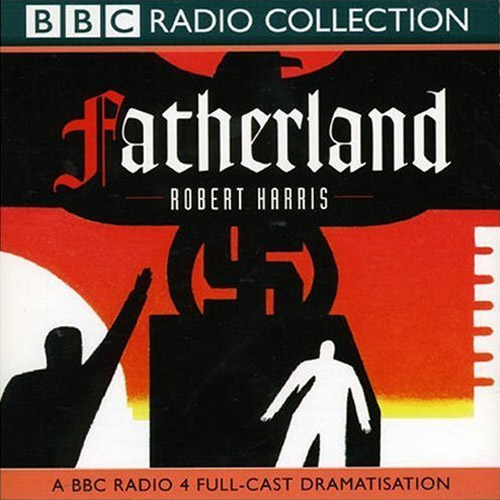
BBC Radio Drama Fatherland by Robert HarrisFatherland
Based on the novel by Robert Harris; Performed by a full cast
5 Parts – Approx. 2.5 Hours [RADIO DRAMA]
BROADCASTER: BBC 7
BROADCAST: Monday September 7 – Friday September 11 @ 1.30pm, 8.30pm and 1.30am (UK time)
Nazi Germany has won the war. Churchill is living in exile. King Edward and Queen Wallis are puppet monarchs of the UK. It is 1964, a week before Hitler’s 75th birthday. Anton Lesser stars as the Berlin detective called to investigate the suspicious death of a retired German senior civil servant.

Also on the schedule…

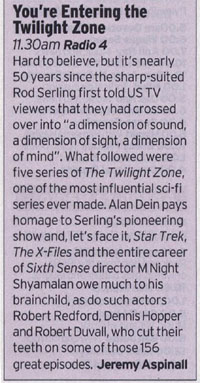
You're Entering The Twilight Zone (Radio Times - Jeremy Aspinall)BBC Radio 4There’s a new documentary called You’re Entering The Twilight Zone, which looks back at the venerable The Twilight Zone franchise. It airs on BBC Radio 4 next week. It’s a 30 minute doc that sounds very solid so I’ll be adding this to my Radio Downloader subscription too. It airs September 15th 2009 on BBC Radio 4 @ 11:30 (U.K. time).

“Alan Dein explores the classic American television series The Twilight Zone, as well as the life and imagination of its creator, Rod Serling.

Fifty years ago, Serling ushered audiences into a new realm of light and shadow. He had already electrified the new medium of television with his powerful dramas and their explorations of race, morality and capitalism, but now he offered glimpses of American dreams and nightmares.”

[Thanks Roy!]

Posted by Jesse Willis

Review of Dune, Messiah by Frank Herbert

SFFaudio Review

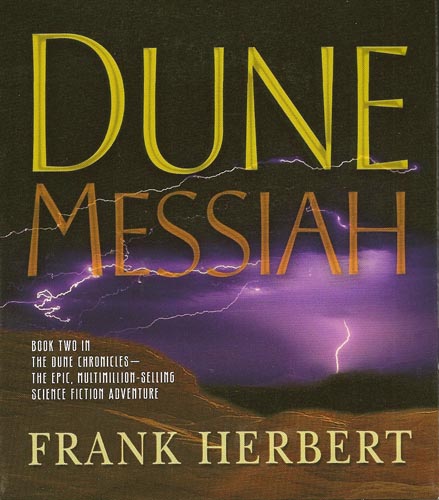
Dune Messiah by Frank HerbertDune, Messiah
By Frank Herbert, Read by Scott Brick, Katherine Kellgren, Euan Morton, and Simon Vance
9 hours – [UNABRIDGED]
Publisher: Macmillan Audio
Published: 2007
Themes: / Science Fiction / ESP / Religion / War / Charismatic Leader /

Its 12 years after the triumph of Paul Atriedes on Arrakis, as presented in Dune. But “happily ever after” wasn’t the kind of book that Frank Herbert was interested in writing. Nor was a “Dune Part II” in which Paul would be presented with another challenge, maybe greater than the first, which he would conquer – with much rejoicing. (Yayyyyy!) Instead, Frank Herbert gave us something (here it comes) completely different.

Dune, Messiah opens with a discussion between members of the Spacing Guild, the Bene Gesserit, the Bene Tleiaxu, and the Princess Irulan about how to bring about the fall of the Emperor Paul, making it immediately apparent that things are not going well for Paul. The known universe has not fared well under his rule. The religious fervor around Paul has increased over time, with people, acting in Paul’s name, performing atrocities on various planets. The Fremen way of life has been completely devastated by the changes brought about by Paul’s government. Paul’s ability to see the future has become something of a burden. He’s often acting in ways to fulfill his role rather than of his own volition. He acts to fulfill fate rather than to fight against it.

It’s not hardly the stuff of heroic literature, like Dune was. Instead, it’s decidedly anti-heroic, which is precisely what Frank Herbert was aiming for. He was writing a book in which his hero makes mistakes in order to illustrate the danger presented by a charismatic leader. From Dreamer of Dune, a biography of Frank Herbert written by his son, Brian:

Among the dangerous leaders of human history, my father sometimes mentioned General George S. Patton, because of his charismatic qualities — but more often his example was President John F. Kennedy. Around Kennedy a myth of kingship formed, and of Camelot. His followers did not question him, and would have gone with him virtually anywhere.

To Frank Herbert, this kind of thing was extremely dangerous. This is an especially interesting counter-viewpoint here in 2009, where the United States has another very charismatic leader. One can’t help but to wonder what Herbert would have to say today.

So Dune can be considered to be the rise of Paul Atreides, and Dune, Messiah could be considered the fall. There’s no question that Dune, Messiah is not the masterpiece that Dune is, but it’s still very interesting. Besides the continued exploration of science fiction ideas like the ghola (Duncan Idaho returns as a ghola in this book – a reanimated man that is Duncan Idaho, but is he really?), the overall exploration of an anti-hero is something that is rare enough in science fiction to make it an refreshing read. Children of Dune, the next book, was definitely on Herbert’s mind as he wrote this one, so it’s difficult to present any kind of final judgment until I read that one. Perhaps the fact that I’m interested enough to continue is judgment enough.

Macmillan Audio’s presentation of the book was excellent. There are multiple narrators, each reading sections of the book. All the narrators are top-notch, so I was very pleased with it.

I found some of the history of Dune, Messiah‘s publication to be interesting as well. John W. Campbell couldn’t wait to serialize Dune in Analog magazine, and did so. But when Dune, Messiah came around, he was disappointed enough in the direction of the story that he wouldn’t buy it for his magazine, despite the popularity of Dune. Galaxy Magazine ended up serializing it.

In Road to Dune, Brian Herbert and Kevin J. Anderson quote a letter from John W. Campbell about Dune, Messiah:

The reactions of science-fictioneers, however, over the last few decades have persistently and quite explicitly been that they want heroes – not anti-heroes. They want stories of strong men who exert themselves, inspire others, and make a monkeys uncle out of malign fates!

Perhaps that’s so, but I enjoyed the book very much, partly because it was different.

Posted by Scott D. Danielson