Interview: Sharon Lee and Steve Miller

SFFaudio News

Sharon Miller and Steve Miller are authors surprised that audiobooks aren’t audio drama. Their reaction to hearing the audiobook version of one of their novels: “freaky” and “odd” and “with any voice tricks”! Yikes!

The rest of the interview is available HERE. |READ OUR REVIEW| of Local Custom by Sharon Lee and Steve Miller.

[via the Buzzy Multimedia Blog]

Posted by Jesse Willis

Aural Noir Review of This Won’t Kill You by Rex Stout

Aural Noir: Review

DH Audio Mystery Audiobook - This Won’t Kill You by Rex StoutThis Won’t Kill You
By Rex Stout; Read by David Elias
1 Cassette – Approx. 60 Minutes [ABRIDGED]
Publisher: DH Audio
Published: 1998
ISBN: 0886468655
Themes: / Mystery / Murder / Crime / Baseball /

Nero Wolfe couldn’t care less about baseball, even the World Series final game–until four players are drugged. Now a team’s chances, and maybe their star players, are dead. Evidence is hard to find, so Archie Goodwin dodges fists and acid while the boss keeps one little secret from the police.

There’s a whole team of suspects for Nero Wolfe to confront in this peppy locked stadium mystery.

Narator David Elias is terrific, filling his lungs for the resonant corpulence of Wolfe’s voice, then higher pitching and faster talking-it for the energetic Archie Goodwin. As well, Elias offers many variation’s on accents and voices for the numerous other minor characters filling out this novelette. He also ain’t bad with a falsetto. The abridgment is very skillful. Rex Stout’s plots are often highly complex, and can lead a reader to be confused as it is. Whatever was expunged for this edition, this audiobook abridgment is easy to follow.

Posted by Jesse Willis

Review of Anathem by Neal Stephenson

SFFaudio Review

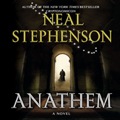
AnathemAnathem
By Neal Stephenson; Read by Oliver Wyman, Tavia Gilbert, William Dufris, and Neal Stephenson
Audible Download –  32 hours 30 minutes [UNABRIDGED]
Publisher: Macmillan Audio
Published: 2008
Themes: / alien invasion / philosophy / religion / alternate universe

After nearly two weeks of listening to this 2009 Hugo-nominated book during nearly every moment of my free time–getting ready for work in the mornings, sitting on the bus, tossing and turning in bed–I’ve finally finished Neal Stephenson’s latest tale of metaphysical adventure. Does the book measure up to Stephenson’s earlier work? More importantly, is it fun to read?

First, some background: Anathem is set on the planet of Arbre, a world much like, and yet unlike, our own. The tale opens in the year 3690 AR (After the Reconstitution), in the Mathic Consent of Saunt Edhar. Consents are much like the medieval monasteries of our own world, except that instead of contemplating religious matters the Mathic avout research and debate matters of math, science, and philosophy. The tale is told from the perspective of Fraa Erasmas, a young avout who has now lived at the Consent for ten years. A mysterious craft appears in the skies above Arbre, which is the driving force behind the plot, since it excites consequences and conflicts first in the Mathic world and then in the Saecular, or outside, world as well. The craft, it turns out, belongs to an alien race unknown to Arbre, and packs a significant military punch. The inhabitants of Arbre, Mathic and Saecular alike, must decide how to face this threat.

I can’t fully answer the first question, since the only other Stephenson novel I’ve read in full was his cyberpunk effort Snow Crash, which I thoroughly enjoyed. Stylistically speaking, comparing these two novels, though, is like comparing apples and oranges. The prose ofSnow Crash is taut, earthy, and vernacular, while that of Anathem is expansive, meandering, and somewhat more formal. Yet the two books share a tendency to veer into philosophical discourse that usually, but not always, has some relevance to the plot.

As to the second question, I wouldn’t quite characterize Anathem as “fun”. It certainly has many moments of intense action, wry humor, and emotional drama. These moments, however, are interspersed between long stretches of the aforementioned philosophical discourse. So one’s response to the novel largely depends on one’s tolerance for and appreciation of Stephenson’s vast store of scientific and theoretical knowledge. In this respect, as well as in its setting, Anathem resembles Umberto Eco’s equally challenging The Name of the Rose.

Those interested in such things will find here a treasure trove of insights (or “upsights” as they’re called in the world of Arbre) into the nature of reality, consciousness, and the universe. Without giving too much away, I’ll simply hint that the quantum physics principles that play such a large role in Philip Pullman’s His Dark Materials trilogy rear their hydra-heads here as well.

The book isn’t all dialogues and theorums and proofs. Much of Anathem‘s beauty stems from its likable characters. Fraa Erasmas is a young lad possessed of loyalty, imagination, and more heart than seems to be usual in the Mathic community. His best friend Fraa Lio, upon whom he bestows the epithet of “thistlehead”, takes a keen interest in the martial arts techniques, or vlor, of the Consent of the Ringing Veil. The cast of brothers is rounded out by the ambitious yet likable Fraa Jesry and the good-natured portly Fraa Arsibalt. Unlike medieval monastaries, Mathic consents are not segregated, so Erasmas and company are joined in their adventures by the capable but hot-tempered Suur Ala and the mild-mannered Suur Tulia. The real standout characters, though, are the enigmatic Fraa Orolo and Fraa Jad. The former has a fascination with cosmology and also with saecular speelies (read: movies), while the latter is first seen puzzling over a disposable razor from the outside world. Both these old men are reminiscent of Albus Dumbledore from the Harry Potter series in that they combine immense knowledge with eccentricity and childlike curiosity.

For a word nerd like myself, much of the pleasure from reading Anathem is derived from marveling at Stephenson’s ability to construct a linguistically coherent alternate reality that still has resonances in our own world. Take the word saunt, for instance, which denotes a Mathic avout who has made some sort of significant theoretical advance. As the book’s glossary explains, the word is actually a contracted form of the word savant, but also immediately brings to the reader’s mind the real-world word saint. I’m fairly certain that all these subtle layers of meaning were intentionally embedded, and this is just one example of many.

While there are endless avenues of literary, cultural, and philosophical allusions to explore and deep philosophical questions to unravel, I found myself a bit weary as I got to the end of the novel. Though certainly a more-than-capable storyteller, Stephenson seems more interested in advancing his scientific explorations, and overlays the story atop them. This is similar to sme of J.R.R. Tolkien’s writings, in which the story is made subservient to linguistic aims. I’m not quite sure where I fall on this “story-versus-substance” spectrum, but if I had to choose I think I’d lean towards the “story” direction.

Given its complexity of its language, Anathem poses a real challenge to audiobook producers. Fortunately, the narrators are up to the task. William Dufris performs the bulk of the novel, and he shifts easily from the erudite jargon of the book’s dialogues to its memorable emotional climaxes. Read by a less capable narrator, Anathem might be marketed as a surefire cure for insomnia, but Dufris brings every character to life as if they were in a speely, the Arbre equivalent of film.

Even with the few caveats listed earlier, it’s hard to underplay Neal Stephenson’s immense achievement with Anathem.

Posted by Seth Wilson
Review of The Final Empire: Mistborn Book 1 by Brandon Sanderson

SFFaudio Review

Greetings fellow sci-fi and fantasy audiobook junkies. My name is Mark Flavin (from California not Ireland) and I am one of many reviewers to answer the call made by Jesse. I enjoy sci-fi and fantasy in all forms but have a special love for cyberpunk, space opera, science fantasy and epic fantasy. I am thrilled to be able to share my reviews with you and I hope that I can add something of value to this awesome blog.

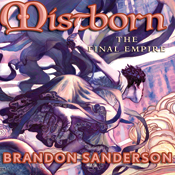
Mistborn Album ArtThe Final Empire: Mistborn Book 1
By Brandon Sanderson; Read by Michael Kramer
Audible Download – 24 Hours 40 Mins [UNABRIDGED]
Publisher: Audible / Macmillan Audio
Published: July 2007
Themes: / Fantasy / Epic Fantasy / Sword and Sorcery / Military / Political / Magic

For a thousand years the ash fell and no flowers bloomed. For a thousand years the Skaa slaved in misery and lived in fear. For a thousand years the Lord Ruler, the “Sliver of Infinity,” reigned with absolute power and ultimate terror, divinely invincible. Then, when hope was so long lost that not even its memory remained, a terribly scarred, heart-broken half-Skaa rediscovered it in the depths of the Lord Ruler’s most hellish prison. Kelsier “snapped” and found in himself the powers of a Mistborn. A brilliant thief and natural leader, he turned his talents to the ultimate caper, with the Lord Ruler himself as the mark.

When I first stumbled across this book on audible I was sceptical. I have to admit this was almost a book I judged by its cover and even after reading the book I am unsure what is going on in this cover. Fortunately I had just finished listening to Elantris and really wanted to see what Brandon Sanderson had in store for me in his next book. I am really glad I looked past the cover because Mistborn is an incredible story of epic fantasy set in a world which is alien and yet the implication (unstated) is it could be our future or past.

The characters in the story have real depth and by the end of the first book I felt like I was a member of the gang, a silent partner in their quest to overthrow the tyrannical rule of the lord ruler and restore freedom to the people. However, where the real depth of the story comes is the system of “magic” (referred to in the story as allomancy) that Brandon Sanderson created. Rather than chanting spells, or tapping into divine powers the characters in the story have the ability to burn metals and each metal has a direct counterbalance. This creates situations where powers are negated and I found that I became actively engaged in the story as I tried to figure out how one character would use their metal to negate the other character’s effects.

In addition to the fantastic plot-line and deep characterizations of the main players Brandon Sanderson does an excellent job of creating a framework for the world of the final empire. From describing the falling ash storms to the rising mists each evening the world is so vividly described that I at times forgot what I was doing. Beyond the descriptive environment there are creatures which are described terrible in form. An example of vivid imagery is in his description of the Steel Inquisitor I won’t ruin it for you but the first time this “thing” was introduced I felt chills. Not so much out of fear (though it was terrible to imagine) but out of excitement that this was something truly unique and new.

Complimenting the excellent storyline is the reading by Michael Kramer who does a fantastic job of giving voice to the characters and describing the land in beautiful detail. The vocal range and emotional range of his reading was excellent. Michael Kramer does an excellent job of switching between characters and into a neutral narrator tone when appropriate. By far my favorite voice in the book is that of Breeze and in the following novels he becomes one of my characters simply because Michael Kramer’s vocalization is so spot on that the character literally seems to come alive.

If I do have one complaint about this book (other than the cover) it is that more attention could have been paid to the audio production. While I don’t expect Dolby 5.1 digital surround sound from an audible download it would be nice to have the audio levels consistent instead of having the audio suddenly get louder and just as suddenly go low.  Also there were a couple of times when words were repeated like the narrator was saying them expecting it to be edited out. All-in-all these were minor issues and did not take away from the overall enjoyment of the book.

Plot twists, action and a fascinating system of “magic” make this a great read and Michael Kramer’s excellent narration makes this a fantastic listen. This is definitely a vacation/beach book because if your like me once you get started you will not want to put it down.

Posted by Mark Flavin

Sci Fi Dimensions: Interview with Richard K. Morgan

SFFaudio Online Audio

There is an excellent interview with Richard K. Morgan over on the Sci-Fi Dimensions podcast. Morgan and his new novel The Steel Remains are rubbing a lot of people the wrong way. His provocative essay on Tolkien’s The Lord Of The Rings drew charges of rabble-rousing and worse. As a shit-disturber myself I thought it was very cool, and though I could definitely see why the rabble might be roused. Morgan is calling things as he sees them – his vision has a dark tinge (but only in comparison to the vision of most) – he definitely sees our world with a jaded eye. His fictional worlds too are full of fallible humans. Everything he’s written seems happily noir. I really dig his ideas, and am very much enjoying the audiobook of The Steel Remains . If you’re not sure if you will enjoy it, have a listen to this interview, it will help you decide.

Sci-Fi Dimensions PodcastInterview with Richard K. Morgan
Interviewed by John C. Snider
1 |MP3| – Approx. 80 Minutes [INTERVIEW]
Podcaster: Sci-Fi Dimensions Podcast
Podcast: August 2008

Posted by Jesse Willis

Review of Witchling by Yasmine Galenorn

SFFaudio Review

Greetings fellow SFFaudio readers! I just thought I’d introduce myself as one of the new geeks slated to post reviews for the site. I’m legally blind, and have relied on SFFaudio for years to direct me to fantasy and SF audio, from new blockbuster releases to hidden diamonds in the rough scattered around the Interwebs. I’m therefore thrilled to be contributing to the site, and look forward to giving something back to this awesome community. Okay, that should suffice for an introduction–now on to the review!

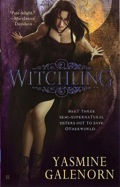
Witchling by Yasmine GalenornWitchling
By Yasmine Galenorn; Read by Cassandra Campbell
Audible Download – 10 Hours [UNABRIDGED]
Publisher: Tantor Media
Published: 2008
Themes: / Supernatural Romance / Urban Fantasy / Vampires / Dragons / Faeries / Seattle /

I was a little hesitant to delve into Yasmine Galenorn’s Sisters of the Moon series, since it’s generally categorized as “supernatural romance”. Yes, this shows contempt prior to investigation on my part. I’ve never read any “paranormal romance”, or much “romance” at all, for that matter. Yet from the first page, I found myself enjoying the world and characters of Witchling. The book reaffirms my belief that genre labels like “paranormal romance” have more to do with marketing convenience than actual substance.

“Urban fantasy” hits nearer the mark. The events of Witchling unfold in Seattle and the surrounding countryside, including the stunning Mount Rainier. The story follows the three D’Artigo sisters, half-human half-faerie beings from Otherworld who conduct work for the Otherworld Intelligence Agency (OIA) to keep their homeland safe. The murder of Jocko the gentle giant by a demon sets the detective-story plot in motion, told through the voice of witch Camille D’Artigo.

For the most part, the pages of Witchling are populated with fantasy staples. Delilah D’Artigo is a changeling able to transform into a tabby cat, and the third sister Menolly was changed into a vampire. Dragons, demons, and sprites also lumber, skulk, and flit about. Though these might seem trite and cliché, Galenorn lends them all enough life and originality that they seldom detract from the story. More inventive figures also make appearances, most notably the Japanese kitsune (fox) demon Morio.

Like other first-person urban fantasy books I’ve read, Witchling’s style is contemporary, witty, and laced with humor. Despite hailing from Otherworld, Camille has apparently spent enough time on Earth to learn its ways, its slang, and its pop culture references, which she uses to good effect in her speech and exposition. The sprightly writing more than makes up for the slow pacing in the book’s first half. In fact, I really enjoyed the dialogue-driven, character-based opening chapters.

While at its heart Witchling is a fun trans-dimensional detective story, it does touch, in a desultory way, on some more serious themes. Since the D’Artigo sisters are half-bloods, born of a human mother and faerie father, they face prejudice and discrimination from both sides of the race divide. Sadly, this dynamic seldom crops up in the plot, but Camille does occasionally reflect on its ramifications for her family.

And, yes, there is romance. Throughout the novel, Camille is preoccupied to some degree with her love life, and this subplot moves apace with the main narrative thread. I found Camille’s libidinous mental musings distracting from the story at times, but overall the romantic scenes and trajectory fit the book’s tone.

Likable characters, an engrossing plot, and smart, snazzy, sexy writing make Witchling an enticing read. Hints throughout the novel and especially during its conclusion reveal that the events depicted are but the tip of the iceberg in an impending battle between faeries and demons, a battle in which it’s likely that humanity will become embroiled. I look forward to exploring Galenorn’s universe further in the sequel Changeling, which it appears is told from the perspective of werecat Delilah D’Artigo.

Cassandra Campbell’s narration of Witchling is solid but uninspired. She imbues a real sense of emotion into the characters, especially the three D’Artigo sisters. The novel’s contemporary style and numerous pop culture references flow naturally into her narration. Campbell sometimes has a tendency to drift into melodrama, however, and the male villains seem particularly overdrawn. On the whole, though, Campbell handles the material well.

For more information on Sisters of the Moon and Yasmine Galenorn’s other projects you can follow her on Twitter.

Posted by Seth Wilson